What does the blocking of the Doha News website mean for media?

qatar-block-618x415

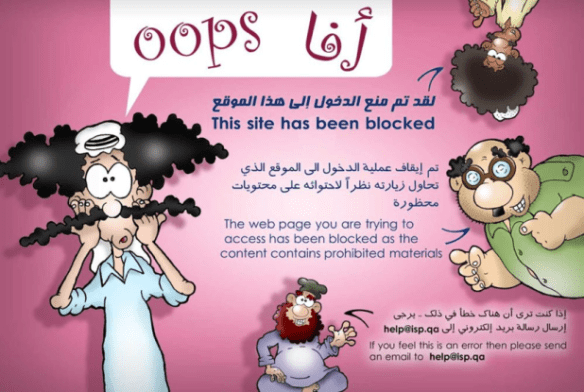
Many Qatar-based visitors to the Doha News website will have seen this block message yesterday. No reason has been given for why the news site is blocked.

It’s not been a good week for the region’s media. First of all 7Days announced that it’d close by the end of the year. And now, the Doha News website has been blocked by Qatar’s two telecommunications firms, Vodafone and Ooredoo. The news site, which is the only independent media outlet in Qatar (i.e. not government owned, was inaccessible to many inside Qatar. To quote from the site’s own announcement:

As many are aware, Doha News became inaccessible to most online users in Qatar as of yesterday, Nov. 30.

Our URL – dohanews.co – was apparently blocked by both of Qatar’s internet service providers, Ooredoo and Vodafone, simultaneously.

Since then, the majority of people in the country have been unable to access our website on their desktop computers and mobile devices.

Exceptions included access to a VPN (virtual private network) or unfiltered corporate internet.

Yesterday, Doha News put in requests for information from the Communications Regulatory Authority (CRA), Ooredoo, Vodafone, the Government Communications Office (GCO) and Qatar’s National Information Security Center (Q-Cert.)

While we waited for their response, we temporarily diverted readers from dohanews.co to another domain name, doha.news.

However, that URL also stopped working in short order.

Deliberately blocked

Given this development and the silence from the government and ISP providers, we can only conclude that our website has been deliberately targeted and blocked by Qatar authorities.

We are incredibly disappointed with this decision, which appears to be an act of censorship.

We believe strongly in the importance of a free press, and are saddened that Qatar, home of the Doha Center for Media Freedom and Al Jazeera, has decided to take this step.

There’s been no announcement from Qatar’s authorities as to why Doha News has been blocked, and there’s been much speculation on Twitter about why the site has been blocked (follow the hashtag  which translates to Doha News website ban to see more).

I’ve written about Doha News before. I respect their team for writing about subjects no other media outlet will cover. I value a free media because I understand the good it does for society. Journalism encourages debate and discourse, it promotes an exchange of ideas and it supports transparency. Doha News is a credit to Qatar. I hope that whoever was behind the decision to block Doha News realizes this, and flicks the proverbial switch. However, given the prevailing sentiment, this hope may be ill-founded.

In the meantime, I wish the very best for the Doha News team. As they’ve shown, there’s a futility to blocking websites in today’s age. They’re already publishing on Facebook and Medium. We are in an age where it’s easier than ever to share information, and attempts to block this only result in more coverage of an issue.

Today the only effective way to stop a story breaking is to jail the reporter. However, this approach will do major harm to Qatar’s reputation, particularly as the home of the Arab world’s largest and most influential broadcaster (Al Jazeera’s acting director general was talking about professional journalism only six weeks back). Already the Doha News story has gone global thanks to reporting by the Associated Press, with coverage as far off as America.

For Shabina, Omar and Doha News team, I and others will keep on supporting you in your mission to report on everything that is happening in Qatar.

‘Bigger, Better and Smarter’ – how the Middle East’s PR industry rates its performance & development in 2015/2016

The Benchmark survey looked at communications practice areas. The results suggest media relations will soon be replaced by social media as the top communications priority.

The Benchmark survey looked at communications practice areas. The results suggest media relations will soon be replaced by social media as the top communications priority.

Yesterday was a busy day for the PR industry in the UAE, with two events on the same day. The first, which was organized by bespoke agency Secret PR and named PR Pressure, was held in Dubai and tackled the everyday issues faced by both PR professionals and their friends in the media sector (more on this later). The second event of the day was held by the Middle East Public Relations Association in Abu Dhabi and focused on innovation.

As part of the build-up to the event, MEPRA launched the Benchmark survey. Through a self-assessment approach, the research seeks to understand where the industry is headed, what is being done well and where improvements need to be made. And with 138 responses, including from 100 in-house departments, 34 agencies and 4 senior independent consultants representing over 1,611 PR professionals across 14 Middle East countries, there’s a lot to ponder.

Firstly, let’s look at the issues thrown up by the Benchmark research. According to respondents, the nature of the public relations is changing. While media relations is still seen as the backbone of the sector, the survey’s respondents expect this to change over the course of 2016 as social media becomes more important to clients and different stakeholder groups alike. There’ll be a similar growth in areas such as influencer engagement, employee engagement, and integrated communications.

There are also major challenges to tackle in the region’s communications sector, including the need to demonstrate results and show a return on investment. And then there’s the money issue; it’s clear that falling oil prices and subsequent slowing in the region’s economy is beginning to bite. In 2016, two out of three respondents see investment in PR staying the same or growing, down from 87.0 per cent in 2015. Similarly, the proportion of people who see budgets falling has more than doubled (13.0 per cent in 2015, up to 34.0 per cent in 2016). There does seem to be a silver lining however when it comes to budgets; one in six respondents expect budget growth of more than 20 per cent in 2016.

A fifth of respondents claimed they were world class. Would you agree?

A fifth of respondents claimed they were world class. Would you agree?

When it comes to performance some in the region’s PR sector clearly don’t lack for confidence – a fifth of in-house departments and agencies regard themselves as ‘world class’ (those scoring themselves an average of more than 7.0/10 for both practice and performance, across 12 elements of communications, were rated as ‘world class’). Despite this, there’s clearly a need to improve in terms of doing things differently; scores on the area of innovation were the lowest recorded by the survey. Responses were low (a rating of 2.31 out of 5) for the statement: ‘The PR industry in the Middle East is more innovative than the industry in other regions’ in 2015. Similarly, the statement: ‘Middle East campaigns are not afraid to ‘disrupt’ – to ignore established convention – to stand out and achieve results’ in 2015 was rated as low with a score of 2.49/5.0. This may change in 2016, as 12.6% more respondents expect the industry to become innovative.

Based on the survey results, another area which the industry has to get right is its hiring and retention practices, especially when it comes to attracting graduates, particularly locals. Talent acquisition scored 5.26 out of ten, and staff retention 5.16 out of 10. Graduate recruitment and attracting local talent were even lower, at 4.58 and 4.32 respectively.

Research is one thing, experiences are another. During the PR Pressure event there were strong emotions expressed on the issues of media relations, ethics and talent (check out the hashtag #PRPressure for all of the posts on the event). It was clear from those media who were present and talking about their own interactions with the PR industry that we still have a long way to go if we’re going to become ‘world class’. Similarly, unless we get talent issues right, including a focus on training, development and certification (which is a major failing as far as I’m concerned), then whatever progress we make will be unsustainable. If the industry keeps on bringing expats in to do a job at every level, it’s going to fail in engaging with local audiences (there’s also the issue of forced localization, which I’ll blog about at a later date).

While the industry may feel that it’s moving in the right direction (and in many areas it is), maybe it’s time for a more honest glimpse into the looking glass, to start addressing key areas of what we do and how we do it. I desperately want to believe that we’re ‘bigger, better and smarter’, but while my heart feels one emotion my head thinks something else. I for one am looking forward to next year’s MEPRA Benchmark. And if you want to play your part and fill in the survey, get in touch with MEPRA.

Keep Calm, Say Nothing – QNB’s response to the customer data hack crisis

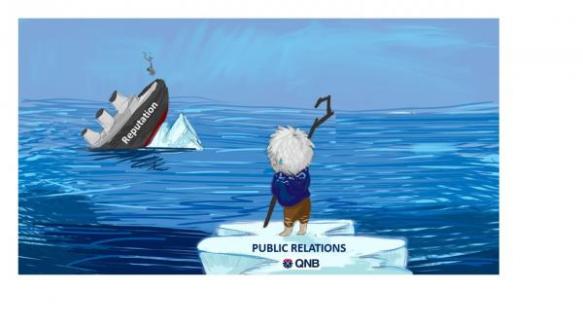
Qatar National Bank's reputation has literally gone down like the Titanic according to this visual from a reader of Doha News (source: Doha News)

Qatar National Bank’s reputation has literally gone down like the Titanic according to this visual from a reader of Doha News (source: Doha News)

Like it or not, there will be times when the proverbial @#$% hits the fan. Each and every organization will go through a crisis. What matters is how an organization responds to the crisis and communicates this response.

Before I talk about the bank in question, I want to step to talk a little about crisis communications. Crisis comms is an artform, and some people (who get paid lots of money) do crisis comms for a full time living. When dealing with a crisis, communications theory states that there are three steps. The first is pre-crisis, which involves setting up a team and processes (the who and the how), and then practising for situations that are likely to occur. The second phase is the crisis itself, and the third is post-crisis and fixing the issue.

Last week someone allegedly released a huge amount of customer data which was hacked from Qatar National Bank. The 1.4 gigabyte file was put online for download. A data hack of customer information is one of the worst things that can happen to a retail bank. But it gets worse. To quote from Doha News.

The data included the financial and personal information of thousands people, many of them QNB customers, and is being spread widely on social media and file-sharing websites.

Cyber security experts said as many as 400,000 customers could be affected, in what is being called one of Qatar’s biggest data breaches.

Since yesterday, several customers have reported attempts to break into their bank accounts, although these appear to have been blocked before any transfers took place.

Others have said there have been attempts to access and even alter their social media accounts.

Yes, it was that bad. But instead of communicating and advising customers on what to do and how to keep themselves safe, QNB’s media team didn’t say a thing. Well, almost. Again, back to Doha News.

More than 24 hours after the data breach became public, QNB has not answered questions from Doha News on what actions customers should take to protect themselves and many customers say they have yet to be contacted by the bank.

Online, it has continued to respond to questions by pointing to yesterday’s statement that said it does not comment on “social media speculation,” even though the confidential information about thousands of its customers is online for anyone to access.

According to the reaction of dozens of customers, some of the information is correct. And yet, even QNB’s Call Center and retail branches are holding fast and not saying anything. One customer was allegedly told that the allegations were ‘propaganda’.

All credit to Doha News. The Qatar-based news website has covered the issue from its beginning with a level of thoroughness that should be a lesson for all local media outlets in the region. The last piece it ran was about a website which could help QNB customers check if they were hacked or not.

Doha News has also been doing much of the work which should have been done by QNB itself, namely advise customers on what is happening, tell them what action they should take and why. QNB’s silence on the issue is a classic example of how organizations in the region used to deal with a crisis prior to the advent of social media. You dig your head in the sand and hope it’ll go away. Well, this is what they’ve done and their reputation has gone down with the Titanic.

Instead, they should have been responding through all consumer-focused communications channels, including social media (a digital crisis consultant I respect greatly and ex-head of comms for the BBC, Donald Steel, advises that any online response should take no longer than 15 minutes). By acknowledging the problem, by explaining how their customers can keep safe, and by promising a review of their security setup, QNB would have helped to have turned a crisis into an opportunity to demonstrate both transparency and concern for customers and their well-being.

In their response (or lack thereof) QNB has looked archaic and they’ve compounded the damage by seeming not to care. I hope that others take stock of the online backlash and understand that when it comes to a crisis in the Gulf, silence is never golden.

More media launches in the Gulf – Newsweek Middle East and Inc.

Who wouldn’t want to be a publisher in the Gulf right now? While the industry is losing money left, right and center in the US (and in Europe), the Gulf is seeing a glut of publication launches. The newest titles are Newsweek Middle East and Inc. Newsweek Middle East was launched recently by ARY Digital Network, a Pakistani television company. Their first issue was launched in English at the end of October and an Arabic edition is also in the pipeline. The website is http://www.newsweekme.com. The publication’s two front pages are below, along with a short video from their Twitter feed (the team have accounts on Facebook and on Instagram, and for those of you young uns out there, they are also running a Snapchat account under the name @NewsweekME).

The second publication, which is yet to launch is Inc. magazine, a monthly publication focusing on fast-growth companies. To be based in Qatar, the publication has been hiring journalists from Dubai publishers and should launch by the turn of the year in both English and Arabic.

https://twitter.com/NewsweekME/status/659700459763015681

https://twitter.com/NewsweekME/status/662256194749390848

https://twitter.com/NewsweekME/status/659419348239446016

While the launches of local editions for two global titles is to be welcomed, especially the Arabic-language editions, the question is if/when will this region suffer the same slowdown in terms of ad sales (Newsweek stopped publishing in the US for sometime in 2012 and 2013 and went fully digital for a year). With the Gulf becoming a global pioneer in terms of digital firsts among consumers (for example smartphone penetration, social media usage), will advertisers realize there’s more ROI to be had in advertising online rather than in print? Let’s wait and find out.

The Gulf’s push to improve its image – why actions speak louder than words

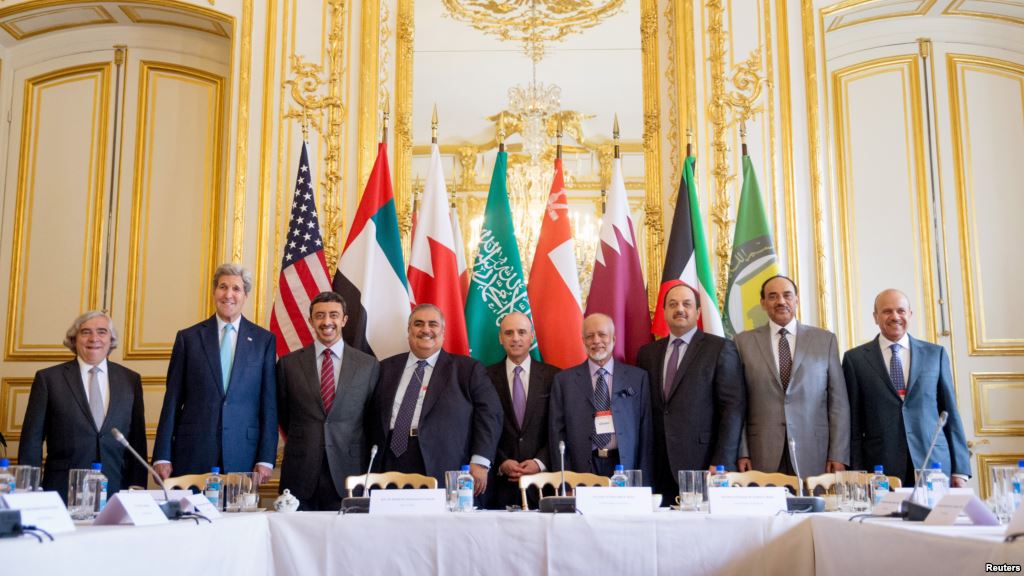
The Gulf's foreign ministers have worked hard to change perceptions of the region abroad. But is there a simpler solution?

The Gulf’s foreign ministers have worked hard to change perceptions of the region abroad. But is there a simpler solution?

I love a good read, especially fiction. But when living in the Gulf, fact can often feel more surreal than fiction. Last week the UAE’s English language daily Gulf News reported on efforts by the six-member Gulf Cooperation Council to improve its image abroad, most notably in Europe and the US. To quote from the newspaper:

Foreign media officials in the Gulf Cooperation Council (GCC) have stressed the need to formulate a common media strategy that will reflect the positive image of the six member countries abroad.

The officials, who were holding a meeting in the Qatari capital Doha, reviewed plans and suggestions for future actions in their communication drive with the international community.

The GCC, established in 1981, comprises Bahrain, Kuwait, Oman, Qatar, Saudi Arabia and the United Arab Emirates.

“The participants discussed several issues related to the progress of their work, including a common strategy to rectify the distorted image that some Western media have about the countries in the region,” Ahmad Al Buainain, the head of the foreign media department at Qatar News Agency (QNA) said.

“The meeting also discussed several papers and new ideas regarding the way forward for the GCC foreign media in European and Asian countries in order to convey the realities on the ground, he said, quoted by QNA.

Plans include holding seminars and meetings with research centres or organizing events at international functions in Europe and in which the GCC countries are participating, he added.

“This new drive is a continuation of the activities conducted by the foreign media officials at past events,” he said.

Ahmed Mussa Al Dhabyan, the head of media cooperation at the GCC Secretariat General, said that the GCC foreign media officials sought to build on their successful experience and formulate a new strategy that matched the latest developments in the communication field.

“The world has gone beyond the global village concept and has now become a single house,” he said. “The GCC has a significant political and economic weight and it has a special standing internationally, and therefore it needs to have a foreign media presence that matches its stature,” he said.

Earlier this month, reports surfaced from Washington D.C. that Saudi was hiring a variety of lobbying groups to bolster its public image in the US. Clearly, the Gulf cares about its reputation abroad, especially when the region’s governments see what they feel to be negative coverage.

On his Facebook account, political commentator (and Sharjah royal family member) Sultan Al-Qassemi gave his take on the article in the Gulf news with a list of suggestions to improve the Gulf’s image abroad.

1- Release activists.
2- Suspend capital punishment.
3- Allow political participation.
4- Eliminate Kafeel (sponsorship) system
5- Expand women’s rights.
6- Enact environmental protection.
7- Broaden citizen’s rights.
8- Bolster freedom of expression (yes within “limits”)

I’d make it even simpler. As any good and ethical public relations practitioner will tell you, your actions speak louder than your words. If the region is serious about tackling any negative perceptions or reputation issues abroad, then behaviour which is contradictory to accepted human norms in regions outside of the Gulf (read the West) must be tackled, and free(r) access should be given to the media. With social media and the internet, it is so much harder to hide anything or to spin information or events. Take for example the leaking of documents from Saudi’s Foreign Ministry recently.

The best way to been seen in a positive light is not more seminars or meetings in European capitals with research centers. Instead, one must behave in a positive light, followed by encouraging the media, both local and international, to report without bias.

While I’ve been in this region long enough to know better, I am still an optimist at heart. And I still believe we are capable of change for the better, as this region is magical in so many ways. However, a word of note. If my face turns shades of blue or purple, do please remind me to breathe.

Me, my wife and our baby – a personal story of how the Gulf is letting down its women by denying their children the right to nationality


The children of Gulf women married to foreigners are not automatically granted nationality, unlike their male counterparts (image source http://www.flight965.com)

 
I promised I’d write on my experiences as a father and I’m having to start things off on a serious note. As some of you may know, my wife is from this region but I am not. We welcomed into our lives a little princess earlier this year.

The sad story is that in the Gulf region children born to Gulf women, in other words women with a nationality from the six GCC states, who are married to foreign men do not receive their mother’s nationality. This is in contrast to Gulf men who are married to foreign women. Their children do receive their father’s nationality.

It’s important to us that our little one cherishes both her cultures and that she’s recognized as both. She’s fortunate to have a European nationality through me, but, try as we might with visits to interior ministry offices and other government bodies, we realized that there is no formal process for our daughter to become a Gulf national like her mother. This is the same all over the Gulf, despite sporadic exemptions to the contrary.

I’ve heard countless reasons for this, such as the need for Gulf women to marry Gulf men, and the legal requirement that a Gulf national should have only one passport. To me, any discussion is bogus. If I was a Gulf male and my wife was a European foreigner our daughter would have qualified automatically for both nationalities.

I hear lots of news about progress being made it terms of women’s rights in the Gulf, which I applaud. However, until Gulf women are able to give their children everything that their male counterparts can, I cannot contend that women here are anywhere near to being equal to the men.

I hope for change, if not for my wife’s generation, then at least for my daughters. I hope you will join me in calling for a change to how Gulf women and their children are treated in the Gulf.

The definition of ‘Nobness’ – the UAE, social media defamation and differing views from the Gulf

It’s that time of year again. I don’t mean Ramadan of course, the month of charity and kindness, but rather the time of year when we read about a case of defamation. Over the past week there was an outcry in Australia following the arrest of an Australian national in the UAE following comments she put up on Facebook. To quote from the Australian Broadcasting Corporation’s website:

In February, Jodi Magi, 39, took a photo of a car in her Abu Dhabi apartment block that was parked across two disabled parking spaces, without any disability stickers.

She blacked out the number plate and put the photo on Facebook, drawing attention to the seemingly selfish act, but not providing any identifying details or names.

However, someone in the apartment block complained to police and the case went to an Abu Dhabi court in June.

Ms Magi, who has lived in Abu Dhabi since 2012, said she was forced to sign multiple documents in Arabic without any translation.

Two weeks ago (at the beginning of July) she was found guilty of “writing bad words on social media about a person” and told she would be deported.

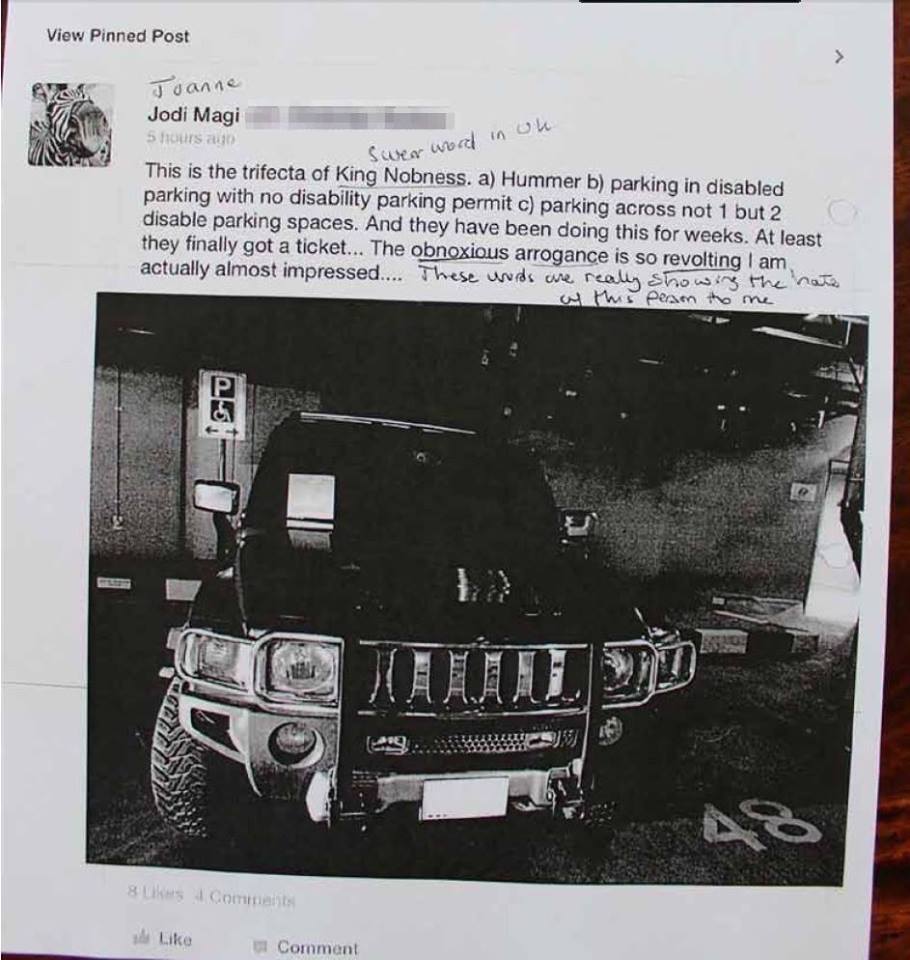
Magi was deported this week from the UAE following intense media coverage. Her argument was that she didn’t know what she’d done wrong in her Facebook post (which you can see below). Her words were considered to be insulting by the complainant, who wasn’t mentioned in the post, and the court agreed with the complainant and, based on the country’s defamation laws (which I’ve written about here), found Magi guilty, fined her, and sentenced her to be deported.

This is the post which got Magi deported. Magi claimed that nobness referred to an Australian term for the elite, rather than the English insult (image source: Facebook)

This is the post which got Magi deported. Magi claimed that nobness referred to an Australian term for the elite, rather than the English insult (image source: Facebook)

While I’m not going to share my views on this (there’s plenty of comments both for and against the issue, but the law is the law), I will share views and thoughts from the rest of the Gulf where double parking is all too common and where the issue is being raised on social media. First up is Bahrain, where there is an Instagram account called Bahrainidiots. Bahrain’s residents are encouraged to share their images of cars which are double-parked for publication on the account’s Instagram feed – for some pictures have a look below.

Similarly, Saudi social media users often share such images, especially on Twitter using the handle #برج_الكلب. Some recent images are below.

https://twitter.com/Dr_MoNassif/status/618500070267355136

https://twitter.com/dr_attar/status/618503839998607361

The most interesting comments about the issue of defamation came from Doha. Speaking to the English-language news site Doha News, criminal attorney and Qatar’s former justice minister Dr. Najeeb Al Nuaimi said it was “highly unlikely” that an expat or Qatari would be arrested for posting a similar picture as Qatar and the UAE differ in their definitions of defamation. To quote:

“In the UAE, this (incident) is seen as ‘you’re showing someone in a bad light’ or that you’re questioning the duty of the police. They didn’t do their job well, and have let this happen, and now you’re posting it and offending them,” he said.

Here, however, the local government would regard sharing such a photo as a “a mark of public service,” he added, continuing:

“We have Qataris posting all over Facebook, Twitter and Instagram (about) things that they don’t like, or wrong things that they see…Here, it’s seen as doing something good.”

One of the publications which wrote about the case, the Abu Dhabi-based English-language daily The National quoted senior Abu Dhabi prosecutor Mohammed Al Dhanhani who explained that Magi was guilty under the 2012 Federal Anti-Information Technology Crimes Law No 5.

“She captured the picture without the consent of the (car’s) owner. She then published the pictures on the web and added insulting phrases.”

Each of these three actions is subject to prosecution under the law, which punishes all violators with a fine and/or jail, and deportation for all expatriates without exceptions, he said.

In an irony not lost on this blogger, while Magi’s state of affairs was playing out The National started its own photo gallery on bad parking in the UAE and posted images on its own website. Based on Al Dhanhani’s own interpretation of the law, is The National also guilty of the same offense under which Magi was sanctioned by capturing pictures without the consent of the car’s owner and then publishing these on the web?

For any lawyers out there, am I right or wrong?

First the Kama Sutra pictures, and then the 2022 GCC media resolution – what is happening to Qatar’s media scene?

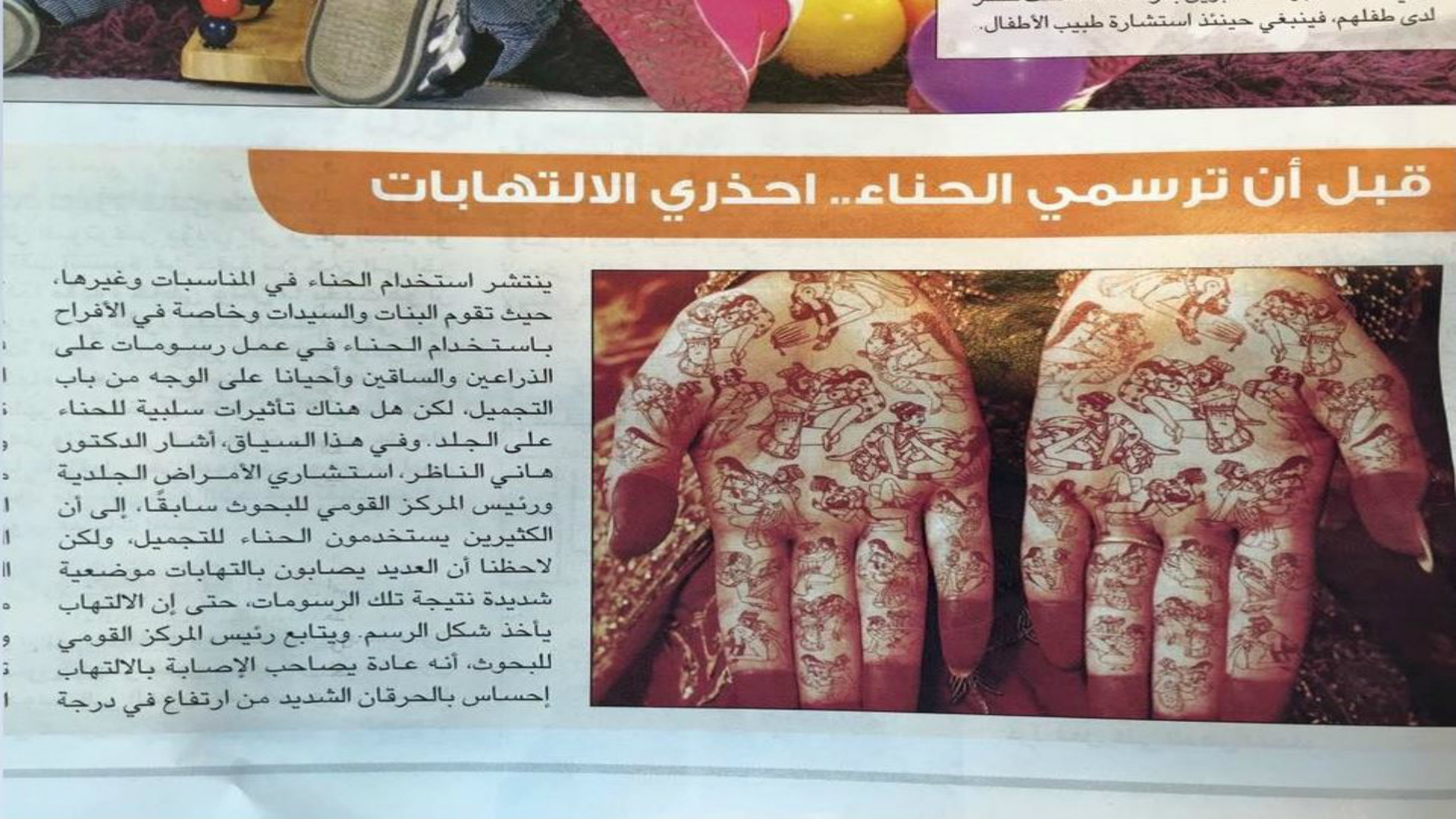
It’s not been the best of summers for Qatar’s media scene. First, there was a slip at the Arabic-language daily Al-Sharq. It wasn’t so much a slip-up as a huge !@#$-up. The paper’s long-time editor-in-chief Jaber Al Harmi was forced to resign after the publication of a photograph depicting sex scenes from the Kama Sutra. The story was best told by the Associated Press. But before that, the offending image is below.

Al Sharq's choice of imagery  for henna tattoos really couldn't have been worse. But where did they find the image?

Al Sharq’s choice of imagery for henna tattoos really couldn’t have been worse. But where did they find the image?

The image showed the woman’s palms decorated in numerous tiny tattoos showing a couple engaged in sexual intercourse.

Harmi took to the paper’s website to describe the incident as “a completely unintended mistake” and the “worst” he had known in his 25-year career in journalism and said he took full responsibility for what happened.

He said he “offered my resignation out of moral responsibility”.

It is not yet known if the resignation has been accepted by the paper’s bosses.

“All apologies are not enough for such a serious mistake, which occurred by publishing morally inappropriate images,” wrote Harmi.

“Our values and principles provide a red line that cannot be breached and so I presented my resignation to the board.”

He added: “This tragic incident revealed to us the extent of the adherence of our community to religion, values and morals.”

On Twitter, he wrote that “all those behind this mistake” have been fired.

But it got better. Following on from the unfolding crisis at FIFA, Qatar has been looking to tackle the corruption allegations surrounding its winning of the 2022 World Cup. As part of this plan, Qatar lobbied the Gulf to request media support. What they got was a call by the Gulf’s governments for all regional media to support Qatar. More from the Doha News website.

In an effort to “counter” media criticism of Qatar’s preparations for the 2022 World Cup, the GCC is calling on journalists in the Gulf to publish stories that support the country’s right to host the international football tournament.

The directive was released following a meeting of GCC information ministers in Doha this week. In a joint statement carried by state news agency QNA late last night, they said:

“GCC information ministers renewed their call for the media to counter all those who seek to question the right of the State of Qatar to host the 2022 World Cup, stressing GCC states full solidarity with the State of Qatar and encouraged media in the GCC to continue countering these campaigns at home and abroad.”

As we say, the media should report the news and not make the news. However, with all that is happening in Qatar, expect more media machinations soon.

Not the headline one hopes for – Migrant workers, ‘trespassing’, and Qatar’s BBC own goal

A communicator’s job (or part of at the very least) is to generate headlines. Preferably favorable headlines. But even the best of intentions can often come undone.

It’s an understatement to say that Qatar has been under the microscope recently. The country, with a population of just over a million (both nationals and expats) and hundreds of billions of dollars of gas reserves, has often strived to make its mark on the global stage. One such project is the news station Al-Jazeera, which has revolutionized media in the Middle East and beyond.

Qatar’s World Cup bid and subsequent win hasn’t been the success the country may have hoped for however. Ever since Qatar was awarded the 2022 World Cup by FIFA, it has been subject to criticism by international NGOs about a host of issues ranging from the rights of homosexuals to labor rights.

The biggest concern has been the living conditions of low-income workers, specifically those people who are building the infrastructure for the World Cup.

To their credit (or maybe because there’s little other choice afforded to them), the Qatari government has tried to tackle allegations of poor treatment of migrant workers head on. They have announced new legislation to penalize companies who do not pay workers on time and an amendment to the national labor law to facilitate the payment of workers through direct bank deposits.

Qatar has also been keen to promote the new migrant labor villages that the government has built. As part of its media efforts, the country’s Labor Ministry invited global media last week to view this new accomodation and meet the country’s Labor Minister to talk about Qatar’s push to promote labor rights.

However, things didn’t go quite as expected. I’ll quote from the Guardian below.

A four-strong BBC crew had been invited by the prime minister’s office on an official tour designed to show off new accommodation for migrant labourers, but were arrested by the security services while trying to gather additional material. They were interrogated and jailed for two days, before being released without charge.

The visit was part of a public relations drive, partly overseen by London-based agency Portland, in the wake of an international outcry over the slave-like conditions for workers exposed by a Guardian investigation in September 2013.

Rather than the story being the improvements in living conditions for Qatar’s migrant workers, the headline on the BBC (which was carried across the globe) was BBC team arrested, and held for several days.

It went from bad to worse for Qatar when Qatar’s communications chief explained that the BBC team had been arrested for ‘trespassing’. Again, to quote from The Guardian.

The Qatari government’s head of communications, Saif al-Thani, said the BBC crew were arrested after departing from an official tour. He said: “We gave the reporters free rein to interview whomever they chose and to roam unaccompanied in the labour villages.

“Perhaps anticipating that the government would not provide this sort of access, the BBC crew decided to do their own site visits and interviews in the days leading up to the planned tour. In doing so, they trespassed on private property, which is against the law in Qatar just as it is in most countries. Security forces were called and the BBC crew was detained.”

The challenge organizations often face is how to ensure that the same message is conveyed across the entirety of the organization. It’s obvious that in Qatar there were differences of opinion which led to the BBC crew being tailed by the security forces once they’d entered the country and to their arrest while doing their job.

The question now for Qatar is how do they go on from here and get the message right, across all of the country’s government and leadership? The media scrutiny is only going to get even more intense, the closer we get to the 2022 World Cup. I’ll continue to watch this story and how it unfolds in the media.

The Gulf’s Communications Sector and the Challenge for Authenticity

Is the communications industry in the Gulf authentic enough?

Is the communications industry in the Gulf authentic enough?

I am, sometimes, allowed to get out by my better half. And this month has been replete with communications events. Two in particular come to mind. The first was an anniversary for a well-known communications consultancy firm which was celebrating a milestone for its UAE-based operations. The second was for a social media network which was talking about the largest advertising period in the region, namely Ramadan.

Both events struck me, but probably for the reasons that the organizers hadn’t intended for. At the first event, for the consultancy anniversary, I’d have expected to have seen a couple of nationals. After all, a number of the company’s clients were government bodies and we were in the capital where the ratio of nationals is much higher than in Dubai. But, unfortunately, there was only one national. Instead, the audience was western, English-speaking and middle-aged.

The second event was just as perplexing. Despite Ramadan being a part of Islam (Ramadan is the Islamic month of fasting), I didn’t see a single Arab or Muslim talk about the event. At both events I was left asking myself, where are the personal insights, where’s the local understanding which I can either learn from or relate to?

In truth, these occasions are a microcosm of the communications and marketing industry in the Gulf region. We’re facing an issue with sustainability – there are far too few nationals and Arabic-language speakers in the industry, especially in high-level positions. To me this essentially means that, as we don’t accurately represent the audience we are trying to communicate with, that we’re not able to do our jobs properly.

I often get asked if I can suggest or recommend good talent, both by agencies and clients. Instead, let me offer a different suggestion. Let’s go straight to the source. Do you know how many young, talented nationals and children of expats who have grown up in the UAE are studying communications? We’re talking about at least 3,000 communications students between institutions such as Zayed University, Canadian University in Dubai, Abu Dhabi University, the American University of Sharjah, the American University of Dubai and Middlesex University. And then there’s the Saudis, the Bahrainis and others in the Gulf.

There’s enough talent out there, particularly Arabic-speaking youth, who want to get into the industry. However, we need to engage with them. The below are just a couple of ideas to get us all engaged on making the communications industry sustainable:

1) Get on campus! There are so many on-site events at universities and both agencies and companies need to step in, to both understand how much talent is out there as well as to educate students on what career opportunities are out there for them, especially for nationals who prefer a government job.

2) Mentor, mentor, mentor – the second option is to engage with students over a longer period. Mentoring allows students to learn from middle to senior-level professionals in the industry and for both to exchange their views. In a time where social media dominates, mentors can also learn a great deal from Arab youth on digital trends.

3) Bring in the interns – the longest-lasting and the most meaningful of the three engagements, an internship will allow students to get on-the-job experience with, hopefully, a view to joining the organization they’re interning with. An internship is the closest thing a student will get to a real-life job and will enable them to complement their in-class learnings with hands-on experience.

Organizations such as the Middle East Public Relations Association are promoting all of the above, in the hope that the industry becomes more representative of the communities in which we live. If we’re hoping to communicate as well as we can to all of the audiences that make up the Gulf, we have to take a different approach to hiring and promoting talent. Bringing in the expat with no local experience or understanding is no longer the right thing to do. We have to be authentic if we are going to be relevant. Are you up to the challenge?