What not to say on live TV – Qatar Airway’s CEO and the bull**** comment on CNN Money

There’s few things worse to do on live television than swearing. Unless you’re a CEO that is. After being accused of treating foreign workers, especially female cabin crew, with disdain in an article published in the Washington Post (the article is entitled ‘The surprising ways in which some flight attendants are still made to live in the 1960s’), Akbar al-Baker did the media rounds to defend his airline’s position and dismiss the claims. Watch the video and the offending comment for yourselves.

To say Akbar al-Baker is gaffe-prone would be an understatement. He has led the airline since 1997 through a period of unparalleled growth. However, when does a leader become a liability? Is Akbar al-Baker, of which much has been said by former staff, a liability to the airline and to Qatar?

Inauspicious Beginnings or PR Coup: Al Waleed’s Al-Arab TV station and how it was shut down on its opening day by Bahrain

Al Waleed’s Al-Arab is now known worldwide thanks to Bahrain’s closure of its operations on its first day of broadcasting (image source: http://www.bbc.com)

Have you heard of the saying, ‘There is no such thing as bad publicity’? If you’re a communications professional at BP or you work for Bill Cosby you may feel differently, but the quote, often attributed to the American self-publicist PT Barnum, still rings true in terms of brand awareness and familiarity.

One man who doesn’t lack for publicity is the Saudi Prince Al Waleed Bin Talal Al Saud. Al Waleed, who has long had an interest in the media (he owns stakes in News Corp, Fox and Saudi Research and Publishing Group), set out his own media vision for the region a couple of years back when he announced his intention to set up his own news channel. Named Al-Arab, the channel would compete with the likes of Al-Jazeera and MBC Al-Arabiya to shape the news agenda.

After years of planning, the channel went live this week. Al-Arab is based in Bahrain, ostensibly to allow the channel to benefit from Bahrain’s relative media freedoms and, as the channel’s general manager and Saudi journalist Jamal Khashoggi put it, to cover “all views” in the region.

On its first day of operations the channel was temporarily suspended by Bahrain’s information ministry. Akhbar al-Khaleej, a pro-government paper, reported that the suspension was due to the channel “not adhering to the norms prevalent in Gulf countries”.

The allegation is that Bahrain’s government took offense to an interview aired with Bahraini opposition activist and politician Khalil al-Marzooq, who was talking about Manama’s decision at the weekend to revoke the citizenship of 72 Bahrainis.

The closure has made headlines worldwide, and has guaranteed headlines for Al-Arab in capitals such as Washington, London, Paris and Berlin. While the closure may have been an operational nightmare, for a publicist it has been a coup. As Oscar Wilde put it, the only thing worse than being talked about is not being talked about. By this measure Al Waleed should be delighted with the launch of his television channel.

The stunt may have also have helped to cement Al-Arab’s position as a channel that will tackle any and all subjects. Before the channel’s launch, Khashoggi stated the need to be both bold in terms of talking about taboos as well as the need to discuss issues from a balanced perspective. “We are going to be neutral; we are not going to take sides,” he said. “We are going to bring in all sides in any conflict because right now we have a conflict in almost every Arab country.”

By setting down this marker from day one, will Al-Arab be able to set itself apart from other channels in the region which do have particular media biases. Will Al-Arab create a middle ground that wins over Arab audiences?

According to Al-Arab’s Twitter feed the station will be operational again soon. I for one can’t wait to watch its re-launch.

And if you want to see the alleged reason for why Al-Arab was shut down watch the clip below.

Baker & McKenzie Habib Al Mulla, Asdaa and OSN and when the client apologized before the agency

Have you ever heard of a client apologizing a week before the agency sends out a correction? (image source: http://www.tumblr.com)

There are few surprises left for veterans of the media, marketing and communications industry in the Middle East. However, every now and then something pops up that can raise a smile or cause a roll of the eyes.

One such story is the unusual case of the UAE-based Baker & McKenzie Habib Al Mulla. Through its public relations agency Asdaa, the law firm put out a release entitled ‘Mergers and acquisitions boom in Middle East’, which laid out the most notable M&A activity in 2014 and Baker & McKenzie Habib Al Mulla’s predictions that cross-border mergers and acquisitions would pick up pace in 2015. The original story is still online here at Khaleej Times.

All well and good we all may think. Except, there was a mistake in the release. And it wasn’t a simple typo or grammatical error. No, it was much more serious. Have a look at the below paragraph.

The Media and Entertainment sector was the largest recipient of inbound M&A activity in terms of value with almost 36 per cent share. This was driven by the $3.2 billion sale of Orbit Showtime Network Co, a Dubai-based owner and operator of TV station, to an undisclosed US private equity firm. This is also the largest deal since 2010.

There was a problem on the above information about OSN’s sale. It never happened. Dubai-based business monthly Trends Middle East was the first publication to point this glaring error out in a blog post. Trends’ editorial team did what any good bunch of journalists should do, and they verified the facts contained in the release. Unfortunately, a number of other publications didn’t (the list is on the Trends website).

The Trends team then reached out to all the parties involved, including Baker & McKenzie Habib Al Mulla, Asdaa and OSN. OSN issued a statement denying the information in the release. Baker & McKenzie Habib Al Mulla also put out a statement to Trends which you can read below.

“Baker & McKenzie Habib Al Mulla would like to clarify that our recent analysis regarding M&A activity in the Middle East was based on data from Thomson ONE Analytics, part of Thomson Reuters. “The data comprised announced deals as of December 14, 2014, including the proposed sale of OSN. Thomson Reuters’ criteria for announced deals include deals that are completed, intended, partially completed, pending and unconditional. We apologize for any unintended misunderstanding regarding the status of OSN’s proposed sale.”

However, despite reaching out to Trends and two days after the press release was issued, Asdaa hadn’t gotten back to Trends with a clarification (as per Trends’ own website). A statement was sent out to the media by Asdaa nine days after the incorrect release was published, and a week after Asdaa’s client had gotten back to Trends with the correction email. The correct as of January 6th is below.

“Baker & McKenzie Habib Al Mulla would like to clarify that our recent analysis regarding M&A activity in the Middle East, issued on 23 December 2014, was based on data from Thomson ONE Analytics, part of Thomson Reuters. The data comprised deals announced during 2014, including the reported approach by an un-named US private equity firm for the acquisition of OSN, which did not proceed. Please note the reference to the sale of OSN was incorrect.

Although an offer was announced in July 2014, the offer was rejected by OSN’s shareholders in August 2014 and OSN continues to be wholly owned by Panther Media Group Limited. We apologise for any unintended misunderstanding regarding the status of OSN’s ownership.”

I have to ask, is this the first time a law firm has apologized before its agency? It’s normally the communications and public relations firms who advocate for a quick and speedy apology. When it seems that a quick and speedy resolution could have brought this to a close, especially in a social media age where the recommended response time is literally 15 minutes, why did the client say sorry before the agency? If the communications industry is to consult and advise clients in a trusted manner, we really have to do better. Let’s hope that those involved have processes in place to both fact-check and, when something goes wrong, get back to media in as short an amount of time as possible.

What are your thoughts?

How not to pitch to the media – examples from the Gulf

I wrote recently about pitching to the media, and I thought I’d share two examples of how not to approach journalists which have been shared with me by a couple of editors here in the Gulf.

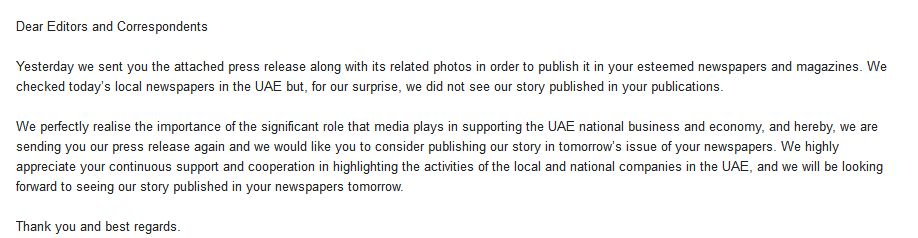
The first is from a local company in the UAE. Written by a former editor (who should know better), the message ticks off the media for not running the release the day before. Is this really going to get your news published? The short answer is most likely not.

Telling off the media isn't the best approach to getting your news published

Telling off the media isn’t the best approach to getting your news published

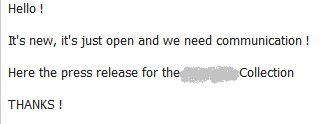
The second pitch is more brief, but just as useless, in that it doesn’t tell the journalist anything. Instead, it almost shouts we’re here so publish something. For a pitch about a fashion collection, so much more could have been done particularly around visuals, to get the news published.

Yes, this is the pitch.

Yes, this is the pitch.

Pitching to journalists isn’t the easiest of things to do – they’re a difficult bunch at the best of times (and I’m including myself in that description as well). However, a well-crafted pitch explaining the news and why it’s beneficial to the journalist’s readers will go a long way to help you achieving your goal of publishing your news.

And to show that journalists also get it wrong, have a look at this piece highlighted by The Media Network.

The Daily Telegraph, published in Sydney by News Corp Australia, has made an embarrassing editorial blunder, by running a headline stating that Australian bombing raids killed dozens of terrorists in the UAE, according to the newspaper’s online platform.

While the story referred to bombings in Iraq – in which Australia’s super hornets conducted a total of 43 flights over the country since becoming operational almost two weeks ago – the prominent headline told a different story.

The headline has since been amended to citing the Middle East instead of the UAE, though the original URL remains.

Should executives say sorry? Just Falafel’s ‘we forgot about the food’

Do you agree or disagree with what  Mohamad Bitar did, and why?

Do you agree or disagree with what Mohamad Bitar did, and why?

Should we admit when things don’t go the way we planned? It’s a tough one. Few corporates hold up their hands when plans go awry (unless there’s a crisis of biblical proportions). US-based corporates such as Walmart are now taking on media outlets to argue their point (this post from Walmart is a remarkable example of fighting back).

Even fewer company bosses in the Gulf go off track and talk from the heart. However, as with everything there are exceptions. Just Falafel is often touted as a home-grown success story, a tale of how a local brand has become global. Founded in 2007 in Abu Dhabi, the falafel-focused outlet has approximately 52 stores in 18 countries according to its website.

However, the chain isn’t to everyone’s tastes. A news story on the English-language website Arabian Business which announced the reasons for the departure of the chain’s former CEO Fadi Malas was used as a comment board by readers to explain their reasons for not liking the brand’s falafel.

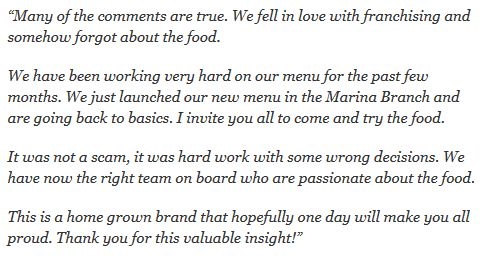
Fair enough you may say. But what followed was either inspirational or horrifying depending on which side of the open/control communications fence you’re on. The Just Falafel founder and MD, Mohamad Bitar, took to the site’s comments section to explain how the company had “forgot about the food”.

The comment as written by just Falafel's Bitar on ArabianBusiness.com

The comment as written by just Falafel’s Bitar on ArabianBusiness.com

The hacks at Arabian Business then took Bitar’s comments and span out a new story, to which readers took to explain what they believe went wrong and how Just Falafel can put it right.

For some consumers, an admission of error can be a powerful tool to reassess and re-engage with a brand. For others, it’s all about projecting an image that others can believe in, and not deviating from that message. Is Mohamad Bitar’s message a moment of genius (if we were in America, I’m sure we’d be calling his move crowd innovation), or does it signal a need for someone to crack the whip at the brand and get everyone on message?

Your thoughts?

How to, and how not to, pitch to the media

Let’s get rid of those bad pitches and give journalists fewer reasons to use the delete button (image source: http://www.meltwater.com)

Having worked as a journalist, as the head of an agency, and finally on the client side, I’ve learned a fair few lessons on the art of pitching a story. The beauty about the communications industry is that no matter how many year’s you’ve put in, you still keep learning. This was the case on Monday of this week, when I received an agency email pitch which basically used the client’s latest piece of coverage as the pitch.

Thanks to that experience I’m sharing with you some tips on how to properly pitch to the media, developed by Forbes contributor Cheryl Connor. They’re simple but effective, and they focus on the content and the delivery rather than the traditional media relations approach used still by many in the region.

1. Choose a target. And make sure the target will actually fit. For example, thousands of companies through the years have attempted to pitch The Wall Street Journal’s Walt Mossberg on writing about products such as network traffic management tools. Yet he specializes in covering products consumers would use. A good fit? Not at all.

2. Read the writer’s prior articles. Thoroughly. Read them with an eye for their interests, their themes, and the way your idea would help extend their subject matter further. (Not “I see you wrote about XX, so how about you write about it again?”) When you make your pitch, let the writer know how and where your idea might fit. Think through the idea through the reporter’s eyes—how will this piece be of interest and need to the reader? How will it meet the criteria the publication and the writer’s section and assignments must meet?

3. Pitch a story—don’t pitch your company. Believe it or not, your company and product, by themselves, are not an interesting topic. But as part of a broader story or an example of a pervasive need or a message—now they can shine. Think of what that story might be and imagine what it might look like in the hands of the reporter you’ve chosen. From that point of view, prepare your pitch. Make your pitch by email first. Let it gel for at least an afternoon, or preferably for a day. If the idea is a good one, the reporter may respond right away. If you don’t hear back, perhaps the next step is a call. When you call, refer to the earlier message. Regardless of whether the reporter has seen it or not, re-forward as a courtesy as you are talking to allow the individual to scan the high points of the message and preliminarily respond.

4. Be respectful of the reporter’s right to make the decision. As tempting as it is to ply the reporter with a strong armed pitch, you will be more successful by respecting the reporter’s right to say yes or no, while providing them with as many meaningful reasons as possible to have the desire to say yes. Is the story an exclusive? An idea or a slant that hasn’t been offered to anybody else? Will it be of broad need and interest to the reporter’s readers or viewers, and does it give them strong news or an angle on the information that hasn’t been presented before? All of these ideas will help.

5. When you speak to the reporter, get straight to the point. The whole idea of buttering a reporter up to the topic you called for is a bad one. Clearly you phoned because you wanted something. With the first words out of your mouth, let them know what it is, and what your reasons are for thinking it’s a good idea. If it’s yes, follow through quickly with the next steps. If not, why not? For another person or with another approach could it be a better idea? With the business of the call handled, you can then visit with the reporter for a bit and catch up if they have the time and the willingness. And at that point, they’ll know the personal interest is sincere.

6. Be honest and transparent about your desire for the interview or the meeting. For example, I was extremely annoyed to get an urgent message from a vendor needing my next available time to discuss their public relations only to find out their one and only reason for the appointment was to give me a demonstration of a product they were hoping I would cover for Forbes. And it was a product that didn’t fit my area of coverage, at that. The executives wasted an hour and a half of their time and mine. Not only will they not see coverage, but the company they represent will now find it highly difficult to get a return appointment with me when they genuinely do want to meet to discuss their PR.

7. If you can’t reach the reporter, avoid the temptation to call repeatedly. Listen to the reporter’s voice mail—it will often provide you with clues. For example, the reporter may be on vacation this week—out sick—moved to another beat (or even another publication) or may be so adamantly opposed to voice messages that you should be aware the message will likely never be heard (or may even offend them). If you do leave a message, one message in a day is ample. If the reporter has left a cell number on the message, refrain from using it unless the matter is genuinely urgent. They’ll appreciate the courtesy you use in reaching out in the ways they most like to be contacted.

8. Consider the strengths of Twitter. Twitter can often be a clue as to where the reporter is and what they are doing on that day. For example, if they Tweet they just arrived at the Oracle World trade show, it’s no wonder they didn’t answer the office phone. Now you know. Time your next call for after the event. Also, many reporters will respond to direct messages through Twitter faster than any other mechanism. Use that advantage, when you can take it, with skill.

These points reflect my own sentiments. A pitch should be interesting and to the point, add value to the journalist and her/his audience and relevant to the journalist’s beat. Communicators are story-tellers. The more interesting our story, the better the chance that the journalist will say yes to the pitch. There’s far too many badly thought-out pitches being made, mass emails promoting a person or a company. The next time you pitch, send the email to a colleague and ask them to answer you, in all honesty, if they’d buy your pitch.

What communications lessons can we learn from Arabtec’s leadership and stock crises?

No investor wants to go through a crisis, but by letting others fill the information vacuum with their facts and thoughts you’ll be prolonging the stock market collapse (image source: http://www.people.opposingviews.com)

For those based in the Gulf and with an interest in communications, the last couple of weeks has been a remarkable story. We’ve watched as the region’s largest construction firm by market value has staggered from one crisis to the next. In less than two months, Arabtec lost over two-thirds of its value – the company’s stock price hit a peak of 7.4 Dirhams on May the 14th and fell to a nadir of 2.61 Dirhams on June the 30th – as well as its CEO and a number of high-profile executives. Where did it go wrong for a company that stated it wanted to be one of the top ten builders in the world?

Undoubtedly, the company’s strategy of transforming from a contractor to a developer and of geographic and sector-based expansion hasn’t paid off during the reign of its previous CEO, the 37 year-old Jordanian Hasan Abdullah Ismaik, who looked to expand the company into the oil and gas and transportation sectors. Ismaik oversaw a US$40 billion dollar agreement with the Egyptian government to build homes in Egypt, and, in a strange move for a Gulf-based contractor, a regional sponsorship agreement with Abu Dhabi-owned Manchester City.

Things began to go drastically awry when rumours spread that Arabtec’s largest shareholder, Abu Dhabi’s Aabar Investments, had reduced its stake in the company. At the same time, the CEO Ismaik had built his stake in the company from 8 per cent all the way up to 28.8 per cent. The story is best told by two reporters at The National, Frank Kane and Hadeel Al Sayegh.

There are some obvious communications lessons to be learned from the Arabtec story, which I hope other companies in the Gulf region will study long and hard.

1) Communicate proactively, stop the rumours: Information on share ownerships seemed to have been leaked out to the market before any announcement by Arabtec itself. While Arabtec didn’t break any rules in terms of non-disclosure, the company could and should have taken a much more proactive stance to explain the share movements made by Aabar Investments, an Abu Dhabi government-owned investment vehicle, and the CEO himself. What was inexcusable was a lack of clarity following a “temporary system glitch” at the Dubai Financial Market, which erroneously reported a drop in Aabar’s stake in Arabtec from 18.85 percent to 14.32 percent. The rumours took over, and filled the void left by a lack of information and analysis.

2) Use the right channels to communicate: As Arabtec’s share price dropped, the CEO announced he was quitting his role. With the stock still heading south, Ismaik announced his resignation. However, this wasn’t announced by the company through a statement to the media or to the stock exchange, but rather by an interview with a newspaper. Again, while Ismaik or Arabtec didn’t break any of the Dubai Financial Market’s rules (which must be reviewed after this sorry debacle), the fact that he announced it himself struck the wrong tone and sent out signals to investors that something was wrong. No information has been forthcoming on his own 28 percent stake in Arabtec, apart from he is willing to sell.

3) No matter the mess, get your story out there: As soon as Ismaik was out, so too were many of his executive management. The company’s head of mergers and acquisitions, Shohidul Ahad-Choudhury, was fired, as were hundreds of employees, including numerous managers. The only comments in the stories that followed were from analysts who were asking, quite rightly, what is going on. It would take eight days before Arabtec would respond to the media at a press conference.

4) Don’t lose your communications team: Whether you like their advice or not, your communications team are essential in a crisis. According to what I’ve been told, Arabtec lost both its head of communications as well as its agency during the past two months. Arabtec’s management should have moved to stem the rumours and controlled the narrative before taking any action re the communications setup, which I hope would have included a more active social media approach (Arabtec’s last tweet from its @ArabtecHolding account was in March).

Reputations that take years to build can be destroyed in a matter of moments in today’s era of information. There’s little excuse for any listed company for not sharing information with shareholders, especially during a crisis. Arabtec has since recovered some of its share value, but the company still has a long way to go if it is to win back investors. Communications is vital to this process. Let’s hope that Arabtec’s new leadership are able to learn some lessons from the past two months, and proactively engage through a systematic communications approach, with strong narratives that lead nothing to the imagination of their investors.

Is Mugabe’s DMCC visit a PR coup or disaster?

Image

There’s few people who have been more vilified in the Western media than the President of Zimbabwe for events in the African country over the past couple of decades. Robert Mugabe is a pariah in the West. But he’s been over in Dubai, and his government is set to open up a ‘diamond embassy’ in Dubai. Dubai Multi Commodities Centre (DMCC), where the embassy will be based, put out a press release and photo op. I’ll leave it to you to answer the title question, namely was chasing media coverage the right or wrong thing for DMCC to do when it comes to Mugabe?

Will the press release and the above image of the visit backfire on DMCC and erode public trust in the organization? Or it is a sign of pragmatism and a coup for the country’s diamond business (image source: arabianbusiness.com)

Reputational Issues and the Pressure from Outside to Change – Will the Gulf’s Firms Be Forced to Adopt More Worker-Friendly Policies

Smile for the media! Will Gulf-based airlines be forced to change their employment practices or will they risk possible reputational damage in the face of criticism from the foreign press? (image source: http://www.nycaviation.com)

First there was Qatar and now the UAE. I’m not talking GDPs, economic growth or any other metric that a government may promote in the public spotlight. Rather, I’m talking about media criticism, notably international media criticism of worker rights.

Over the past couple of weeks a series of articles have been written, mainly by the European media, critiquing the lack of rights for employees of Qatar Airways and Emirates. The pieces, in particular a lengthy series of allegations in Swedish newspaper Expressen, have shone a light on employment practices, many of which appear distasteful to those not used to working or living in the Gulf.

The article in Expressen entitled the Truth About the Luxury of Qatar Airways details the conditions under which Qatar Airways employees have to live. The report, which can be read here, tells of strict curfew times for air hostesses and pilots, constant surveillance, and instant terminations.

Others have run similar allegations. Even locally, we’re beginning to see these articles appear in the press; Arabian Business recently ran two pieces on the HR practices of both Qatar Airways and Emirates.

With a global presence comes greater media scrutiny. Similarly, global events on your doorstep can attract negative headlines (look no further than Brazil in the run up to this year’s World Cup or even Qatar, the 2022 World Cup andthe country’s labor camps).

In a sense, I’m surprised that this hasn’t happened sooner. The region’s three big airlines are global players who aim to capture transit traffic which they shuttle through their hubs in the Gulf. Similarly, the region’s sovereign wealth funds have been snapping up brands globally for some time now, but especially in Europe where trophy assets have become a staple for SWFs in Doha and Abu Dhabi.

So, how do the airlines react? Never one to be outdone for a quote, Qatar Airways’ CEO has furiously denied all of the allegations and has instead railed at the newspapers printing the articles and called them, in effect, racist. To quote from Arabian Business:

“Like any other organisation, we terminate nonperforming employees and these are allegations made by ex-QA staff.”

“This is not against Qatar Airways but against my home country. They are throwing stones at my country for no reason at all.”

Emirates has been more low-key in their response on the claim that they mistreat female employees by firing female cabin crew who become pregnant during the first three years of their employment.

In the long-term how should the airlines respond? If they continue to deny or ignore the allegations, will they face a backlash from consumers concerned about the airlines’ reputation? What’s certain is that the headlines are not going to go away; to the contrary, the deeper you dig, the more bodies you will find. It’s going to be fascinating to see if the negative media coverage from outside the region eventually forces a change in worker policies.

This is one theme I’m going to be following with increasing interest.