How can the UAE encourage more locals to enter the media industry?

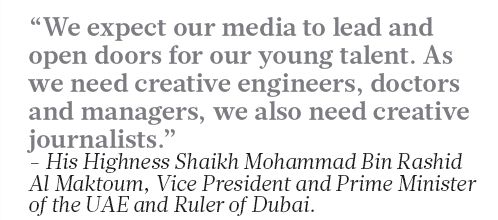
The words of HH Sheikh Mohammad during the Emirati Media Forum. The country is looking to encourage more locals to enter the media industry

The words of HH Sheikh Mohammad during the Emirati Media Forum. The country is looking to encourage more locals to enter the media industry

This month we’ve been treated to not one but two regional forums focusing on the media sector. First we had the Abu Dhabi Media Summit. Not to be outdone, Dubai held the second edition of the Emirati Media Forum (EMF). The words above were the highlight of the event, and Sheikh Mohammed bin Rashid Al Maktoum, Vice-President and Prime Minister of the UAE and Ruler of Dubai, spoke about the need for there to be more nationals in the media sector.

Reinforcing the message, UAE Minister for State and Chairman of Sky News Arabia Dr Sultan Ahmed Al Jaber spoke on the need for the country’s media to, as Gulf Today put it, become proactive and anticipative, provide deep analysis and interpretation for the current events, carry its social and cultural responsibilities, deliver our message and voice to the world and reflects our sound peaceful culture.

“Over the past years, UAE media has registered many successes and achievements and we need to adopt a balanced and objective strategy that shall contribute in enhancing and bolstering UAE creditability regionally and internationally.”

“When I call for a proactive role, I do not mean exaggeration but rather I call upon our national media to be an icon for ethics and professionalism.”

As a former journalist in the UAE and someone who has dealt extensively with media across the Gulf, the country doesn’t lack for journalists or publications. However, the vast majority of journalists are expats. Even on the Arabic side, most of the media are from Egypt, Jordan or Lebanon.

Whilst it could be argued that the media industry in the Gulf isn’t respected or held in the same regard as in other geographies such as Europe or America, most of the countries in the region have a high percentage of nationals working as journalists – most of the Arabic-language journalists in Saudi are locals, while Bahraini journalists include the head of the local AP bureau. Kuwait has the most lively political publications, which are mostly fueled by local columnists and writers. If countries like Bahrain and Kuwait, two countries with national populations roughly the size of the UAE, how can the UAE promote media among their nationals? Here’s a couple of ideas to get nationals more engaged in the media:

1) Encourage critical thinking and debate – it’s probably no surprise that Kuwait and Saudi have the largest number of local writers, thanks in part to debates around issues such as governance, politics and other issues which matter to local communities. The greater the range of views and opinions that are on offer locally, the greater the public engagement with that media. Conversely, the greater the degree of monotony the less interest there is in the media.

2) Support an independent press – there’s some confusion in the region in terms of what the media is and what its job is. As many media outlets are government owned, they’re often seen as a voice for the authorities. Independent media are generally viewed as more credible, more likely to take on vested interests and promote investigative journalism. Independent media help to promote a strong civil society that in turn promotes transparency and ethics.

3) Engage nationals from a young age – there are some up-and-coming young Emiratis in the media sector who are producing great work. They’re the exception however. Most of the nationals in the media are older and occupy higher positions. We need young role-models for today’s Emirati students to follow, role-models who will tell of the long days, of the persistence on chasing a lead, and of the exhilaration in scoring a scoop.

As was touched upon at the Emirati Media Forum, the Internet is disrupting traditional media. In America dozens of newspapers have had to close shop due to our changing media consumption habits. In a world where stories are broken and shared virally online, many are arguing that traditional media is not needed as it has been for decades. I disagree. Good local analysis can put any news story in context. This is where a strong press plays a role.

For a country that wants to be the first in everything it does, the UAE needs to look again at the local media and ask where is the country’s Al Jazeera, and where are UAE journalists who can be compared to the likes Saudi presenter Turki Al Dakhil, Bahraini editor-in-chief Mansour Al-Jamri, and Kuwaiti journalist Mohammed Al-Sager, all of whom are well respected, famous figures in the media industries in their home countries and abroad.

If the UAE wants a strong media presence and aims to attract more UAE nationals into the sector, then there has to be a shift towards a strong, empowered media that can tell the country’s story through its own words. A mature media that can speak on its own behalf, that has a reputation for holding others to account, and which strengthens local communities can only be good for everyone in the country, most of all its nationals, and will help to attract young nationals who want to support their country’s development as well as be involved in what is one of the most exciting jobs anyone can do.

I’m going to end this piece with a quote from the Columbia School of Journalism, of what media can do for a country.

Journalism exposes corruption, draws attention to injustice, holds politicians and businesses accountable for their promises and duties. It informs citizens and consumers, helps organize public opinion, explains complex issues and clarifies essential disagreements. Journalism plays an irreplaceable role in both democratic politics and market economies.

For those in the industry, I’d love to hear your feedback.
How not to pitch to the media – examples from the Gulf

I wrote recently about pitching to the media, and I thought I’d share two examples of how not to approach journalists which have been shared with me by a couple of editors here in the Gulf.

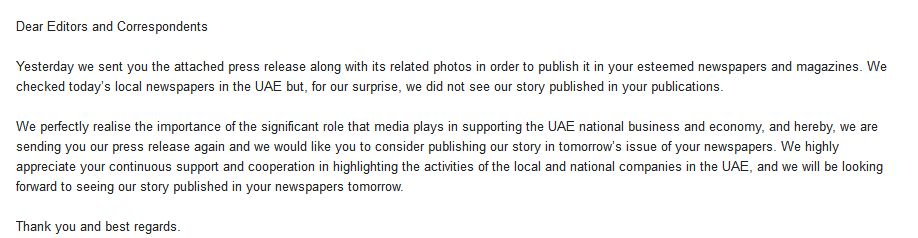
The first is from a local company in the UAE. Written by a former editor (who should know better), the message ticks off the media for not running the release the day before. Is this really going to get your news published? The short answer is most likely not.

Telling off the media isn't the best approach to getting your news published

Telling off the media isn’t the best approach to getting your news published

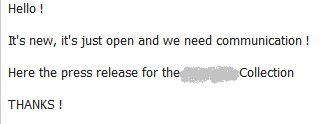
The second pitch is more brief, but just as useless, in that it doesn’t tell the journalist anything. Instead, it almost shouts we’re here so publish something. For a pitch about a fashion collection, so much more could have been done particularly around visuals, to get the news published.

Yes, this is the pitch.

Yes, this is the pitch.

Pitching to journalists isn’t the easiest of things to do – they’re a difficult bunch at the best of times (and I’m including myself in that description as well). However, a well-crafted pitch explaining the news and why it’s beneficial to the journalist’s readers will go a long way to help you achieving your goal of publishing your news.

And to show that journalists also get it wrong, have a look at this piece highlighted by The Media Network.

The Daily Telegraph, published in Sydney by News Corp Australia, has made an embarrassing editorial blunder, by running a headline stating that Australian bombing raids killed dozens of terrorists in the UAE, according to the newspaper’s online platform.

While the story referred to bombings in Iraq – in which Australia’s super hornets conducted a total of 43 flights over the country since becoming operational almost two weeks ago – the prominent headline told a different story.

The headline has since been amended to citing the Middle East instead of the UAE, though the original URL remains.

How to, and how not to, pitch to the media

Let’s get rid of those bad pitches and give journalists fewer reasons to use the delete button (image source: http://www.meltwater.com)

Having worked as a journalist, as the head of an agency, and finally on the client side, I’ve learned a fair few lessons on the art of pitching a story. The beauty about the communications industry is that no matter how many year’s you’ve put in, you still keep learning. This was the case on Monday of this week, when I received an agency email pitch which basically used the client’s latest piece of coverage as the pitch.

Thanks to that experience I’m sharing with you some tips on how to properly pitch to the media, developed by Forbes contributor Cheryl Connor. They’re simple but effective, and they focus on the content and the delivery rather than the traditional media relations approach used still by many in the region.

1. Choose a target. And make sure the target will actually fit. For example, thousands of companies through the years have attempted to pitch The Wall Street Journal’s Walt Mossberg on writing about products such as network traffic management tools. Yet he specializes in covering products consumers would use. A good fit? Not at all.

2. Read the writer’s prior articles. Thoroughly. Read them with an eye for their interests, their themes, and the way your idea would help extend their subject matter further. (Not “I see you wrote about XX, so how about you write about it again?”) When you make your pitch, let the writer know how and where your idea might fit. Think through the idea through the reporter’s eyes—how will this piece be of interest and need to the reader? How will it meet the criteria the publication and the writer’s section and assignments must meet?

3. Pitch a story—don’t pitch your company. Believe it or not, your company and product, by themselves, are not an interesting topic. But as part of a broader story or an example of a pervasive need or a message—now they can shine. Think of what that story might be and imagine what it might look like in the hands of the reporter you’ve chosen. From that point of view, prepare your pitch. Make your pitch by email first. Let it gel for at least an afternoon, or preferably for a day. If the idea is a good one, the reporter may respond right away. If you don’t hear back, perhaps the next step is a call. When you call, refer to the earlier message. Regardless of whether the reporter has seen it or not, re-forward as a courtesy as you are talking to allow the individual to scan the high points of the message and preliminarily respond.

4. Be respectful of the reporter’s right to make the decision. As tempting as it is to ply the reporter with a strong armed pitch, you will be more successful by respecting the reporter’s right to say yes or no, while providing them with as many meaningful reasons as possible to have the desire to say yes. Is the story an exclusive? An idea or a slant that hasn’t been offered to anybody else? Will it be of broad need and interest to the reporter’s readers or viewers, and does it give them strong news or an angle on the information that hasn’t been presented before? All of these ideas will help.

5. When you speak to the reporter, get straight to the point. The whole idea of buttering a reporter up to the topic you called for is a bad one. Clearly you phoned because you wanted something. With the first words out of your mouth, let them know what it is, and what your reasons are for thinking it’s a good idea. If it’s yes, follow through quickly with the next steps. If not, why not? For another person or with another approach could it be a better idea? With the business of the call handled, you can then visit with the reporter for a bit and catch up if they have the time and the willingness. And at that point, they’ll know the personal interest is sincere.

6. Be honest and transparent about your desire for the interview or the meeting. For example, I was extremely annoyed to get an urgent message from a vendor needing my next available time to discuss their public relations only to find out their one and only reason for the appointment was to give me a demonstration of a product they were hoping I would cover for Forbes. And it was a product that didn’t fit my area of coverage, at that. The executives wasted an hour and a half of their time and mine. Not only will they not see coverage, but the company they represent will now find it highly difficult to get a return appointment with me when they genuinely do want to meet to discuss their PR.

7. If you can’t reach the reporter, avoid the temptation to call repeatedly. Listen to the reporter’s voice mail—it will often provide you with clues. For example, the reporter may be on vacation this week—out sick—moved to another beat (or even another publication) or may be so adamantly opposed to voice messages that you should be aware the message will likely never be heard (or may even offend them). If you do leave a message, one message in a day is ample. If the reporter has left a cell number on the message, refrain from using it unless the matter is genuinely urgent. They’ll appreciate the courtesy you use in reaching out in the ways they most like to be contacted.

8. Consider the strengths of Twitter. Twitter can often be a clue as to where the reporter is and what they are doing on that day. For example, if they Tweet they just arrived at the Oracle World trade show, it’s no wonder they didn’t answer the office phone. Now you know. Time your next call for after the event. Also, many reporters will respond to direct messages through Twitter faster than any other mechanism. Use that advantage, when you can take it, with skill.

These points reflect my own sentiments. A pitch should be interesting and to the point, add value to the journalist and her/his audience and relevant to the journalist’s beat. Communicators are story-tellers. The more interesting our story, the better the chance that the journalist will say yes to the pitch. There’s far too many badly thought-out pitches being made, mass emails promoting a person or a company. The next time you pitch, send the email to a colleague and ask them to answer you, in all honesty, if they’d buy your pitch.

@saudigazette’s reader voices and does the Kingdom have an image problem?

Saudi Gazette's new Voices column aims to give readers an opportunity to share their own opinions

Saudi Gazette’s new Voices column aims to give readers an opportunity to share their own opinions

Saudi Gazette has launched a fascinating project to give its readers an opportunity to write more than a letter to the editor, but rather pen a guest column. The first column, named Voices, features the thoughts of former Saudi journalist and doctoral candidate Najah Al-Osaimi. The piece by Najah looks at Saudi’s image and how it is perceived abroad. It makes for an interesting read, even more so when considering its publishing in Saudi Arabia.

Let me know your thoughts on Saudi Arabia and its image problem abroad. And thank you Saudi Gazette for another wonderful idea. If you are interested in writing a column for the Saudi Gazette then email your contribution, no less than 300 words, to voices@saudigazette.com.sa.

Will Huffington Post’s entry into the Gulf be a game-changer?

How will the Huffington Post affect the Gulf’s media landscape? We’ll find out early next year. (image source: http://www.aim.org)

Being in the Middle East’s media sector can often feel like waiting for a bus. You can wait for years for a new launch (post-2008 in any case) and then all of a sudden you have two of the world’s largest news portals announcing expansion plans. First we had Buzzfeed, and now we have the Huffington Post. The local site Doha News broke the story earlier this month. According to the piece, the site will be partnered by the former director general of the Al Jazeera Media Network Wadah Khanfar and his media firm Integral Media Strategies.

The site will be in Arabic and will launch early next year. HuffPost Arabi, as it will be known, will be based in London. HuffPo founder and editor-in-chief Arianna Huffington is quoted by Doha News as saying the site would “bring more Arab voices into the conversation and deepen the world’s understanding of life in the Arab world, from its problems to its accomplishments to its untapped potential.”

The site will include a combination of aggregation, blog posts from a wide variety of sources and original reporting from HuffPo reporters and Khanfar’s team.

Launched in 2005, the original Huffington Post redefined online media by working with bloggers to aggregate news. The site was the first online news portal to win a Pulitzer and was sold in 2011 for 315 million dollars to AOL. Besides English, the Huffington Post is published in French, Spanish, Italian, Japanese, German, Portuguese and Korean.

However, how will the Arabic be received? Firstly, Khanfar was one of the driving forces behind the success of Al Jazeera. However, with him at the helm HuffPost Arabi is likely to be persona non grata in many of the Gulf states due Al Jazeera’s implied support for Islamist groups and perceived interference in the internal politics of governments across the region.

In addition, much of the dialogue that the Huffington Post is looking to encourage in the region can already be found online on social media. With its base in London, five thousand kilometers from the Gulf, how will the HuffPost Arabi be able to distinguish itself in a crowded media landscape that is government controlled? I can’t wait to find out.

Changes in the Region’s Media Scene – BuzzFeed in, Dubai One is out, and we say goodbye to Iain Akerman

In the spirit of Ramadan, here’s a BuzzFeed cat meme to get us all excited! (image source: BuzzFeed)

The summer is traditionally a quiet period for the region; the same goes for Ramadan. This year seems to have been the exception to the rule. First, we had Gulf News reporting that BuzzFeed is considering opening an office in the Middle East. The website publisher, famous for its kitten memes and political coverage, apparently sees an opportunity in Arabic with a local audience, according to the piece written by Gulf News’ Alexander Cornwell.

BuzzFeed, the news and entertainment website best known for its pictures of cats, wants to expand into the Middle East with the launch of an Arabic website.

Launched in 2006, the United States website, which is steadily increasing its hard news content, has already launched UK, Australia, France, Brazil and Español (Spanish) editions. Since November 2013, the website has seen more than 130 million unique monthly visitors, of whom 30 per cent are from outside the United States.

Scott Lamb, Vice-President of International, BuzzFeed, told Gulf News in a phone interview that the Middle East is one of two regions where BuzzFeed is most interested in expanding to.

“There is nothing like BuzzFeed in the Arabic-speaking content,” he said…

Lamb said that there is no set date for the launch of the Arabic language website and that it would have to wait until next year after Germany and India, indicating that the finer details are yet to be worked out.

Asked where BuzzFeed would base its regional operations given that many major international media outlets have set up bureaus in Dubai in recent years while Beirut and Cairo are seen as more traditional regional hubs for news bureaus, Lamb said that it had not been decided.

“We’re not that far down the road,” he said, “We have a fairly big office in London. One possibility would be doing a lot of the coverage from there. But if we were to set up in the region, we would want a physical presence.”

BuzzFeed New York office produces much of its Spanish content.

BuzzFeed started producing hard news content in 2012 with coverage of the US presidential election. Since then it has hired Miram Elder, recruited from The Guardian, as its Foreign Editor.

Internationally, BuzzFeed has had reporters on the ground covering Syria, Iraq and Ukraine. Elder has also led coverage of two topics that are heavily discussed on social media, women’s rights and lesbian, gay, bisexual, and transgender (LGBT) issues.

“We saw this very vibrant conversation around the news in those two spheres [and so] we wanted a team to create original content,” Lamb said.

BuzzFeed plans to continue to increase the amount of hard news content, but Lamb said it would not be stepping away from the traditional social media friendly content of cute cats and quizzes that it is still best known for.

“Ideally, we are looking for a 50/50 mix … we try and keep it very balanced,” he said.

As if the thought of cat memes alongside Arabic-language LGBT news wasn’t enough, the second piece of news was the closure of Dubai One, the English-language television station run by Dubai Media Incorporated (DMI). The channel, best known for programmes like HerSay and Out and About, will lay off 80 percent of its staff as reported by Arabian Business.

Dubai One was created to cater to expatriates in Dubai and the wider region. The channel has fallen behind the likes of satellite provider OSN and the Saudi-owned giant MBC.

Sarah Ahmed Al Jarman, the general manager for Dubai One, told Arabian Business via email that “we have stopped our 4 locally produced shows”, without elaborating. Al Jarwan also referred any further questions to the DMI inhouse public relations team.

And last but not least, we have to say a sad farewell to the Editor of Campaign Middle East, Iain Akerman. Iain was spoken of by those in the creative and media sectors as a journalist to be both feared and respected – he’d chase his sources for breaking news and he’d often champion investigative journalism. I once remember talking to one agency head who referred to Iain with a pained expression. Iain, I wish there were more like you here. You will be truly missed.

Getting the timing wrong when communicating – MBC’s NYT mishap

The timing of the decision not to print the New York Times in the UAE couldn't have been worse for MBC's Al Ibrahim

The timing of the decision not to print the New York Times in the UAE couldn’t have been worse for MBC’s Al Ibrahim in light of his comments on local press freedoms

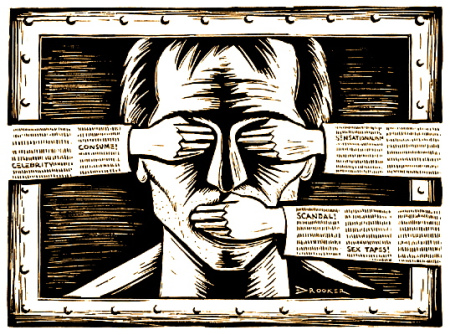
Despite what you’ve been led to believe, there are lots of mischief makers in the Gulf – there’s even a handful in the United Arab Emirates. These naysayers were online last month and poking fun at the chief of the largest satellite broadcast group in the region, the Middle East Broadcasting Group, after he announced that Dubai offers “complete press freedom”.

Sheikh Waleed Al Ibrahim, chairman of MBC Group, told journalists at the Arab Media Forum that the Emirate offered complete press freedom in a region where the media is heavily regulated by government. To quote from Arabian Business.

“We launched the Middle East Broadcasting Centre (MBC) Group as a pan-Arab media in 1991 in London – to be able to exercise freedom of the press – as most Arab countries were not open to the idea of press freedom.”

“It was an uphill task initially. However, we remained committed to develop quality contents for the Middle East audiences. We tried to enter Egypt and the government did not let us enter to protect the local television channels. However, when an invitation came from Dubai, we started to engage with Dubai government. Initially, I was reluctant to relocate as we might have to compromise on the content – fearing that we might become subject to censorship and interference. Since then, we were never asked by the government how we run our business and why we do what we do. There has been no government interference on our programme.”

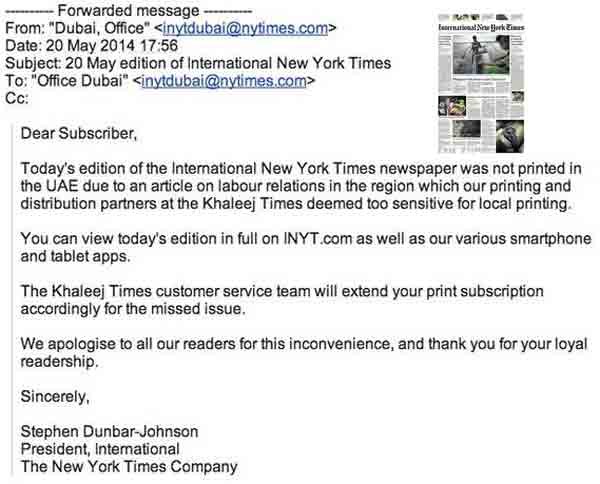
So far, so good. But, as pointed out by comments underneath the Arabian Business article the New York Times was pulled from the publishing presses in the UAE by its local, government-owned partner due to an article printed in the newspaper on labour rights at New York University Abu Dhabi.

While Al Ibrahim’s comments may be spot on, the timing of the New York University Abu Dhabi controversy and the halting of the printing of the New York Times said much more than Al Ibrahim’s comments. Actions do speak louder than words, and despite Al Ibrahim’s best intentions his words were undone by a decision which underlines how much press freedom we have in the region.

The silent expatriate guests – should we raise our voices or remain quiet on sensitive subjects?

Should we as expatriates remain silent or speak up about issues which we feel are contrary to our beliefs? (image source: http://www.thewordontheword.blogspot.com/)

The past week has been an interesting one for foreign media junkies who follow affairs in the Gulf. Two articles were published in the English-speaking press which have proved to be controversial. The first was a damning piece in the New York Times on labor rights for workers hired from the Asian sub-continent to build the New York University Abu Dhabi. The second was a fine piece of investigative journalism from the Sydney Morning Herald on the subject of government subsidies for Etihad, the Abu Dhabi-owned airline.

The above criticisms in the foreign media shouldn’t surprise experienced communications professionals. Etihad is becoming a global brand with stakes in a number of airlines across Europe and Australia. Similarly, the report about labour issues relates to an American institution, New York University, and its Abu Dhabi campus. Qatar has similarly experienced negative publicity from abroad relating to the country’s labour practices following its winning of the rights to host the 2022 World Cup.

Recently, I attended a conference on the subject of corporate social responsibility. When asked about whether expatriates should tackle these issues with both governments and the national population, one of the most senior communications professionals in the region responded by saying ‘we’re the guests and so we shouldn’t tackle these issues.’

Unfortunately, the most common refrain to any comment which can be taken in a negative light is, ‘if you don’t like it, then leave.’ There’s a lack of moral courage shown by many expatriates to talk about issues which may offend, or which may get them into the bad books. Similarly, are many nationals willing to listen to the opinions of others? The concept of traditional Arabian hospitality is often talked about, a tradition that requires the host to listen to and honour the guest, but the reality on the ground is often different.

Modern societies are mature enough to take on board different voices, to learn from the opinions of others. As a person who has tried to do his part for the rights of others, I do find it embarrassing that as the people who live here in the region, we’re unable to raise these issues with our hosts in a civilized dialogue (and for those who say I’m looking to impose foreign, western standards there are many hadiths or sayings of the Prophet pbuh on issues such as workers’ rights).

Should we have the moral courage to speak on these issues, to benefit the communities and the countries with which and in which we live? Or should we remain silent? The answer, to me at least, is obvious. What do you say?

Turkey, Twitter and how a ban couldn’t/wouldn’t happen in the Gulf

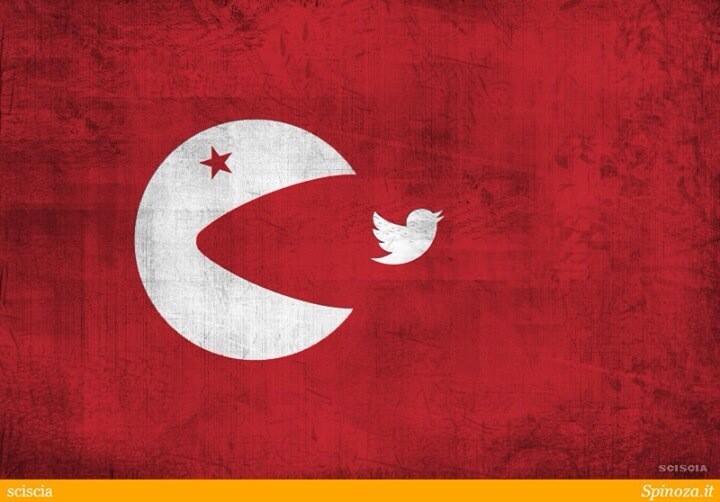
While Turkey is busy trying to gobble up Twitter, there’s little chance of anyone in the Gulf banning social media any time soon (image source: http://www.globalpost.com)

Last week, we in the Arab world were treated to a spectacle that we’re all too often participants in. Instead, we looked on as the government of a neighboring country pulled the plug on a social media service and denied its citizens and residents the right to use Twitter. The story behind the move by Turkey’s Prime Minister, Recep Tayyip Erdoğan, to block access to Twitter is fascinating, a page-turner about corruption, dissent and how one man is trying to dominate political will in his own country (have a read of the background here, in a wonderful piece written by the New Yorker’s Jenna Krajeski).

A question/tweet by the Wall Street Journal’s Ellen Knickmeyer about the situation in Turkey from a Middle Eastern perspective got me thinking about the subject. Here’s my take on the Gulf states country-by-country.

Saudi Arabia

Let’s start with the largest country in the region, Saudi Arabia. There are millions online and active on social media in the Kingdom (both Twitter and Facebook have fifteen million Saudi users between them – Facebook has approximately eight million users and Twitter just under seven million ). For many, social media is a release, a forum for open debate where anything and everything can be discussed.

The whole spectrum of Saudi society is online and using social media – some of the most popular and prolific tweeters are religious scholars. while there is criticism of policy online, would the government be willing to risk a public backlash any social media channels were to be closed? Rather, Saudi’s social media policy can be summed up in one sentence – do what you want online but we are watching you. Saudi’s online laws, which have recently been rehauled, allow for citizens to be detained for their online activities (a recent piece by Abeer Allam for Al-Monitor covers recent developments in the Kingdom).

Bahrain

The second Kingdom on the list, Bahrain has suffered more than most over the past three years. Bahrain’s social media has become almost as polarized as the situation in the country, between those who support the government and those who support the opposition. However, despite the war of words online Bahrain has never threatened to pull the plug on social media (there was a communications blackout during the early days of the political crisis in Bahrain).

Instead, the island state has tightened up its online legislation and has cracked down on bloggers and other activists who use social media (Global Voices’ editor Amira AlHussaini wrote a piece about the arrest of blogger Mohammed Hassan in July 2013).

The Kingdom uses social media to communicate both locally and globally on issues such as security, foreign policy and terrorism. Would Bahrain seek to indirectly legitimize the opposition’s claims that the government is cracking down on media through pulling the plug on social media? Not likely.

The United Arab Emirates

The second largest country in the GCC by population, the United Arab Emirates has taken to social media like a duck to water; the country’s leadership are online, the country’s businesses are online and the country’s population are also online tweeting, updating their statuses and uploading pictures of every single meal and building around them mainly on their smartphones. The UAE’s population communicates about literally everything, except to criticize.

There’s so few people in the UAE who aren’t supporting the country’s leadership that the thought of any social media being pulled seem ludicrous. For those that do dissent the UAE introduced in 2012 more stringent online laws which include jail time for those that defame the country. These laws have been put into effect.

Kuwait

Maybe surprisingly for those who don’t know the region, Kuwait has the freest media industry in the region, with columnists regularly criticizing government policy. Kuwait’s parliamentary system and the level of public discourse in the country means that few subjects are off-limits. Kuwait’s social media scene is also buzzing – Twitter reckons that over half of the country’s population, 1.5 million out of 2.7 million, are active users.

Even in Kuwait however, there have been cases of people being jailed for their tweets, either for insulting the Emir or for blasphemy. Still, it’s hard to see how or why any social media channels would be banned in a country that is known to enjoy a ‘debate’ every now and then.

Oman

On the periphery of the Gulf, Oman was affected by the Arab Spring. The country’s ruler Sultan Qaboos introduced sweeping reforms to appease Omanis calling for a better standard of living. The country has contended with online activists and the authorities have warned people not to spread libel and rumours that prejudice national security. Would Oman seek to shut down social media? Again, it’s unlikely.

Qatar

Last but certainly not least, Qatar has championed its own brand of journalism aka Al Jazeera for over a decade now. The country with its vast gas reserves has not had to contend with any political discussions about its governance and future. Qatar has jailed one person, a Qatari national, for publishing a poem on Twitter.

In addition, the country’s government is seeking to introduce a revised cybercrime law which would increase and expand the capacity under which a person communicating online could be jailed for (for a detailed news piece read this article by Matt Duffy on Al Monitor here). However, there’s little chance of anyone in government shutting down any social media channels in the country.

In short, social media has changed the Gulf just as it’s changed the world. The region’s citizens and residents have much more freedom to talk about issues online. The Gulf’s governments and their business interests have also become adept at using social media to promote their own messaging and market themselves. The region’s citizens are aware that even online they’re being monitored (this BBC article describes this notion of being watched) and most of them will tread carefully about what they say and how they say it. For others, they’ll go online anonymously and tweet to their heart’s content.

For governments, social media has become a release value on societal pressures and the message to nationals is clear – talk about whatever you want but don’t criticize. Examples have been made of those who do. But, while the governments have the ability to cut off social media and even throttle or close access to the internet, thankfully the Gulf isn’t Turkey. No one here is going to ban Twitter or any other social media channel any time soon.