
Arab News, Molouk Ba-Isa, the Axact scandal and how the Arab media lost a world exclusive in 2009

Molouk Ba-Isa broke the Axact story five years before the New York Times. And then her story was pulled by the management of Arab News two weeks after it was published (image source: Saudi Gazette)

Molouk Ba-Isa broke the Axact story five years before the New York Times. And then her story was pulled by the management of Arab News two weeks after it was published (image source: Saudi Gazette)

While there’s plenty of media titles in the Middle East region – by all accounts the Gulf is the one part of the world where print is still making a profit – there’s few occasions I can remember where the region has had a world exclusive.

There’s always an exception to the rule, and unsurprisingly the person who has been in the limelight recently is a Saudi-based journalist called Molouk Ba-Isa. For those who know her, Molouk is a no-nonsense reporter who often tackles items of interest to her readers and who produces original news rather than copying and pasting news releases.

Molouk’s name was mentioned in the New York Times, as the journalist who first broke the Axact fake diploma scandal. To quote from the first piece the New York Times wrote on the story, in which it broke news of the scandal:

Heavy scrutiny by investigators, politicians and the fractious Pakistani media sector has mounted over the past week for Axact, a Karachi-based software company that has made millions selling fake degrees through a sprawling empire of school websites.

Axact, which has its headquarters in Karachi, Pakistan, ostensibly operates as a software company. Axact runs hundreds of websites, many of which purport to be online universities and high schools based in the United States.

Axact has thrived for more than a decade on its ability to hide links between its operation in Karachi and hundreds of fictitious online schools, many of them claiming to be American. But more such links are coming to light in the days since The New York Times published a detailed account of the company’s operations.

The Axact story wasn’t broken by the New York Times, but rather by Molouk Ba-Isa, who was writing for the Arab News back in 2009. Again, to quote from the New York Times:

For years, former employees said, Axact’s diploma certificates were shipped to customers across the globe through a courier service in Dubai, to give the impression of being based in that city’s free trade zone. But that facade nearly collapsed in 2009, when a technology journalist from Saudi Arabia started looking more closely.

The journalist, Molouk Ba-Isa, was following up on a report that Rochville University had awarded a master’s in business administration to an American pug named Chester. Although Rochville’s physical location was a mystery, Ms. Ba-Isa learned from a courier company official in Dubai that the degree originated from Axact’s office in Karachi.

But when The Arab News published her report, naming Axact, she said her editors received a strongly worded legal threat from company lawyers, and the article was removed from the Internet. This week, Ms. Ba-Isa said in an email that she felt vindicated.

In her weekly article for the Saudi Gazette, Molouk wrote about her Axact story which was published both in print and, even more importantly for a company which sells degrees via the internet, online.

On October 7, 2009, I received an email from Abdul Karim Khan & Company with a subject line “Cease and Desist.” The email was sent from akkc2005@yahoo.com, copied to legal@axact.com.

Abdul Karim Khan & Company, claimed to be “Advocates, Attorneys and Legal Consultants,” located at Suite No. 1108, 11th Floor, Kashif Centre, Sharah-e-Faisal, Karachi.

The email stated that the lawyers represented Axact (Pvt.) Ltd and they were putting forward a Cease and Desist Letter authored by Fahim ul Karim.

The letter demanded that the article published on October 6 be removed from arabnews.com or prosecution would proceed. Arab News was also included and threatened in the Cease and Desist Letter.

Immediately, I was asked by senior Arab News staff to provide evidence for all allegations in my report. I turned over my notes and the taped interview with Vicky Phillips, the founder of GetEducated.com, whose dog had been awarded the degree.

I provided telephone numbers for the shippers in Dubai and images of the shipping label. Within a week of the first email, the legal documents arrived from Pakistan to Jeddah by courier.

Once the article had been up on the website for two weeks, senior management at the newspaper made the decision to take the report down to stop any lawsuit.

However, no apology was issued and my report was never retracted. I continued to dig for information about Axact’s illegal activities.

While Molouk should be praised for her pioneering work, why didn’t the management at Arab News and its publisher defend her reporting and keep it online? Did they really fear a court case? Do they bear responsibility for those who have been defrauded by Axact in the five years since that initial piece was published by Molouk? And what does this say about investigative journalist in the Middle East?

A global scoop which never was… Molouk, you did a fantastic job. If only our publishers are as brave as our journalists, maybe this piece would have had a different ending. Ultimately, I’ll leave the last word to Molouk.

My thanks go out to all those who have helped to publicize Axact’s alleged malfeasance. Keep up the good work.

Not the headline one hopes for – Migrant workers, ‘trespassing’, and Qatar’s BBC own goal

A communicator’s job (or part of at the very least) is to generate headlines. Preferably favorable headlines. But even the best of intentions can often come undone.

It’s an understatement to say that Qatar has been under the microscope recently. The country, with a population of just over a million (both nationals and expats) and hundreds of billions of dollars of gas reserves, has often strived to make its mark on the global stage. One such project is the news station Al-Jazeera, which has revolutionized media in the Middle East and beyond.

Qatar’s World Cup bid and subsequent win hasn’t been the success the country may have hoped for however. Ever since Qatar was awarded the 2022 World Cup by FIFA, it has been subject to criticism by international NGOs about a host of issues ranging from the rights of homosexuals to labor rights.

The biggest concern has been the living conditions of low-income workers, specifically those people who are building the infrastructure for the World Cup.

To their credit (or maybe because there’s little other choice afforded to them), the Qatari government has tried to tackle allegations of poor treatment of migrant workers head on. They have announced new legislation to penalize companies who do not pay workers on time and an amendment to the national labor law to facilitate the payment of workers through direct bank deposits.

Qatar has also been keen to promote the new migrant labor villages that the government has built. As part of its media efforts, the country’s Labor Ministry invited global media last week to view this new accomodation and meet the country’s Labor Minister to talk about Qatar’s push to promote labor rights.

However, things didn’t go quite as expected. I’ll quote from the Guardian below.

A four-strong BBC crew had been invited by the prime minister’s office on an official tour designed to show off new accommodation for migrant labourers, but were arrested by the security services while trying to gather additional material. They were interrogated and jailed for two days, before being released without charge.

The visit was part of a public relations drive, partly overseen by London-based agency Portland, in the wake of an international outcry over the slave-like conditions for workers exposed by a Guardian investigation in September 2013.

Rather than the story being the improvements in living conditions for Qatar’s migrant workers, the headline on the BBC (which was carried across the globe) was BBC team arrested, and held for several days.

It went from bad to worse for Qatar when Qatar’s communications chief explained that the BBC team had been arrested for ‘trespassing’. Again, to quote from The Guardian.

The Qatari government’s head of communications, Saif al-Thani, said the BBC crew were arrested after departing from an official tour. He said: “We gave the reporters free rein to interview whomever they chose and to roam unaccompanied in the labour villages.

“Perhaps anticipating that the government would not provide this sort of access, the BBC crew decided to do their own site visits and interviews in the days leading up to the planned tour. In doing so, they trespassed on private property, which is against the law in Qatar just as it is in most countries. Security forces were called and the BBC crew was detained.”

The challenge organizations often face is how to ensure that the same message is conveyed across the entirety of the organization. It’s obvious that in Qatar there were differences of opinion which led to the BBC crew being tailed by the security forces once they’d entered the country and to their arrest while doing their job.

The question now for Qatar is how do they go on from here and get the message right, across all of the country’s government and leadership? The media scrutiny is only going to get even more intense, the closer we get to the 2022 World Cup. I’ll continue to watch this story and how it unfolds in the media.

Periscope, Meerkat and why communicators should be live-streaming events

Are you going to make the most of live-streaming services such as Meerkat (left) or Periscope to better communicate your story?

Are you going to make the most of live-streaming services such as Meerkat (left) or Periscope to better communicate your story?

We all love video delivered via the internet, and now there’s several more reasons to love video on the internet. The online community has been raving about the launch of live streaming video apps such as the Twitter-owned Periscope and Meerkat. I’m also excited, but for a different reason. Both Periscope and Meerkat open up a whole world of possibilities for public relations and communication professionals. These live streaming services, both of which were launched this year, will push us further down the line, towards visual communication and away from the old mantra of press releases and traditional media.

Apps such as Periscope and Meerkat enable any and everyone with an iPhone or Android-based smartphone to live stream, at no additional cost and with high-quality streaming. As a communicator, we can now capture and share our stories worldwide or to a select group through Twitter or directly via the apps as the story happens. Live streaming applications are already being used by journalists and commentators in the UAE. Dr James Piecowye of Dubai Eye (@jamesEd_me) and Khaled AlAmeri of The National (@KhaledAlAmeri) are both using Periscope – James to actually stream his radio show live every night as well as events such as Creative Mornings Dubai, Khaled to live stream his views on current affairs. With Periscope, users can comment during the live-stream which in turn fuels the conversation and promotes engagement.

On the PR News website Mark Renfree sums up eloquently why live streaming apps such as Periscope and Meerkat should matter to PR pros.

1) Capture and share the moment as it happens. Live streaming is here and people are using it. Politicians are giving speeches, celebrities are providing fans with virtual backstage access and people are watching their friends make sandwiches using live streaming apps. During a catastrophic fire in New York’s East Village on Thursday, journalists and citizens used live streaming apps to document and share the tragedy as it developed.

2) PR pros can provide a whole new type of content. Streaming apps offer communicators a whole new way to engage their audiences—whether they’re consumers, employees or the general public. Everything from shareholder meetings to PR stunts can now be broadcast and, specifically with Periscope, saved and posted on other channels.

3) Live streaming can give communicators increased control over messages. Streaming apps allow communicators to broadcast content themselves, a task that was usually left to journalists and the news media. Periscope and Meerkat eliminate the middle man between communicators and their audiences.

4) This opens up a new chapter for the hot-mic problem. Nearly everyone, everywhere is now carrying a live streaming video camera. For individuals and brands in the spotlight, these apps are adding to an environment in which there is already little reprieve from the ever-watchful eye of the public.

When is a brand-celebrity engagement toxic? The Etihad and Landmark stories

Have brand associations between Kidman and Etihad and Khan and Splash helped or hindered their respective brands?

Have brand associations between Kidman and Etihad and Khan and Splash helped or hindered their respective brands?

We just love celebrity endorsements. They’re useful for building brand equity, for improving ad recall, they convey celebrity status to the brand, and help brands stand out from the pack. When done right, celebrity engagements work wonders for the brand. Think Michael Jordan and Nike or Beyonce and Pepsi.

And then there’s what we do in the Middle East, specifically the Gulf. I’ve had a number of views come my way, particularly in relation to two deals which were done recently. The first is for the Abu Dhabi-based airline Etihad. In March Etihad signed up Hollywood actress Nicole Kidman to front up its latest advertising push which focused on Etihad’s redefinition of luxury travel. You can see the video below.

A global name, Kidman is Etihad’s fourth brand ambassador from Australia (can you name the other three, or the airline’s one Frenchman and German sports stars?). The discussion comes in around Etihad’s customer groups and how much the airline’s brand ambassadors actually resonate with these groups. Despite being Abu Dhabi-based and owned by the UAE’s capital, Etihad doesn’t have a single Arabic-speaking or Arab national as a brand ambassador. It’s hard to know how much Kidman would resonate with audiences in the Gulf, but Etihad hasn’t done much to find and leverage off brand ambassadors who’d appeal to Arabs in and around the Gulf (particularly those who are likely to travel in first class).

For Kidman, the association with Etihad has brought its own risks. Just a couple of weeks after the deal with Etihad, Kidman was criticized by a flight attendants’ union, the Association of Professional Flight Attendants, following her appearance in an advert for an airline it claims treats female employees “deplorably” and operates using “discriminatory labour practices”.

While there’s always a risk of being targeted, and criticized, by a specific interest group as in the case of Kidman, there’s even more risk to a brand’s equity when a celebrity misbehaves (think Tiger Woods and affairs with adult film stars) or does something which consumers may consider to be unethical.

One such example is Bollywood filmstar Salman Khan. Khan, who is an A-list film star in India, is the face of Dubai-based clothing retailer Splash. However, over the past week Khan was found guilty of committing manslaughter in a hit-and-run accident back in 2002 (Khan was allegedly drunk and lost control of his car, which slammed into a group of homeless people sleeping on a pavement).

The editor of Arabian Business, Anil Bhoyrul, penned a strongly-worded opinion piece on the issue only this week. The piece has gone on to become one of the most commented-on pieces in the history of the online news portal.

On a roll, Arabian Business published a piece about a public backlash against Splash for their support of Khan. You can read excerpts below.

Dubai-based Landmark Group is facing a public backlash, after the CEO of one of its leading brands described convicted Bollywood killer Salman Khan as a “great man.”

Bollywood star Salman Khan, who is a brand ambassador for Splash, was sentenced to five years in jail after being found guilty of killing a homeless man while driving under the influence of alcohol. He is currently on bail pending an appeal.

Khan was appointed as a brand ambassador for Splash in 2013, and is currently featured in a number of advertising campaigns for the retailer’s products. His face appears in several large billboards across Dubai, promoting clothing ranges.

But despite the conviction, Splash CEO Raza Beig said last week: “At Splash we love Salman Khan and we will support him through every up & down. My heart breaks to find out about the verdict but as they say every great man in history has gone through some struggle to achieve greater heights so probably this is his calling. We cannot comment on the judgement and do not believe he deserves it but Allah’s will it is.”

Will this brand association and the support of Splash’s CEO for Khan turn toxic and lead to a public boycott? What’s certain is that the Splash brand will not be helped by the current association with Khan, and the CEO’s stance would appear to be at odds with the opinion of many Splash customers. There is one truth all brands need to bear in mind – the consumer is boss. What matters is not what is important to us as people who manage the brand(s), but rather what is important to them.

What do you think of these celebrity endorsements? Are they flying high or are they a damp squib (excuse the puns). Share your thoughts. I’d love to hear from you.

Did Skydive Dubai do enough communications following the tragic death of skydiver Majed Al Shuaiby?

There are days I love my job as a communicator. And then there are days when my heart breaks. One of those days was last week, with the tragic news of a death at Skydive Dubai. Majed Al Shuaiby was an experienced skydiver – he had over 700 dives under his belt according to the local media. On April the 30th Majed took to the skies. Unfortunately, his parachute did not open and he died on impact.

This news, as sad as it is, is also newsworthy. We have a young man, who is only 35 years old, who perished whilst undertaking a sport which is often thought of as high risk. The accident made the news, with coverage nationally and regionally (Majed was a Saudi national). Unsurprisingly, the news first appeared on social media, on the evening of the 30th, the day of the accident.

In a tribute Majed’s name trended on Twitter in Saudi with the hashtag #ماجد_الشعيبي.

Many of those who were online and who knew of the accident started to reach out to Skydive Dubai. The initial reaction was, to put it mildly, disappointing.

https://twitter.com/ammorsy/status/593784283237457921

What Skydive Dubai did, a day after the accident, was put up a post on its Facebook Desert Campus page and push users there. There’s no separate post on Skydive Dubai’s main Facebook page and no posts on Twitter.

The holding statement above has been used for media attribution as well, as can be seen from The National’s story.

Was the statement from Skydive Dubai enough or could they have done more?

Was the statement from Skydive Dubai enough or could they have done more?

While the investigation is still under way to determine what happened, could Skydive Dubai have done more to publicly address the incident and offer their condolences to the family, whilst also addressing concerns around the safety of skydiving?

No one wants to go through a crisis, especially when people are injured or there’s a fatality. However, we as communicators are on the front line to advise our employers and communicate in a way that is respectful, that comforts, and that shows we are also human. As we say, perception is reality and Skydive Dubai’s initial response, to block users, would seem entirely at odds with what communicators should do in a crisis. Going beyond that, is a holding statement enough? We need to present both the facts and show our emotion. We should never simply ignore bad news, and block conversations. Could Skydive Dubai have done more? Do let me know your thoughts.

On a final note, I’d like to convey my condolences to Majed’s family. Allah yurhamu and may god bless his soul.

The National and how it (finally) got the Saayidat Gas Blast story right

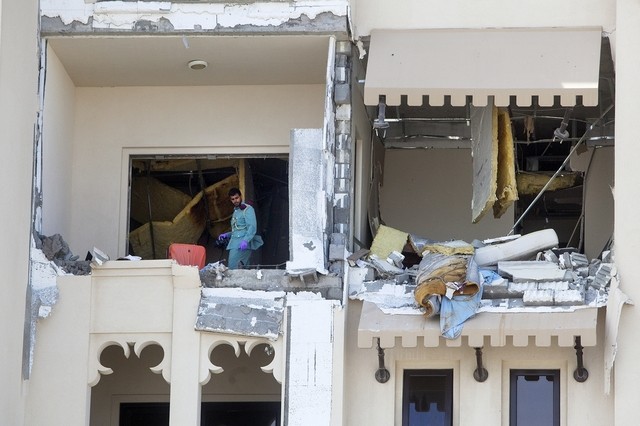
The money picture of the gas blast flat was captured on the second day by The National (image source: The National)

The money picture of the gas blast flat was captured on the second day by The National (image source: The National)

As an ex-journalist who nowadays spends more time in corporate communications than writing for the press, I still enjoy spending time reading what the media produce. One local story was particularly moving for me. On the 24th of March, in the evening, a gas explosion tore through the compound where me and my wife live in Abu Dhabi. My wife felt the blast, which she described as feeling like an earthquake.

As you’d expect, the incident made the news. Abu Dhabi-based English-language newspaper The National was quick out of the blocks to cover the incident with an online piece posted the same night. While the speed of the output was noteworthy, the paper got several essential facts wrong.

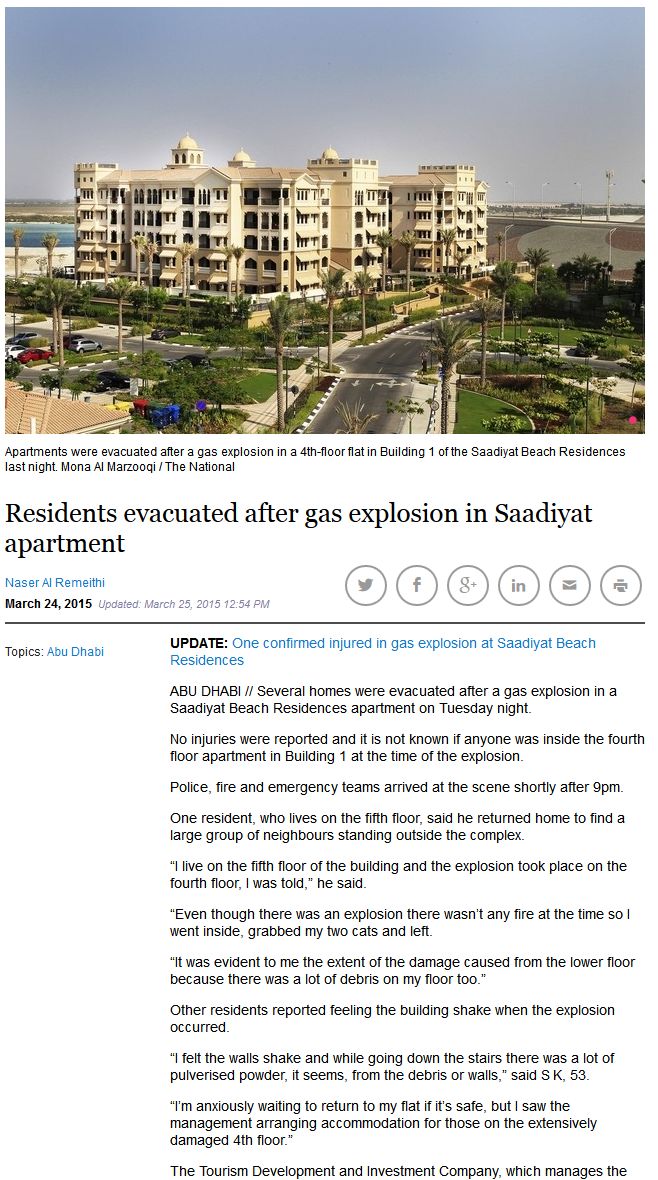
The first was the explosion’s timing – the incident happened at 7.30pm and emergency services were quickly on site afterwards. Secondly, and even more importantly, there were injuries despite the article’s assertion that no injuries were reported (two ambulances were on-site). And thirdly, a stock image of the building was used rather than a picture of the location following the blast (the compound is thirty minutes drive from The National’s offices).

The National's first story on the Saadiyat gas blast was quick to print but important details were wrong

The National’s first story on the Saadiyat gas blast was quick to print but important details were wrong

The piece didn’t feel as if it was put together in the right fashion, as if there wasn’t anyone on site from the paper to collect statements and talk to the authorities. It felt as if it was a desk-job. There was definitely no photographer on site to take the gold-ticket picture which would have set the stage for the piece.

However, the next day The National upped the ante in their second piece. First of all, they had the picture of the gas-blast flat which the first piece desperately needed. This money shot was supplemented by additional images. The piece confirmed the one injury. The piece was much stronger in terms of its facts as well as the emotional focus of the residents who were in the building when the blast occurred and their fears and concerns.

Was there still an issue? As far I am concerned, yes. The piece was almost a gushing testimonial to the compound’s developer TDIC. I felt as if TDIC had commissioned the piece, rather than having a piece written about them by an objective journalist (disclaimer – both TDIC and The National enjoy shared ownership, though that shouldn’t have any bearing on editorial independence). Have a look at the extract from the article and tell me what your opinion is.

Ionnais Xenakis, 27, a pilot with Etihad, lives on the fourth floor with his wife Erini, 27, a few apartments away from the flat where the explosion occurred.

“I was sitting on the sofa with my husband and baby. We heard a loud noise and a vibration,” Mrs Xenakis said.

“We weren’t sure what it was so we grabbed our baby and dog, and ran. We saw our neighbour Barry who was injured in the explosion. He told us that he turned on his light and then the apartment exploded.

“He has just moved into the building and told us that his gas wasn’t even connected yet. It was a little difficult to get out of the emergency exit because it was dark, and the emergency doors were damaged and blocked the path,” she said.

“We helped him out until the paramedics came. It was tough, but the one thing that we can all agree upon is TDIC’s swift reaction and assistance.

“They supported us like a family. They did more than we expected them to do. I was even given a stroller for my baby by one of the employees.

“They also gave me everything I needed for my baby. They were there, attending to all of our needs about 15 minutes after the explosion.”

TDIC made arrangements for the Xenakis family’s dog and cat to be taken to the Australian Veterinary Clinic in Abu Dhabi.

The third and fourth pieces by The National switched from reporting on the blast to the feelings of the residents and their concerns about the safety of their homes. The third piece was much shorter, but it was all the better for it. The fourth piece followed in a similar vein, and both included quotes from two residents (albeit the same residents). There was also the required comment from the local authorities on the steps they were taking to reassure the public – this gas blast was the second in the capital in the space of a week.

The paper saved the best for last, with a piece at the beginning of this week on the injured man himself and his own story as to what happened that night. The journalist rounded off the piece with a final comment from one of the residents.

Residents were displaced for several days. Some tenants from the blast floor are still being housed at the Anantara Eastern Mangroves by the Tourism Development and Investment Company. They are eager to find out what caused the explosion.

“It’s important to identify the error behind this because I believe it could’ve been prevented,” said L R, a neighbour of Mr Johnson. “A poor man was seriously injured because of this. We don’t need hard lessons and tragic stories to learn from our mistakes.”

The National did the right thing and got the piece right, with rolling coverage on the story and a focus on the facts as well as a human-interest element that rounded off the coverage. The journalist made amends for the initial piece which was lacking in both information and visuals to craft a number of pieces that hit the mark every time. The only thing left to say is to wish the person injured in the blast, Barry Johnson, a speedy recovery. It was a memorable night for all the wrong reasons, and I hope that he will be back on his feet and fully recovered sooner rather than later. I hope to read about Barry’s recovery in The National as soon as it happens.

I’d like to wish Barry Johnson a speedy recovery and I hope to read the news soon in The National (image source: The National)

Obama and Netanyahu reach out to the masses – how the net helps as well as hinders the message

Politicians who use digital for their messaging need to remember that once it's online, it's there forever (image source: YouTube)

Politicians who use digital for their messaging need to remember that once it’s online, it’s there forever (image source: YouTube)

Politicians love to talk, at least those in the West do. Some politicians talk with a purpose, while others talk for the sake of rhetoric. We’ve had plenty of talk over the past couple of weeks, thanks in part to both global and regional political campaigns.

The net has completely changed how leaders communicate with their audiences. For example, leaders can now directly reach out to whole nations directly and without the need for a medium or intermediary such as the media. Two examples come to mind this week. The first is that of Benyamin Netanyahu, who went over the heads of Israeli media to directly address the Jewish Israeli public to exhort them to vote. In his address, which was posted to his Facebook page, he warned of the Israeli Arab threat. You can have a look at the video below.

While the demagoguery may have worked with the right-wing voters, this and other responses to questions such as the possibility of there being a two-state solution are not helping Netanyahu internationally. In a day and age where everything is on the internet and can be translated by a machine, there’s little to no opportunity for politicians to say one thing to one audience and then do a 180 with a different audience. Netanyahu’s media assertions that his words were misinterpreted are difficult to understand for anyone with an internet connection who can watch his words directly online.

Obama has also been using video this week, to address Iranians on the eve of Nowruz, the Iranian New Year. Using the opportunity to reach out directly and talk about the opportunity for an agreement over their nuclear ambitions, Obama’s message is simple and sincere. He’s stepped over the Ayatollahs and the government-controlled media to appeal to Iranians, who can access his speech online (the video is not recorded in high definition, for faster loading for Iranians). I’ve included both the comments and the video below.

“This moment may not come again soon. I believe that our nations have an historic opportunity to resolve this issue peacefully — an opportunity we should not miss. The days and weeks ahead will be critical. Our negotiations have made progress, but gaps remain. And there are people, in both our countries and beyond, who oppose a diplomatic resolution. My message to you — the people of Iran — is that, together, we have to speak up for the future we seek. This year, we have the best opportunity in decades to pursue a different future between our countries.”

There’s no doubt the power of digital to step over the media and appeal directly to the masses. What our leaders need to remember is that whatever is put on this medium is immutable. For politicians who are known for changing their position based on whom they’re talking to such as Netanyahu, digital may come back to haunt them. For others who are trying to reach out and build bridges, such as Obama, video represents the best medium to send a message out to as big an audience as possible.

What do you think? Do you agree or disagree? I’d love to hear your thoughts.

Inauspicious Beginnings or PR Coup: Al Waleed’s Al-Arab TV station and how it was shut down on its opening day by Bahrain

Al Waleed’s Al-Arab is now known worldwide thanks to Bahrain’s closure of its operations on its first day of broadcasting (image source: http://www.bbc.com)

Have you heard of the saying, ‘There is no such thing as bad publicity’? If you’re a communications professional at BP or you work for Bill Cosby you may feel differently, but the quote, often attributed to the American self-publicist PT Barnum, still rings true in terms of brand awareness and familiarity.

One man who doesn’t lack for publicity is the Saudi Prince Al Waleed Bin Talal Al Saud. Al Waleed, who has long had an interest in the media (he owns stakes in News Corp, Fox and Saudi Research and Publishing Group), set out his own media vision for the region a couple of years back when he announced his intention to set up his own news channel. Named Al-Arab, the channel would compete with the likes of Al-Jazeera and MBC Al-Arabiya to shape the news agenda.

After years of planning, the channel went live this week. Al-Arab is based in Bahrain, ostensibly to allow the channel to benefit from Bahrain’s relative media freedoms and, as the channel’s general manager and Saudi journalist Jamal Khashoggi put it, to cover “all views” in the region.

On its first day of operations the channel was temporarily suspended by Bahrain’s information ministry. Akhbar al-Khaleej, a pro-government paper, reported that the suspension was due to the channel “not adhering to the norms prevalent in Gulf countries”.

The allegation is that Bahrain’s government took offense to an interview aired with Bahraini opposition activist and politician Khalil al-Marzooq, who was talking about Manama’s decision at the weekend to revoke the citizenship of 72 Bahrainis.

The closure has made headlines worldwide, and has guaranteed headlines for Al-Arab in capitals such as Washington, London, Paris and Berlin. While the closure may have been an operational nightmare, for a publicist it has been a coup. As Oscar Wilde put it, the only thing worse than being talked about is not being talked about. By this measure Al Waleed should be delighted with the launch of his television channel.

The stunt may have also have helped to cement Al-Arab’s position as a channel that will tackle any and all subjects. Before the channel’s launch, Khashoggi stated the need to be both bold in terms of talking about taboos as well as the need to discuss issues from a balanced perspective. “We are going to be neutral; we are not going to take sides,” he said. “We are going to bring in all sides in any conflict because right now we have a conflict in almost every Arab country.”

By setting down this marker from day one, will Al-Arab be able to set itself apart from other channels in the region which do have particular media biases. Will Al-Arab create a middle ground that wins over Arab audiences?

According to Al-Arab’s Twitter feed the station will be operational again soon. I for one can’t wait to watch its re-launch.

And if you want to see the alleged reason for why Al-Arab was shut down watch the clip below.

Baker & McKenzie Habib Al Mulla, Asdaa and OSN and when the client apologized before the agency

Have you ever heard of a client apologizing a week before the agency sends out a correction? (image source: http://www.tumblr.com)

There are few surprises left for veterans of the media, marketing and communications industry in the Middle East. However, every now and then something pops up that can raise a smile or cause a roll of the eyes.

One such story is the unusual case of the UAE-based Baker & McKenzie Habib Al Mulla. Through its public relations agency Asdaa, the law firm put out a release entitled ‘Mergers and acquisitions boom in Middle East’, which laid out the most notable M&A activity in 2014 and Baker & McKenzie Habib Al Mulla’s predictions that cross-border mergers and acquisitions would pick up pace in 2015. The original story is still online here at Khaleej Times.

All well and good we all may think. Except, there was a mistake in the release. And it wasn’t a simple typo or grammatical error. No, it was much more serious. Have a look at the below paragraph.

The Media and Entertainment sector was the largest recipient of inbound M&A activity in terms of value with almost 36 per cent share. This was driven by the $3.2 billion sale of Orbit Showtime Network Co, a Dubai-based owner and operator of TV station, to an undisclosed US private equity firm. This is also the largest deal since 2010.

There was a problem on the above information about OSN’s sale. It never happened. Dubai-based business monthly Trends Middle East was the first publication to point this glaring error out in a blog post. Trends’ editorial team did what any good bunch of journalists should do, and they verified the facts contained in the release. Unfortunately, a number of other publications didn’t (the list is on the Trends website).

The Trends team then reached out to all the parties involved, including Baker & McKenzie Habib Al Mulla, Asdaa and OSN. OSN issued a statement denying the information in the release. Baker & McKenzie Habib Al Mulla also put out a statement to Trends which you can read below.

“Baker & McKenzie Habib Al Mulla would like to clarify that our recent analysis regarding M&A activity in the Middle East was based on data from Thomson ONE Analytics, part of Thomson Reuters. “The data comprised announced deals as of December 14, 2014, including the proposed sale of OSN. Thomson Reuters’ criteria for announced deals include deals that are completed, intended, partially completed, pending and unconditional. We apologize for any unintended misunderstanding regarding the status of OSN’s proposed sale.”

However, despite reaching out to Trends and two days after the press release was issued, Asdaa hadn’t gotten back to Trends with a clarification (as per Trends’ own website). A statement was sent out to the media by Asdaa nine days after the incorrect release was published, and a week after Asdaa’s client had gotten back to Trends with the correction email. The correct as of January 6th is below.

“Baker & McKenzie Habib Al Mulla would like to clarify that our recent analysis regarding M&A activity in the Middle East, issued on 23 December 2014, was based on data from Thomson ONE Analytics, part of Thomson Reuters. The data comprised deals announced during 2014, including the reported approach by an un-named US private equity firm for the acquisition of OSN, which did not proceed. Please note the reference to the sale of OSN was incorrect.

Although an offer was announced in July 2014, the offer was rejected by OSN’s shareholders in August 2014 and OSN continues to be wholly owned by Panther Media Group Limited. We apologise for any unintended misunderstanding regarding the status of OSN’s ownership.”

I have to ask, is this the first time a law firm has apologized before its agency? It’s normally the communications and public relations firms who advocate for a quick and speedy apology. When it seems that a quick and speedy resolution could have brought this to a close, especially in a social media age where the recommended response time is literally 15 minutes, why did the client say sorry before the agency? If the communications industry is to consult and advise clients in a trusted manner, we really have to do better. Let’s hope that those involved have processes in place to both fact-check and, when something goes wrong, get back to media in as short an amount of time as possible.

What are your thoughts?

The curious case of the Dubai TV station which was fined for not airing an interview

Lights, camera, and no action! The Dubai-based station was found to be acting unprofessionally by a Dubai court for not showing an interview, and fined 100,000 Dirhams for its improper conduct (image source: http://www.dreamtek.wordpress.com)

Are you looking for a bizarre story to start off the year? If so, you’re in luck. Dubai’s English-language newspaper Emirates 24/7 reported on the case of a Dubai TV station which was fined over 25 thousand dollars for not airing an interview. Yes, you read it right. The station was fined by a court in the Emirate for not broadcasting a pre-recorded interview. You can read excerpts below.

A well-known guest won a court case and was compensated Dh100,000 by Dubai Court from a TV channel which did not broadcast his interview. A person sued a satellite channel after it hosted him in one of its programmes and did not broadcast the episode after broadcasting advertisement on the channel of his interview and instead broadcasting the interview of a different person.

The plaintiff said that the TV channel approached him for an interview and sent him air tickets and booked him into a hotel. It also recorded an interview with him and said that it will be broadcasted on a particular date.

The plaintiff added that on that day, the TV channel announced that the interview would be broadcasted at a particular time. However, on that time, the TV channel aired an interview with a different person and did not show his interview.

The plaintiff added that he got in touch with the TV channel and tried to find out their reason for not airing his interview, but the TV channel did not give him any answer.

He also said that he requested the TV channel to make an apology for not showing his interview, but there was no response from them.

This, according to the plaintiff, affected him and caused moral damages to him and he filed a lawsuit against the channel before the Dubai Court to compel the TV channel to pay him half-a- million dirhams.

The Dubai Court of First Instances ruled in favour of the plaintiff and that he was eligible of Dh100,000 as compensation for his subsequent psychological and moral damages.

According to Emirates 24/7 the case was reviewed by both the Court of Appeal as well as the the Court of Cassation. The Court of Cassation said in its ruling that the TV channel was guilty of misconduct, and that the station had failed to comply with professional ethics as well as the Press Code of Ethics.

The report doesn’t refer to a specific code of ethics document; in 2007 the UAE media adopted a code of conduct. However, this agreement was based on principles such as respect for the truth, freedom and integrity, fairness to all, transparency, rightful acquisition of information, accuracy in reporting, elimination or minimizing harm, especially in relation to children, credibility in reporting, and respect for personal privacy. The agreement did not seem to be a binding legal contract, and there is no mention of a scenario such as the one above in the reporting on the code of conduct.

I have to hold my hands up and say I’m dumbstruck by this news. For a legal professional to pass judgement on what is essentially a business decision by a news outlet is illogical. The channel did not breach any laws, and it is the right of any media outlet to decide what does construe and what does not construe news. The plaintiff was not out of pocket as his expenses were paid for. His only loss was his time.

The above sets a dangerous precedent for both the media and communicators in the region. While I’m all in favor of professional behaviour for journalists, I also understand and support the right of media outlets to air or publish news as they see fit. The judiciary stepping in to penalize media outlets for simply doing their job is a dangerous precedent for all of us. This is one precedent that I hope is not considered again in any repeated legislation.