Unknown's avatar

About alexofarabia

I'm am obsessive compulsive communicator who has lived in the Gulf for almost a decade. Enjoying the challenge of working in a region where you've got to be innovative, patient and determined to make things happen. Miss being a full-time journalist! Miss family even more! Sometimes I mouth off, but more often I grit my teeth and try to encourage change through a smile (not as easy as you think). Despite now living in Dubai Bahrain is home for me.

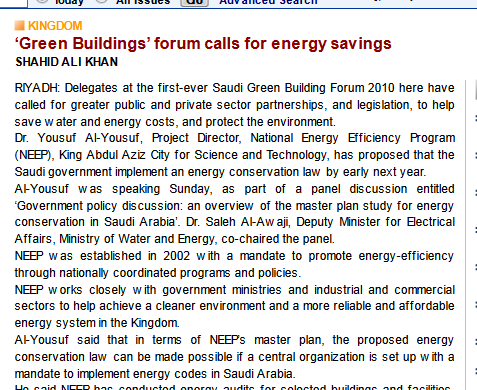
A role model from the GCC’s government sector, Dr Saleh Al-Awaji

I’m not easily impressed, and I don’t often give compliments. It’s a character flaw of mine. However, every now and then comes along a person who amazes me by their determination, their work ethic, and their belief that they can make a difference.

One of those people who I have not only had the absolute pleasure to meet, but actually to work with is Dr Saleh Al-Awaji. Dr Al-Awaji is the Deputy Minister of Electricity and Water. Not only that, he is the Chairman of Saudi’s electricity provider, the Saudi Electricity Company.

Now, usually senior government officials can be heard to reach, they’re surrounded by their staff, and they are difficult to talk to. When or if you do get the chance to talk to them, don’t expect more than a couple of lines before they move on to their next engagement.

To me, Dr Al-Awaji is everything that a government employee should be. He’s incredibly hard working (how many times  have you received an email from a GCC government official out of office hours) and he’s passionate about what he is doing. I’ve always been struck by Dr Al-Awaji and his determination to make a difference through his work. He’s also eloquent and knows more about the energy sector in Saudi than anyone.

Have a look at the gallery below to see more about Dr Al-Awaji and what he is working on. We need more government officials like Dr Al-Awaji. I for one am grateful for knowing and having worked with the Deputy Minister and Chairman of Saudi Electricity Company. If you’re interested in Dr Al-Awaji’s full bio then go here (yes, he even has his own website!).


Link

ImageThe past couple of months have been unusual for the Kingdom’s English language media sector. First, Saudi’s leading English language newspaper by circulation appointed a new Editor-in-Chief Abdulwahab Al-Faiz in October 2011. Al-Faiz, who was previously Editor-in-Chief of the Arabic-language newspaper Al-Eqtisadiah, replaced the long-standing incumbent Khaled AlMaeena.

Since then, Arab News has changed some of its print layout and pulled more news from Arabic-language newspapers particularly those owned by its publisher the Saudi Research & Publishing Company. Al-Faiz was known at Al-Eqtisadiah for increasing advertising revenues through supplements and special reports.

AlMaeena has been associated with Arab News for over twenty years. He built the editorial team. For many reader AlMaeena was the newspaper, he was as much Arab News as Arab News was him. Even after he’d left the Arab News in October of last year, AlMaeena still held the title of Editor at Large for Arab News (even on Wikipedia he’s still listed as their Editor-in-Chief).

The announcement of AlMaeena as the Saudi Gazette’s Editor-in-Chief two weeks ago was a shock to many. However, the decision by Okaz, the publisher of the Saudi Gazette, may be a masterstroke. In many ways AlMaeena is just as much of a brand as is the Arab News. He has always supported issues associated with the expatriate community in Saudi Arabia, especially Asians.

In those two weeks at the helm of Saudi Gazette AlMaeena has already hired a number of his team. The ex-deputy Editor at Arab News Somayya Jabarti and Laura Bashraheel among others are now plying their trade at Saudi Gazette. I for one hope that AlMaeena keeps doing what he does best, namely focusing on editorial quality and running stories that are in the interest of the expatriate community. Already people have been writing into the newspaper wishing AlMaeena and his team success.

A letter written by a Saudi Gazette reader from Toronto congratulating AlMaeena and his team on the news of their appointment at the newspaper.

So what now for the Arab News? For me, it wasn’t a natural decision to appoint Al-Faiz who had never edited an English-language paper. The announcement hinted at the publisher wanting to increase advertising and other non-advertising revenues. The danger to Arab News is that with a lack of good editorial their readership numbers will fall, and consequently their advertising revenues.

My other hope is that Saudi Gazette will start adopting more social media channels to promote the newspaper. AlMaeena is a social media enthusiast who has embraced Twitter. Let’s hope that the bold move by Okaz will raise the standard of English-language media in Saudi Arabia. I can’t wait to see what AlMaeena and his team do at the Saudi Gazette.

PS for a fascinating insight into Khaled AlMaeena by one of his Arab News writers, read this blog post by Siraj Wahab

Twitter, censorship and Saudi’s Hamza Kashgari

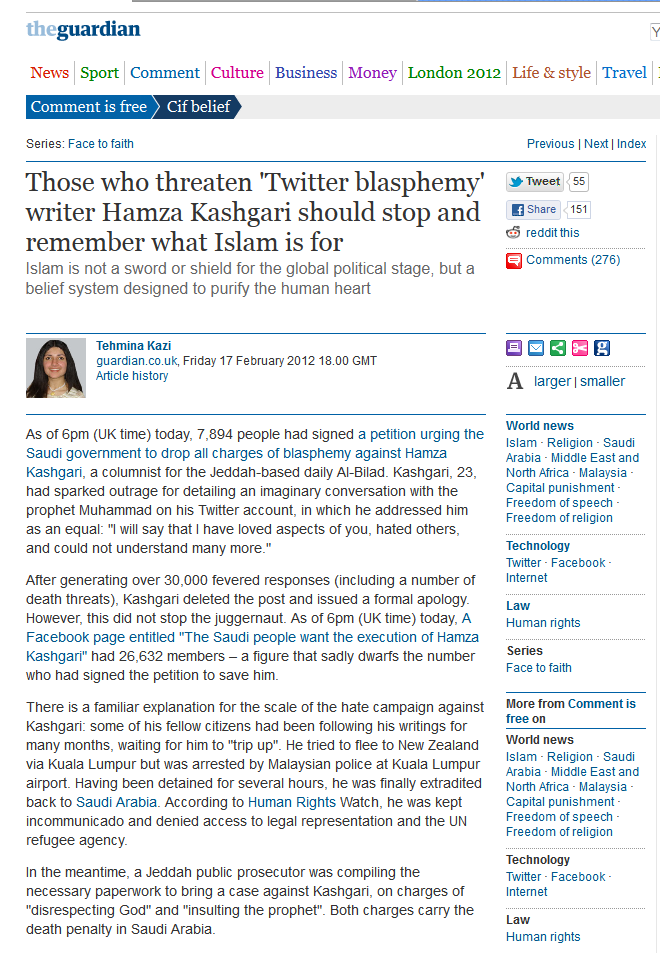
Two months back Twitter introduced its new censorship policy, which would selectively block tweets on a country by country basis. In its blog, Twitter said it could “reactively withhold content from users in a specific country”.

A month later, that new policy was put to the test. A young Saudi national named Hamza Kashgari tweeted a number of thoughts which were to cause a national outcry not just in the Kingdom but across the Muslim world. Realizing what he’d done, Kashgari deleted his tweets, fled to Malaysia and then promptly get deported back to Saudi Arabia. The full story can be read here.

Twitter argued that the change to its censorship policy, from a global mechanism to delete tweets to one where they are censored at a country level, would allow for greater freedom of expression. However, were Twitter’s management team and legal counsel thinking of political or cultural issues where legislation is already in force? One could recount laws on Holocaust denial or incitement to racial hatred as issues where laws in such places as Europe are clear cut; if someone in Germany makes a public statement that denies the Holocaust they can be prosecuted. Twitter’s thinking here is clear. That Tweet can be deleted in Germany, but it could still be seen in another country where the statement does not break the law.

The Kashgari case is different, and less clear-cut. Kashgari’s Tweets may have been less incendiary in a Muslim country such as Turkey which follows a less conservative school of Islamic thought. However, it was not Twitter who censored Kashgari’s tweets but rather the man himself who deleted his messages after receiving death threats.

The question is, how useful is Twitter’s censorship policy on a country-by-country basis without people actively monitoring what is being said online? Even then, with all the traffic on Twitter would anyone be able to actively monitor Twitter? Even if the company was using algorithms would Twitter be able to pick up tweets such as Kashgari’s which are offensive to thousands but which may not explicitly break the law.

If people do tweet a message that is deemed to be illegal or offensive wouldn’t peer pressure and public opinion force them to delete their tweets, as Kashgari did? In which case, what is the point of Twitter’s new censorship player. I’d like to see how their new policy would work in practice, as I am sure many others would do too.

#BurgerKing Billboard Gets #Diabetes Graffiti

What a powerful picture and story. Just have a look at the below. Thanks to the boys at @wildpeeta for this.

The full story can be found here…

Don’t name yourself after a model. #SAGIA and its #SEO image antics

Before I write anything else thank you @Khaled and @TurkiSaudi for showing me this.

SAGIA or the Saudi Arabian General Investment Authority is tasked with bringing in foreign direct investment to Saudi Arabia. Obviously the organization has to have a pretty solid online presence. It’s previous governor Amr Dabbagh was known for his media outreach.

But my oh my, someone needs to work on their search engine optimization. Check out SAGIA on Google images. As @turkiSaudi says, that’s what happens when you name your organization after a model (Sagia Castaneda that is). @Khaled, I think you’re onto something when you say that she should be a spokeswoman.

https://twitter.com/#!/khaled/status/162105471296208897

When in doubt deny. Abdul Latif Jameel and its response to the #ToyotaCruiseFailSa story

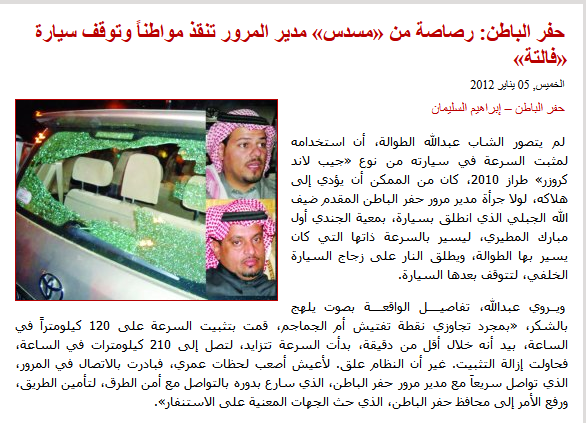
A storm was kicked up by a remarkable story about a Toyota Land Cruiser that apparently malfunctioned when on cruise control. I wrote briefly about the story a couple of weeks back, but to sum up the incident (you can find the original story here in Al Hayat newspaper in Arabic here) a Toyota Land Cruiser was stuck in cruise control at a speed of 210 kilometers per hour. The car was stopped by police who shot a number of live bullet rounds at the vehicle. Luckily no one was harmed, but the story rapidly went viral on social media and #ToyotaCruiseFailSa was a top trending hashtag in Saudi for days.

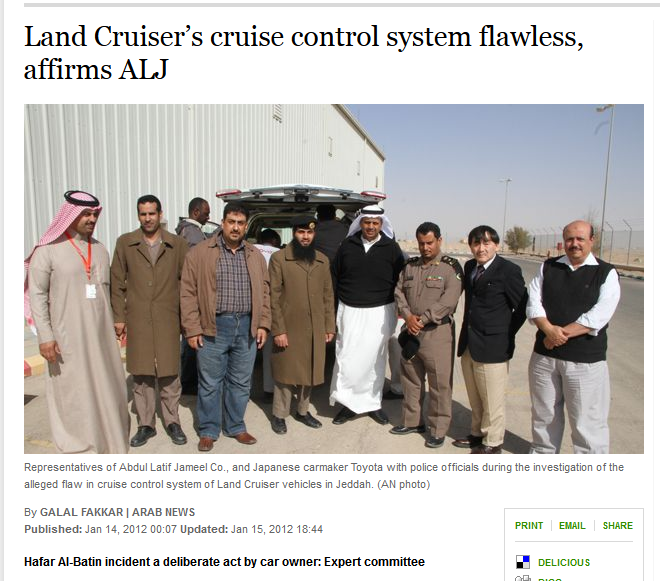
Toyota’s distributor Abdul Latif Jameel has crafted a sterling reputation as one of, if not, the best provider of automotive service in the Kingdom. Following the media reports of what happened in Hafr Al-Batin the company apparently tested the car along with several governmental bodies.

To cut the story short, Abdul Latif Jameel arranged a press conference to explain its findings and response to the incident. The seriousness of the incident and its brand implications was underlined by Abdul Latif Jameel’s decision to hold the event on a Friday, the weekend over here in the Kingdom.

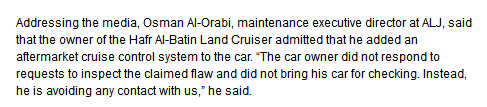
After a series of tests on the car and what was Abdul Latif Jameel’s explanation? Hafar Al-Batin incident a deliberate act by car owner: Expert committee (byline from the follow day’s Arab News which can be read here).

In summary, Abdul Latif Jameel came out fighting. It claimed that:
• the cruise control system in the Toyota Land Cruiser is flawless and working in the proper manner
• not a single incident of cruise control system defects had been reported from any Toyota vehicles sold in Saudi Arabia
• the company will never allow a flaw to go unreported

To paraphrase from the article, Abdul Latif Jameel laid the blame for the incident solely on the car’s owner.

I’m not going to jump in and get into the nitty gritty of car mechanics, but would anyone be surprised if a customer didn’t respond after having a near-death experience with your product? What concerned me was that the Saudi media didn’t reach out to the car’s owner to verify what Abdul Latif Jameel’s executives had said. Instead, they reported one side and not the other.

The above is pretty much a bog standard response from firms based in Saudi, to deny there’s a problem or that if something has happened that it is their problem. Would I want to buy a product from a company that shoves the blame onto the product owner? That doesn’t apologize, even if it isn’t their fault?

I had the pleasure to meet with Colin Hensley, Former General Manager of Corporate Affairs & Planning, Toyota Motor Europe, Belgium, at the Saudi Brand and Communications Forum last year. Toyota was put through the ringers in 2010 for all of their recalls. Then the largest car manufacturer in the world, Toyota recalled over 7.5 million cars. Colin told me how Toyota had learned valuable lessons from the incidents and was now putting those lessons into practice. I would have hoped that Toyota would have shared those lessons with Abdul Latif Jameel.

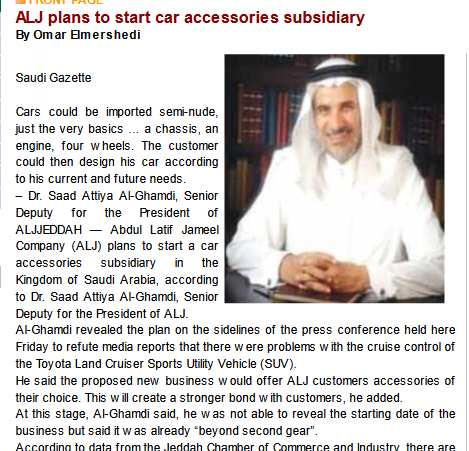
One day after the Abdul Latif Jameel press conference the distributor puts out another news story. Abdul Latif Jameel plans to start car accessories subsidiary. I’m not making this up unfortunately. Let’s hope someone sees the funny side of this, as I don’t.

Internal communications may be the best investment you ever make

I was incredibly lucky last week to listen to two compelling business consultants. I’m usually a hard critic to please and I don’t often take to consultants coming in to tell me what I should and should not be doing. But the two gentlemen who came into the company last week, Scott McKain and Jonar Nader, both emphasized the importance of listening and knowing your customer.

What impressed me most during the two days of business and management workshops was Nader’s insistence that companies fail because of a disconnect between their employees. By forgoing the people-management skills and internal communications companies fail to engage their staff. For more about Nader and his thoughts have a look at his blog which includes thoughts on his visit to Dubai.

To quote from one of Nader’s recent essays, “Most people are plagued by miscommuication, jealousy, and immaturity, resulting in poor performance. Individually, staff members might be great workers, but when lumped together with a range of personalities, egos clash.”

“As a technical genius, your success will depend on how well you marshall your team. Sadly, many technical gurus either isolate themselves and become eccentrics who lack influence, or they jump in the deep-end of management and drown in unfamiliar territory.”

I couldn’t agree with Nader more on people management being at the core of a company’s success and failure. Both Nader and McKain talked about information, about communication between employees. One of the best tools that I ever used and managed was was an internal website, an intranet. It may sound strange – after all an intranet is only designed for use by employees rather than the general public. Its audience is strictly defined and limited.

However, I’ve found that companies with intranets have a much better educated workforce. Employees generally understand their firm’s rules and regulations much better than companies who don’t have an intranet. An intranet also plays a major role in keeping the workforce up to date in terms of new products, successes, and company changes.

In short, the more a workforce is empowered with information, the more your employees will communicate. The less they’ll be in the dark about where the company is headed and how the company intends to grow. Your employees become your advocates rather than your naysayers. For the return on the investment is there anything better than an intranet and more internal communications in general?

And if you’re interested in knowing about Scott McKain have a look at this video!

Does the Gulf need media advertising watchdogs?

Most of us act pretty sensibly all of the time. We know the limits and we tend not to cross them. An advertising creative exec should know the red lines better than anyone. Their job often involves the use of humor while at other times they will intend to shock consumers to attract their attention. Many of us will know of campaigns launched by Benetton which aim to cause offense. When such adverts are released they’re often pulled very quickly due to a wrap on the wrists both by consumers as well as national advertising watchdogs such as the Advertising Standards Authority.

I and countless others watched on over the past two weeks as one Dubai-based gym launched a series of adverts online via its Facebook site. While it was obvious that the adverts were designed to be controversial the use of an image of Auschwitz and the tagline kiss your calories goodbye was a step too far for many people.

In what seems to then have been a concerted PR campaign the Dubai-based Circuit Factory reached out to a number of media outlets in the country to apologize for the advert. The gym’s owner has explained that he didn’t see the advert, that the designer behind the advert was fired (strangely this person isn’t named and shamed), and that a donation of 3,900 Dirhams would be made to a Holocaust-related charity. The first and best article which was featured in The National can be found here.

The one point which wasn’t picked up by the journalists covering this story was the perception of the Holocaust in the Middle East. Most of those covering the Circuit Factory debacle were European writers, who in my own view have a different view to the importance of the Holocaust as opposed to most natives of the Middle East. Here the Holocaust is viewed through the prism of the Palestinian issue, and it could be argued that there is less sympathy towards the victims of the Holocaust due to the antipathy felt towards Israel by Arabs.

Whether this featured in the thinking behind the Circuit Factory’s advertising or not, the question that one has to ask is why is there no advertising watchdog in the UAE, or any other country in the region? I would have assumed that the Gulf’s various ministries of information and culture would oversee the advertising industry. But despite the obvious thought there seems to be little desire to introduce such a concept in the Gulf (there are exceptions such as Dubai’s real estate watchdog vetting foreign real estate advertising in the Emirate but these are the exception rather than the norm).

Certainly, the Holocaust advert would have been pulled in the UK by the advertising watchdog. The Circuit Factory would also have been censured and could have been fined a hefty amount. Would firms think twice about releasing shock advertising if they’d be wrapped over the wrists? I’d hope so. The initial apology was released via Twitter.

https://twitter.com/#!/CircuitFactory/status/154164519931887617

The Circult Factory has certainly benefited from the free publicity. The Auschwitz advertising coverage has gone global and the owner has admitted that the demand generated by the publicity has been remarkable.

In contrast the price paid for this coverage has been virtually nil. The donation made by the gym’s owner wouldn’t even cover an advert equivalent to the space taken by a single story published in The National. I’m being cynical here, but I very much doubt that this advert was put out without awareness of the PR buzz that would be generated. I hope I’m wrong, but having worked in comms and media for so long nothing surprises me.

For more fun images from The Circuit Factory’s owner have a look here (yes, we’re giving more free PR for the company but they’re interesting to look at to get a view of why I feel this wasn’t just a mistake). And why not throw in a second classy image while we’re at it, from the Vietnam War.

What do #brands do with #franchises when consumers get #socialmedia angry?

A couple of recent events, both personal as well as public, have highlighted the challenges facing brands when it comes to franchises and customer service. Social media has given consumers the ability to interact directly with brands in ways which were never before possible. Today’s consumers expect a response from brands’ social media feeds, be it on Twitter or Facebook.

So what do brands do when they’re not in full control? How do brand communication teams deal with a consumer who is angry at a franchise? It’s an interesting question, especially for us consumers and comms professionals here in the Middle East.

A number of high profile examples have brought to light the limited scope for communications between consumers here in the Middle East and brands from locations outside of this region. The best case study would be the #noshaya Twitter-led campaign against the Kuwaiti-based retailer M.H. AlShaya. The call to boycott the company’s stores back in December was a response to AlShaya’s decision to stop providing cash refunds to customers throughout its stores.

AlShaya owns tens of franchises across the Gulf, including Top Shop, BHS, and H&M. It’s by far the largest retailer in the Middle East and thousands of Saudi consumers took to social media to vent their anger at AlShaya’s decision (for the full reasons behind the boycott please see this previous blog post).

After only a couple of hours of the campaign going live online activists started messaging the retail brands directly.

https://twitter.com/#!/hindkz/status/143315760419323904

https://twitter.com/#!/Maialshareef/status/143021336778903553

Activists sent hundreds of messages to the official Twitter accounts of retailers who had franchise agreements with M.H.AlShaya. While I may be wrong (and I hope I am) I didn’t see a single response from these retailers. These retailers weren’t helped by promoting their own refund policies on their websites, most of which were much more generous that AlShaya and included cash refunds on returned products – the activists’ key demand.

Another consumer-led campaign which hit the headlines this week relates to a nightmare incident in Saudi involving a Toyota Landcruiser which was stuck in cruise control at a speed of 210 kilometers per hour. For those Arabic readers out there check out this harrowing news piece from Al-Hayat newspaper. #ToyotaCruiseFailSa has been a top trending hashtag in Saudi for the past two days.

Out of all the car brands in Saudi Toyota probably has the best reputation for reliability and customer care. Does Toyota rely on its distributor Abdul Lateef Jameel to step in a repair the public relations damage done (so far, there’s been little word from the distributor) or do they step in themselves to reassure Saudi drivers? The response of one Toyota Landcruiser owner is typical of those trending the topic on Twitter.

https://twitter.com/#!/m_alshwaier/statuses/155276831241666560

The Arabic translates as, “I haven’t used the cruise control since buying the car because of this story.”

To ask again, when do brands step in to protect their brand value? How or what do they agree with their franchise and distributor partners as to who is responsible for what? Social media has changed the communications sector in ways that few could have envisaged. One short but interesting article online has found that consumers who contact the brand via social media are much more likely to expect a response to their queries. Check out The State of Social Marketing 2011 – 2012 by Brian Solis

I wonder how many of us in communications are taking note of what is happening around us before the same thing happens to the brands that we are entrusted with?

How to reach an audience through #SocialMedia and #influencers

Social media is the latest and greatest thing at the moment in the world of marketing and communications but how do we in an emerging market make the most out of what we’d call influencers, people on the web who are followed and listened to by others. The challenge that we face in a market is the Middle East is a lack of the mainstream online influencers, bloggers. Compared to Europe and the US, there are fewer bloggers in the Middle East, especially in countries such as Saudi Arabia. For those interested in pioneer bloggers, have a look at this list compiled by commentator Sultan Al-Qassemi or the Arab Media and Society’s portal on blogs.

Despite the challenges social media is an incredibly powerful way of reaching out to an audience, partly due to directness as well as its credibility. But how do you find the right influencers to reach out to? There’s a couple of very simple ways to do this and tools to use. Klout is probably the best known site for analyzing social media influence across a variety of sites such as Twitter, Facebook, Google+, LinkedIn, FourSquare, Youtube, Instagram, and WordPress.

Klout trawls social media network data and creates profiles on individuals and assigns them a “Klout score.” The higher the Klout score the more influence a person has online. Klout claims to have built more than 100 million profiles from crawling social media sites. While the site is far from perfect, it’s probably the most widely used tool to rate someone’s social media influence. You can search on Klout’s website either by topic or by the influencer’s name. Klout will give you three lists – one for top influencers, one for top +k recipients (basically people who have been rated highly by other Klout users rather than Klout’s own ratings system), and one for best content. Try a search on Dubai using Klout and see whom the website recommends.

The Klout profile for Mashable journalist Brian Hernandez

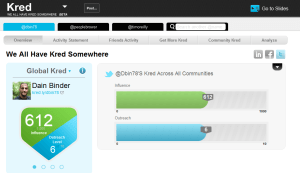
There are a number of other social ranking sites. The one which is gaining the most interest is kred.ly. At the moment Kred.ly is limited to analyzing people’s Twitter feeds only. However, Kred.ly may become very useful as it’s linked into a website called peoplebrowsr. Peoplebrowsr aims to give marketers and communicators access to influencers. The idea goes that you’d be able to identify people who are specialized in a certain topic and then pay them to promote your company or service. I’d love to hear from anyone who has used kred.ly and peoplebrowsr, especially in the Middle East.

Screenshot from social media analytics site kred.ly for blogger Dain Binder

So let’s give an example of what I’d be looking to do if I was working in tech. First thing would be to identify people with a big enough audience and enough credibility to influence others. One such user may be a prolific twitter user and the founder of saudimac.com Khaled Abdulrahman. Tweeting with the handle @khaled Khaled has over 13,000 followers and regularly updates his web site.

http://twitter.com/#!/khaled/status/153421180550922241

Khaled is a great example of an influence as he uses multiple sites to engage with an audience.

The challenge I have now is how to work with or influence Khaled. Traditional marketing would have meant paying the influencer. This is common for celebrity social media endorsements. However, this doesn’t always have to be the case with bloggers and topic specialists. Many may be willing to support you if they believe in the cause that you are promoting or if the content you give them is relevant or interesting.

The beauty of Klout, kred.ly and other tools is that they’re either free or fairly cheap to use. So when you’re next looking for people to help you communicate to an intended audience you’ve got no excuse for not finding the right influencers on the world wide web.