Unknown's avatar

About alexofarabia

I'm am obsessive compulsive communicator who has lived in the Gulf for almost a decade. Enjoying the challenge of working in a region where you've got to be innovative, patient and determined to make things happen. Miss being a full-time journalist! Miss family even more! Sometimes I mouth off, but more often I grit my teeth and try to encourage change through a smile (not as easy as you think). Despite now living in Dubai Bahrain is home for me.

Bahrain, Saudi and the UAE use Facebook to Announce Ambassador Pullout

It’s pretty remarkable – I’m not just referring to the withdrawal of the Bahraini, Emirati and Saudi ambassadors from Doha but also the way the news was announced. I, like many others, saw the news first not on traditional news channels but via Twitter. And where was the original announcement? On the Facebook page of the Saudi Ministry of Foreign Affairs. It’s pretty remarkable to see social media being used to release such information, especially considering the medium is designed with dialogue in mind. If you read Arabic have a look at the comments on the Ministry’s page.

The original announcement, which was later carried in the region’s papers, is below.

The Saudi Ministry of Foreign Affairs announced the pullout of the three ambassadors via its Facebook page before the story broke in the traditional media

The Saudi Ministry of Foreign Affairs announced the pullout of the three ambassadors via its Facebook page before the story broke in the traditional media

Saudi Bans Energy Drinks Advertising – What Now Happens To Social Media

The Kingdom’s Government took the drastic step yesterday of introducing a raft of measures aimed at restricting the sale, promotion and consumption of energy drinks. The move, which was not expected, will mean that as of now energy drinks companies will no longer be able to advertise or carry out promotion campaigns through ‘electronic or print media or any other means’.

It doesn’t end there. The Saudi Cabinet banned the free distribution of energy drinks to consumers belonging to all age groups. Energy drinks have also been banned in restaurants and canteens at government establishments, as well as educational and health institutions, public and private sports clubs and halls.

To quote from the report on the Al-Arabiya news-site, the full list of measures includes:

1 – To prohibit advertising of any energy drink or do advertising or promotional campaigns for any energy drink via any readable, audible or visible media organ, or by any other means.”

2 – To prohibit energy drinks companies, their agents, distributors and marketing associations from sponsoring any sporting, social or cultural event, or taking any procedure leading to promotion.

3 – To prohibit the free distribution of energy drinks to consumers of all age groups.

4 – To prohibit the sale of energy drinks in restaurants and canteens in government facilities; education and health facilities; halls and public and private sports clubs.

5 – Upon the decision, factory owners and importers of energy drinks shall be committing to writing a text on the tin of any energy drink in Arabic and English languages – warning of the harmful effects of energy drinks.”

In a market that has been constantly growing for the energy drinks sector (you can find Red Bull, Bison, Power Horse and other popular energy drinks brands everywhere), this is going to be a major blow for the business. Red Bull has already put out statements defending its position, including its availability in 165 countries worldwide and a lack of evidence to show that it is harmful (you can read the statement in full here). Red Bull and other brands are major event sponsors, and it’s uncertain where the shortfall in funding will come from.

However, the one area which has yet to be clarified is social media. Red Bull has its Saudi Twitter feed (@RedBullSaudi) and Facebook pages for its events. Red Bull did put out a tweet today from its Saudi feed. How is social media classified? Is it advertising or is social media more subtle? And how do the authorities class social media? It’ll be interesting to see how this plays out, both in the real world as well as on social media.

Saudi women raising the bar – Somayya Jabarti becomes the first female newspaper editor in the Gulf

Somayya Jabarti has become the first female editor-in-chief in the Gulf region. She’ll be leading the Saudi-based Saudi Gazette following Khaled Almaeena’s departure (image source: metrotvnews.com)

Saudi Arabia often gets a bad wrap when it comes to how it treats its women. However, for those of us who have lived in the Kingdom, we know of the strength and abilities of Saudi women. They’re tenacious, eloquent, hard working and, in my view, a wonderful bunch. The latest media announcement coming out of the Kingdom has made headlines the world over.

On Sunday, the English-language newspaper Saudi Gazette announced that its editor-in-chief Khaled Almaeena would be stepping down from his role with immediate effect. Almaeena, who joined the Saudi Gazette in October 2011, penned his own farewell letter which was published on the newspaper’s front page. It’s a wonderful read and spells out Almaeena’s views on how a newspaper should be run and why editors should be pushing the boundaries when it comes to reporting contentious issues.

Unarguably the most important announcement made by Khaled and the Saudi Gazette that morning was the promotion of Somayya Jabarti to the top editorial position in the newspaper. I’m going to quote directly from Khaled’s piece:

Today I proudly leave my nominee, a female journalist β€” Somayya Jabarti β€” who will take the helm of the paper. She has been associated with me for almost 13 years, and I’ve had the goal almost as long of wanting to see a Saudi woman enter the male-dominated bastion of editors-in-chief. It was not a question of gender but of merit that decided and earned her this opportunity. I am proud to have played a role in her career. She is determined and dedicated, and I can assure her and the team that I will be there to assist and advise, so that Saudi Gazette further advances as a media unit in a highly competitive and digital age.

I’ve known of Somayya for many years and I’ve interacted with her on a number of occasions. She’s tenacious, independent and determined that she and her team cover the news without self-censoring the editorial (this is still a common trend in the Gulf). I’d go further however, and say that Somayya is representative of today’s Saudi women. Saudi women are often viewed from outside the Kingdom as oppressed, as in need of help and support.

However, my own experiences have often shown the opposite to be true. If anything, Saudi women are the most independent in the Gulf when it comes to wanting a career and earning a living. If anything, Somayya is proof of what Saudi women are capable of and how the Kingdom is changing. For me, what’s most telling is that this first didn’t happen in other Gulf states which often tout how they’re advancing women’s rights, but in Saudi. I often feel that the pressures Saudi women face mold them, make them become stronger and more focused. Saudi women have learned to fight and they’re no longer willing to wait for change or to accept what they’re being given with platitudes.

In the Kingdom all top editorial positions at the country’s newspapers are approved by the Ministry of Information and Culture and so Somayya’s appointment would have been given the government’s blessing. I’ll leave the last word to the lady herself, for an interview she gave with Al-Arabiya. I’m sure she’ll do her fellow Saudi women proud!

β€œThere’s a crack that has been made in the glass ceiling. And I’m hoping it will be made into a door. This is a first for a Saudi daily… A mold has been broken where editors-in-chief of Saudi daily newspapers are concerned. Being the first Saudi woman [newspaper editor] is going to be double the responsibility… One’s actions will reflect upon my fellow Saudi women.”

Dubai Police and the ignominy of being hacked on social media

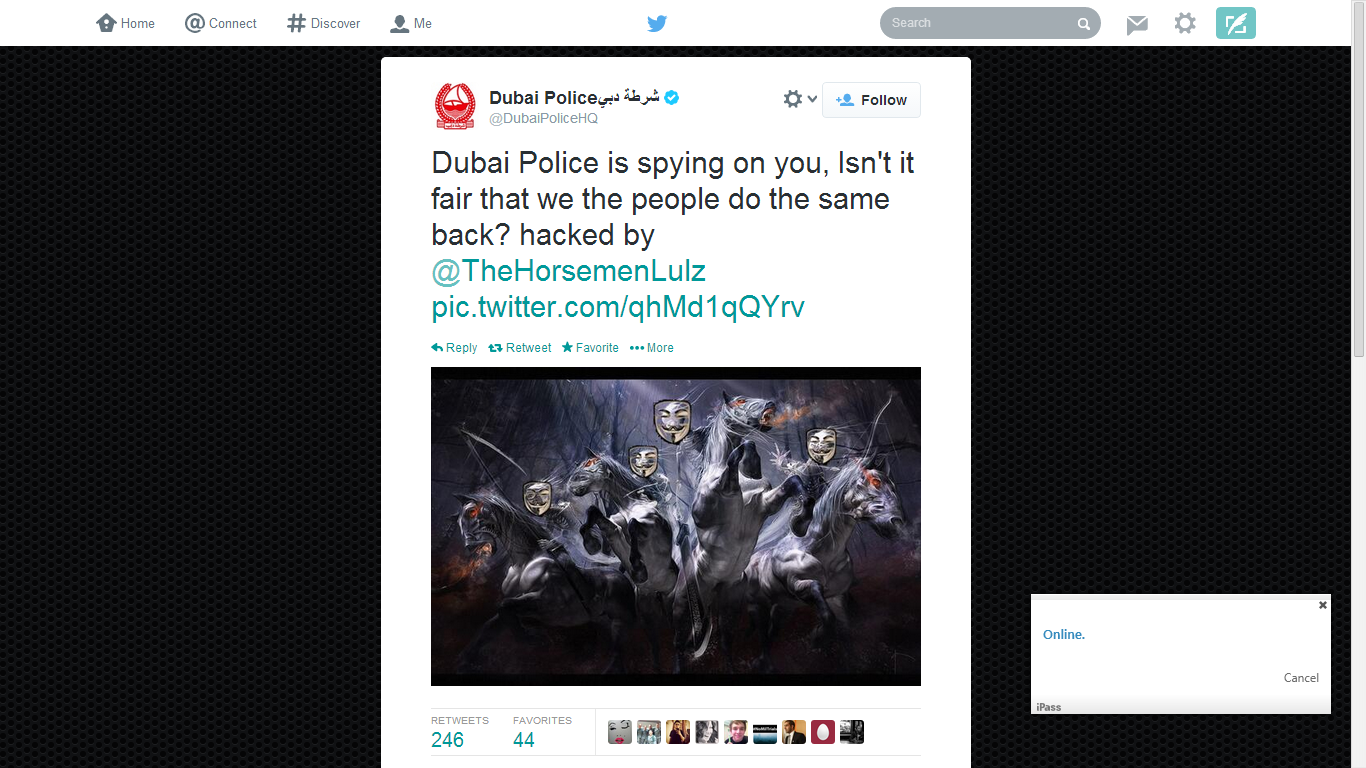
When your day job is to ensure the safety and security of those around you, it doesn’t get worse than this for Dubai Police. The police force best known for solving crimes in a matter of moments and driving around in swanky super cars (the latest is a three million dollar Bugatti Veyron) has just been hacked by a group with the Twitter handle @TheHorsemenLulz – presumably named after the infamous hacker collective LulzSec.

All but one of Dubai Police’s social media sites have been hacked, including Twitter, Tumblr, LinkedIn, and Pinterest (Facebook was the only social media channel that wasn’t hacked). While the images have now been removed, a couple of hours after the sites were compromised, here’s a screenshot of the offending image on the Dubai Police Twitter feed @DubaiPoliceHQ.

A screen shot of the image sent out by the hackers via the @DubaiPoliceHQ Twitter account

A screen shot of the image sent out by the hackers via the @DubaiPoliceHQ Twitter account

While the most obvious questions are how were these accounts hacked and how easy was it to hack the accounts, my issue is more about the group behind the hacks who have claimed several other cyber attacks in the UAE, including crashing the websites of Noor Islamic Bank, the Telecommunications Regulatory Authority and the UAE Central Bank. Do we have a locally-based hacker group in the UAE?

In a Tweet that included the @DubaiPoliceHQ Twitter account the group put out a video in November saying they’d be targeting the UAE Government. While the tweet and the video didn’t make too much sense, why wasn’t the issue taken seriously by those handling the @DubaiPoliceHQ Twitter account? With the UAE’s Government Summit taking place in Dubai tomorrow shouldn’t cyber security be top of the agenda for the public sector, and in particular the Dubai Police?

https://twitter.com/TheHorsemenLulz/status/406006175071625216

Goodbye Dr Taryam, Hello Al Otaiba – Changes in the UAE’s Media Landscape

Mohammed Al Otaiba has taken up the top job at The National, despite having no prior media experience (image source: The National)

The past couple of days have been one of loss and change for the UAE’s newspapers. On the same day, news pieces announced the passing of Dr Taryam, the co-founder of the largest Arabic-language newspaper Al Khaleej, and the appointment of Mohammed Al Otaiba as the editor-in-chief of Abu Dhabi’s English-language daily, The National.

Dr Abdullah Taryam was one of the founders of the country’s Arabic media industry; He established Al Khaleej newspaper with his brother, the late Taryam Omran Taryam in Sharjah in 1970. After initial difficulties – the paper wasn’t printed for eight years during 1972 and 1980 due to funding – Al Khaleej grew to become what is the Dar Al Khaleej newspaper group which includes English-language daily The Gulf Today, Arabic-language weekly political magazine Al Shuruq and the Arabic-language family magazine Kol Al Usra. With a PhD in modern history from Exeter University Dr Taryam also held the posts of Minister of Education and Minister of Justice for the UAE. Gulf News wrote an extensive obituary on Dr Taryam which can be read here.

On the morning of the 30th The National announced its own change at the top, namely the appointing of Mohammed Al Otaiba as the editor-in-chief. I’m going to lift the text from The National’s piece rather than summarize.

β€œWe are pleased to announce the appointment of Mohammed Al Otaiba as editor-in-chief of The National and are confident that his well-rounded experience in media, foreign policy and diplomacy will add a valuable global perspective to The National,” said Saif Saeed Ghobash, the acting chief executive officer of Abu Dhabi Media, which publishes The National.

Mr Al Otaiba said: β€œI am delighted to join The National newspaper and to be granted the opportunity to be part of a true success story for English journalism in the UAE. Writing has been a strong passion of mine for years and I look forward to being part of such a dynamic team of journalists.”

Mr Al Otaiba has a background in diplomacy and media, including 10 years representing the UAE at the UN in New York, Beijing and London.

He recently served as head of Image Nation Abu Dhabi, a division of Abu Dhabi Media. After being appointed head of the organisation in October 2011 he helped develop Abu Dhabi’s film industry.

Mr Al Otaiba’s appointment comes at a time when the newspaper is strengthening its local news coverage, Abu Dhabi Media said in a statement on Thursday.

It has recently supplemented its coverage with focus pages and a larger national news section, β€œboosting its reputation as a key English-language newspaper of record reflecting and supporting the country’s development and achievements,” the company said.

Abu Dhabi Media manages 18 broadcast, publishing and digital media brands and is considered among the fastest growing organisations in the region.

Mr Al Otaiba holds a bachelor’s degree in mechanical engineering from the American University in Cairo, and a master’s degree in administrative studies from Boston University, with a concentration in multinational commerce.

The reaction to the news has been interesting to watch, with observers noting Al Otaiba’s lack of newspaper and media experience.

The piece in The National does seem to be contradictory, with Al Otaiba’s international experience praised and then noting The National’s increased focus on local reporting. Al Otaiba’s appointment may be an attempt to ensure that The National is fully aligned with the official line. The paper, which was ostensibly founded to promote a free local press, has suffered over the past couple of years as it has attempted to promote a higher quality of journalism whilst ensuring that it doesn’t upset the national authorities and its owner, the Abu Dhabi Government.

It’ll be interesting to see how Al Otaiba does and how The National’s newsroom responds to the change. On the 30th January we’ve lost one renowned local media figure; have we been given another one in his stead?
What a difference a day makes – the media shift in Bahrain and public perception

It’s often said that 24 hours in the newsroom is a unique experience and Bahrain’s media is no different. The island nation’s media has been reporting on the difficult situation the country is going through for the past couple of years. Wednesday the 15th of January was no different from the past couple of months in that the Kingdom’s English-language media were reporting on government efforts to keep the country safe (much of the focus was on social media and Twitter in particular. The below is a shot of the front page.

The Front Page of Bahrain's Gulf Daily News for the 15 January 2014

The Front Page of Bahrain’s Gulf Daily News for the 15 January 2014

That night, news leaked about national reconciliation talks between Bahrain’s Crown Prince and the largest opposition party Al-Wefaq. As expected, the local media carried the news on their front pages.

The front page of Gulf Daily News from the 16 January. Notice a change in tone?

The front page of Gulf Daily News from the 16 January. Notice a change in tone?

While I won’t discuss the politics of the issue, what I do find interesting is the remarkable shift in position over 24 hours and how groups are described by the media from the one issue to the other. While it may be easy to control the dialogue and the messaging for one of the parties in Bahrain, it’s not so easy to shift public perception. Time will tell what difference this particular 24 hours have made, not only to the media’s take on affairs but also how the public perceives the situation as reported in the media.

The Chicago Tribune and how to get audience participation right through social media

I wanted to highlight this remarkable site from the Chicago Tribune. The blog, which will be hosted for a year and has the hashtag #trib2014, hosts reader photos from Instagram and enables participation through developing weekly themes. The newspaper’s staff are curating the site, but the visuals and captions are stunning. The weekly themes allow for a higher level of audience participation and give readers something to focus on rather than asking for their own images of a generic subject. Have a look at the below images from the blog. I can’t wait for someone to do this type of thing in the Gulf (just so you know, I’m extremely patient).

http://instagram.com/p/jHZ9XpuLdG/

http://instagram.com/p/jMbI0duLfo/

http://instagram.com/p/i1eLDLuLX3/

It’s not me, it’s you – Who Censored the Wolf of Wall Street?

Want swearing, sex and other obscene moments in your film? Then you’re best heading to Beirut (image source: http://www.huffingtonpost.com)

I’m a very nostalgic person. I remember the good old days when the internet was all about dots and beeps, when a gourmet burger could be found in a Happy Meal and when newspapers came with columns inked out by a black marker. Censorship isn’t a foreign concept to the Gulf region. Be it television, printed media or, more recently, the internet, censorship is a given. I sometimes wondered about the rooms of employees who’d be sitting in a room reading over the foreign papers with their thick, fat marker pens ready and eager to put market to paper on a large section of the paper.

Rarely do we hear from those people behind the censorship. However, the past couple of days have thrown a light on the world of censorship in the region. The latest Martin Scorsese film, The Wolf of Wall Street, is a tale of financial excesses with an over-excessive use of expletives, sex, drugs and other naughty things. It’s not surprising that such a film may cause flutters, especially in a conservative part of the world. While most of the country’s cinema-goers would have expected cuts here and there, the film ended up losing 45 minutes from its three-hour running time.

Local media reported on the incident, including a wonderful piece by Rory Jones, the UAE-based correspondent for the Wall Street Journal. As the piece is so fun I’m going to quote directly from Mr Jones.

Whole scenes were taken out of the Martin Scorsese-directed movie, including a particularly raucous trip to Las Vegas that included a plane full of prostitutes. The F-word has also been removed where possible, creating an almost constant jerking of the screen as one frame has been spliced into another.

Somewhat understandably, film-goers in the U.A.E. have taken to social media to vent their anger over the cuts, warning others not to see the film as most cinemas are not making viewers aware of the level of censorship.

As Mr Jones and others such as Gulf News’ tabloid! have pointed out, cinema releases are supposed to be censored by the National Media Council. In this case, the NMC has pointed the finger at the film’s distributor, Gulf Film. Why the distributor would want to annoy cinema-goers to the point that they tell others not to see the film and demand refunds from the cinema firms is beyond me. Gulf Film haven’t commented. One official from the NMC did speak however and here’s what he told tabloid!:

Juma Obaid Al Leem, director of the Media Content Tracking Department at the NMC told tabloid! the cuts were made even before it came under their review.

β€œWe didn’t touch the film. The distributor already made the cut [when it came to us]. When we asked the distributors, they said they cut all those scenes and words, because they want to distribute the film in GCC,” he said.

Al Leem added that, following complaints from moviegoers, the NMC has instructed distributors to leave the editing to them.

β€œ[We have told them] next time, don’t touch the film. We will make the cuts. We will decide. Maybe some scenes will be accepted. Don’t make any cut outside till they bring the full film and we will decide about the film,” he said. β€œWe told them very clearly.”

Ironically, the film has been released in its entirety in Lebanon. It seems that nothing can offend the Lebanese cinema-goer, not even the Wolf of Wall Street. As for the UAE, we’ll have to put up with only two-thirds of a film. A wolf in sheep’s clothing anyone?

The Sheikh Mohammed School of Communication

I’m no posterboy for Dubai I’ll admit. But I do admire how the Emirate’s ruler communicates with the media. The BBC aired an interview with Sheikh Mohammed Bin Rashid Al Maktoum this week and the piece made headlines the world over. Sheikh Mo as he’s known here shared his thoughts on everything from Iran, Syria and Egypt to horse doping and human rights in the UAE. Sheikh Mohammed talks plainly, he gets to the point, and he admits when things go wrong; asked about the jailing of a number of young men for a spoof video Sheikh Mohammed says:

β€œWe try to change it. We are not perfect and we try to change it. Any mistakes, we go in and try to change it. We’re not perfect, but we are doing our best.”

What’s fascinated me the most has been how the media industry has taken its pick of quotes to build headlines around. For the UAE’s media the key talking points were Sheikh Mohammed’s call to lift sanctions on Iran and his views on Syria and the need for Syria’s President Bashar Al Assad to step down. His views on Egypt’s General El-Sisi dominated the Egyptian papers.

If you want to watch and learn from Sheikh Mohammed School of Communication and see a leader who is unique in terms of how he interacts with the media then watch the interview on the BBC on the 17 January at 04:30 GMT & 09:30 GMT and read the article by the BBC’s Jon Sopel here. You can watch a teaser below from the original airing of the interview yesterday.

I wish there were more leaders in the Gulf who’d talk to and with the media.