Unknown's avatar

About alexofarabia

I'm am obsessive compulsive communicator who has lived in the Gulf for almost a decade. Enjoying the challenge of working in a region where you've got to be innovative, patient and determined to make things happen. Miss being a full-time journalist! Miss family even more! Sometimes I mouth off, but more often I grit my teeth and try to encourage change through a smile (not as easy as you think). Despite now living in Dubai Bahrain is home for me.

#Hajjselfie, Whatsapp and smartphones – how is technology changing Islam and Muslims?

We’re a funny bunch in how we can change so quickly and then justify how we’ve changed 180 degrees. I remember how up until ten years back, camera phones were banned in Saudi Arabia. And today, the hot topics are #Hajjselfie and how modern technology is making its mark on Saudi society.

The beginning of October was the timing for the annual Hajj pilgrimage, a mandatory religious duty for Muslims. During Hajj Muslims are to abstain from all temptations which may lead to sin; in essence, the pilgrimage is a time for renewal for the two million plus Muslims who take the rite of passage annually.

This year, one of the major stories which broke at Hajj was the #hajjselfie. You’ll probably know of the selfie, a self-portrait photograph, typically taken with a hand-held digital camera or camera phone and then shared online via social networking services. This year, the selfie was introduced en-mass to Hajj. To quote from Saudi Gazette and AFP.

Raising his arm, Yousef Ali hugs his elderly father near the Grand Mosque in Makkah as they grin for a selfie — a craze that has hit this year’s Haj. But not everyone is happy about young pilgrims from around the world constantly snapping “selfie”, photographs taken of one’s self, as they carry out Haj rights.

From Tawaf — circumambulating the Holy Kaaba — to prayers atop Mount Mercy in Arafat, and stoning of the “devil” in Mina, the key stages of Haj have all been recorded on cameras and smartphones for posterity, and for instant sharing through social media.

“As this is my first pilgrimage, it is important for me to document all the events taking place around me,” Ali, 24, told AFP, snapping a picture of himself with a green sign reading “Big Jamarah”, which refers to a wall where pilgrims ritually stone the Satan.

“Wherever I go, I take pictures, especially since nowadays we have these little cameras… that offer a full view of the area,” the bearded Kuwaiti said with a smile.

The increasingly popular phenomenon has sparked controversy among conservatives, however, with some taking to Twitter to criticize pilgrims who take selfies.

“When we went for Umrah in the mid-90s, Dad nearly had his camera confiscated to shouts of ‘haram!’ Now, #HajjSelfie is A Thing. What a world,” wrote one Tweeter.

Another user named Kahwaaa wrote: “It’s a time to connect to Allah and purify my soul. #hajjselfies selfies shouldn’t be taken.”

But others said the issue was being blown out of proportion.

“People creating a huge issue about #hajjselfies. If photos are allowed during Haj then what is wrong with selfies?,” asked Abdul Mufeez Shaheed.

Nothing at all, says Ali’s father Mohammed Ali, 65.

“A person taking such pictures is documenting a rare event”, a once-in-a-lifetime experience for many Muslims, he said, wearing a traditional white robe.

“This is a symbolic place representing history,” Mohammed Ali added, pointing to the three sites which pilgrims began stoning on Saturday at the start of the Eid Al-Adha feast of sacrifice, which is celebrated by Muslims worldwide.

Two women covered in traditional black abayas and veils hurried toward the Big Jamarah wall, but not without stopping for a quick self-portrait along the way.

“My daughter and I are taking selfies to show our Haj pictures to our family in Paris. It’s also a nice memento,” said one of the women, a Saudi pilgrim from Jeddah who gave her name only as Umm Abdallah, 44.

Her daughter Wafaa Ahmed, 19, said: “I love taking many selfies wherever I go to keep them for myself, as well as to show them to my friends and brothers.”

Speaking to AFP by telephone, a professor of Islamic Shariah law Riyadh said that “if photographs are only for personal memory and not for disseminating, then no problem.

“But if they were for the purpose of showing off, then they are prohibited, such as the photography that takes place at the (Haj) rites.”

The scholar requested anonymity.

“It is better for Muslims to avoid them,” he said of selfies.

For the teenage pilgrim Wafaa Ahmed, “this is not a convincing view” because taking selfies “has nothing to do with religion”.

The elderly pilgrim Mohammed Ali also discounts the scholar’s opinion.

He says the camera “is a tool such as mobiles, used even by religious scholars who have not prohibited them, so why prohibit another tool of the modern era?”

As he speaks, a group of young Saudi men gather for a group selfie in front of a Jamarah wall before they stone the “devil”.

Analytics of #Hajjselfie by Topsy. The trend peaked on October the 4th.

Analytics of #Hajjselfie by Topsy. The trend peaked on October the 4th.

The #hajjselfie wasn’t the only social media story coming out of Saudi Arabia this month. A recent piece in Saudi Gazette bemoaned the erosion of traditions surrounding the vacation among Saudi nationals.

“Take for instance the recent Haj holidays where it was common practice to visit relatives but several people did not do so,” said Omar Yousif Tobbal, a senior projects manager in a government firm.

He said that these occasions allow families to spend time together but people are increasingly resorting to calling or texting their relatives to extend their greetings instead of actually visiting them.

“If it hadn’t been for modern technology, families would meet, dress up and generally enjoy themselves,” he said, adding that before the advent of technology, Saudis had more time for each other and talked for hours on common themes of interest. However, there are some who still observe the occasion in accordance with tradition, he noted.

It’s not all for the worse however. One positive which came out of the combination of social media and Hajj this year was the appreciation show to the security teams who were working to ensure the safety of the two million pilgrims through the use of the hashtag #thanks_security_men. This time from Arab News.

Photos and videos of security officers from various military sectors assisting and providing services to pilgrims during the Haj season have been trending across social networking sites, such as Twitter. A number of religious leaders and media personnel have devoted their pages to discussing the positive role of security authorities in Saudi Arabia in the success of this year’s Haj season.

Active users on social networking sites produced various hashtags, notably #thanks_security_men, to express their gratitude and appreciation for their humanitarian efforts and positive representation of Saudi Arabia.

What are your thoughts on the above? Do you think #Hajjselfie is halal or haraam? Let me know your thoughts, especially if you were on Hajj. And have a look over the #hajjselfie images below from BuzzFeed, from what is one of the most amazing spectacles on earth.

https://instagram.com/p/tiNN9gykKn

https://instagram.com/p/tTIH6ZEPEs

https://instagram.com/p/thiGdlANFk

Thinking of drinking and driving? @TimHortonsGCC criticized by Dubai Police for social media blunder

There’s a fine line between engaging and offending online. The popular Canadian coffee shop chain Tim Hortons got into trouble this week with a post which went on on its @TimHortonsGCC Twitter account and its Facebook page.

The post below went online on the 14th of this month. Almost immediately after posting, the picture was attacked by the brand’s followers as being inappropriate and encouraging dangerous driving.

Do you drink and drive? The image from Tim Hortons GCC was criticized both by fans and by the Dubai Police (image source: http://www.7daysindubai.com_

Even worse for the brand, drinking and eating whilst driving is deemed as an offense by Dubai Police. The social media team’s image was in contravention of the Emirate’s laws. You pretty much know you’ve boo-booed when the police tell you off.

Speaking to local English-language newspaper 7Days, Dubai Police’s Colonel Saif Muhair Al Mazroui explained following such advice could risk lives on the roads.

He said: “Any motorist who doesn’t pay attention to the road is endangering the lives of others. Eating or drinking inside the car while driving is prohibited as it might cause accidents when the motorist gets busy and doesn’t focus on the road.”

Tim Hortons GCC did pull down the advert after it was posted and the CEO issued an apology shortly afterwards. Santhosh Unni explained that the image “was meant to reflect a common consumer behaviour pattern. We do not promote reckless driving and request our customers to always be careful on the road.”

However, brands need to think twice particularly when the issue of safety is involved. The Tim Hortons GCC Twitter feed and Facebook pages haven’t been active since the posting, which may suggest the brand is having a second look at how it manages its social media. The next time you think of drinking and driving, remember Tim Hortons GCC.

Are Snapchat users in the Gulf abandoning the picture app after latest hack?

Are Snapchat users in Bahrain, and the rest of the GUlf, leaving the service after the latest hack to affect the service? (image source: http://www.adweek.com)

Bahrain’s Al-Bilad newspaper printed an interesting piece today following the latest hack on the popular photo-messaging application Snapchat. The app is best known for allowing users to share videos and images which disappear 10 seconds after being received. Explicit images sent via Snapchat have reportedly been leaked from a third-party app in an event being dubbed the “Snappening”. Hackers are threatening to post online a large collection of photos, including nude images, sent by 200,000 Snapchat users (it is possible to save the pictures by taking a screen grab before the images are deleted).

The piece in Al-Bilad claims that dozens of Bahrainis are leaving Snapchat following the hack. There’s little to back up this assertion and no information on how many users the app has in Bahrain or in the Gulf. However, it’s entirely plausible that this is the case. Snapchat is best known for the sharing of images of a personal nature. If these hacked images are leaked, and there’s 13GB of photos that hackers are threatening to share online on the chat forum 4chan, then Snapchat users in the Gulf could be affected. For a region that is known for its conservatism and for the concept of honor, particularly among its women, any public distribution of personal images would be disastrous for women in the Gulf.

You can read the piece here (which is in Arabic), as well as comments by Ali Sabkar, the President of the Social Media Club Bahrain, on how to avoid being the victim of such hacks in future, especially for people who use closed social networks. Few Gulf brands use Snapchat (one exception is Dubai Media Inc), but the app is huge in the US. The application’s designers claimed in June that over one billion images were being shared every day via Snapchat.

The cost, and ethics, of paying Instagrammers in Kuwait

Kuwait is known for its love of Instagram and local Instagrammers (image source: http://www.248am.com)

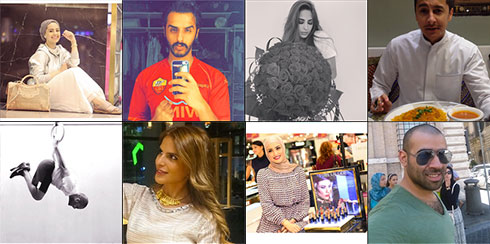
A fascinating blog post by Mark of TwoFortyEightAM has me focusing on not just the cost of using Instagrammers, but the ethics of advertising through influencers in this region. In his post last week, Mark published a list of how much Kuwaiti Instagrammers get paid per post by advertisers. To quote from Mark’s blog, here’s a sample of some Kuwaiti Instagrammers and how much they/their agencies charge (note: prices are in Kuwaiti Dinars and one KD is just under 3.5 US Dollars).

@ahmad_asb (134,700 followers) KD450
@alimubarak1 (68,152 followers) KD450
@ameralshaibani (204,455 followers) KD450
@ascia_akf (1,005,559 followers) KD850
@azizbader (497,708 followers) KD850
@basharnoo (342,316 followers) KD400
@batoul_alkandari (224,233 followers) KD450
@bb_alabdulmohsen (59,123 followers) KD350
@dalalid (866,687 followers) KD850
@daneeda_t (358,396 followers) KD450
@dr_shammat (887,156 followers) KD750
@elham_alfedhalah74 (1,758,795 followers) KD900
@faisalalbasri (474,132 followers) KD850
@fawaz_alfahad (111,874 followers) KD400
@groupwanasah_ (444,647 followers) KD350
@hayaalshuaibi_79 (814,972 followers) KD700
@kaftanusman (516,835 followers) KD500
@nohastyleicon (811,541 followers) KD850
@omaralothman (92,482 followers) KD500
@thedietninja (351,952 followers) KD550
@therealfouz (216,096 followers) KD500
@theveeview (631,973 followers) KD500
@yousif_alblooshi (171,520 followers) KD350

You can see pricing lists for one agency, Ghaliah, here.

What fascinates me more than the pricing (and the analytics) is that of the ethics associated with influencers such as the above. In the US, if an influencer is taking money for a post they’ll have to make this known to their audience – it’s a legal requirement to ensure that their audience understands what they’ve just posted online is paid-for and therefore is an advert.

However, there are few Instagrammers here who do the same. As mentioned by one of Mark’s visitors, one of the Instagrammers above does use a * to denote a paid-for ad. But as for the others, there’s no suggestion as to what is paid-for and not paid-for.

Is this right? As a follower, I’d like to know if someone is paid for promoting another brand. It’s honest and forthright. Unfortunately, we will have to keep on guessing whether or not these posts are free or paid-for. Maybe this is one area where we need more government legislation to help consumers know what is really going on.

As for the costs of these Instagrammers, it’d be interesting to know how advertisers track their return-on-investment for sponsoring these paid-for posts. While Kuwait is one of the largest markets for Instagram in this region, it’s still difficult to know what percentage of followers is real and what percentage is fake. Similarly, when you’re spending over $2k USD on an Instagram post what are your intended outcomes as an advertiser?

I’d love to hear your thoughts on the above, as well as how much Instagrammers get paid in the rest of the region. Ta for now!

How to, and how not to, pitch to the media

Let’s get rid of those bad pitches and give journalists fewer reasons to use the delete button (image source: http://www.meltwater.com)

Having worked as a journalist, as the head of an agency, and finally on the client side, I’ve learned a fair few lessons on the art of pitching a story. The beauty about the communications industry is that no matter how many year’s you’ve put in, you still keep learning. This was the case on Monday of this week, when I received an agency email pitch which basically used the client’s latest piece of coverage as the pitch.

Thanks to that experience I’m sharing with you some tips on how to properly pitch to the media, developed by Forbes contributor Cheryl Connor. They’re simple but effective, and they focus on the content and the delivery rather than the traditional media relations approach used still by many in the region.

1. Choose a target. And make sure the target will actually fit. For example, thousands of companies through the years have attempted to pitch The Wall Street Journal’s Walt Mossberg on writing about products such as network traffic management tools. Yet he specializes in covering products consumers would use. A good fit? Not at all.

2. Read the writer’s prior articles. Thoroughly. Read them with an eye for their interests, their themes, and the way your idea would help extend their subject matter further. (Not “I see you wrote about XX, so how about you write about it again?”) When you make your pitch, let the writer know how and where your idea might fit. Think through the idea through the reporter’s eyes—how will this piece be of interest and need to the reader? How will it meet the criteria the publication and the writer’s section and assignments must meet?

3. Pitch a story—don’t pitch your company. Believe it or not, your company and product, by themselves, are not an interesting topic. But as part of a broader story or an example of a pervasive need or a message—now they can shine. Think of what that story might be and imagine what it might look like in the hands of the reporter you’ve chosen. From that point of view, prepare your pitch. Make your pitch by email first. Let it gel for at least an afternoon, or preferably for a day. If the idea is a good one, the reporter may respond right away. If you don’t hear back, perhaps the next step is a call. When you call, refer to the earlier message. Regardless of whether the reporter has seen it or not, re-forward as a courtesy as you are talking to allow the individual to scan the high points of the message and preliminarily respond.

4. Be respectful of the reporter’s right to make the decision. As tempting as it is to ply the reporter with a strong armed pitch, you will be more successful by respecting the reporter’s right to say yes or no, while providing them with as many meaningful reasons as possible to have the desire to say yes. Is the story an exclusive? An idea or a slant that hasn’t been offered to anybody else? Will it be of broad need and interest to the reporter’s readers or viewers, and does it give them strong news or an angle on the information that hasn’t been presented before? All of these ideas will help.

5. When you speak to the reporter, get straight to the point. The whole idea of buttering a reporter up to the topic you called for is a bad one. Clearly you phoned because you wanted something. With the first words out of your mouth, let them know what it is, and what your reasons are for thinking it’s a good idea. If it’s yes, follow through quickly with the next steps. If not, why not? For another person or with another approach could it be a better idea? With the business of the call handled, you can then visit with the reporter for a bit and catch up if they have the time and the willingness. And at that point, they’ll know the personal interest is sincere.

6. Be honest and transparent about your desire for the interview or the meeting. For example, I was extremely annoyed to get an urgent message from a vendor needing my next available time to discuss their public relations only to find out their one and only reason for the appointment was to give me a demonstration of a product they were hoping I would cover for Forbes. And it was a product that didn’t fit my area of coverage, at that. The executives wasted an hour and a half of their time and mine. Not only will they not see coverage, but the company they represent will now find it highly difficult to get a return appointment with me when they genuinely do want to meet to discuss their PR.

7. If you can’t reach the reporter, avoid the temptation to call repeatedly. Listen to the reporter’s voice mail—it will often provide you with clues. For example, the reporter may be on vacation this week—out sick—moved to another beat (or even another publication) or may be so adamantly opposed to voice messages that you should be aware the message will likely never be heard (or may even offend them). If you do leave a message, one message in a day is ample. If the reporter has left a cell number on the message, refrain from using it unless the matter is genuinely urgent. They’ll appreciate the courtesy you use in reaching out in the ways they most like to be contacted.

8. Consider the strengths of Twitter. Twitter can often be a clue as to where the reporter is and what they are doing on that day. For example, if they Tweet they just arrived at the Oracle World trade show, it’s no wonder they didn’t answer the office phone. Now you know. Time your next call for after the event. Also, many reporters will respond to direct messages through Twitter faster than any other mechanism. Use that advantage, when you can take it, with skill.

These points reflect my own sentiments. A pitch should be interesting and to the point, add value to the journalist and her/his audience and relevant to the journalist’s beat. Communicators are story-tellers. The more interesting our story, the better the chance that the journalist will say yes to the pitch. There’s far too many badly thought-out pitches being made, mass emails promoting a person or a company. The next time you pitch, send the email to a colleague and ask them to answer you, in all honesty, if they’d buy your pitch.

#HappyDubai and the times when you need a good community manager

If you were working on #HappyDubai would you view this image positively or negatively?

If you were working on #HappyDubai would you view this image and the associated Tweet positively or negatively?

First we had the successful #MyDubai initiative. Now, we have #HappyDubai which was launched last week by Dubai Municipality.

According to an article in Gulf News residents can now share positive experiences regarding municipal services through the Happy Dubai initiative. They can post comments and pictures using the #HappyDubai social media hashtag. The feedback will spread through Twitter (@myhappydubai) and the happydubai.ae website. The feel-good initiative, launched on Tuesday, aims to highlight civic services of the Dubai Municipality and feedback from stakeholders.

“With the Happiness Map, we are aiming to track conversations around #HappyDubai and where they are coming from. In time, it will become an interesting reference point to identify areas in Dubai that are the favourite #HappyDubai places for residents,” the municipality told Gulf News.

“This phase of the campaign allows residents to send us their comments and feedback through the website. Residents can also get in touch with us via other touch points including Dubai Municipality’s social media presence, our 24-hour contact number 800900, e-mail us at info@dm.gov.ae or visit our centres around the emirate.”

Here’s where it gets more complicated. The beauty of the #MyDubai campaign is that its objective – the public are asked to share their own experiences of Dubai, without a spin and without a filter. #HappyDubai is subjective, and one of the aims of the Happy Dubai campaign is to make Dubai one of top 10 happiest cities in world by 2021. Dubai’s residents are being asked to share their happiness with Dubai Municipality and the city in general. Rather than engaging in a dialogue, they’re being asked to take a specific emotional stance which is a much riskier strategy.

Hussain Nasser Lootah, director-general of Dubai Municipality, said: “Various initiatives and the projects adopted and executed by Dubai Municipality in different fields give the emirate its unique style which makes it ‘stand out’ among the most developed cities in the world.

“The UAE has been ranked 14th in the happiness index set by the Global Initiative of the UN. Our goal is to spread happiness among the population of UAE and by 2021, Dubai would like to be one of the top ten happiest cities.”

The worst thing that can happen is for the campaign to be hijacked. This isn’t new, and even brands such as McDonalds have had to pull campaigns due to consumers not reacting as they’d hoped (a great example is #McDStories).

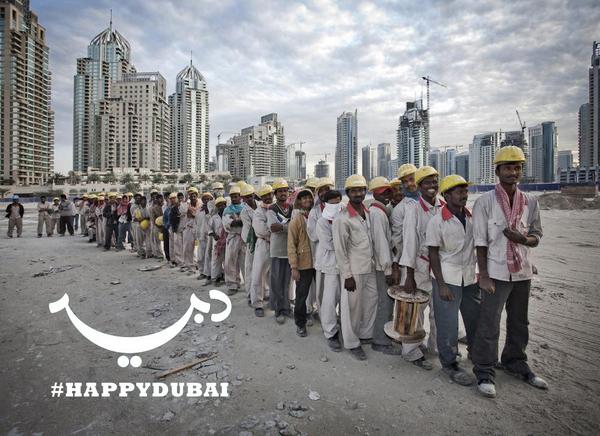
There’s a lot to love about Dubai and the campaign launched by Dubai Municipality (the microsite is a great feature, especially the #HappyDubai map), but not everyone feels as strongly about #HappyDubai as the people behind the campaign. One “David Brown” tweeted repeatedly about the issue facing labourers in the Emirate with the hashtag #HappyDubai. See the below for one Tweet, including a link to a site about alleged human rights abuses in the GCC and the image Photoshopped with the #HappyDubai logo.

Could it get worse? Well, yes it could do if your community manager misunderstands the point being made and then retweets the original message. The follow-up is even worse (unless I’m missing the irony).

The lesson is simple. Before a campaign is even launched whoever handles social media needs to understand the various viewpoints that may be coming his or her way, both positive and negative (the same is also true of the whole organization). There should be talking points and message tracks in place for any negative sentiment. This is especially true of a campaign such as #HappyDubai which takes a subjective stance on people’s emotions towards a specific issue.

And more than anything else, if you can’t spot a negative comment and you work in social media, you need to find a new industry to work in.

@saudigazette’s reader voices and does the Kingdom have an image problem?

Saudi Gazette's new Voices column aims to give readers an opportunity to share their own opinions

Saudi Gazette’s new Voices column aims to give readers an opportunity to share their own opinions

Saudi Gazette has launched a fascinating project to give its readers an opportunity to write more than a letter to the editor, but rather pen a guest column. The first column, named Voices, features the thoughts of former Saudi journalist and doctoral candidate Najah Al-Osaimi. The piece by Najah looks at Saudi’s image and how it is perceived abroad. It makes for an interesting read, even more so when considering its publishing in Saudi Arabia.

Let me know your thoughts on Saudi Arabia and its image problem abroad. And thank you Saudi Gazette for another wonderful idea. If you are interested in writing a column for the Saudi Gazette then email your contribution, no less than 300 words, to voices@saudigazette.com.sa.

Will Huffington Post’s entry into the Gulf be a game-changer?

How will the Huffington Post affect the Gulf’s media landscape? We’ll find out early next year. (image source: http://www.aim.org)

Being in the Middle East’s media sector can often feel like waiting for a bus. You can wait for years for a new launch (post-2008 in any case) and then all of a sudden you have two of the world’s largest news portals announcing expansion plans. First we had Buzzfeed, and now we have the Huffington Post. The local site Doha News broke the story earlier this month. According to the piece, the site will be partnered by the former director general of the Al Jazeera Media Network Wadah Khanfar and his media firm Integral Media Strategies.

The site will be in Arabic and will launch early next year. HuffPost Arabi, as it will be known, will be based in London. HuffPo founder and editor-in-chief Arianna Huffington is quoted by Doha News as saying the site would “bring more Arab voices into the conversation and deepen the world’s understanding of life in the Arab world, from its problems to its accomplishments to its untapped potential.”

The site will include a combination of aggregation, blog posts from a wide variety of sources and original reporting from HuffPo reporters and Khanfar’s team.

Launched in 2005, the original Huffington Post redefined online media by working with bloggers to aggregate news. The site was the first online news portal to win a Pulitzer and was sold in 2011 for 315 million dollars to AOL. Besides English, the Huffington Post is published in French, Spanish, Italian, Japanese, German, Portuguese and Korean.

However, how will the Arabic be received? Firstly, Khanfar was one of the driving forces behind the success of Al Jazeera. However, with him at the helm HuffPost Arabi is likely to be persona non grata in many of the Gulf states due Al Jazeera’s implied support for Islamist groups and perceived interference in the internal politics of governments across the region.

In addition, much of the dialogue that the Huffington Post is looking to encourage in the region can already be found online on social media. With its base in London, five thousand kilometers from the Gulf, how will the HuffPost Arabi be able to distinguish itself in a crowded media landscape that is government controlled? I can’t wait to find out.

The challenge of control in the age of social media – Garnier, the Israel-Gaza conflict and the threat of boycott

How much damage has Garnier Israel done to the Garnier global brand through its local actions? (image source: http://www.deliberation.info)

Listen long enough to any communicator working for a multinational in an emerging market and they’ll touch on the issue of what is called ‘corporate’. The concept of centralized communications, of control being exerted from head office over global communications is understandable – corporations want to ensure that the message being disseminated is consistent with the aims of the company as a whole. Rather this than each country office doing as they wish, which may result in local messages which are not in alignment with the global communications.

Combine this with the reach and immediacy of social media, and the implications for going off-message can be explosive. Many brands have been implicated in the recent Israel-Gaza conflict, and issues such as this have the ability to polarize opinion, particularly online where millions have been expressing their support for and anger with one side or the other.

While many of the brands who have been targeted by Pro-Palestinian groups advocating for boycotts have in effect kept their own counsel and said nothing (with the exception of Starbucks which took the step of reiterating that it neither operates in Israel nor supports the Israeli army), Garnier was caught out by its local operations.

Halfway through the conflict Garnier Israel had donated 500 gift packs to StandWithUs, an Israeli advocacy group which promotes the country to the world through social media. During July and August StandWithUs also undertook a number of domestic initiatives such as providing gift packs to soldiers on the front line and in support functions.

First, StandWithUS donated the 500 gift packs from Garnier to a group of female Israeli soldiers. The organization then promoted the handout on its social media channels (most prominently on Facebook), with the following comments:

“We are honoured [sic] to be delivering these “girly” care packages for our lovely female IDF fighters!

Today’s delivery of care packages was stocked with thousands of products for our girls protecting Israel. They even received facial soaps and minerals, so they can still take care of themselves, eve while defending the country.

Shout out to the Garnier Israel|גרנייה for the amazing donation of facial soaps, minerals and deodorants!”

Unfortunately for Garnier, the post was quickly picked up by Pro-Palestinian social media goers. As the UK’s Independent newspaper noted on Saturday the 9th of August, the Facebook post alone had been shared over 22,000 times and had garnered 3,000 comments, most of which were calling for a boycott of Garnier products. The post has also inspired a hashtag, #BoycottGarnier, calling for consumers to shop buying the brand. Even Garnier’s own brand ambassador to the Arab World, Hind Sabry, took to the media to voice her displeasure at what had happened. The Independent curated some of the reactions to the post which I’m including below.

https://twitter.com/cnimhearthaile/statuses/495962711373938689

A week after the now-infamous post Garnier USA released a comment distancing itself from the donations by Garnier Israel (have a look below). But, is this too little, too late? In a globalized world of brands which are commonplace in every country on the planet and which need to appeal to as many consumers as possible, what can companies do to ensure that the action of local entities doesn’t harm their global image when it seems that nothing can be communicated to an external audience in private?

“Garnier values peace and harmony and has a strict policy of not getting involved in any conflict or political matter. The hand-out of about 500 products was part of a local retailer initiative. This was managed strictly at local market level and we are very sorry if anyone was offended,” Garnier’s Corporate Communications Director Ms Kerr said.

In the age of social media, the assumption has to be that if the message is going to alienate a specific stakeholder group, then just don’t put it out there, period. For corporations the size of Garnier, that’s easier said than done.

PS To make matters even worse, Garnier’s apology has reportedly upset Israelis who have now vowed to stop buying the company’s products according to the Times of Israel.