The concept of bona fide and the threat to the UAE’s classifieds industry

If the 7Days report is acted upon soon by the country’s authorities will this mean the end of classified adverts in the UAE? (image source: cre8network.com)

I’m playing catch-up at the moment on the blog, due to moving house and having too many things to do and not enough hours in the day. One piece which did catch my eye was a report in 7Days. The piece, which was entitled ‘UAE Interior Ministry warns newspapers against maids, tutors ads’, quotes a Major General at the UAE’s Interior Ministry as saying:

“Newspapers need to be careful before putting job adverts for domestic workers such as nannies, maids, drivers and private tutors in their publications.

“Publications need to first verify the identities of these people and confirm they are staying legally in the country before they advertise their services.”

The officer notes the numerous reports from families of children being abused by the domestic help or private tutors hired through classifieds. The Major General quotes a recent incident in Abu Dhabi when police arrested a teacher whom allegedly kissed and molested two girls during a private lesson at their home.

“The Australian parents of the girls reported the 58-year-old Egyptian man to police after their daughters, aged eight and 13, told them the private tutor kissed them and also touched the older girl during a maths lessons.

The parents told police they had contacted the teacher through a newspaper advert.”

I want to bring up the concept of bona fide or good faith, the term that encompasses a sincere belief or motive without any malice or the desire to defraud others. It derives from the translation of the Latin term bona fide, and courts use the two terms interchangeably. Just as any other party, newspapers and other providers of classified services including online sites such as Dubizzle need to trust that the other party they’re dealing with are acting in good faith and telling the truth.

To ask newspapers to do due diligence on each and every person advertising as a tutor and/or maid would seem to be a tall task. What would newspapers be asking for? How would they be able to do a background check? And for online sites which host thousands of adverts, would they even have the human resources for such a task?

Revealingly, the 7Days article ends by noting that the tutor to the Australian family had earlier been deported after he was convicted of molesting a child, but returned to the UAE by sneaking through one of the country’s ports. Maybe it’s not the newspapers who should be doing due diligence, but rather other parties?

The UAE’s Obsession with (women’s) Rankings and its consequences when things go wrong

Is it right to trumpet the times when you come top and make excuses when you're not?

Is it right to trumpet the times when you come top and make excuses when you’re not?

Everybody loves a good ranking, especially when you’re ranked at or near the top of the listings. If you’re doing a survey, a list or a table then you’ll always be welcomed in the UAE. The country has leveraged off its rise up the rankings of global surveys to promote inward investments and position itself as the leading destination in the Gulf and the wider Middle East region for all things consumer and business-related.

However, things don’t always turn out so well with surveys. A recent Global Gender Report published by the World Economic Forum ranked the UAE 107 out of 135 countries listed in the report. The response from one writer, Shaikha Al Maskari, was to list what the UAE has done for women, and to showcase why Emirati women are pioneers in their field.

Rather than review the article (which was actually entitled ‘The Happiest Women in the World’ in print) I’m going to quote selectively. Enjoy the read while this writer throws her toys out of the pram, belittles the rest of the region and the strides the Gulf’s women have made and harps on about what her country has done without really saying much. Or maybe it’s just me…

“The question of women equality in the UAE is always brought under the limelight with a negative connotation that they are oppressed, discriminated against and constrained — especially in the social, cultural, economic and political perspective. To the UAE, it is just a stereotypical challenge; to other Arab countries, the problem is much more complex.”

“The constitution clearly states that women have equal rights as men and it ensures that they are provided equal opportunities in employment and advancement and equal pay at the work place. And in many cases, a female is favoured over a male candidate — form of an unannounced affirmative action.”

“…we have achieved what no other Arab country has in decades. It is no wonder that we take pride in calling her our model and “Mother of the Nation”. Emirati women enjoy vast privileges that are envied. Based on Islamic rulings, the man is the care provider for the family and financial responsibility rests with him.”

XPRESS – the UAE’s investigative newspaper

Over the past couple of weekends I’ve become increasingly irritated. It’s not that I don’t like weekends; on the contrary I enjoy the time away from work. However, I’ve become accustomed to picking up the XPRESS newspaper. The title, which was launched in March 2007, is a weekly newspaper which is published by Al Nisr Group (Al Nisr also publishes Gulf News).

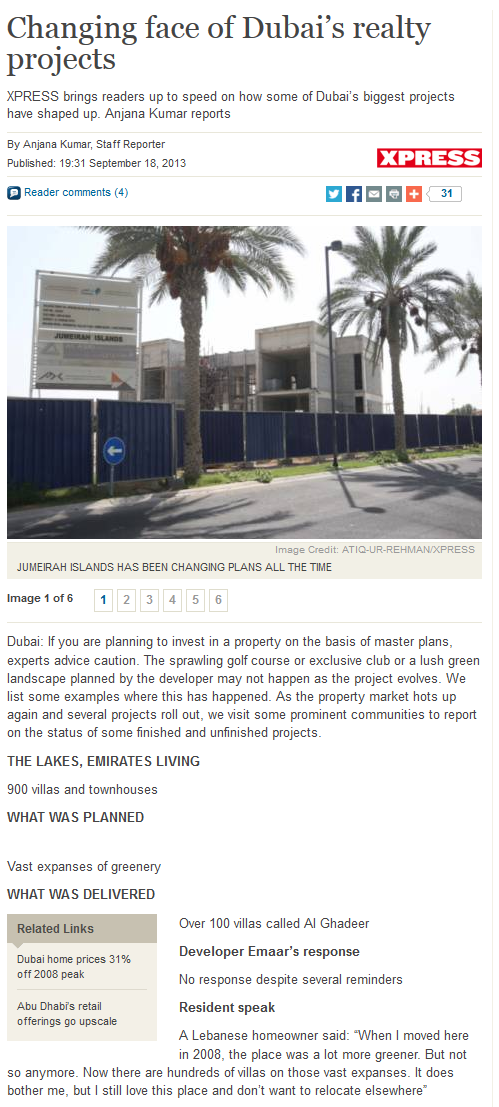
The paper, which describes itself as a community paper, is released every Thursday. Of late, XPRESS has focused on investigative pieces and has run a number of pieces that have caught my eye. Some of the best include a report on the changing face of a number of Dubai’s largest real estate projects (see the below or click on this link), the cost of wasted medicines to the country’s coffers and insurance firms, and the horror story of how the MMA forex scam robbed thousands of their money.

XPRESS regularly focuses on stories that engage the community including this piece on how developers have not kept their word on project developments

XPRESS regularly focuses on stories that engage the community including this piece on how developers have not kept their word on project developments

There have been some duds including a scandalous piece that seemed to suggest expats were more inclined to engage in illegal sexual acts which focused on a Norwegian lady who was raped and yet charged by the local police (this piece and the comments by a number of Emirati lawyers still shocks me). But in general XPRESS is a wonderful read which often puts other newspapers to shame. If you have a spare copy save it for me!

Another breaking news piece by XPRESS which wasn't picked up by other media outlets in the UAE

Another breaking news piece by XPRESS which wasn’t picked up by other media outlets in the UAE

The importance of the mobile web for Gulf-based businesses

Remember the good old days, when mobiles were there only for making or receiving calls? Forget them, and start thinking mobile web sites and more business (image source: tandemdigital.co.uk)

It’s official! The UAE is again a world leader, but this time in smartphone penetration. Seventy four percent of UAE residents carry a big, bad smartphone in their hands (some of us have two of them on the go at a time). Saudi Arabia is third, with seventy three percent of people carrying mobile devices according to research conducted by Google for its ‘Our Global Planet’ project.

The good people at UAE-based PR agency Spot On PR have summarized the findings for the UAE and you can do the same by going to Google’s website and customizing your query. What’s most striking is local behaviours. Have a look below.

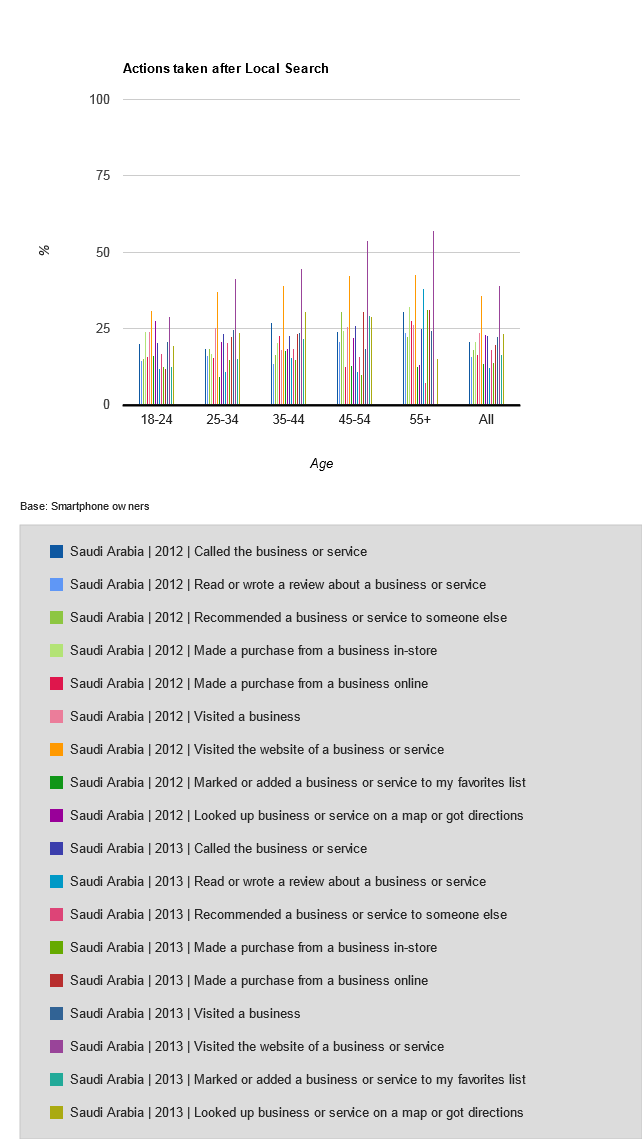
Have a look at the frequency of local searches and look at the growth from 2012 to 2013

Have a look at the frequency of local searches and look at the growth from 2012 to 2013

Actions taken after Local Search in Saudi Arabia in 2012 and 2013 across all age ranges and gender types

Actions taken after Local Search in Saudi Arabia in 2012 and 2013 across all age ranges and gender types

What is strikingly obvious from both of the graphs above is that local search is now essential to local businesses. And yet, we’re still pretty awful when it comes to developing websites for mobile browsers.

So how do you change this? The first piece of news is pretty obvious. Go and get a website (it’s amazing how many businesses still don’t have sites in this part of the world). Secondly, if you’re not sure about how mobile-friendly your website is then test it using a tool such as W3C’s Mobile Ok Checker. These will be able to tell you what you’re doing right and what you’re getting wrong when it comes to rendering or displaying your site on a mobile browser.

If you’re stuck on how to develop a website that renders well on mobile browsers why don’t you consider using a content management system such as WordPress. WordPress has website styles that automatically adapt or respond to different browser types. WordPress is free and you don’t need to even pay hosting fees if you use WordPress’ own servers.

Even if you have a mobile-friendly website remember to use back-end analytics programmes from Google or other providers to better understand what your customers are doing on your website and what you can do to improve their experience. If you’re looking for more advice on what you should be doing to generate business from mobile have a look at this crib sheet for mobile e-marketing by local developer Saad Bhatti or get in touch with the good people at Spot On. But the general message is, do more on mobile!

The UAE, Egypt and the dangers of an open bias among media

How can a journalist consider him or herself a professional after openly declaring a media bias? (image source: http://www.thepoliticalcarnival.net)

There’s few proverbs which would sum up today’s Middle East more than “may you live in interesting times”. Unfortunately as we are discovering over and over again, that Chinese proverb is not a blessing but rather a curse. When I look at Egypt over the past couple of weeks I would have thought I was watching a Ramadan-season tragi-comedy rather than real life events. The situation is desperate; the sense of hurt and anger is palpable on all sides of what is now a conflict between two opposing forces.

Generally speaking, the media in Egypt is also becoming more polarized. Most media outlets in the region are owned either directly or indirectly by the government or by groups and individuals with a specific agenda. Even those media who don’t have a particular bias still have to self-censor for fear of crossing a red line. However, it’s rare for a (supposed) journalist or media group to come out and openly show a bias.

Two incidents made the headlines this week in the UAE. The first, and the most brazen, was an announcement of a one million Egyptian pound (US$143,000) bounty for information leading to the capture of three Muslim Brotherhood leaders in Egypt. The pledge was made by an Emirati columnist named Hamad Al Mazroui through Twitter (Hamad has been called a journalist but he write columns rather than factual reporting).

This bizarre event was followed by a statement published by the UAE Writers Association in which it stated that “it is against the attempts of the Brotherhood to manipulate the tolerant image of Egypt and moderation.” The statement, which was first published on the country’s national newswire, reiterated the UAE Writers Association’s support for the Egyptian Writers Union, which has listed the Brotherhood in the terrorism list. The Association also commended the UAE’s unwavering support to Egypt.

I have few illusions about national media being influenced by their respective governments’ policies. However, the aim of journalists should be to report the facts and then provide analysis. Research by Gallup has shown that public trust in the media is highest when the media shows no bias; the opposite is true when there is an open bias.

Do such actions help to resolve the situation in another country? Do they help us to understand what is happening on the ground? And do they promote a sense of trust in media outlets here when reporting or commenting on the situation in Egypt? Journalism comes with responsibilities to report and analyse in a manner that is balanced and removed from prejudice. Let’s have more of this please, and less of an no open bias.

Social media and diplomacy – @IsraelintheGCC, Israel’s virtual embassy in the Gulf

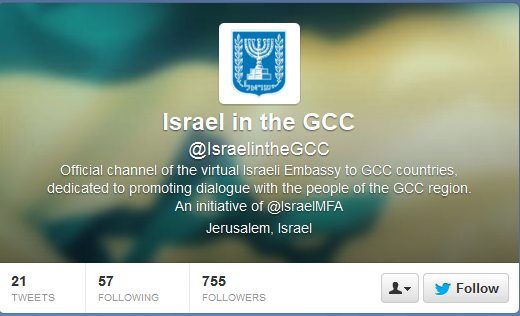
The launch of the @IsraelintheGCC twitter account is a cheap but potentially effective media channel for the Israeli government

The launch of the @IsraelintheGCC twitter account is a cheap but potentially effective media channel for the Israeli government

No matter your political persuasion, you have to admit that the Israelis are an ingenious bunch. Their latest idea is a simple concept, a virtual embassy for a part of the world where there’s little/no Israeli State presence, the Gulf. Israel, which doesn’t enjoy official diplomatic relations with any of the Gulf states, has launched a ‘virtual embassy in the Gulf’ through Twitter. The account, which is named @IsraelintheGCC, aims to “open lines of dialogue” with people living in the Gulf according to a report by the UAE-based English-language daily Gulf News. According to the Israeli daily Haaretz, the person behind the idea is Yoram Morad, Director of the Department of Digital Diplomacy at the Ministry of Foreign Affairs of Israel.

Not unsurprisingly, Israel has always faced challenges when trying to communicate its point of view to its Arab neighbours. However, that hasn’t stopped the State from engaging various mediums to argue for its policies. Israel launched an Arabic-language television channel in 1994 following the announcement of the Israeli-Palestinian peace process. The establishment of the @IsraelintheGCC twitter account follows news of a potential re-engagement between the Israelis and Palestinians as well as mounting pressure on Iran to halt its nuclear enrichment programme.

It could be argued that Israel has been much more active than the Arab states in terms of communicating its key messages – there were plans to launch a Hebrew-language channel in Egypt as of last year according to the Christian Science Monitor, but I haven’t heard much in the way of an actual launch.

The messaging employed by @IsraelintheGCC, which is being run by the Twitter account of the Israeli Foreign Ministry, would appear to be aimed at propagating a more diplomatic tone than that of Israel’s internal politics. The account, which has tweeted 21 times to date, has only quoted the country’s Prime Minister twice (its fair to say that Bibi Netanyahu wouldn’t win many popularity contests in the Gulf), but it has talked about social media in the Arab world, sustainability issues, and wished followers a Ramadan Kareem. The one time Netanyahu has been quoted was in relation to European sanctions on the Lebanese organization Hizbollah which isn’t well liked in the Gulf due to its pro-Iranian stance. There are tweets in Arabic too. Have a look at some of the posts below.

Over the past couple of years social media has allowed companies, politicians and celebrities to directly bypass the media and reach out directly to anyone that wants to listen. Now the same can be said of social media for States who, for diplomatic reasons, cannot establish a physical presence. I’ll be following the account, and am looking forward to seeing how long this project lasts, how much dialogue it generates and how successful it becomes for the Israeli government.

What are the dos and dont’s regarding defamation in the UAE

Defamation in the UAE is a criminal rather than a civil matter and the burden of proof is on the defendant. So be aware of the risks when you post online (image source: http://www.turbosquid.com).

After the outcry surrounding the arrest of the videographer who filmed an alleged assault in the street this week I thought it best to recap what defamation in the UAE covers and how to ensure that you don’t get into issues when creating and uploading content to the web.

Defamation in the UAE is different to most European jurisdictions in that defamation is a criminal rather than a civil matter. Raising a defamation case in the UAE is easy to do (actually, it’s much easier to do here than in other Gulf states including Saudi Arabia) and there’s no distinction between public forums and being online. The basics, as noted by Adil Khan in a post for sovedo.com, are below.

  • It is publicly forbidden to take a picture of another person without their permission.
  • Verbal abuses or gestures (even without the presence of a witness) can also lead to a fine and/or sentence.
  • Defamation via libel (written) or slander (spoken) is dealt by a criminal court as opposed to a civil court, where punishments would only include a monetary fine.

The burden of proof is on the defendant to show that the allegations are false. Similarly, truth isn’t an absolute defense if the comment or content has proved to be damaging to the reputation of the person or organization who/which claims to have been defamed.

The issue of defamation gets even more complicated when it comes to social media. Blogger extraordinaire Alexander McNabb covered a case back of May of a University Lecturer who’d been charged of defamation for writing a blog about his experience with a previous employer. All social media channels are considered to be public forums, regardless of where those forums are hosted. Social media channels are considered to be prominent public forums and even those people posting anonymously can be prosecuted.

Two legal counsels from law firm Clyde and Co., Rebecca Kelly and Sharon Procter, have published one piece on AMEinfo that is worth a read both for individuals and their employers when it comes to social media and defamation in the UAE.

Probably, the best piece of advice is play it safe if you’re not sure whether your comments could be construed as defamation or not. And if you’re still unsure, remember the penalty for being convicted of defamation can be up to two years in prison and a fine of as much as Dh20,000 (US$5,444). So post in haste, repent at leisure.

How long do we have to wait for competition in the UAE’s telco space?

Sometimes you have to wonder if anyone at Du, Etisalat or the TRA is listening when it comes to doing a deal on market liberalization (image source: http://www.healthyblackmen.org)

As the saying goes, everything comes to those who wait. If you’re waiting for competition in the UAE’s telco space you may have a couple more years of waiting. Reuters published a story today detailing how despite talks beginning in September 2009, Du and Etisalat have yet to agree terms for network sharing. The best bits from the Reuters piece are below.

The United Arab Emirates’ two telecom operators, Etisalat and du, remain at loggerheads over a deal to allow them to compete on fixed line services nearly four years after negotiations began.

Du and Etisalat already offer fixed-line, broadband and television packages in the UAE, but not in the same districts, with du confined to the newer areas of Dubai.

The two companies, which are both majority-owned by government institutions, started technology trials that would allow network sharing more than two years ago and an agreement was slated to be concluded by 2011-end.

But a report from the Telecommunications Regulatory Authority (TRA) this week shows the companies cannot agree on the extent of so-called bitstream access, which would enable one operator to permit the other to use its fixed network, or a method to determine the fees for allowing such access.

“The two licensees are still negotiating,” states the regulator’s report, which was published on its website.
“Bitstream access could have a significant impact on competition.”

The TRA states it will “impose a requirement to offer bitstream access products for both residential and business markets,” reiterating a commitment it made in a 2010 policy document.

Further liberalisation has proved fraught – mobile number portability, which would allow customers to retain their phone number when switching provider, has yet to be introduced despite the regulator previously stating this would be available by mid-2008.

Now, almost four years later ad yet we’re still nowhere near having any competition in the telecoms space in the UAE. The question is when is the UAE’s Telecoms Regulatory Authority going to step up and force the two telcos to agree a deal?

Across the region, we have some powerful regulators who have forced incumbent operators into making changes (Bahrain’s TRA is a great example of how a regulator should act on behalf of a country’s consumers). And yet, despite repeated promises from the TRA the UAE’s public is still waiting for a raft of measures that will liberalize the telecommunications sector, reduce costs and, hopefully, raise the quality of the country’s telecommunication services.

Just remember, if you’re waiting for the respective parties to agree and benefit from market liberalisation in the UAE’s telco sector it’s probably best not to hold your breath based on Du’s and Etisalat’s track record.

Is the media a government tool or an independent voice – thoughts from Abu Dhabi

Freedom of expression or expression of national institutions? We’re still very much in the latter camp in the Middle East (image credit: http://www.menassat.com)

There was a fairly low key but important discussion this week in the UAE’s Federal National Council. The body, the closest thing that the UAE has to a parliament, welcomed Shaikh Abdullah Bin Zayed Al Nahyan, the country’s Foreign Minister, to discuss the issues of the media and the work of the National Media Council, the UAE’s regulatory body for the sector.

The below excerpts are from an article in Gulf News which ran this week. Have a read through the quotes:

The National Media Council came under fire from the House for its “weak role in [the] Emiratisation of the media, dominance of foreign media content and lack of plans to promote the [UAE’s] cultural identity.”

The NMC was also criticised for the lack of coordination between the media outlets and universities, lack of training programmes for journalists and broadcasters, and a failure by media outlets to address concerns of citizens.

The FNC also voiced concern over the UAE’s low ranking in the press freedom index. Ali Jasem, a member from Umm Al Quwain, said the UAE ranked 158th on the Press Freedom Index last year.

Shaikh Abdullah said he expected that the ranking will improve once the new media law is issued with an article that bans jailing journalists for exercising their duties.

Shaikh Abdullah said discussions in the FNC lacked a uniform stand on the issue of freedom of expression.
“Some members demand a higher ceiling of freedom and less control, while others call for censorship, which is confusing,” Shaikh Abdullah said.

Shaikh Abdullah reiterated that the NMC respected the editorial policies of all media outlets operating in the country and that it never intervened in their work or nature of their content.

“The country’s policy is to leave the executive work to the media outlets, whether owned by the local governments or the private sector, so that there will be no contradiction between [the NMC’s] work and theirs,” he added.

Shaikh Abdullah said media outlets are “our partners and they are wholeheartedly contributing to the UAE’s media strategies.

It’s fairly common in the Middle East for the media to be seen as a tool of government policy. The media reiterates the government line and rarely engages in debate. This viewpoint hasn’t changed much despite attempts by global media outlets, newswires such as Reuters and Bloomberg, to write uncensored about a range of social, political and cultural issues.

What’s noticable from the above is that even in a country which is fairly media-friendly by the standards of the Middle East there’s still a view that the media needs to be an instrument of policy which ‘promotes cultural and national identity.’ I’ve been incredibly fortunate to have been raised in a part of the world where a strong, independent media fosters debate, promotes transparency and holds others to account. How far are we from this state of affairs in the Middle East? Your guess is as good as mine. However, in the meantime I’ll keep flying the flag for a media sector that has the teeth to do its job and act as an independent voice for discussion, debate and originality.

Geant launches a budget brand called… Advert (in Arabic)

I love budget brands. I used to live on them when I was a uni student. There’s nothing better than paying as little as possible for the basics, especially when money is tight and we don’t want to forgo those everyday essentials as well as a treat now and then. I was excited to see Geant in the UAE launching a low-cost series of items. Low-cost brands haven’t been common in the Middle East despite the increasing popularity of hypermarkets in the Gulf.

Geant plumped for the name Elan in English, which could suggest inspiration or style. So far so good (though one could ask if the concept of inspiration fits well with budget tissues, mineral water and ketchup). But then we come to the Arabic. And here’s where we have a concern. Elan has been translated as اعلان which means… advert.

I don’t understand the thinking behind the brand’s naming. Was someone thinking this space would be sold? How did brand manager think this would resonate with Arab shoppers? Would you buy a bottle of mineral water called Advert?

Kudos to Geant for taking the initiative to launch a budget brand, especially when food and household prices are rising. But please think about that naming good people. You can do so much better.

PS for a full list of what Geant sells in its Elan range click on this link.