Executives promising to go naked on television, Cobone’s PR stunt, and The Address’ post-crisis crisis?

Paul Kenny's fake PR release for Cobone, Ziad El Chaar naked on TV and Emaar's ongoing issues following the Address fire made this week an interesting one for media in the UAE (image source: Arabian Gazette)

Paul Kenny’s fake PR release for Cobone, Ziad El Chaar naked on TV and Emaar’s ongoing issues following the Address fire made this week an interesting one for media in the UAE (image source: Arabian Gazette)

Media in the Middle East is rarely dull, and the past few days have proved that there’s some hilarity as well as serious questions about what people in our region do and then tell to the media.

Let’s start with the real estate brand which is developing a reputation for foot-in-mouth disease. Speaking to the Sunday Times, Damac’s Managing Director Ziad El Chaar told The Sunday Times he would “go on TV naked and resign” if the worst market projections are realised. Aside from the fact that any naked executive dance on television would be illegal in the UAE (at least without a VPN), his comment hasn’t been taken too well judging by the reaction on Arabian Business’ online portal. Maybe there’s some fans of naked real estate executives out there. If so, please do show yourselves so we can get you help…

Another bizarre piece from last week which wasn’t picked up widely. Speaking to an audience of entrepreneurs last week, the founder of discounting site Cobone Paul Kenny admitted that he used a PR stunt to kick-start his business. Shortly after founding the site, Kenny put out a press release claiming that 1,000 vouchers for a discounted pizza had been sold to Cobone consumers. That release, Kenny now claims, was a fake. Let’s quote Kenny from the Arabian Business story.

“We were second to market. GoNabit [an online group buying website founded by Dan Stuart and Sohrab Jahanbani] was first. When we launched, everyone was saying: ‘You are the same as GoNabit,’ which we were but I said we weren’t.

So I went to at Vapiano, which is an Italian restaurant, and bought a thousand pizzas at a huge discount and they sold out by 12pm. I put a big sold out sticker on the site and an hour later I released a press release saying ‘Cobone.com breaks e-commerce record in the Middle East.’

And the truth is that everyone started reading and asking ‘Who is this company Cobone.com?’ ‘What is e-commerce?’ ‘What’s a record?’ You know it created a lot of interest in the business and instantly people started recognising us as a different business.

I remember that a day after you could do a Google search to see we were on around 483,000 websites. First, e-commerce in the Middle East was never covered. Then what is an e-commerce record? What is Cobone.com?

So you got a ball rolling of media interest from that point.”

There’s a popular saying about the luck of the Irish. And there’s another saying about making one’s own luck. Luckily for Kenny, no asked if the news was real (or checked with the restaurant). If they had, his deception may not have worked so well.

And finally, another follow-on story about the New Year’s Eve fire at The Address, from The National in which one owner of property at the hotel lost 1.3 million Dirhams worth of art in the blaze.

Ramin Salsali spoke out this week urging The Address owner Emaar Properties to quickly process residents’ compensation claims as well as repair the property. To quote from the story.

“Until now, they [Emaar] have been very fair and have quickly reacted to accommodate people, put them in hotels, give them the first basic possibilities just to start to recover.”

He expected “a very unbureaucratic and pragmatic approach” from the developer in terms of how claims were handled – especially since a police report last week indicated that an electrical short-circuit from a spotlight caused the blaze.

“The whole world is now watching. The effect on real estate is unbelievable. People have pulled out of contracts where they don’t know about the fire safety of the cladding. It’s not good for Dubai.”

One of the greatest challenges any organization can face is not just the crisis itself, but the post-crisis reflection and learning. Emaar isn’t there yet in terms of dealing with any major grievances from those who lost property and items during the fire (and there’s been remarkably little negativity from any of the hotel’s residents so far), but the communication with this group of people needs to be both clear and quick to get these issues resolved. Otherwise, Salsali’s point about blow-back for the Emirate’s real estate sector may become true. Let’s hope not.

And for the next post I’ll be talking daddy issues again. It’s been a while since I posted any stories about my little princess, and I’m looking forward to it!

Flip-Flopping during a crisis – how Damac’s handling of the Trump backlash has proved costly

First you don't see it, then you do. Damac initially removed Trump's name after his comments on Muslims, only to restore it a couple of days after (top photo by Reuters/bottom photo by  Rahul Gajjar of Khaleej Times)

First you don’t see it, then you do. Damac initially removed Trump’s name after his comments on Muslims, only to restore it a couple of days after (top photo by Reuters/bottom photo by Rahul Gajjar of Khaleej Times)

Imagine for a moment, if you will, one of your key business partners/influencers saying something controversial. Imagine that they’ve just racially attacked your most important group of customers. And then imagine that, rather than dumping this partner, you instead flip-flop around the issue and end up not only looking rather foolish, but do yourself and your reputation a fair amount of harm in the process.

If you work at Damac, you don’t need to imagine any of the above. The Dubai-headquartered real estate developer, which counts Donald Trump as one of its business partners, has been flip-flopping since Trump came out with a comment on the 7th of December that there should be a “total and complete shutdown of Muslims” entering the United States. This statement, which was made following the deadly shootings in California’s San Bernardino, weren’t the first Trump had made about Muslims. He had previously that he was in favour of shutting down American mosques and establishing a database for all Muslims living in the US or giving them a form of special identification that noted their religion.

Damac’s relationship with Trump International includes branding for two Trump-branded gold courses and a collection luxury villas at the developer’s Akoya project in Dubai. I don’t know the full extent of the relationship, but local newspaper 7DAYS claimed that, in addition to the licensing fees that Damac would have to pay to Trump for the use of his name and image, Trump himself had invested in the project.

Following the controversy around Trump’s latest Muslim statements, Damac put out a statement that could be called, at best, avoiding the issue.

Damac Properties senior vice president Niall McLoughlin told 7DAYS in a statement: “We would like to stress that our agreement is with the Trump Organisation as one of the premium golf course operators in the world and as such we would not comment further on Mr Trump’s personal or political agenda, nor comment on the internal American political debate scene.”

Instead of publicly taking Trump to task and distancing the company from his statements, Damac took a different approach. A couple of days after the outcry, on the 10th of December Damac took Donald Trump down – his image and name that is, from their developments. To quote from 7DAYS.

Hoardings that previously carried photos of the billionaire businessman advertising Damac’s Trump-branded golf course and luxury villas stood bare on Umm Suquiem Road on Thursday, right at the entrance to the development.

All well and good you may think – Damac quietly rebranded their development and distanced themselves from Trump. However, in a further twist, Trump’s name was back on billboards two days later, on the 12th of December. Here’s how the English-daily Khaleej Times put it:

On Friday, a prominent advertising billboard showing Trump golfing that had stood at the Akoya development, where the housing and one of the golf courses is being built, was gone. All that remained of it was the board’s brown wooden background. Another billboard declaring the development “The Beverly Hills of Dubai” still stood nearby.

Trump’s name also appeared to have been pulled off one sign greeting visitors to the complex. The sign, outside a sales office at the site, originally had Trump’s name in lettering on a stone wall. But on Friday the letters were littering the ground in front of it.

A second, similar sign facing a major road was intact with Trump’s name on it. Earlier in the week, that sign had been taken down but by Friday, it was back in place.

“The exterior signage at Trump International Golf Club, Dubai was temporarily removed on Tuesday for a short period of time, however as of last night, the signage is back up and fully intact,” the Trump Organization said in a statement to The Associated Press on Friday.

Also, the Damac webpage dedicated to the Trump PRVT gated community, which is part of the development, appeared to have been removed, leading only to a “not found” page.

Since the development is still under construction, the removal of the branding with Trump’s name and image seemed to be largely symbolic. It was not known if it signaled Damac will outright break the licensing contract.

Damac Properties has declined to comment on the removal of Trump’s name and billboard from the property. It earlier said it “would not comment further on Mr. Trump’s personal or political agenda, nor comment on the internal American political debate scene.”

To change the issue, Damac has switched tactic. Instead of talking politics, the developer announced that it would guarantee rental returns for those buying in its Akoya (Trump-branded) project. The National broke the story last week.

Damac Properties, the developer caught in a storm over its partnership with the controversial US presidential hopeful Donald Trump, is offering lucrative rental returns on some of its properties to lure investors.

Damac, which said it would stick with Trump International despite his anti-Muslim tirade, is providing a 24 per cent rental guarantee on selected units in Dubai, including the Akoya project associated with the billionaire, the developer said in a statement.

Owners of selected properties will be able to secure an eight per cent annual return in the first three years after handover.

The company was offering these returns because it believes the Dubai property market is “set for stable growth in the medium term”, Damac said. “We have seen quite a bit of scaremongering in the market in recent months, which can have a detrimental effect on sentiment in the market,” said Niall McLoughlin, the senior vice president at Damac. “By providing such a high, tax-free offering on our units, we are putting our head above the rest and underwriting any fluctuations that may occur down the line.”

Reputational issues become even more important for companies which are listed, as Damac is. Damac’s shares initially fell 15 percent following the muted response. Investors may also not have appreciated the rental guarantee initiative, as you can see from the share price chart below.

Damac's share price fell after the initial outcry. The share price has also fallen following Damac's attempts to repair the reputational damage through the rental incentive promise.

Damac’s share price fell after the initial outcry. The share price has also fallen following Damac’s attempts to repair the reputational damage through the rental incentive promise.

While I don’t know the relationship between the two, would Damac have been wiser to have taken an initial hit and exited the contract with Trump rather than flip-flopping on the issue, drawing it out and drawing more attention to the brand association? Add in the costs with guaranteeing rental returns in addition to the share drop, and this crisis will prove costly both in the short as well as the long-term. To me, the media and the company’s shareholders the answer about whether or not to dump Trump – and take a short term hit through contractual obligations but save the company’s reputation and keep shareholders and customers happy – seems fairly obvious.

Innovation, Data and Control – Squaring the Circle in Dubai

Can governments in the Middle East find a way to balance control with innovation and access to data?

Can governments in the Middle East find a way to balance control with innovation and access to data?

Someone re-found their mojo this month. The English-language newspaper The National published a number of eye-opening pieces on two issues that are often discussed, but little understood.

The first was an investigative piece (yes, I know!) on the challenges that Dubai’s Road and Transport Authority (RTA) has faced with the disruption caused by app-based taxi providers such as Uber and its local rival Careem. To put the story into context, the RTA does not only regulate taxis in the Emirate of Dubai, but it also manages its own fleet of taxis.

The piece, which is a fascinating insight into how the Emirate is not only run but also how it is looking to balance control with innovation, poses the question of how a government which controls much of the business in the country promotes innovation whilst protecting its revenues. For me, the key paragraphs in the article, written by the newspaper’s business editor Mustafa Alrawi, are below.

In Dubai, The National understands, Uber and Careem have narrowly escaped a clampdown by the regulator that would have significantly curtailed their abilities to operate. The biggest issue has been the alleged failure to maintain prices above taxi fares. On its website Uber states that “ … in Dubai, regulations require our fares be 30 per cent higher than taxi fares”.

It is understood, however, that the regulator had been planning a far stronger response to the practices of private hire companies booked by smartphone app, ahead of new regulations to address the emergence of technology-led companies in the transport sector. These regulations are expected next year, according to previously reported comments from the RTA.

It is understood that the Dubai government stepped in before the row escalated to ensure that innovative companies such as Uber and Careem would not be hamstrung by any action by the RTA. The circular is understood to represent a kind of temporary truce between the regulator and the technology firms maintaining the status quo for now.

A second article the following day in The National touched on another important issue for the country – that of statistics and control over information. Here’s the introduction:

A new law that demands companies seek government approval before carrying out surveys in Dubai could damage the property sector and discourage research in the emirate, experts have warned.

The Dubai government announced a law late last month intended to help enable the Dubai Statistics Center “to establish an advanced statistics system”, according to a statement. But experts zoomed in on a provision in the new law that forbids private companies from “conducting any survey[s] without obtaining authorisation from the Dubai Statistics Center”.

As pointed out by one of those interviewed, there’s no such thing as a data vacuum. The lack of any official data will be filled by rumours, which can prove to be much more damaging.

Professor Joseph Kadane, chair of the American Statistical Association’s committee on scientific freedom, which produces reports for the United Nations on best practice in government statistics, warned that the new law would likely lead to the spread of “uninformed rumours and uncertainty about the extent of the downturn” in Dubai’s property market.

“This will do far more harm to Dubai’s economy than allowing private surveys to be conducted and published,” Mr Kadane said. “International investors, in particular, are sensitive to the quality of the information available to them in deciding where to invest.”

Both articles touch on fundamental issues relating to innovation and data. The underlying theme is control. Governments in the Middle East have long controlled everything around them, including their economies. In today’s digital world, where innovation can come out of nowhere and where data can be created and spread in an instant, governments need to understand that the control of yesterday is no longer possible and instead look to collaborate.

And, on a final note it’s great to see good local reporting. I hope The National keeps it up.

Innovation and the need to think simply

Innovation starts with the ability to ask a question

Innovation starts with the ability to ask a question

This week is a special one in the UAE – it’s officially Innovation Week and the country is full of activities extolling the virtues of innovation and all that this word entails (I admit, I’ve come to dislike this word, not because of what it stands for but rather its constant misuse).

As I’m a media junkie, two news pieces stuck out. The first was an effort by the Dubai Media Office to promote innovation through its Media Innovation Lab, a quarterly event that aims to promote a culture of innovation and creativity in media. To quote from Emirates 24/7, “the initiative seeks to share knowledge on media-related innovation among corporate communication and media professionals and media students. It is also in line with the UAE leadership’s directives to promote innovation in all sectors.”

The second is even more ambitious, and, quite literally, out of this world. I’ll let The National’s copy explain this innovation for you:

High school and university students from across the UAE have the chance to directly shape the future of space exploration.

Two competitions giving them the opportunity to watch their experiments blast off on a rocket to the International Space Station were announced on Tuesday at the launch of The National Space Programme in Abu Dhabi.

In the initial stages of the programme, The National, Abu Dhabi Media’s English-language newspaper, has linked up during Innovation Week with the UAE Space Agency, Boeing and other public and private organisations.

The National Space Programme contests are Genes in Space, challenging high school pupils to create a DNA analysis experiment, and the Satellite Launch project, in which a university team will build a satellite.

There’s a third strand I’d like to bring in here. I had the pleasure of talking to a university professor who teaches media here in the UAE. He was recalling the story of an occasion when the power failed at his academic institution. One of his students, a local, asked if she should cover the happening for the university student publication. He said yes and encouraged her to go and follow up with the operations department who look after issues relating to maintenance.

This student did just that and headed down to the operations department to understand more about the power cut. When she did meet someone, she asked what happened and explained why she was asking a question. And the response? “Why are you asking such questions? Who is your professor?”

While I love the ambitions of blasting into space or talking about creativity in the media, I’d love to see us put our feet on the ground and push for a climate where a question is welcomed, both from each of us as individuals as well as the media. As for the curious student, the brave lady did publish her story. She’s my innovator this week.

The Ups and Downs of Periscope in the UAE

It was a case of down Periscope last week in the UAE

It was a case of down Periscope last week in the UAE

No pun intended with the title, but Periscope, the live video streaming app which is owned by Twitter, really has been through the wringer of late. The service, which only launched at the beginning of this year, was picking up steam in the UAE thanks to its purchase by Twitter.

However, the country’s users were left out in the cold after the government’s Telecommunications Regulatory Authority put a halt to its usage last week. The allegation made on social media was the Periscope users were sharing content that they shouldn’t have been sharing and which was not in keeping with the UAE’s culture.

But that’s only part of the story. According to the UAE’s Telecommunications Regulatory Authority there was no ban on the application, but rather a technical problem which was stopping users from accessing the application in the country.

As of Thursday and 48 hours after the initial blockage the app was up and running. However, the episode is another example of how easy it is for applications to be blocked in the region without notice. You’ve been warned.

Discrimination, Verbal Assaults and the Internet – is the UAE doing more harm than good to its brand?

Is the UAE risking its well-earned reputation as a country that we all love by arresting and jailing those who fall foul of its legal code when alternatives are available to resolve conflict?

Is the UAE risking its well-earned reputation as a country that we all love by arresting and jailing those who fall foul of its legal code when alternatives are available to resolve conflict?

There’s never a dull moment when it comes to local dramas. For years we’ve had cases of messy divorces, affairs and other issues which have spilled into the local media here in the UAE. However, these soaps have been superseded thanks to a glut of new laws (or a stricter implementation of existing laws) relating to personal rights and freedom of speech.

Only this week, there have been two cases which have made regional headlines. The first has been the arrest of a man at Abu Dhabi Airport for what has been best described as a rant after he missed his connecting flight. I’ll quote from the article in the English-language newspaper Emirates 24/7:

Emirati Police recently arrested a British citizen of Indian origin for allegedly insulting security personnel, the airline’s employee and the UAE, using obscene words, after he missed a connecting flight from Abu Dhabi.

He missed a connecting flight from Abu Dhabi to India caused by delays of his earlier flight from Heathrow to Abu Dhabi.

Lieutenant Colonel Fares Al Bakiri from CID, Abu Dhabi Police, who is heading the investigations, explained that the incident took place a week ago when the traveler arrived at Abu Dhabi International Airport on a delayed flight from Heathrow Airport resulting in missing the connecting flight from Abu Dhabi to India. He started swearing at the airline’s employee, and blocked the passengers’ queue behind him, insisting to board his connecting flight although the gate was closed and the aircraft is about to take off.

The second story this week involves the first case brought under the UAE’s new anti-discrimination law. Aimed at making hate speech a legal offence, the law imposes a jail term up to 10 years and a fine of between 50,000 dirhams to two million dirhams on any person or group causing offense or aiming to create discord in the country. To get back to the case, here’s the story from the English-language daily The National:

A high-ranking Dubai security chief has launched a criminal complaint against a Saudi writer under the new law against hate crime.

Lt Gen Dhahi Khalfan, deputy chief of police and general security, accuses the writer, Dr Mohammed Al Hadif, of spreading hatred of the UAE on social media.

“We are organising a case now to pursue him, according to the new law,” Gen Khalfan said on Twitter. “Criticism is one thing and hatred is another thing. The case has been filed, Al Hadif is wanted, and it’s time to try him in court.”

Gen Khalfan, the former Chief of Dubai Police, has previously accused Dr Al Hadif of being a member of an organisation linked to the Muslim Brotherhood.

The writer has been a vocal critic of the UAE’s involvement in the Saudi-led coalition to defeat Houthi rebels in Yemen, and of the UAE’s relations with Iran. Last year, Saudi Arabia banned him from using Twitter because of his support for the Brotherhood and for the reinstatement of the former Egyptian president Mohammed Morsi.

The law criminalising all forms of discrimination on the grounds of religion, caste, creed, doctrine, race, colour or ethnic origin was enacted on July 20.

Penalties for those convicted range from six months to more than 10 years in prison and fines from Dh50,000 to Dh2 million.​

To repeat, the defendant isn’t in the UAE, but rather Saudi Arabia. And my assumption is that he’s speaking or airing his views from Saudi Arabia which is outside of the UAE’s jurisdiction.

As a global hub, the UAE has done brilliantly at carving out a reputation as a business-friendly country which welcomes all who want to invest and live in the country. However, with other recent cases in mind, is the UAE at risk of damaging its own hard-earned reputation as the place to be by making examples of individuals in difficult circumstances or who are outside of their own jurisdiction?

I can imagine that we all would be peeved after missing our connecting flight, while I can’t help but think that it’s better to engage proactively with those who share different views rather than take them to court, especially if they’re not in my jurisdiction when they commit a crime which the other country made not consider to be a crime.

While the law is the law, I can’t help but feel a dollop of common sense wouldn’t go amiss here, especially if the UAE is to continue its brand building project to shape in our minds the image of a country where we all want to be in, live and support. Are these cases doing more harm than good to the UAE’s reputation, and should we all be more forgiving when it comes to such cases where a touch of empathy would help to resolve the situation.

What are your thoughts? I’d love to hear them.

The definition of ‘Nobness’ – the UAE, social media defamation and differing views from the Gulf

It’s that time of year again. I don’t mean Ramadan of course, the month of charity and kindness, but rather the time of year when we read about a case of defamation. Over the past week there was an outcry in Australia following the arrest of an Australian national in the UAE following comments she put up on Facebook. To quote from the Australian Broadcasting Corporation’s website:

In February, Jodi Magi, 39, took a photo of a car in her Abu Dhabi apartment block that was parked across two disabled parking spaces, without any disability stickers.

She blacked out the number plate and put the photo on Facebook, drawing attention to the seemingly selfish act, but not providing any identifying details or names.

However, someone in the apartment block complained to police and the case went to an Abu Dhabi court in June.

Ms Magi, who has lived in Abu Dhabi since 2012, said she was forced to sign multiple documents in Arabic without any translation.

Two weeks ago (at the beginning of July) she was found guilty of “writing bad words on social media about a person” and told she would be deported.

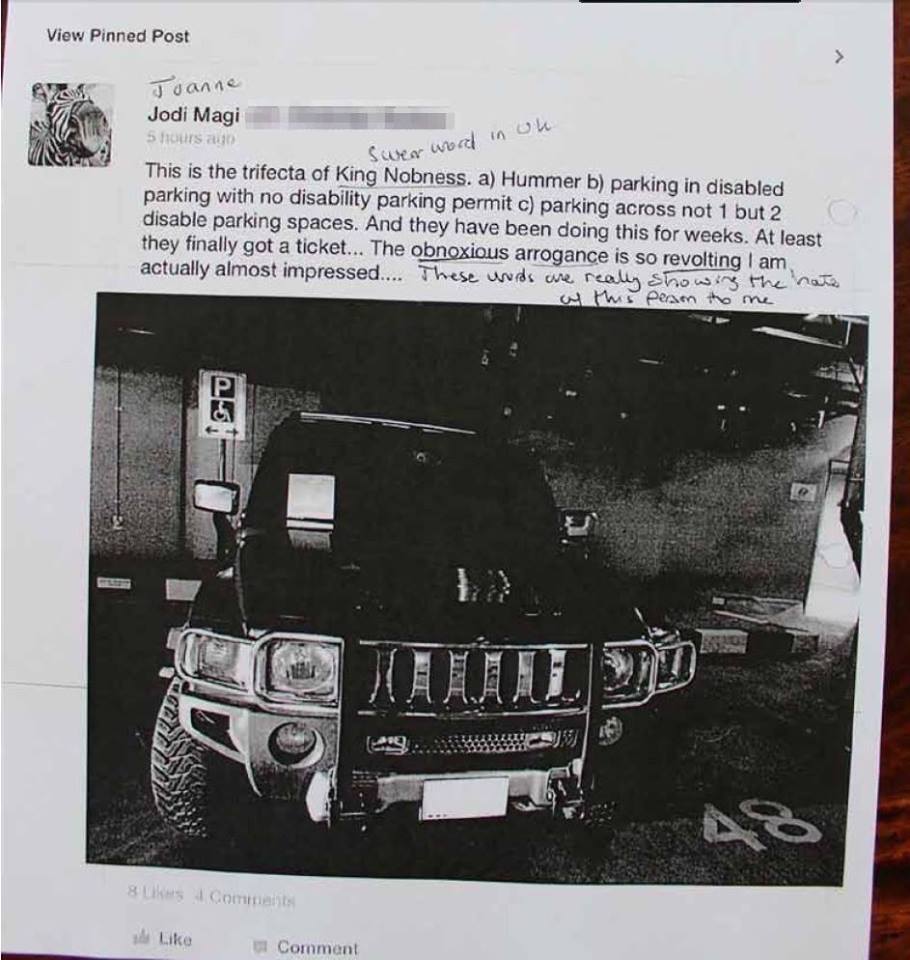
Magi was deported this week from the UAE following intense media coverage. Her argument was that she didn’t know what she’d done wrong in her Facebook post (which you can see below). Her words were considered to be insulting by the complainant, who wasn’t mentioned in the post, and the court agreed with the complainant and, based on the country’s defamation laws (which I’ve written about here), found Magi guilty, fined her, and sentenced her to be deported.

This is the post which got Magi deported. Magi claimed that nobness referred to an Australian term for the elite, rather than the English insult (image source: Facebook)

This is the post which got Magi deported. Magi claimed that nobness referred to an Australian term for the elite, rather than the English insult (image source: Facebook)

While I’m not going to share my views on this (there’s plenty of comments both for and against the issue, but the law is the law), I will share views and thoughts from the rest of the Gulf where double parking is all too common and where the issue is being raised on social media. First up is Bahrain, where there is an Instagram account called Bahrainidiots. Bahrain’s residents are encouraged to share their images of cars which are double-parked for publication on the account’s Instagram feed – for some pictures have a look below.

Similarly, Saudi social media users often share such images, especially on Twitter using the handle #برج_الكلب. Some recent images are below.

https://twitter.com/Dr_MoNassif/status/618500070267355136

https://twitter.com/dr_attar/status/618503839998607361

The most interesting comments about the issue of defamation came from Doha. Speaking to the English-language news site Doha News, criminal attorney and Qatar’s former justice minister Dr. Najeeb Al Nuaimi said it was “highly unlikely” that an expat or Qatari would be arrested for posting a similar picture as Qatar and the UAE differ in their definitions of defamation. To quote:

“In the UAE, this (incident) is seen as ‘you’re showing someone in a bad light’ or that you’re questioning the duty of the police. They didn’t do their job well, and have let this happen, and now you’re posting it and offending them,” he said.

Here, however, the local government would regard sharing such a photo as a “a mark of public service,” he added, continuing:

“We have Qataris posting all over Facebook, Twitter and Instagram (about) things that they don’t like, or wrong things that they see…Here, it’s seen as doing something good.”

One of the publications which wrote about the case, the Abu Dhabi-based English-language daily The National quoted senior Abu Dhabi prosecutor Mohammed Al Dhanhani who explained that Magi was guilty under the 2012 Federal Anti-Information Technology Crimes Law No 5.

“She captured the picture without the consent of the (car’s) owner. She then published the pictures on the web and added insulting phrases.”

Each of these three actions is subject to prosecution under the law, which punishes all violators with a fine and/or jail, and deportation for all expatriates without exceptions, he said.

In an irony not lost on this blogger, while Magi’s state of affairs was playing out The National started its own photo gallery on bad parking in the UAE and posted images on its own website. Based on Al Dhanhani’s own interpretation of the law, is The National also guilty of the same offense under which Magi was sanctioned by capturing pictures without the consent of the car’s owner and then publishing these on the web?

For any lawyers out there, am I right or wrong?

Did Skydive Dubai do enough communications following the tragic death of skydiver Majed Al Shuaiby?

There are days I love my job as a communicator. And then there are days when my heart breaks. One of those days was last week, with the tragic news of a death at Skydive Dubai. Majed Al Shuaiby was an experienced skydiver – he had over 700 dives under his belt according to the local media. On April the 30th Majed took to the skies. Unfortunately, his parachute did not open and he died on impact.

This news, as sad as it is, is also newsworthy. We have a young man, who is only 35 years old, who perished whilst undertaking a sport which is often thought of as high risk. The accident made the news, with coverage nationally and regionally (Majed was a Saudi national). Unsurprisingly, the news first appeared on social media, on the evening of the 30th, the day of the accident.

In a tribute Majed’s name trended on Twitter in Saudi with the hashtag #ماجد_الشعيبي.

Many of those who were online and who knew of the accident started to reach out to Skydive Dubai. The initial reaction was, to put it mildly, disappointing.

https://twitter.com/ammorsy/status/593784283237457921

What Skydive Dubai did, a day after the accident, was put up a post on its Facebook Desert Campus page and push users there. There’s no separate post on Skydive Dubai’s main Facebook page and no posts on Twitter.

The holding statement above has been used for media attribution as well, as can be seen from The National’s story.

Was the statement from Skydive Dubai enough or could they have done more?

Was the statement from Skydive Dubai enough or could they have done more?

While the investigation is still under way to determine what happened, could Skydive Dubai have done more to publicly address the incident and offer their condolences to the family, whilst also addressing concerns around the safety of skydiving?

No one wants to go through a crisis, especially when people are injured or there’s a fatality. However, we as communicators are on the front line to advise our employers and communicate in a way that is respectful, that comforts, and that shows we are also human. As we say, perception is reality and Skydive Dubai’s initial response, to block users, would seem entirely at odds with what communicators should do in a crisis. Going beyond that, is a holding statement enough? We need to present both the facts and show our emotion. We should never simply ignore bad news, and block conversations. Could Skydive Dubai have done more? Do let me know your thoughts.

On a final note, I’d like to convey my condolences to Majed’s family. Allah yurhamu and may god bless his soul.

The National and how it (finally) got the Saayidat Gas Blast story right

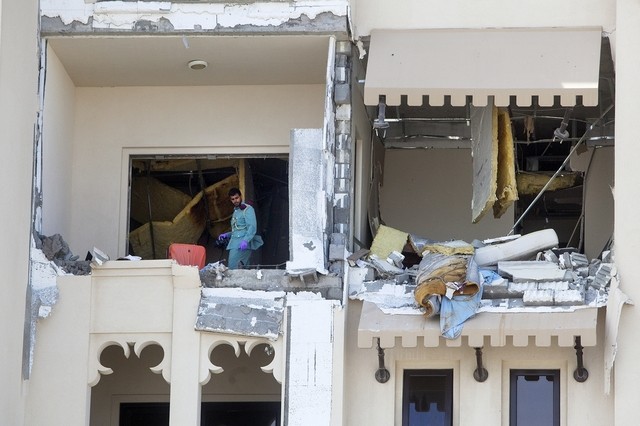
The money picture of the gas blast flat was captured on the second day by The National (image source: The National)

The money picture of the gas blast flat was captured on the second day by The National (image source: The National)

As an ex-journalist who nowadays spends more time in corporate communications than writing for the press, I still enjoy spending time reading what the media produce. One local story was particularly moving for me. On the 24th of March, in the evening, a gas explosion tore through the compound where me and my wife live in Abu Dhabi. My wife felt the blast, which she described as feeling like an earthquake.

As you’d expect, the incident made the news. Abu Dhabi-based English-language newspaper The National was quick out of the blocks to cover the incident with an online piece posted the same night. While the speed of the output was noteworthy, the paper got several essential facts wrong.

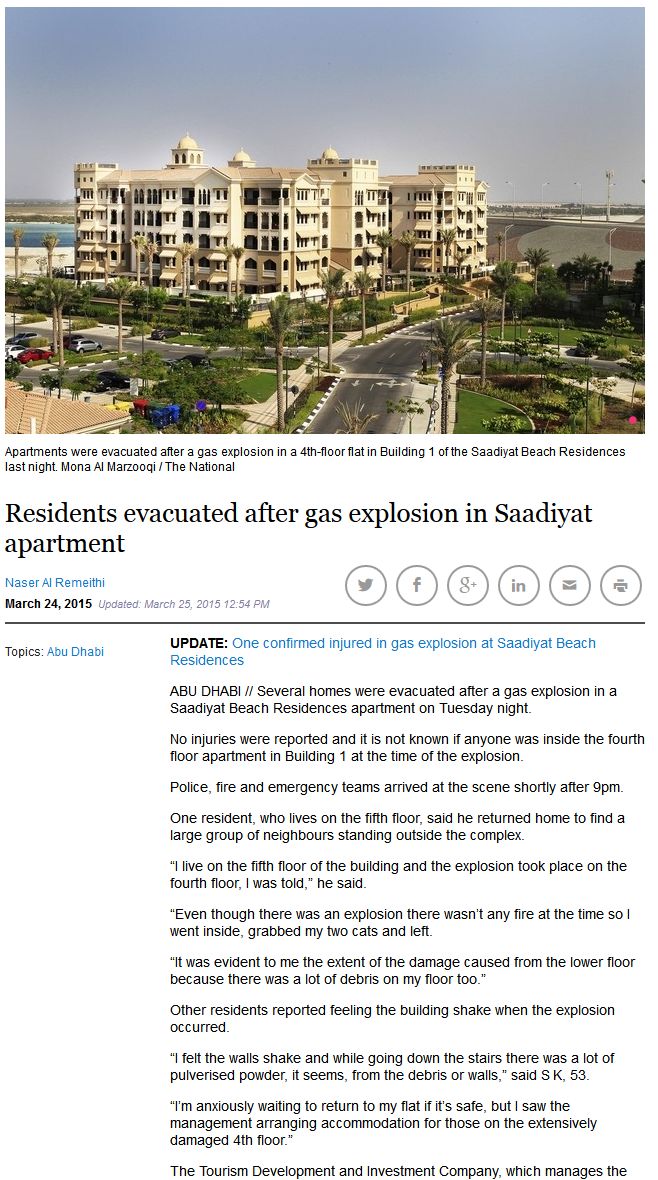
The first was the explosion’s timing – the incident happened at 7.30pm and emergency services were quickly on site afterwards. Secondly, and even more importantly, there were injuries despite the article’s assertion that no injuries were reported (two ambulances were on-site). And thirdly, a stock image of the building was used rather than a picture of the location following the blast (the compound is thirty minutes drive from The National’s offices).

The National's first story on the Saadiyat gas blast was quick to print but important details were wrong

The National’s first story on the Saadiyat gas blast was quick to print but important details were wrong

The piece didn’t feel as if it was put together in the right fashion, as if there wasn’t anyone on site from the paper to collect statements and talk to the authorities. It felt as if it was a desk-job. There was definitely no photographer on site to take the gold-ticket picture which would have set the stage for the piece.

However, the next day The National upped the ante in their second piece. First of all, they had the picture of the gas-blast flat which the first piece desperately needed. This money shot was supplemented by additional images. The piece confirmed the one injury. The piece was much stronger in terms of its facts as well as the emotional focus of the residents who were in the building when the blast occurred and their fears and concerns.

Was there still an issue? As far I am concerned, yes. The piece was almost a gushing testimonial to the compound’s developer TDIC. I felt as if TDIC had commissioned the piece, rather than having a piece written about them by an objective journalist (disclaimer – both TDIC and The National enjoy shared ownership, though that shouldn’t have any bearing on editorial independence). Have a look at the extract from the article and tell me what your opinion is.

Ionnais Xenakis, 27, a pilot with Etihad, lives on the fourth floor with his wife Erini, 27, a few apartments away from the flat where the explosion occurred.

“I was sitting on the sofa with my husband and baby. We heard a loud noise and a vibration,” Mrs Xenakis said.

“We weren’t sure what it was so we grabbed our baby and dog, and ran. We saw our neighbour Barry who was injured in the explosion. He told us that he turned on his light and then the apartment exploded.

“He has just moved into the building and told us that his gas wasn’t even connected yet. It was a little difficult to get out of the emergency exit because it was dark, and the emergency doors were damaged and blocked the path,” she said.

“We helped him out until the paramedics came. It was tough, but the one thing that we can all agree upon is TDIC’s swift reaction and assistance.

“They supported us like a family. They did more than we expected them to do. I was even given a stroller for my baby by one of the employees.

“They also gave me everything I needed for my baby. They were there, attending to all of our needs about 15 minutes after the explosion.”

TDIC made arrangements for the Xenakis family’s dog and cat to be taken to the Australian Veterinary Clinic in Abu Dhabi.

The third and fourth pieces by The National switched from reporting on the blast to the feelings of the residents and their concerns about the safety of their homes. The third piece was much shorter, but it was all the better for it. The fourth piece followed in a similar vein, and both included quotes from two residents (albeit the same residents). There was also the required comment from the local authorities on the steps they were taking to reassure the public – this gas blast was the second in the capital in the space of a week.

The paper saved the best for last, with a piece at the beginning of this week on the injured man himself and his own story as to what happened that night. The journalist rounded off the piece with a final comment from one of the residents.

Residents were displaced for several days. Some tenants from the blast floor are still being housed at the Anantara Eastern Mangroves by the Tourism Development and Investment Company. They are eager to find out what caused the explosion.

“It’s important to identify the error behind this because I believe it could’ve been prevented,” said L R, a neighbour of Mr Johnson. “A poor man was seriously injured because of this. We don’t need hard lessons and tragic stories to learn from our mistakes.”

The National did the right thing and got the piece right, with rolling coverage on the story and a focus on the facts as well as a human-interest element that rounded off the coverage. The journalist made amends for the initial piece which was lacking in both information and visuals to craft a number of pieces that hit the mark every time. The only thing left to say is to wish the person injured in the blast, Barry Johnson, a speedy recovery. It was a memorable night for all the wrong reasons, and I hope that he will be back on his feet and fully recovered sooner rather than later. I hope to read about Barry’s recovery in The National as soon as it happens.

I’d like to wish Barry Johnson a speedy recovery and I hope to read the news soon in The National (image source: The National)

Educating the Gulf on our humanity through social video – examples from Bahrain, Saudi and the UAE

Here in the Gulf region we’re increasingly seeing the use of online video content, particularly to tackle issues that are both social and controversial. This week there have been media stories on three examples from three different countries.

The first video has been produced by the Saudi Human Rights Commission to Saudi nationals to be kinder to their domestic workers, most of whom have to leave behind a family of their own to earn a living and support them. The video is well shot, and aims to give humanity back to domestic workers, especially those from South East Asia, through concepts such as motherhood.

The second is from Bahrain, but shot by one social media influencer called Yousef Al Madani. The clip focuses on the treatment of white-collar workers in Bahrain, most of whom come from the Asian subcontinent. Yousef looks to take the place of one of these workers at a local grocery store, where they often have to rush out to take orders from customers who sit in their cars and wait for the items to be brought to them. The clip, which has been talked about in the media, has been viewed over half a million times. This video is dubbed into English as well.

The third and final clip is from a corporate, Cola Cola to be exact. To quote the National:

An online advertising campaign by Coca-Cola showing the company handing out excess baggage tags at the airport to travellers has been viewed almost one million times on YouTube.

The clip “Coca-Cola –Taking Home Happiness” begins by showing passengers checking in at Dubai International Airport to head off to various destinations to see family. By Thursday, the video had generated more than 987,000 hits since it was uploaded a month ago. According to the website for Campaign Middle East magazine, Coco-Cola shot the video on December 22 with the cooperation of the airport.

The campaign – which is available only in the UAE and Oman – is expected to expand with additional prizes like flight vouchers, TVs and mobile phones, the company said. The video follows a similar online campaign last year which showed labour camps with Coca-Cola phone booths, into which bottle tops rather than coins could be fed to pay for international calls.

The video, which is probably the best shot out of the three (this is Coca Cola after all), is also dubbed.

What are your thoughts on the above? Are these videos effective? Would they have been more effective on television as well, or less effective? And is one more effective than the other, possibly due to its topic, its producer, its intent as well as its authenticity? Do let me know your thoughts.