And if you’re not enjoying your flight, just remember you’re not flying Middle East Airlines

If you’re really not enjoying that flight, if the in-flight service isn’t what you hoped for, or if your in-seat screen is not responding, just remember that you’re not flying on Middle East Airlines.

One traveler took on Middle East Airlines via social media. You can read about Hussein Dajani’s story here.

Or just watch the video, which is much more fun.

The one thing I will never understand is that while no one I know enjoys traveling on MEA, try and get a Lebanese national to fly anything else (if you’re flying from Saudi the choice is understandable). If you’re that unhappy, then show your displeasure by not using the airline.

Kudos to Hussein Dajani for taking on the airline and proving that consumers can make a difference through social media.

Does the Gulf need media advertising watchdogs?

Most of us act pretty sensibly all of the time. We know the limits and we tend not to cross them. An advertising creative exec should know the red lines better than anyone. Their job often involves the use of humor while at other times they will intend to shock consumers to attract their attention. Many of us will know of campaigns launched by Benetton which aim to cause offense. When such adverts are released they’re often pulled very quickly due to a wrap on the wrists both by consumers as well as national advertising watchdogs such as the Advertising Standards Authority.

I and countless others watched on over the past two weeks as one Dubai-based gym launched a series of adverts online via its Facebook site. While it was obvious that the adverts were designed to be controversial the use of an image of Auschwitz and the tagline kiss your calories goodbye was a step too far for many people.

In what seems to then have been a concerted PR campaign the Dubai-based Circuit Factory reached out to a number of media outlets in the country to apologize for the advert. The gym’s owner has explained that he didn’t see the advert, that the designer behind the advert was fired (strangely this person isn’t named and shamed), and that a donation of 3,900 Dirhams would be made to a Holocaust-related charity. The first and best article which was featured in The National can be found here.

The one point which wasn’t picked up by the journalists covering this story was the perception of the Holocaust in the Middle East. Most of those covering the Circuit Factory debacle were European writers, who in my own view have a different view to the importance of the Holocaust as opposed to most natives of the Middle East. Here the Holocaust is viewed through the prism of the Palestinian issue, and it could be argued that there is less sympathy towards the victims of the Holocaust due to the antipathy felt towards Israel by Arabs.

Whether this featured in the thinking behind the Circuit Factory’s advertising or not, the question that one has to ask is why is there no advertising watchdog in the UAE, or any other country in the region? I would have assumed that the Gulf’s various ministries of information and culture would oversee the advertising industry. But despite the obvious thought there seems to be little desire to introduce such a concept in the Gulf (there are exceptions such as Dubai’s real estate watchdog vetting foreign real estate advertising in the Emirate but these are the exception rather than the norm).

Certainly, the Holocaust advert would have been pulled in the UK by the advertising watchdog. The Circuit Factory would also have been censured and could have been fined a hefty amount. Would firms think twice about releasing shock advertising if they’d be wrapped over the wrists? I’d hope so. The initial apology was released via Twitter.

https://twitter.com/#!/CircuitFactory/status/154164519931887617

The Circult Factory has certainly benefited from the free publicity. The Auschwitz advertising coverage has gone global and the owner has admitted that the demand generated by the publicity has been remarkable.

In contrast the price paid for this coverage has been virtually nil. The donation made by the gym’s owner wouldn’t even cover an advert equivalent to the space taken by a single story published in The National. I’m being cynical here, but I very much doubt that this advert was put out without awareness of the PR buzz that would be generated. I hope I’m wrong, but having worked in comms and media for so long nothing surprises me.

For more fun images from The Circuit Factory’s owner have a look here (yes, we’re giving more free PR for the company but they’re interesting to look at to get a view of why I feel this wasn’t just a mistake). And why not throw in a second classy image while we’re at it, from the Vietnam War.

How to reach an audience through #SocialMedia and #influencers

Social media is the latest and greatest thing at the moment in the world of marketing and communications but how do we in an emerging market make the most out of what we’d call influencers, people on the web who are followed and listened to by others. The challenge that we face in a market is the Middle East is a lack of the mainstream online influencers, bloggers. Compared to Europe and the US, there are fewer bloggers in the Middle East, especially in countries such as Saudi Arabia. For those interested in pioneer bloggers, have a look at this list compiled by commentator Sultan Al-Qassemi or the Arab Media and Society’s portal on blogs.

Despite the challenges social media is an incredibly powerful way of reaching out to an audience, partly due to directness as well as its credibility. But how do you find the right influencers to reach out to? There’s a couple of very simple ways to do this and tools to use. Klout is probably the best known site for analyzing social media influence across a variety of sites such as Twitter, Facebook, Google+, LinkedIn, FourSquare, Youtube, Instagram, and WordPress.

Klout trawls social media network data and creates profiles on individuals and assigns them a “Klout score.” The higher the Klout score the more influence a person has online. Klout claims to have built more than 100 million profiles from crawling social media sites. While the site is far from perfect, it’s probably the most widely used tool to rate someone’s social media influence. You can search on Klout’s website either by topic or by the influencer’s name. Klout will give you three lists – one for top influencers, one for top +k recipients (basically people who have been rated highly by other Klout users rather than Klout’s own ratings system), and one for best content. Try a search on Dubai using Klout and see whom the website recommends.

The Klout profile for Mashable journalist Brian Hernandez

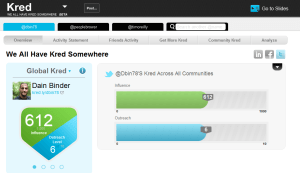
There are a number of other social ranking sites. The one which is gaining the most interest is kred.ly. At the moment Kred.ly is limited to analyzing people’s Twitter feeds only. However, Kred.ly may become very useful as it’s linked into a website called peoplebrowsr. Peoplebrowsr aims to give marketers and communicators access to influencers. The idea goes that you’d be able to identify people who are specialized in a certain topic and then pay them to promote your company or service. I’d love to hear from anyone who has used kred.ly and peoplebrowsr, especially in the Middle East.

Screenshot from social media analytics site kred.ly for blogger Dain Binder

So let’s give an example of what I’d be looking to do if I was working in tech. First thing would be to identify people with a big enough audience and enough credibility to influence others. One such user may be a prolific twitter user and the founder of saudimac.com Khaled Abdulrahman. Tweeting with the handle @khaled Khaled has over 13,000 followers and regularly updates his web site.

http://twitter.com/#!/khaled/status/153421180550922241

Khaled is a great example of an influence as he uses multiple sites to engage with an audience.

The challenge I have now is how to work with or influence Khaled. Traditional marketing would have meant paying the influencer. This is common for celebrity social media endorsements. However, this doesn’t always have to be the case with bloggers and topic specialists. Many may be willing to support you if they believe in the cause that you are promoting or if the content you give them is relevant or interesting.

The beauty of Klout, kred.ly and other tools is that they’re either free or fairly cheap to use. So when you’re next looking for people to help you communicate to an intended audience you’ve got no excuse for not finding the right influencers on the world wide web.

To #socialmedia or not to social media – #Gulf newspapers say yes, Gulf governments say no

The last twelve months have been a defining year for social media across the Middle East. Citizen journalism has flourished. Most of the mainstream media publications have also adopted or begun to adopt social media as another channel to reach the general public.

The first adopters were media outlets in the UAE, particularly those who were already well established digital media. You have the likes of arabianbusiness.com who tweet at @ArabianBusiness – the site has over 27,000 tweets and 13,000 followers on Twitter and almost 3,500 likes on Facebook. Dubai’s largest English-language newspaper Gulf News which tweets at @gulf_news, has over 21,000 followers on Twitter. Abu Dhabi’s The National has a number of prolific social media users on its writing staff, including @ben_flanagan…

http://twitter.com/#!/ben_flanagan/statuses/151940336132964352

…and @amna_alhaddad

http://twitter.com/#!/amna_alhaddad/statuses/151968268817661952

Interesting for those based outside of the UAE is how media re now turning to Twitter and Facebook. Saudi’s largest English-language publication, the Arab News, has long had a Facebook site. Arab News has more likes than Arabian Business. Rival publication Saudi Gazette has a Twitter feed on its site, and recently launched its Twitter handle, @TheSaudiGazette, last month.

http://twitter.com/#!/TheSaudiGazette/status/140188317839917056

Similarly in Bahrain, its largest English-language newspaper the Gulf Daily News now has Twitter and Facebook aggregator tools on every newspage. We’ll doubtless see more media using social networks to reach a wider audience.

While the Gulf’s media is moving ahead with social media, the region’s governments are clamping down on what could be termed anonymous social media users probably due to the role that social media has played in the Arab Spring.

Bahrain was the first to propose legislation. The country’s parliament discussed new punishments for cybercrime that include 10-year prison sentences and fines of up to 300,000 Bahraini Dinars. Kuwait and UAE are following suit. Both countries have questioned and/or detained bloggers of late for varying reasons. One article this week in Kuwait’s media suggested that the country could ban anonymous social media activity.

http://twitter.com/#!/Shusmo/statuses/151729250351845376

UAE officials have suggested that anyone caught using social media ‘irresponsibly’ will be punished.

http://twitter.com/#!/KABRASS101/status/151644446029647872

Will the drive to regulate social media in the Gulf work? Can’t wait to find out!

Viral conversations – Saudi Women’s Forum streamed live with #womanforum hashtag

I often get asked about Saudi Arabia, about its people, customs and culture. But every so often you can get a glimpse into this magic kingdom and enjoy a peak at the real Saudi. Last week, on the 10th and 11th of December, the Saudi Center for Women’s Studies held a conference on women’s rights and responsibilities. For the first time I can remember for such an event, it was streamed live on the internet, including with commentary in English.

While I’d love to have a peak at the number of unique users on the site, social media activity in the Kingdom surged during the two days. Writing with the hashtag #womanforum Saudi and Arab nationals shared and commented on the views presented by the speakers (as this is Riyadh/Saudi women speakers did not share the same hall as the men and so were not visible in the video if you were wondering why there seemed to be no women at a women’s conference).

Most of the tweets and updates were in Arabic, but others did post in English.

http://twitter.com/#!/commitmentphobi/status/147175873446019073

The organizers of the event even used Facebook to upload pictures of the event and the speakers involved. If I can dig out the link I’ll add here.

Several days later in both English and Arabic media articles were published on the event. Here’s the link to the Arab News story, and the other for the Saudi Gazette piece.

While the media did pick up on important aspects of the event, the pieces were published several days after and lacked both the immediacy of the social media feeds as well as the cut and thrust of the debates online. With Saudi women and their rights being such an important topic in the Kingdom today, you’d have to ask if one article in a newspaper could do justice to the entire event.

As an addition to the above much of the argument for Saudi women working has been waged online. This is one video that was circulated this week using the womanforum hashtag. The video was uploaded in March but was circulated again this time round due to the renewed focus on women’s rights and work in Saudi. There’s nothing like a viral conversation, even in the magic kingdom.

Bahrain’s order to reinstate unemployed employees, students and #BHSacked

The recent events in Bahrain have been covered from a to z locally, regionally and globally. Much of the conflict between the government, its supporters and opponents has gone online. Bahrain has seen a surge in the use of social media this year both pro-government and pro-protestors.

As the conflict in Bahrain has ebbed and flowed much of the debate has gone online. One group of Bahrainis who have been particularly vocal have been those who lost their jobs and university places due to their actions and views which they expressed publicly.

This group, led in part by the medics sacked from Salmaniya Hospital and other medical institutions, have been pushing for their reinstatement. The campaign, much of which has been directed online via Twitter and Facebook, has been given added impetus by the findings of the Bahrain Independent Commission of Inquiry report which investigated human rights abuses committed following the events of 2011 in Bahrain.

In its report, on pages 406 and 407, the Bahrain Independent Commission of Inquiry called for the reinstating of those who were fired from their posts. To quote verbatim from point 1664.

More generally, the report confirmed that, following on from HM King Hamad’s Eid speech, it was decided that there would be no further dismissals when the remaining 1,423 cases were reviewed. The maximum penalty upon review would be a 10-day suspension from work and salary. In other words, 1,423 dismissals by the public bodies have been overturned by the CSB and these people have already gone back to work on normal pay.

Despite the official statements there still seem to be many on the island who have not returned to work. Protests have been ongoing before the release of the BICI report at the end of November. Activities by those demanding their reinstatement has been stepped up over the past week. These protests have been extensively covered online via social media. Using the hashtag #BHSacked protesters have extensively uploaded pictures and videos of their protests.

One of the sacked doctors today protesting outside Bahrain's Ministry of Labor

They’ve also sent their messages to prominent journalists on twitter such as @nickkristof. Check out the link for a video shot from an iPhone today at the protests outside Bahrain’s Ministry of Labor.

What’s most interesting from a corporate communications point of view is how many of those who support this group have set up their own twitter accounts in the name of companies who have laid people off, including Alba and Gulf Air. Here’s a link to one tweet from a profile called antiBatelco (I’d love to embed but Twitter still hasn’t rolled out the option yet). They’ve used company logos for their account profile pictures. None of the companies affected seems to have taken to social media to defend their actions.

So what does the government of Bahrain do? What can it do? Not much legally, seeing as the human rights commission appointed by the King himself has stated that those who were fired be reinstated to their jobs. There’s little hope that people will fade away after a period of time either. As those protesting are both unemployed and educated there’s little hope that they’ll either stop protesting or taking their cause online.

The difference today is how social media and the use of images and video can keep a campaign running and running. Both sides in Bahrain have been quick to take up the use of online tools to argue their cases. However, digital media changed who now has the most share-of-voice and influence. Social media has exacerbated that shift. A group of motivated and IT-savvy activists with a couple of iPhones and Blackberries with internet connections can now challenge their governments. Where do we go from here? For those protesting back in Bahrain, it’s to get back to work.

If you understand social media then put your hand in the air

The past year has shaken so many pre-conceived notions about the region, not least how people communicate with each other. Only a couple of days ago research from Paris-based Semiocast showed that Arabic has become the fastest growing language on Twitter. Equally Facebook has become one of the most frequented sites in the Middle East and its usage grew by upwards of sixty percent over the last year in. If anyone has any specific figures on Facebook growth and subscriber numbers for the Middle East then please do pass along.

This is fantastic if you’re a marketeer. You have endless social communities you can directly reach out to, for your brand or your products. Unlike most conventional media in this region which aren’t audited for circulation numbers, marketeers can track their spending via social media through a host of tools. With the cost of social media comparatively low compared to traditional advertising and the increasing numbers of people online and using sites such as Twitter and Facebook, you’d think marketeers would be jumping out of their seats and kissing their monitors.

My question is do companies understand social media? I’ve had several recent eye-popping examples of how firms don’t seem to understand what social media is for. There’s the case of dairy giant Almarai which failed to push through pricing increases due to a lack of direct online communication with its consumers.

But even those firms who are using social media don’t seem to understand the directness and spontaneity of digital dialogue. One exec from a digital marketing firm told me of how he’d have to have five signatures from his client before posting anything on their Facebook site. A personal experience with Dubai-based bank Standard Chartered on their Twitter feed and Facebook sites also summed up for me at least the frustrations of how social media is being used here. Rather than answer a question and have the authority to help out, the same old ‘these are the rules, we can’t do anything’ line was rolled out. If you can’t do anything, then why are you interacting with me? To increase my frustration with your brand and service?

I recently looked over a social media plan from a European-based agency, and while all the reporting structures are there to say who is being targeted and why, I still feel that the point is being missed. Social media is about a dialogue, it’s about engaging with the public in real time by people who know your company and who are able to solve an issue. It’s content and authority rolled into one. If you can get that right, then you empower your customers who in turn will listen to what you have to say. If you get social media wrong, you only end up compounding a customer’s disappointment and frustration with your poor service or product.

Social media. Is there anything more revolutionary for the marketing industry today? Let’s hope that companies in the region cotton on before a consumer Arab Spring shakes up the business community.

The power of social media in Saudi – How consumers took on Almarai and won

The past year has been one of transformation across the Middle East. What has happened on the ground has been mirrored online. Today fewer people out there across the Arab world would deny that the internet will make a difference.

The Arab Spring as it has been labeled by the media has affected the way that consumers interact with brands and their products/services. Arab consumers, particularly young consumers, are much more willing to voice their frustrations and concerns online. If pushed, they will also take on brands and coordinate their actions with others online in what could be dubbed concerted campaign-like actions.

We’ve seen a number of examples of consumer-led action in 2011. There’s been the widely publicized #Qtelfail campaign which highlighted how unhappy both foreigners and Qataris were with Qatar’s government-owned telecommunications firm Qtel. Then there was the #VodafoneShokran hashtag which was used by Egyptians to criticize the global telco for its decision to turn off its network during the Egyptian uprising.

Even Saudis have gotten into the habit of getting online to flex their consumer muscle. On July 3 the largest dairy producer in the Middle East Almarai raised the price of a two-liter bottle of fresh milk from seven to eight Saudi Riyals and reduced the size of its one Saudi Riyal laban from 200ml to 180ml. The company had justified the price hikes by pointing to increasing costs for raw materials, packaging and higher wages.

Saudi consumers went online to protest at the price rises. Those on Twitter used the hash tags #mara3i, #StopMara3i to voice their concerns, noting that other diary companies had not raised their prices. A Facebook page calling for a Gulf-wide boycott also attracted hundreds of followers.

Boycott-related images posted on Twitter internet included a photo of Almarai-branded laban bottles in a store overlaid with text reading “Let it rot.” Another picture, from a Saudi Twitter user, featured a bottle of Almarai laban with the caption “Go to Hell My Friend – Saudi Citizens.”

“Usually, companies raise their prices if it suffers losses,” said statement written on a Facebook page set up to boycott Almari’s products. “Well, this is absolutely not the case for Almarai, one of the biggest Saudi companies in terms of revenue. Why does it want to raise profits? Is it willing to form an economic empire at the expense of the crushed citizen?”

Egyptian newspaper Al-Ahram published a few of the thousands of comments published online. “They exploit us by increasing prices and consumer protection doesn’t turn a hair,” Abdul Aziz Al Qobeishy said on “together to face the greedy Marai.”

Another Facebook user, Yasser El-Harbi, said “Go on people and AlMarai will remain an unforgotten lesson for vendors in different sectors.”

The outburst and consumer backlash was so pronounced that the Saudi Ministry of Commerce stepped in. The Minister himself issued a decree to force Almarai to revoke the price rises which the company duly did on the 11 July.
In a written statement Almarai defended its initial decision to raise the price of its products.

“In compliance with the resolution issued by the ministry … Almarai is taking the price of its two litre fresh milk and laban pack sizes in the kingdom of Saudi Arabia to the level that prevailed with immediate effect,” the company said on its website the day after complying with the ministry’s ruling.

“However, Almarai believes that the rationale and justification for the price increase is still valid. We will continue to work with the relevant government authorities to address this issue.”

What’s so striking about the Almarai incident is that it took less than eight days of anger to surface through sites such as Facebook, Twitter and blogs or discussion boards for the Saudi authorities to take action. Almarai is listed on the Saudi stock exchange and its founders/owners include the Saudi Royal family.

It’s even more remarkable when you consider than hardly any traditional media outlets had covered the story prior to the ministry’s decision. That the ministry took notice of the thousands of Saudi consumers who had vented their anger online is an indication of how powerful social media has become.

Contrast this to the decision by Coca Cola and Pepsi to raise the price of a can from one Riyal to one and a half Riyals several years back. Despite a consumer backlash which was led by traditional media outlets such as newspapers the Ministry of Commerce did not step in to rescind the price rise.

I feel in part that social media has become a much better barometer of consumers’ feelings than traditional media in countries like Saudi Arabi. The Almarai boycott is a simple example of this.

What Almarai also proved is how bad Saudi firms are at communications and public relations. Rather than reaching out to consumers the company acted as if it was immune to criticism. The company’s CEO talked to a business news channel, MBC Al Arabiya, rather than talking to his customers. Almarai issued statements to the Saudi stock market rather than getting people online to start a discussion with disgruntled consumers. The company failed to talk with Saudis who buy its products and was duly punished for ignoring them.

Following the boycott Almarai has set up a communications department, in part to tackle reputational management issues as well as crisis communications. However, I’m not optimistic that if Almarai does try for a second time to raise prices the company will be ready to tackle the backlash. For that to happen, the management needs to understand that they have to reach out to consumers, talk with them both online and offline, and understand their concerns. I hope I am proved wrong.