The Magic Kingdom always seems to get a bad reputation when it comes to adoption; everyone else always seem to think that Saudi Arabia will be the last to the party. However, on my last trip to Riyadh a couple of weeks back I was pleasantly surprised to see QR codes at the airport and throughout the city.
I’m sure that even if you can’t recall what QR codes are, you will have seen them in magazines or on posters. QR codes (the QR stands for quick response) are optical machine-readable labels which resemble bar codes. QR codes have become popular in consumer advertising in the United States, Europe and Asia due to their ease of use and the ability to guide/track a consumer’s actions through the technology; smartphone users (that’s most of us nowadays) can use QR-code scanner apps to open a website which relates to the advertiser and its products. For an example of a QR code have a look below; the code is even branded.
A branded QR code from the BBC (credit: shadowdev.com)
In Riyadh’s King Khalid Airport the mobile operator Mobily is using QR codes on its advertising boards to direct traffic to product microsites. Riyadh Municipality is also using QR codes to help the public identify street names and places. Similarly, Jeddah Municipality has started rolling out a QR code tagging system for its streets. To quote from the English-language daily Arab News article.
Visitors and residents will be able to learn of a street name, location and GPS coordinates by taking a snap shot using their smart phone reader.
“The signs have already been mounted at number Jeddah’s districts,” said undersecretary for projects and urban construction at the Jeddah mayor’s office Ibrahim Kutub Khana. “This includes Basateen, Muhamadia, Naeem and Salamh. These new signs includes a property’s GPS coordinates, street name and location inside the district. To make locating and navigating in Jeddah more easier and convenient visitors and residents.”
By pointing their smart phones at the QR code tag, all the information is stored inside a database. The information can be accessed through satellite positioning systems.
Plans are also under way for installing additional new signs in more of the city’s districts.
Not only are advertisers using QR codes, but the Saudi government has managed to implement a system for two cities, each with a population of seven million people. How’s that for a regional first? Let’s hope other advertisers in the region follow the Saudi lead and start using QR codes in their advertising/content.
When it comes to online shopping, you should pity us poor souls in the Gulf and the wider Middle East. There’s no Amazon and no eBay. We’ve only had our own iTunes store for a couple of months (Apple officially launched its UAE iTunes store in December of 2012). When we refer to online and shopping in the Gulf, what we really mean is messaging our friends on BBM or Whatsapp while roaming the nearest/biggest mall in town.
There are some brave souls who are trying to make a difference and fight the good fight. One of my favorite sites is Dubizzle, which specializes in online classified advertising across 13 countries in the Middle East and North Africa region. Basically put, whatever you need, you’ll find it being sold on Dubizzle.
And now comes the fun part. I wouldn’t have thought that people in this region would take to the internet to buy cars, but after receiving a number of stats from Dubizzle’s very friendly marketing manager I’ve been proved completely wrong. Have a look at the below Infographic and then tell me why we don’t have more e-commerce companies operating in this region.
You think people don’t buy cars online? Have a look at this, and think again.
A couple of days ago was a very special day. Many years back something of immense importance occurred and I popped out into this world. I’m so proud of this day that I tell each and every company that I come into contact with online through their forms pages. My favourite firms out there are the airlines, who want me to repeat my birth date each and every time I think of flying with them.
Well, that special day which only comes once a year neared and I was pleasantly surprised to receive a host of name customized emails from businesses I have dealt with reminding me it was my birthday. I’d used Bahrain Air a couple of times, most recently at the end of May in 2012. I was impressed that they’d set up the feature (it isn’t too hard to automate the process if you have a good database and e-marketing tool) and that they’d not only sent it to my own email but also my wife’s email which I’d booked for the same trip.
Thank you Bahrain Air for the kind thought!
And then there was another airline, the airline which we were traveling on that very day. I first traveled on Emirates in 2003 and love the airline. However, did the good people remember this ground-breaking day? Unfortunately they didn’t, despite me reminding them every two weeks when I travel between Dubai and Bahrain. No card, no happy birthday. There was a boarding reminder however (does that count?).
Technology is a wonderful business leveler. I was impressed by an airline that is low-cost and that has a fleet of four planes. In contrast Emirates has at least 190 planes and spends ridiculous sums on marketing every year, which Bahrain Air certainly does not. That Bahrain Air was able to make an impression at such a low cost says wonders for their marketing team, unlike the good people at Emirates. Now if only they were able to offer an added incentive to travel with them, a call to action such as a small discount, I’d probably have gone and booked immediately.
As for Emirates that day, even the world-class persuasive powers of my wife weren’t enough to get us an upgrade (it’s his birthday she said with a stern voice). And to top it off, the in-flight entertainment system wasn’t working. Oh well, at least we were spared from the 15 minutes of advertising that the airline is now showing in-flight.
At least I didn’t see this on my in-flight with Emirates… (Photo credit: Themetapicture.com)
If you’re looking for a way to beat the Saudi speed traps look no further than Twitter!
Saudis are ingenious. And they don’t like to be told what to do. When you combine the two the results are imaginative to say the least. I’m late to the game on this one but I was intrigued when a family member showed me the latest attempt to beat Saher, the country’s traffic cameras which have been fining speeding Saudi drivers ever since they were installed back in 2010.
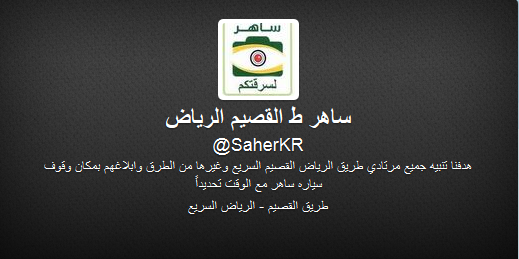
The friend opened up his phone, went to his Twitter feed and clicked through on to one Twitter account, named @SaherKR. This feed can be used by followers to alert their fellow Formula One drivers of any mobile or fixed Saher cameras, checkpoints, or any other inconveniences on the road between Riyadh and Qasim. One example is below.
There’s dozens of these accounts today in Saudi. My favourite is @Saher_khj which is followed by 10,000 Twitterers and gives all the details needed to avoid speed traps including the exact area of the camera, the speed limit and the time of day the user has passed by the camera.
“@hizamfahd: @Saher_khj للمتجهين للخرج ساهر قبل مفرق ام الشعال بعد مخرج ٧
I am left asking myself however how these people have the time to write a 140 character message while most likely doing 150 kilometers an hour in their Toyota Camrys or Hyundai Accords. Maybe that’s why their driving is so erratic as they’re shuffling their fingers across their iPhones whilst attempting to steer the car?
This isn’t the first time that the Saudis have used technology to overcome pesky government interference. The first widely reported solution was a mobile phone application called Trapster which alerted drivers via their iPhones of speed cameras in the vicinity. The application proved so popular that mobile phone shops were charging customers over $100 dollars to install on the iPhone. The application itself was free (if you don’t believe me, it’s printed in the media so it must be true).
And the fun part of this detective work? The family member who showed me all of these Tweets works as a senior manager in the Saudi Interior Ministry and is responsible for road safety. Boys, they know who you are and where you are! Ticketing by Twitter? Sounds good to me!
Based on the latest statistics shared at the Studio Edge event Facebook is the one network to rule them all (unless you’re a keen bird watcher that is)
Facebook came to town last week, and they brought lots of numbers with them. I was lucky enough to be invited along to the first Studio Edge event in the Middle East region. And I was astounded by the numbers that the team kept on rolling out. I’ve summarized these numbers below for you.
According to Facebook’s own research there are fifty three million active Facebook users in the region who use the service at least once a month. Egypt is Facebook’s largest market, followed by Saudi Arabia and then the United Arab Emirates.
Fifty two percent of Facebooks users access the site solely through their desktops and laptops; thirty eight percent use both mobile phones and computers, and ten percent only use their mobiles updating their profile and other Facebook activities. Twenty million people in the Middle East and North Africa are using Facebook today through their smart phones.
The average age of Facebook users in the region is 27 years and 64 percent of MENA users are male. That’s in contrast to the global split of male to female users which is currently 50/50. MENA Facebookers spend approximately seven hours on Facebook a month (that’s double the global average). And fifty two percent of Facebookers in the UAE use Facebook whilst watching television.
Middle East Facebook users like 84 pages compared to the global average of 51, and they view approximately 550 pages a month. Over forty percent of their time is spent on the news feed section of Facebook.
And to top off all of that, Facebook’s user base is growing in excess of 20 percent in the region.
With all of this information above, I’m hoping that we’re going to see more businesses online using the site. But if there was ever any doubt that Facebook is a first-tier consumer communications channel then please do re-evaluate how you use the network and start using the site properly.
One other interesting observation from the Facebook event. Most of the attendees were from advertising and creative agencies. I only spotted one public relations company. And yet, Facebook is all about content. Shouldn’t the Middle East’s PR industry be getting in on the act and promoting the quality of its social media services more?
I was reading over the news this week and came across an announcement by General Electric. The American engineering giant recently announced a one billion dollar investment in the Kingdom, including the establishment of an innovation center in Dhahran’s Techno-Valley in the country’s oil-producing Eastern Region (you can read about the announcement here).
The company showcased the facility last week to a select number of media, and gave a glimpse into how the center would be the focal point of the company’s engagement with local customers, Saudi-based researchers and universities and industry groups. More cryptic (to me) was the statement that the GE innovation center will act as a hub where “entrepreneurs and companies can incubate business ideas and pursue innovation in energy efficiency, aviation, healthcare, and elsewhere.”
I’m always thrilled to see investment into Saudi Arabia, particularly when it’s focused on knowledge transfer and supporting Saudi nationals in developing their skills and abilities. But one question has stuck in my head. What is innovation in this context? Will we see new technologies and products being developed by GE and its partners in Saudi? And why Saudi Arabia for an innovation center?
To be fair, the region is not known for developing world firsts, unlike the United States. In the 2011 there were two million patents filed worldwide. Of that number Saudi Arabia filed for 990. The Kingdom is primarily known for its consumption of goods rather than value creation through local entrepreneurship and knowledge creation.
Efforts have been made to introduce systems and concepts to foster more local innovation – the Kingdom’s Saudi Arabian General Investment Authority has set up various centers to support entrepreneurs establish new companies and increase the competitiveness of small to medium sized businesses. There are 120,000 plus Saudi nationals studying at universities abroad under the King Abdullah Scholarship Programme, whose knowledge will also make a major impact on the nation’s economy.
There is one area where Saudi Arabia innovates and that is in the oil and gas sector. Situated in the Eastern Region, King Fahd University of Petroleum and Minerals (KFUPM) is renowned for its academic research into the oil and gas industry. KFUPM has successfully partnered with the private sector to further its academic research and find practical applications for its academic output.
My hope is that GE’s new innovation center, which is located alongside KFUPM, will build on the wealth of oil and gas/energy knowledge that has been created in the Kingdom’s Eastern Region to create new applications that we will see being put into use in other parts of the Middle East.
For me, innovation is taking that (in many cases) latent ability and talent and nurturing it through mentoring, support and guidance. If GE can pull this off, and gradually benefit the many industries that GE has a hand in on a local level I’ll be delighted as will many others who understand how much Saudi and its people are capable off. Let’s hope others follow in GE’s footsteps and consider their own innovation investments in the Kingdom.
GE has committed to support Saudi innovation alongside KFUPM. When will other multinational companies follow?
Is energy a problem for the Gulf? At first thought one wouldn’t think so. However, the Gulf region is facing a ticking bomb. To put it as simply as possible, the cost of producing electricity is becoming unsustainable. Demand for electricity has reached a point where countries are burning up to a fifth of their daily oil production. Unfortunately electricity prices have barely risen over the past couple of decades.
I didn’t realize the scale of the problem of electricity subsidies and the growing demand for electricity in the Gulf region until I worked in the energy sector. The issue is slowly gaining the attention that it deserves. One of the most impressive public sector leaders I know, Dr Saleh Al Awaji, has been constantly working to highlight ways to reduce energy consumption in Saudi Arabia. Only last week the BBC’s Middle East analyst Bill Law wrote a compelling article on the subject, which should be read by everyone who is concerned about energy consumption in the Gulf.
Bill Law’s article on electricity subsidies makes for a a compelling read.
And this brings me to my argument. In marketing and communications we all hope to plan and work to a long-term plan. For me, what distinguishes the good from the great are those professionals who know when and how to seize the moment, take the initiative and weave these waves of interest in related subjects into the communications plan.
So, what would make sense within the context of the above issue of energy subsidies? Possibly a company’s vision and thoughts on how its technology can reduce residential energy consumption, or improve the efficiency of electricity distribution, or ways in which alternative energy can complement traditional fossil fuel energy production.
The idea is simple. But it’s all about timing and approach in order to gain the maximum coverage for a company and its thought leadership. I’d love to see how energy leaders such as GE and Siemens are aiming to help the Gulf’s utilities and governments in averting the electricity subsidy cliff.
Of course there are times when it may appear in bad taste to seize the moment and partake in tactical, opportunistic communications activities. For example, promoting armored backpacks days after the devastating school shooting in Newtown.
If you were a company producing armored backpacks for school children would you promote your product after a deadly shooting?
Years ago, there was only one, the phone to rule all phones. No body ever asked for a phone. They asked for a Nokia. Saudi Arabia was the land of Nokia. And the rest of the Gulf wasn’t far behind. One tale I was told about the Finnish phone behemoth was that Saudi was the largest market worldwide for Nokia’s Communicator series of phones.
Saudi ten years back. Yes, Saudis loved their Nokia Communicators (this isn’t a Communicator but they’re about the same size).
And the came Apple, followed by Samsung, HTC, Blackberry and other mobile devices of all shapes and form. And Nokia was no longer the same company that it was before.
But then, there was a change. Nokia came together with Microsoft. And something new was born.
The Lumia 920 in all its glory. Yellow is optional.
The portents didn’t speak well for the partnership between the two companies. I remember owning a Windows-based SPV phone about ten years ago. While the phone did last, it wasn’t the easiest device to use. Microsoft hasn’t had a good track record when it comes to mobile operating systems. And Nokia’s Symbian has died a death. How would the two companies compete with Apple’s iOS software and Google’s Android platform?
As a reformed optimist and a gadget monster I took the plunge and ordered a new Nokia Lumia 920 on its release last month. I liked the look of the hardware – the Lumia has a 768 by 1280 pixel screen which is slightly larger than the iPhone 4, a 1.5GHz dual-core Qualcomm processor, 32Gb of storage, an eight megapixel Carl Zeiss lens camera, NFC, Bluetooth, HSDPA and HSUPA connectivity and all the Wi-Fi that you’d need. The phone is chunkier than most, weighing in at 185 grams and with a dimension of 130.3 by 70.8 and 10.7mm, but I like my phones chunky and plumpy.
Going beyond the hardware, what I liked most about the new Nokia Windows-based lineup was the software. The operating system is simple to use with tiles on the front page to heavily-used applications and functions. The front screen can be easily customized to meet the needs of the user, it’s intuitive and copying files to and from the phone is so simple (though Microsoft still needs to work on the Windows Phone app which tends to crash when copying music). I can also sync files to my desktop and laptop using Microsoft’s Skydrive. All in all, the phone’s operating system is a joy to use and Microsoft is heading in the right direction when it comes to usability (though I’d love to see more shortcut buttons or tiles.
But there’s more good stuff to come. Nokia has long been a leader in the maps space following its acquisition of Navteq in 2008. The maps on the Lumia 920 are rich with detail including 3D rendering, they’re simple to use and most importantly they’re full of detail. With Nokia Drive you can do away with any other GPS software and hardware you may use for driving. Again, the system is easy to use, the voice directions are clear and I haven’t found any glaring mistakes in terms of geography and topography.
The most fun thing about my Nokia 920 experience so far is the Nokia City Lens, which is the smartest use of augmented reality so far. Basically, the City Lens allows you to look at the screen and view what locations of interest are nearby (be they restaurants, hotel, museums, shops, or even famous sights). Once you click on a point of interest you’ll be able to view pictures, read reviews and be guided there by Nokia Maps. Much of the content on Nokia City Lens is consumer-generated, which is going to make the application even more interesting as time goes by. As my brief explanation hasn’t the app any justice have a look at the embedded video.
I have tried the camera and true to form Nokia’s cameras as wonderfully clear. There’s much more I need to play around with on the camera settings, but I leave the photography to my talented wife.
And the downside? The applications, or lack of, currently available for the phone. There’s no Instagram as of yet and no native Twitter application, Whatsapp is still unstable, and compared to the iPhone and Android-based phones Microsoft needs to do more to convince developers to create apps for Windows 8 Mobile.
Having tested the phone both at home and abroad I know that Nokia is onto a winner. The Windows 8 environment will grow and develop with time and Nokia has bet its future on the operating system (it’s only crashed twice, which is remarkable for a Microsoft device). I’d love to see Microsoft publicize the operating system more (they’ve been surprisingly quiet in talking about Windows 8 Mobile despite it being crucial to their vision of a connected PC-phone-tablet ecosystem).
The question is now, will Nokia pick itself up again in the Gulf? While Blackberry is dying a death globally, the Canadian manufacturer is still doing remarkably well in the Gulf due in part to its Blackberry Messenger Service. Apple retains bragging rights to the best smartphone around, despite (in my view) doing remarkably little with the device since the launch of the 3GS. And then there’s Google. Can anyone stop the search giant with its Android operating system?
I’m certainly hoping that Nokia comes back strong. The product is one to shout about. Will its marketing be strong and bold enough to cut through the disappointment and ambivalence that many people feel about Nokia today in the Gulf to rediscover the love affair that they once had with the Finnish giant? Toivotaan niin Nokia! Game on Apple!
Will Iran’s version of Youtube be as big a hit as the original?
The second story wasn’t as funny. The International Telecommunications Union had gathered its member states in Dubai to discuss a number of issues at the World Conference on International Telecommunications. The one which hit the headlines was internet regulation. In short, a number of countries from the Middle East and other emerging regions submitted proposals that would have allowed member countries to monitor and control data flowing through their respective parts of the internet.
While this is already happening in many parts of the world, the proposed resolution would have basically made it legal and proper for all 190 or so of the ITU’s “member states” to have the power to regulate the Internet to promote security, fight spam, et cetera.
I for one am concerned about the future of the internet and online access. While internet filtering and domain blocking isn’t new to the Middle East (the Gulf’s telecommunications bodies block material that they deems offensive including religious or pornographic material) it’s clear that the past two years have opened a Pandora’s box when it comes to control of the internet. Governments in Egypt and Tunisia tried to close off access to the internet to stop revolution. That didn’t work. Gulf countries have legislated against online threats. As I’ve pointed out above Iran is building its own country-wide internet whilst blocking access to foreign-hosted sites that pose a threat to the Islamic Republic.
So where are we headed to next? How far will governments in the Middle East go in order to secure their own national communications networks? And is there anybody or anyone out there who will bring some common sense to the issue of web regulation in the Middle East?
While I don’t expect multinationals like Google and Yahoo (or even Facebook) to step up to the plate and say to Arab governments we will not regulate the web for you (after all, Yahoo and Google didn’t say no to China), I am hopeful that the region’s populations will become more vocal about their online rights. Egyptians and Tunisians have proved that they will demand and protect their new-found rights. Let’s hope others, especially in the Gulf, will begin to seriously think about what their governments are doing online and asking:
Who is watching me online?
What online data do they want and why?
Can I be jailed for my online activities? Do I have to self-censor my thoughts and activities?
What is the future of the internet in the Middle East? Are we headed towards a patchwork of national or regional wide webs aka Iran? Or will sense prevail? Goodness knows we need commerce and entrepreneurship to flourish in this region to generate more jobs and an open internet is essential to both. Answers on an email, an online comment, or (if your connection is monitored) a postcard please!
Are you up for some (more) government censorship and online monitoring?
I love entrepreneurs, I really do. At their best they’re gutsy, bold, decisive, innovative, and they’re not afraid of risk. Frankly, we need more entrepreneurs in the Middle East.
I had the pleasure and the opportunity to meet the person behind the idea of souqalmal.com last week. After stints with GE, Mastercard and the consultancy firm Bain Ambareen Musa took the jump into the entrepreneurial space to found souqalmal.com.
Souqalmal.com is the first website I’ve come across in the region which provides a comprehensive view of a variety of financial products, including credit cards, personal finance, home and vehicle finance, insurance and personal banking accounts. In other words the portal is an Gulf-based version of money.co.uk (the site presently caters to Kuwait, Saudi Arabia, and the UAE) and is both incredibly easy to use as well as very handy when comparing different products in the market.
Souqalmal isn’t just about providing the basic data however. The site lets subscribers rate products, just as you would do on a Tripadvisor for a hotel or amazon.com for a book. As a consumer you get to rate that service and provide your input to hundreds and thousands of others who will be using the site. That consumer feedback element should raise the bar for the financial services industry in the region by highlighting what is both good and bad about the product and it services.
What I love most about what Ambareen is doing is that she’s established a business that is providing a much-needed public service. She’s dived in, she’s pushing ahead, and I do believe that she and souqalmal.com will improve what and how the financial sector offers and deals with the region’s consumers. I for one wish her all the success in the world, and can’t wait to start putting down my thoughts on souqalmal’s review sections!
Will Souqalmal.com and one person’s entrepreneurial spirit change the face of consumer banking in the Gulf? Let’s hope so!





 Alex of Arabia's Blog