Turkey, Twitter and how a ban couldn’t/wouldn’t happen in the Gulf

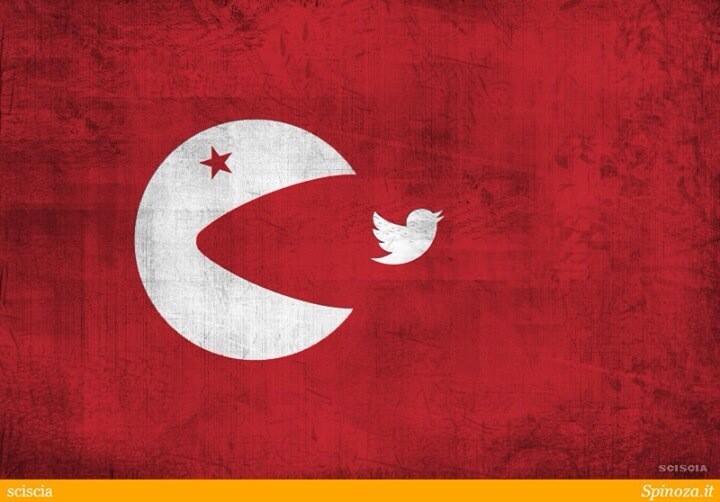
While Turkey is busy trying to gobble up Twitter, there’s little chance of anyone in the Gulf banning social media any time soon (image source: http://www.globalpost.com)

Last week, we in the Arab world were treated to a spectacle that we’re all too often participants in. Instead, we looked on as the government of a neighboring country pulled the plug on a social media service and denied its citizens and residents the right to use Twitter. The story behind the move by Turkey’s Prime Minister, Recep Tayyip Erdoğan, to block access to Twitter is fascinating, a page-turner about corruption, dissent and how one man is trying to dominate political will in his own country (have a read of the background here, in a wonderful piece written by the New Yorker’s Jenna Krajeski).

A question/tweet by the Wall Street Journal’s Ellen Knickmeyer about the situation in Turkey from a Middle Eastern perspective got me thinking about the subject. Here’s my take on the Gulf states country-by-country.

Saudi Arabia

Let’s start with the largest country in the region, Saudi Arabia. There are millions online and active on social media in the Kingdom (both Twitter and Facebook have fifteen million Saudi users between them – Facebook has approximately eight million users and Twitter just under seven million ). For many, social media is a release, a forum for open debate where anything and everything can be discussed.

The whole spectrum of Saudi society is online and using social media – some of the most popular and prolific tweeters are religious scholars. while there is criticism of policy online, would the government be willing to risk a public backlash any social media channels were to be closed? Rather, Saudi’s social media policy can be summed up in one sentence – do what you want online but we are watching you. Saudi’s online laws, which have recently been rehauled, allow for citizens to be detained for their online activities (a recent piece by Abeer Allam for Al-Monitor covers recent developments in the Kingdom).

Bahrain

The second Kingdom on the list, Bahrain has suffered more than most over the past three years. Bahrain’s social media has become almost as polarized as the situation in the country, between those who support the government and those who support the opposition. However, despite the war of words online Bahrain has never threatened to pull the plug on social media (there was a communications blackout during the early days of the political crisis in Bahrain).

Instead, the island state has tightened up its online legislation and has cracked down on bloggers and other activists who use social media (Global Voices’ editor Amira AlHussaini wrote a piece about the arrest of blogger Mohammed Hassan in July 2013).

The Kingdom uses social media to communicate both locally and globally on issues such as security, foreign policy and terrorism. Would Bahrain seek to indirectly legitimize the opposition’s claims that the government is cracking down on media through pulling the plug on social media? Not likely.

The United Arab Emirates

The second largest country in the GCC by population, the United Arab Emirates has taken to social media like a duck to water; the country’s leadership are online, the country’s businesses are online and the country’s population are also online tweeting, updating their statuses and uploading pictures of every single meal and building around them mainly on their smartphones. The UAE’s population communicates about literally everything, except to criticize.

There’s so few people in the UAE who aren’t supporting the country’s leadership that the thought of any social media being pulled seem ludicrous. For those that do dissent the UAE introduced in 2012 more stringent online laws which include jail time for those that defame the country. These laws have been put into effect.

Kuwait

Maybe surprisingly for those who don’t know the region, Kuwait has the freest media industry in the region, with columnists regularly criticizing government policy. Kuwait’s parliamentary system and the level of public discourse in the country means that few subjects are off-limits. Kuwait’s social media scene is also buzzing – Twitter reckons that over half of the country’s population, 1.5 million out of 2.7 million, are active users.

Even in Kuwait however, there have been cases of people being jailed for their tweets, either for insulting the Emir or for blasphemy. Still, it’s hard to see how or why any social media channels would be banned in a country that is known to enjoy a ‘debate’ every now and then.

Oman

On the periphery of the Gulf, Oman was affected by the Arab Spring. The country’s ruler Sultan Qaboos introduced sweeping reforms to appease Omanis calling for a better standard of living. The country has contended with online activists and the authorities have warned people not to spread libel and rumours that prejudice national security. Would Oman seek to shut down social media? Again, it’s unlikely.

Qatar

Last but certainly not least, Qatar has championed its own brand of journalism aka Al Jazeera for over a decade now. The country with its vast gas reserves has not had to contend with any political discussions about its governance and future. Qatar has jailed one person, a Qatari national, for publishing a poem on Twitter.

In addition, the country’s government is seeking to introduce a revised cybercrime law which would increase and expand the capacity under which a person communicating online could be jailed for (for a detailed news piece read this article by Matt Duffy on Al Monitor here). However, there’s little chance of anyone in government shutting down any social media channels in the country.

In short, social media has changed the Gulf just as it’s changed the world. The region’s citizens and residents have much more freedom to talk about issues online. The Gulf’s governments and their business interests have also become adept at using social media to promote their own messaging and market themselves. The region’s citizens are aware that even online they’re being monitored (this BBC article describes this notion of being watched) and most of them will tread carefully about what they say and how they say it. For others, they’ll go online anonymously and tweet to their heart’s content.

For governments, social media has become a release value on societal pressures and the message to nationals is clear – talk about whatever you want but don’t criticize. Examples have been made of those who do. But, while the governments have the ability to cut off social media and even throttle or close access to the internet, thankfully the Gulf isn’t Turkey. No one here is going to ban Twitter or any other social media channel any time soon.
Dubai Police and the ignominy of being hacked on social media

When your day job is to ensure the safety and security of those around you, it doesn’t get worse than this for Dubai Police. The police force best known for solving crimes in a matter of moments and driving around in swanky super cars (the latest is a three million dollar Bugatti Veyron) has just been hacked by a group with the Twitter handle @TheHorsemenLulz – presumably named after the infamous hacker collective LulzSec.

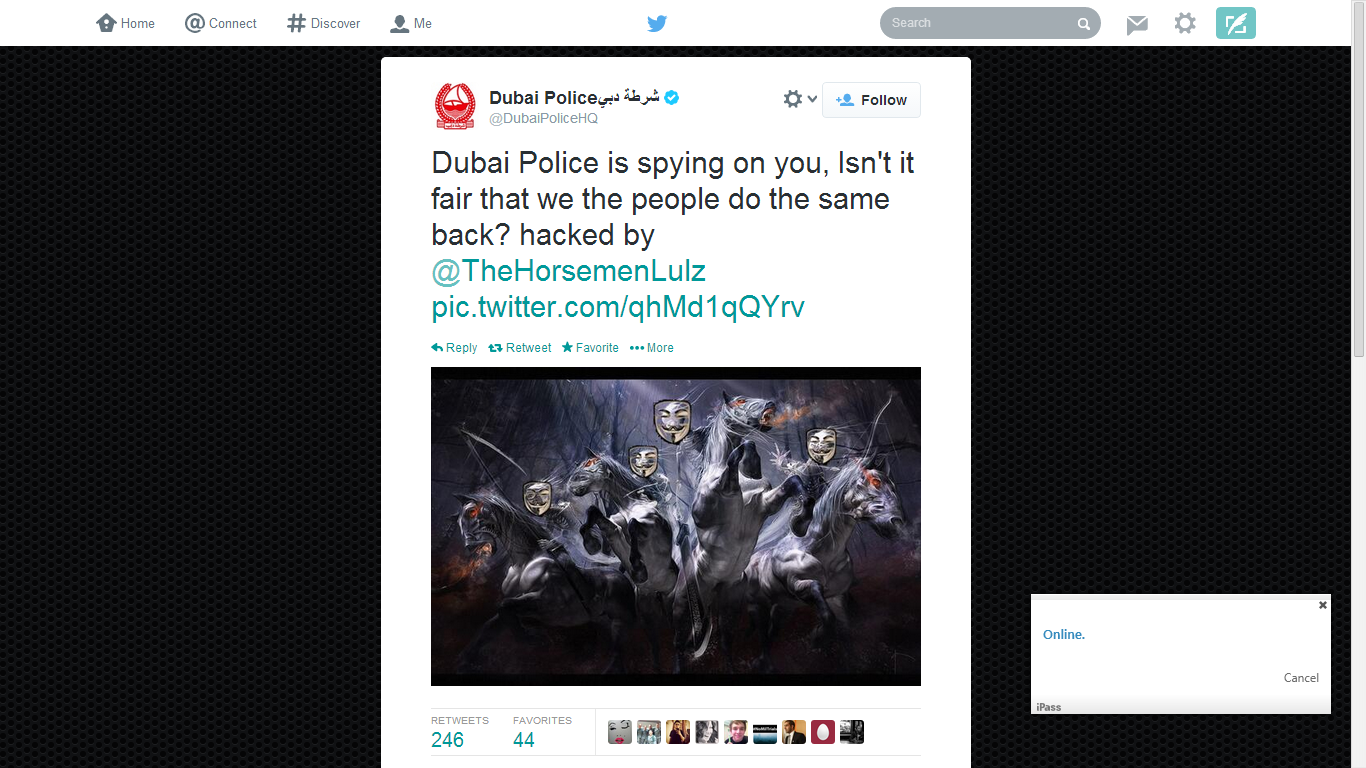
All but one of Dubai Police’s social media sites have been hacked, including Twitter, Tumblr, LinkedIn, and Pinterest (Facebook was the only social media channel that wasn’t hacked). While the images have now been removed, a couple of hours after the sites were compromised, here’s a screenshot of the offending image on the Dubai Police Twitter feed @DubaiPoliceHQ.

A screen shot of the image sent out by the hackers via the @DubaiPoliceHQ Twitter account

A screen shot of the image sent out by the hackers via the @DubaiPoliceHQ Twitter account

While the most obvious questions are how were these accounts hacked and how easy was it to hack the accounts, my issue is more about the group behind the hacks who have claimed several other cyber attacks in the UAE, including crashing the websites of Noor Islamic Bank, the Telecommunications Regulatory Authority and the UAE Central Bank. Do we have a locally-based hacker group in the UAE?

In a Tweet that included the @DubaiPoliceHQ Twitter account the group put out a video in November saying they’d be targeting the UAE Government. While the tweet and the video didn’t make too much sense, why wasn’t the issue taken seriously by those handling the @DubaiPoliceHQ Twitter account? With the UAE’s Government Summit taking place in Dubai tomorrow shouldn’t cyber security be top of the agenda for the public sector, and in particular the Dubai Police?

https://twitter.com/TheHorsemenLulz/status/406006175071625216

Copy and Paste: Gitex news and repeating the same message

I used to joke with a good friend of mine who works as a journalist that companies would often recycle news year after year during the region’s largest technology exhibition. I’d tell him that firms would simply change the date of the previous year’s press release and joke that maybe he’d do the same.

I was reading over one news piece from Dubai Airport Free Zone (DAFZA) during this year’s GITEX. The piece, which I’m pasting below and which is linked to here, is on the launch of the organization’s first official mobile application.

DAFZA launches its first mobile application, in 2013

DAFZA launches its first mobile application, in 2013

I thought I’d seen the news before, so obviously I asked Google. And what did I find?

DAFZA launches its first mobile application news, from GITEX 2011

DAFZA launches its first mobile application news, from GITEX 2011

Copy and paste anyone?

Five tips on how to survive and thrive during Gitex

It’s here, the region’s most manic event. Gitex, the Gulf Information Technology Exhibition, is to public relations and media people what Christmas is to parents of little children who believe in Father Christmas; a ruthless, insane, once-in-a-year event where everyone wants what’s on their wish list and you have to deliver.

From someone who’s done his fair share of Gitex exhibitions both as a journo, a PR person and as one of the organizers, here’s my five top tips on how not just to survive Gitex but thrive despite all of the noise, confusion, and occasional tantrums (you know whom these executives and organizers are). So here we go!

1) A phone with an endless battery

At Gitex your phone will be ringing incessantly. No one has died, there’s no new births to report, and the world is not coming to an end. But if you’re a journalist you’ll be every PR person’s best friend for five days (especially if you work for the official publisher ITP). And if you’re a PR person the pressure to deliver interviews will quickly build to a crescendo. Every single journalist within a four-hour flight will be on your quick dial list. Just don’t let the phone die.

Make sure your phone battery never, ever dies during Gitex. Or else you’ll never be forgiven. (image source: Daily Mail)

2) Lots and lots and lots of caffeine

You will not eat or sleep during Gitex. What you will live on is caffeine and taurine. You will drink coffee, tea, and Red Bull like its water. Gitex veterans will normally lug around with them a couple of cans of energy drinks. And for those new to Gitex, bring lots of small change. The venue doesn’t sell cheap beverages (there is however a supermarket around the corner in the DWTC residences, besides the metro station and opposite Pizza Express).

The above is one way to carry your Red Bull during Gitex, though it’s not recommended. (image source: wikimedia)

3) Ear Plugs

Gitex is noisy. Actually that’s wrong. Gitex is deafening. Exhibitors assume that the higher the wattage from their surround sound system, the more people will stop and watch the models… ahem, executives talking about their business. Gitex is the exhibition equivalent of a Tuesday night club which is hosting a drum and bass session combined with a ladies free-entry policy. If you want to ensure that you leave with your hearing intact then take ear plugs with you. Just don’t forget to take them out when you’re interviewing/arranging for interviews.

Pillows won’t help with the noise pollution at Gitex. Get some ear plugs. (image source: http://www.alpinehearingprotection.com)

4) Panadol, Ibuprofen, Vicodin…

You get the point. At some time during Gitex, you’re going to be hit by the mother of all headaches. Be prepared, take lots of meds with you. And if you don’t have any and the dreaded throbbing and pain strikes then head on down to the pharmacy on the concourse to grab your pain killer of choice.

Bring drugs, lots of drugs! You will need them. (image source: The Guardian)

5) The Patience of a Saint

At some point you’re going to be surrounded by screaming, nagging executives who are behaving like a bunch of toddlers/prima donnaa. There’s really thing that you can do, apart from swallow your pride, paint a smile on your face, and remain calm. Gitex would test the patience of the Dalai Lama, so remember you’re not alone in your frustrations. For the week however, you will have to suffer in silence. Remember that patience is a virtue so stay calm!

Keep calm, take a deep breath. Gitex will soon be over. (image source: http://www.keepcalm-o-matic.co.uk)

What’s your top tips for Gitex? Share and share alike. Remember, we’re in this together!

Meet Fraz Chishti, (possibly) the region’s first Chief Innovation Officer

How important is innovation to you and your business? (image source nbry.files.wordpress.com)

What is innovation? It’s an idea that is also bandied about today. Launch a phone in a different colour? Let’s call it innovation. How about a longer chip? Yup, that’s innovation. Well, it probably isn’t. To me, innovation should be a treasured word. To me, it implies the introduction of a new product or service that results in a transformation, upheaval even, in how we think or act. A simple example could be the car, the internet, or the mobile phone. The point is that innovation keeps us improving and moving forward.

I had the pleasure of meeting a person who does innovation for his day job. Fraz Chishti, who works for Noor Investment Group, is the first Chief Innovation Officer I’ve ever come across in this region. While his CV is impressive – he has a Phd in chemical engineering and has worked in communications, marketing, information technology and project management – what’s different about Fraz is his willingness to question and probe and not accept the status quo.

His opinions, especially for someone working in the financial sector, are different from what you’d expect. For example, Fraz worked with his CTO, the technology department and internal stakeholders to implement an open source application for the bank’s Human Resources department. Open source is a taboo in the banking sector, due to the risks associated with security and the lack of supplier accountability. However, Fraz and his team innovated and worked to develop a solution that met the requirements of a number of parties. Instead of going with an established provider, Fraz stepped out of the box and delivered a tool which, as he puts it, “gets the job done.”

In markets and industries which are becoming increasingly crowded and competitive, companies need to find better ways to distinguish themselves. They can either do that through marketing (which most do), or through a product and service focus. Add to that the disruptive nature of our digital age and consider how rapidly our world is changing.

Just talking to Fraz is an experience in realizing opportunities and unlocking potential. He’s disarmingly honest – Fraz worked with Noor Islamic Bank to understand the potency of social media rather than just jumping in blindly – with a touch of common sense (just ask him about e-commerce).

What’s clear is that Noor Investment Group has a person on the top table who isn’t afraid of floating ideas, concepts and thoughts which he will then take and mold into a functional model. He is the rare individual here who understands different functions of a business, who knows how to get ideas accepted by different stakeholders, and then collaborate to transform those ideas into processes, products or services that will add to a company’s bottom line as well as improve a customer’s perception of his organization.

In the US, the innovation officer has become an accepted position among blue-chip firms. But we’re still lagging behind in this region. If we’re looking to create rather than copy, innovate rather than import we’re going to need many more Fraz Chishtis. I for one wish Fraz and his future innovation colleagues the best of luck.

* This piece was first published on the Kipp Report news portal.

The importance of the mobile web for Gulf-based businesses

Remember the good old days, when mobiles were there only for making or receiving calls? Forget them, and start thinking mobile web sites and more business (image source: tandemdigital.co.uk)

It’s official! The UAE is again a world leader, but this time in smartphone penetration. Seventy four percent of UAE residents carry a big, bad smartphone in their hands (some of us have two of them on the go at a time). Saudi Arabia is third, with seventy three percent of people carrying mobile devices according to research conducted by Google for its ‘Our Global Planet’ project.

The good people at UAE-based PR agency Spot On PR have summarized the findings for the UAE and you can do the same by going to Google’s website and customizing your query. What’s most striking is local behaviours. Have a look below.

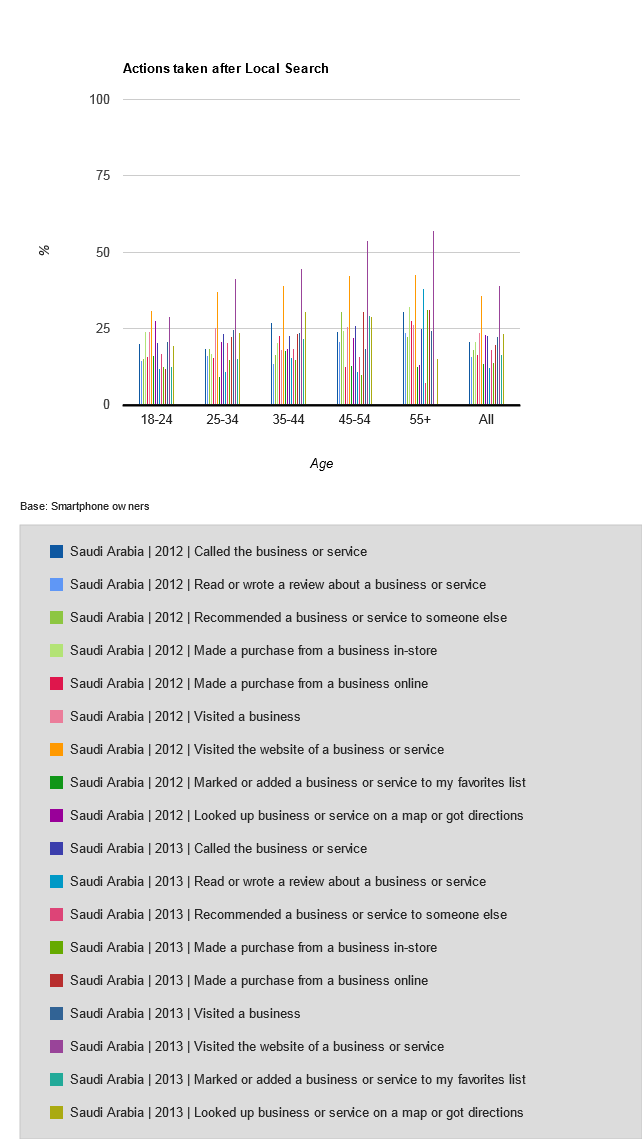
Have a look at the frequency of local searches and look at the growth from 2012 to 2013

Have a look at the frequency of local searches and look at the growth from 2012 to 2013

Actions taken after Local Search in Saudi Arabia in 2012 and 2013 across all age ranges and gender types

Actions taken after Local Search in Saudi Arabia in 2012 and 2013 across all age ranges and gender types

What is strikingly obvious from both of the graphs above is that local search is now essential to local businesses. And yet, we’re still pretty awful when it comes to developing websites for mobile browsers.

So how do you change this? The first piece of news is pretty obvious. Go and get a website (it’s amazing how many businesses still don’t have sites in this part of the world). Secondly, if you’re not sure about how mobile-friendly your website is then test it using a tool such as W3C’s Mobile Ok Checker. These will be able to tell you what you’re doing right and what you’re getting wrong when it comes to rendering or displaying your site on a mobile browser.

If you’re stuck on how to develop a website that renders well on mobile browsers why don’t you consider using a content management system such as WordPress. WordPress has website styles that automatically adapt or respond to different browser types. WordPress is free and you don’t need to even pay hosting fees if you use WordPress’ own servers.

Even if you have a mobile-friendly website remember to use back-end analytics programmes from Google or other providers to better understand what your customers are doing on your website and what you can do to improve their experience. If you’re looking for more advice on what you should be doing to generate business from mobile have a look at this crib sheet for mobile e-marketing by local developer Saad Bhatti or get in touch with the good people at Spot On. But the general message is, do more on mobile!

If you don’t like it, then leave! Hey @Dutweets and how not to deal with customers online

One week, two social media blunders in the United Arab Emirates. First we had Subaru Emirates and now we have Du, the UAE’s second largest telecommunications company, getting everyone into a tizzy.

The background to the story, which has been covered by the UAE-based magazine Computer News Middle East, is an increase in charges for the company’s home user pricing plans. The price increases, which have risen by up to 37 percent, seem to have been posted on the company’s website rather than having being formally announced by the company.

Unsurprisingly, consumers haven’t taken to Du’s price increases (note – for data services the UAE operates a monopolistic system whereby you have to purchase from the sole telco who is licensed to operate in your area, which is either Du or Etisalat). Du’s twitter account, @Dutweets, has been inundated with tweets from aggrieved consumers who understandably don’t want to pay more for their existing service and don’t want Du’s offer of additional phone minutes in compensation for the higher prices. Have a look below:

Unfortunately, for the people in the company running the Du account (Du handles social media internally I believe) things have gone from bad to worse. One reply has gone viral and is receiving a swathe of negative feedback on Du and its social media efforts.

I do feel for @Dutweets as they’re having to face the fallout from a pricing decision which has been poorly executed and hasn’t been communicated in the right manner – from a customer perspective there’s no justification for a price rise for the same service, especially when Du’s customers have no other provider and when their existing contracts should be honored for the contracts’ duration. However, if a company isn’t willing to resolve issues through social media then what’s the point of entering into a dialogue with the community? And no matter the frustration levels you can’t respond to customers in a manner that seems unsympathetic. So please, no more Hey! messages @dutweets. Understand the concerns, pass on the message to the executives and wait for a positive message from upstairs. Don’t do a Subaru, because you’re only going to make things much, much worse for yourselves.

https://twitter.com/WildeTrude/status/364691859576061954

https://twitter.com/alextohme/status/364719579089485826

Social media and diplomacy – @IsraelintheGCC, Israel’s virtual embassy in the Gulf

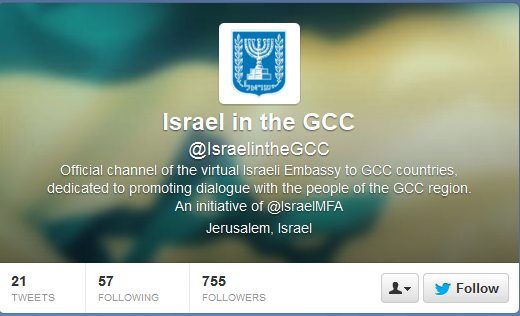
The launch of the @IsraelintheGCC twitter account is a cheap but potentially effective media channel for the Israeli government

The launch of the @IsraelintheGCC twitter account is a cheap but potentially effective media channel for the Israeli government

No matter your political persuasion, you have to admit that the Israelis are an ingenious bunch. Their latest idea is a simple concept, a virtual embassy for a part of the world where there’s little/no Israeli State presence, the Gulf. Israel, which doesn’t enjoy official diplomatic relations with any of the Gulf states, has launched a ‘virtual embassy in the Gulf’ through Twitter. The account, which is named @IsraelintheGCC, aims to “open lines of dialogue” with people living in the Gulf according to a report by the UAE-based English-language daily Gulf News. According to the Israeli daily Haaretz, the person behind the idea is Yoram Morad, Director of the Department of Digital Diplomacy at the Ministry of Foreign Affairs of Israel.

Not unsurprisingly, Israel has always faced challenges when trying to communicate its point of view to its Arab neighbours. However, that hasn’t stopped the State from engaging various mediums to argue for its policies. Israel launched an Arabic-language television channel in 1994 following the announcement of the Israeli-Palestinian peace process. The establishment of the @IsraelintheGCC twitter account follows news of a potential re-engagement between the Israelis and Palestinians as well as mounting pressure on Iran to halt its nuclear enrichment programme.

It could be argued that Israel has been much more active than the Arab states in terms of communicating its key messages – there were plans to launch a Hebrew-language channel in Egypt as of last year according to the Christian Science Monitor, but I haven’t heard much in the way of an actual launch.

The messaging employed by @IsraelintheGCC, which is being run by the Twitter account of the Israeli Foreign Ministry, would appear to be aimed at propagating a more diplomatic tone than that of Israel’s internal politics. The account, which has tweeted 21 times to date, has only quoted the country’s Prime Minister twice (its fair to say that Bibi Netanyahu wouldn’t win many popularity contests in the Gulf), but it has talked about social media in the Arab world, sustainability issues, and wished followers a Ramadan Kareem. The one time Netanyahu has been quoted was in relation to European sanctions on the Lebanese organization Hizbollah which isn’t well liked in the Gulf due to its pro-Iranian stance. There are tweets in Arabic too. Have a look at some of the posts below.

Over the past couple of years social media has allowed companies, politicians and celebrities to directly bypass the media and reach out directly to anyone that wants to listen. Now the same can be said of social media for States who, for diplomatic reasons, cannot establish a physical presence. I’ll be following the account, and am looking forward to seeing how long this project lasts, how much dialogue it generates and how successful it becomes for the Israeli government.

How long do we have to wait for competition in the UAE’s telco space?

Sometimes you have to wonder if anyone at Du, Etisalat or the TRA is listening when it comes to doing a deal on market liberalization (image source: http://www.healthyblackmen.org)

As the saying goes, everything comes to those who wait. If you’re waiting for competition in the UAE’s telco space you may have a couple more years of waiting. Reuters published a story today detailing how despite talks beginning in September 2009, Du and Etisalat have yet to agree terms for network sharing. The best bits from the Reuters piece are below.

The United Arab Emirates’ two telecom operators, Etisalat and du, remain at loggerheads over a deal to allow them to compete on fixed line services nearly four years after negotiations began.

Du and Etisalat already offer fixed-line, broadband and television packages in the UAE, but not in the same districts, with du confined to the newer areas of Dubai.

The two companies, which are both majority-owned by government institutions, started technology trials that would allow network sharing more than two years ago and an agreement was slated to be concluded by 2011-end.

But a report from the Telecommunications Regulatory Authority (TRA) this week shows the companies cannot agree on the extent of so-called bitstream access, which would enable one operator to permit the other to use its fixed network, or a method to determine the fees for allowing such access.

“The two licensees are still negotiating,” states the regulator’s report, which was published on its website.
“Bitstream access could have a significant impact on competition.”

The TRA states it will “impose a requirement to offer bitstream access products for both residential and business markets,” reiterating a commitment it made in a 2010 policy document.

Further liberalisation has proved fraught – mobile number portability, which would allow customers to retain their phone number when switching provider, has yet to be introduced despite the regulator previously stating this would be available by mid-2008.

Now, almost four years later ad yet we’re still nowhere near having any competition in the telecoms space in the UAE. The question is when is the UAE’s Telecoms Regulatory Authority going to step up and force the two telcos to agree a deal?

Across the region, we have some powerful regulators who have forced incumbent operators into making changes (Bahrain’s TRA is a great example of how a regulator should act on behalf of a country’s consumers). And yet, despite repeated promises from the TRA the UAE’s public is still waiting for a raft of measures that will liberalize the telecommunications sector, reduce costs and, hopefully, raise the quality of the country’s telecommunication services.

Just remember, if you’re waiting for the respective parties to agree and benefit from market liberalisation in the UAE’s telco sector it’s probably best not to hold your breath based on Du’s and Etisalat’s track record.

Is too much government intervention good or bad for innovation in the Gulf?

Is the Gulf’s innovation being hindered by too much government intervention? (credit: techpionions.com)

There’s been a couple of news stories recently that caught my eye. One was an interview on Kipp Report with the managing director of an online website called Tejuri.com. The article, which you can reach here, focuses on how Tejuri.com positions itself as the official online distribution channel for retailers registered with the Emirate’s Department of Economic Development.

Aside from the wisdom of launching an online distribution channel that is government-supported in the year 2013, the piece got me thinking about other areas. One example is non-governmental work, which (surprise, surprise) is often not only regulated but led by government-related bodies. And then you’ve got the ultimate example of government intervention, which is the ownership of the upstream and downstream oil and petrochemical sectors, numerous financial institutions and other businesses. And then there’s the sovereign wealth funds.

My question to these and other government interventions is how much do these activities stunt growth and disrupt innovation? Here I’m going to refer to United Nations World Intellectual Property Organization and Insead that ranks the top ten most innovative countries. The original piece from Bloomberg is here.

Switzerland, Sweden and Singapore are the most innovative countries in the world, according to a study by the United Nations World Intellectual Property Organization and Insead that found a wide gap between rich and poor nations.

Innovation is an important engine of growth and new jobs, the Global Innovation Index 2012, which ranked 141 economies, showed. The index considered institutions, human capital and research, infrastructure and market and business sophistication as well as as the results of innovation such as patents and software in determining how countries fared.

Finland ranked fourth, followed by the U.K., the Netherlands, Denmark, Hong Kong, Ireland and the U.S.

Numerous surveys such as the above and this research one by the United Nations University show that governments help foster innovation most through investing in social capital (read education) and through financial funding – the irony in some parts of the Gulf is that education is in the hands of the private sector rather than the government. Governments then have to step back and then let individuals and businesses get on with it. The same can be said of the non-governmental sector, which, pretty obviously, works best without governmental support s groups and communities work to best pinpoint social issues and tackle them.

The argument often goes that entrepreneurs drive innovation and that governments need to reduce their interventions, reduce bureaucracy and increase financial support for small to medium sized firms to drive growth. However, is that what we are seeing in the Gulf? Or are we still not fulfilling our potential due to too much, rather than too little, government intervention?