Youtube has changed how we view and understand video on the internet. But despite the site’s importance (Youtube streams four billion videos a day), many agencies or corporate firms don’t use Youtube or monitor its content.
If you’re looking for an easier way of measuring trends such as top rated, most favourited, most shared and trending videos then check out http://yt-feeds.appspot.com/. This site, which allows you to access Youtube’s API feeds, will tell you what you need to know about 18 different categories of videos from 34 different countries or regions (the Middle East region includes details for Saudi Arabia, Egypt and the United Arab Emirates).
Youtube’s API feeds site is incredibly easy to use and will help you better understand which videos are proving popular online
And as an extra treat, check out this video from the team behind Youtube’s most popular Saudi comedy channel/program, La Yekthar. This is a short clip for the comedy team, and while the dialogue is in Arabic I’m sure you’ll understand the underlying comedy.
If you’re interested in knowing about La Yekthar then have a read of this profile of one of the comedians behind the show. The shows that the La Yekthar team post onto Youtube are usually viewed a million times plus. I hope you enjoy the clip below.
Every once in a while, you come across a story that is heartbreaking. What happened to Natalie Creane is tragic. Four years ago Natalie and her new fiance celebrated their engagement by staying at the Emirates Palace Hotel in Abu Dhabi. After arriving she opened the wardrobe door and bent to put her shoes in the wardrobe. She looked up as a wooden panel fell from the front of the AV unit and hit her on the head, right on the temporal lobe.
According to a number of sites set up on her behalf Natalie was diagnosed with intractable refractory epilepsy and brain trauma. Since then she has been in four comas, she suffers from seizures which cause her to collapse suddenly and she has frequently sustained serious injuries during these seizures, including broken bones. Natalie has been on ventilators, had blood clots in her lung and leg, extreme blood toxicity, paralysis, temporary loss of sight, massive hair loss, severe debilitating headaches, temporary loss of speech, confusion, permanent memory loss, insomnia, constant infections due to suppressed immunity and has been admitted over 20 times to intensive care. Natalie suffers from Post Traumatic Intractable Refractory Epilepsy and Traumatic Brain Injury.
Despite all that has happened to her Natalie’s case with the Emirates Palace Hotel is still outstanding. The Emirates Palace Hotel initially referred the family to its insurance company. After talks with the company broke down, the family was faced with the hotel’s lawyers. Forced to take their case to court, a full two years after the accident, the family is still fighting for justice now – four years on from Natalie’s accident.
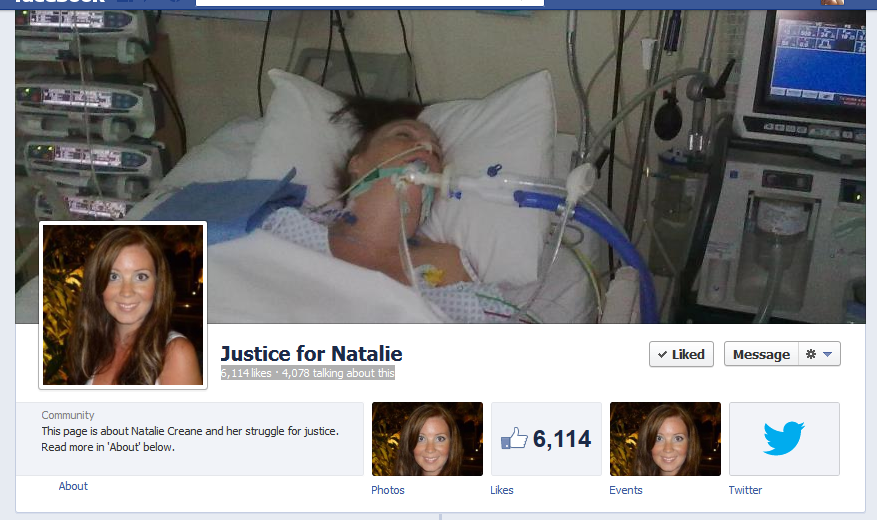
After four years of what I can imagine to be a living nightmare, including two years of litigation, Natalie’s family have finally gone public. They set up a Facebook page on the 9th of July which you can see here, and the family also set up two twitter handles, @JusticeForNatal and @JusticeForNat.
As of today, the Facebook page has 6,114 likes. Even more importantly when it comes to measuring influence and importance on Facebook 4,078 users are currently talking about Natalie. Here’s a screenshot of her page below.
The Justice for Natalie Facebook Page has only been live a few weeks but has already gone viral in the UAE and beyond
Her family have made use of Twitter to get her story noticed by media through retweets and mentions, posting pictures both via Twitter and Pinterest, and using the hashtag #justicefornatalie (there was some initial confusion online around the 20th when the Twitter handle switched from @justicefornatal to @justicefornat).
Ten days after setting up the social media channels Natalie’s story broke in mainstream media with a news piece in the UAE’s largest English circulation newspaper Gulf News followed by news pieces online at Albawaba and in print with another English-language UAE newspaper, 7Days. Natalie’s story has since been covered by global news outlets such as the BBC and the Huffington Post.
(Natalie’s story was first covered here last year by the National, but owing to the UAE’s defamation and libel laws newspapers use initials rather than full names when covering an active case).
Natalie’s family have also set up an online petition via Care2 where they’re aiming to gather 2,000 signatures (the petition is here and they’ve set up Team Natalie Marathon in Abu Dhabi for November (you can sign up here).
There’s even videos on Youtube, including the below which was put together by a supporter of the campaign.
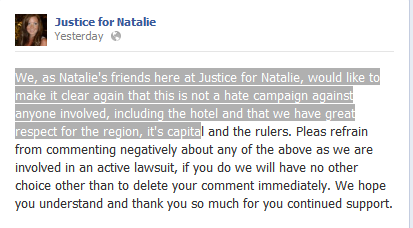
Natalie’s family have stressed that the campaign has one aim, namely to raise her case’s profile and find some settlement so that Natalie can receive the support that she so desperately needs.
Rather than being a negative, hate campaign against the hotel the family are using human interest messages and regular updates on Natalie’s condition to attract attention and build a community online. In the space of two and a half weeks Natalie’s case has gotten more attention than it has done over four years. Understandably, the family have tried to get this issue resolved in a way that will not prejudice a court settlement, but with Natalie’s condition not improving it’s understandable that they feel the best way to ensure that their daughter has the care she needs is now through public relations.
Natalie is currently in a public hospital in Dubai, Rashid Hospital, where she is receiving palliative care. As her family write on Natalie’s Facebook page, “she urgently needs to receive specialist neurological help but the family has spent all they have over the past four years as they fought to get the hotel to step up and admit its liability for an incident which has resulted in such appalling consequences for Natalie.”
I for one hope that the Emirates Palace Hotel and the Kempinski Hotels group which manages the property settle this as soon as possible. They’re harming their own reputation. And, most importantly, they are denying their own responsibility to provide care for an incident which could be said to be a result of their own negligence.
How online communities have rallied round Natalie’s family is remarkable. And it goes to show how effective social media today can be in highlighting a worthy cause. Let’s all hope that Natalie finally gets justice and receives the support she needs to recover from all that has happened to her.
I love to post random videos. And this is a beauty. In Saudi seeing a camel by the side of the road isn’t unusual. The drive from Dubai to Al Ain used to be infamous for car-camel crashes (due to a camel’s body weight, height in relation to a car bonnet and its spindly legs, if you hit one it’d fall through the windscreen and seriously injure or kill the driver and front seat passenger). However, having a camel running up a bypass off Dubai’s main highway is unheard of (at least over the past couple of years).
So next time you drive, never mind those inane motorists, the plodding trucks and speeding taxis. It’s the camel that you have to take care to avoid. Especially while filming a clip for Youtube.
Outrage, anger, and disapproval on today’s UAE Twitter feeds. There are times when you hold your head on your hands and wonder how anyone could have posted this or that online.
The veritable Time Out Dubai got itself into a pickle today with the below article which was published online.
The offending article on Time Out Dubai’s website today. The 5 to try: bars in Ramadan piece was pulled down earlier today
While Dubai does have its fair share of bars, the timing of the article wasn’t in the best possible taste. The holy month of Ramadan began last week. Ramadan is a time for reflection, abstinence and fasting for Muslims. While alcohol is not consumed by practicing Muslims it is freely available in Dubai. Places that serve alcohol during Ramadan do little to promote themselves during this month, and it’s beyond me why this article was even commissioned. Putting bar in the same sentence as Ramadan is bound to cause trouble and/or offense.
I don’t know for how long the article has been online but the tweets were rolling in thick and fast last evening and this morning. Here’s a couple of them below.
While there has been an angry reaction from many people online, there’s also been a good deal of messages defending Time Out Dubai (maybe not so much for the article per se, but for other reasons). Here’s a couple of examples.
#stoptimeoutdubai people need to relax.the country is trying to cater to non muslims and other nationalities.
I must give kudos to Time Out Dubai for their actions today. The magazine editors have taken down the offending article and they’ve apologized online and through social media. They moved quickly to undo the damage, promise that the incident won’t be repeated in the future and, most importantly, say sorry.
We would like to apologise for any offence caused by our recent article on the subject of nightlife during (cont) http://t.co/3zCSnKzi
The only question now is, with this so much energy going into a campaign to preserving the sanctity of Ramadan will we see people online start rallying for other worthy causes? Famine in Yemen perhaps? Civil war in Syria? Let’s hope so.
There have been a slew of articles coming out from the US and Europe on social media and when to communicate to ensure that a message gets heard by a maximum number of people. Blogs from Bitly and other social media tools have highlighted the issue of timing and its importance in terms of how content goes viral.
The When Should I Post this Infographic by digital agency Raka was based on Bitly’s data for social media content distribution
I hadn’t heard of anything along those lines in the Middle East until recently, when one agency told me they’d won a contract to promote a national sports league via social media. The agency in question claimed that they had an ace up their sleeve during the pitch; they’d guaranteed the client that they would communicate in the evenings during the matches themselves, rather than promoting the games during office hours.
The thinking was simple. The target audience would be most focused on the sport an hour or two before, during and an hour or two after the games.
By that logic, wouldn’t the same also ring true for a variety of other audiences across the region? For example, for non-alcoholic drinks such as Barbican one of the prime times for selling is during football games. Similarly, wouldn’t restaurants and other venues which do most of their business in the evening do well to communicate afternoons and evenings rather than in the morning?
It’s an interesting one to think about for marketing and communications professionals. I’d love to see someone coming up with similar studies to the bitly blog and Infographic above, particularly for the GCC region. But I’m guessing most business and brand-related social media communications in the Middle East are being posted during office hours.
Everyone I know in the marcomms industry has a smartphone, a laptop, a tablet, and a 3G mobile connection. Connectivity doesn’t seem to be the issue to communicating outside of office hours, so then what is? Is it all down to the permissions and approvals processes that companies here have in place?
There are a myriad of tools which can help measure responses and even suggest the optimal time to post messages on social media based on previous data. One to look at is Crowdbooster. This online tool is free to use and you can use it to schedule messages to Twitter and Facebook. If you’re looking for a basic but useful tool to work out when to post to social media, try out Crowdbooster.
Crowdbooster is a great tool to use when you need to know the best timings for posting messages
But do remember, don’t sleep and tweet or Facebook! Or else you might end up writing something that you will regret.
The Argentinian footballer and manager Maradona has always be a figure of controversy. A media scum has followed his every move. Maradona’s move to and time at the UAE football club AlWasl has been filled full of incidents. The last headline for the Argentinian may be one of the strangest I have seen for some time.
His fourteen month stint in charge of the football team came to an abrupt end last week when Maradona was fired. This may not be too much of a surprise based on the club’s performances and results. However, how did Maradona first learn he was given the boot? By Twitter.
Can you imagine getting fired? By Twitter? Article from Mashable
There’s been countless articles written and published on Maradona’s claim that he was let go by Twitter (the original goal.com article is here and another one by the UAE’s Gulf News is here.
How did this happen? And legal implications does this have? Needless to say, Maradona’s time at AlWasl has ended with a bang. I for one will miss him in the Gulf.
Youtube has been one of the key tools of activists across the globe, and particularly in the Middle East. In response to requests from NGOs and activists on the ground who are naturally concerned about their safety when uploading videos to the site Youtube has today launched face blurring. This tool allows video uploaders and editors to obscure faces within videos with the click of a button.
“Whether you want to share sensitive protest footage without exposing the faces of the activists involved, or share the winning point in your 8-year-old’s basketball game without broadcasting the children’s faces to the world, our face blurring technology is a first step towards providing visual anonymity for video on YouTube.”
The screenshot below, which is taken from Youtube’s blog page and post on this new service, is an example of how the technology will work in practice. It’ll be interesting to see how often this is used by activists, and how authorities will respond. Kudos however to Youtube and Google for listening and providing a solution that should, I hope, save people from torture, intimidation, or worse.
The picture above shows clearly how simple it will be from now on to blur people’s faces on Youtube.
PS this is going to give marketers out there a fun new way to roll out teaser campaigns! I can’t wait to see who gets creative with this for their brands.



 Alex of Arabia's Blog