What is the future of the internet in the Middle East?

The past week has thrown out a couple of fun and serious stories and news reports about the internet in the Middle East. The first was Iran reportedly deciding to create its own version of YouTube in order to filter out what it deems to be inappropriate content posted on the world’s largest video-sharing network. There’s a screenshot from the Mehr site, which loads remarkably slowly for a site which hosts videos for viewing and sharing, below.

Will Iran's version of Youtube be as big a hit as the original?

Will Iran’s version of Youtube be as big a hit as the original?

The second story wasn’t as funny. The International Telecommunications Union had gathered its member states in Dubai to discuss a number of issues at the World Conference on International Telecommunications. The one which hit the headlines was internet regulation. In short, a number of countries from the Middle East and other emerging regions submitted proposals that would have allowed member countries to monitor and control data flowing through their respective parts of the internet.

While this is already happening in many parts of the world, the proposed resolution would have basically made it legal and proper for all 190 or so of the ITU’s “member states” to have the power to regulate the Internet to promote security, fight spam, et cetera.

A number of opinions and views can be found online on the issue, including interesting posts by technology historian Peter Salus entitled The UN and your Business: Why ITU Dubai Loss is your Gain and Why the ITU is the wrong place to set Internet standards by Tech writer Timothy B. Lee.

I for one am concerned about the future of the internet and online access. While internet filtering and domain blocking isn’t new to the Middle East (the Gulf’s telecommunications bodies block material that they deems offensive including religious or pornographic material) it’s clear that the past two years have opened a Pandora’s box when it comes to control of the internet. Governments in Egypt and Tunisia tried to close off access to the internet to stop revolution. That didn’t work. Gulf countries have legislated against online threats. As I’ve pointed out above Iran is building its own country-wide internet whilst blocking access to foreign-hosted sites that pose a threat to the Islamic Republic.

So where are we headed to next? How far will governments in the Middle East go in order to secure their own national communications networks? And is there anybody or anyone out there who will bring some common sense to the issue of web regulation in the Middle East?

While I don’t expect multinationals like Google and Yahoo (or even Facebook) to step up to the plate and say to Arab governments we will not regulate the web for you (after all, Yahoo and Google didn’t say no to China), I am hopeful that the region’s populations will become more vocal about their online rights. Egyptians and Tunisians have proved that they will demand and protect their new-found rights. Let’s hope others, especially in the Gulf, will begin to seriously think about what their governments are doing online and asking:

  • Who is watching me online?
  • What online data do they want and why?
  • Can I be jailed for my online activities? Do I have to self-censor my thoughts and activities?

What is the future of the internet in the Middle East? Are we headed towards a patchwork of national or regional wide webs aka Iran? Or will sense prevail? Goodness knows we need commerce and entrepreneurship to flourish in this region to generate more jobs and an open internet is essential to both. Answers on an email, an online comment, or (if your connection is monitored) a postcard please!

Are you up for some (more) government censorship and online monitoring?

Paris Hilton and the holy city of Makkah – where’s the synergy?

This is one of the few images that I could find of Paris which would be suitable for this blog. This isn’t her attire for the store’s opening however.

Socialite and party-lover Paris Hilton. And the holiest city to all Muslims worldwide, Makkah. These two don’t often find themselves in the same magazine or TV programme, let alone in the same sentence.

However, all of that has changed with the launch of Paris Hilton’s fifth store in Saudi Arabia. And yes, you guessed right. The store will be in the holy city of Makkah.

Ms Hilton tweeted about the opening with a picture of the store. She also added that this was her fifth store in Saudi Arabia out of a total of 42 stores worldwide. Seems we just can’t get enough of Paris Hilton over here.

Unsurprisingly there’s been a fair amount of reaction within Saudi itself. The news was first covered in Saudi by the national newspapers and has quickly been picked up by international outlets including CNN. The CNN piece, which you can read here, neatly sums up the differing reactions to the store’s opening.

https://twitter.com/ParisHilton/status/268874585326354432

The commercialization of Makkah isn’t recent. For years the city has been transformed by a host of high-end shops, stores and malls. It’s very different in another city I love dearly. Most of the old city of Jerusalem (Al-Quds in Arabic) has resisted change, and is all the better for it in terms of its spirituality and warmth.

Returning back to Paris and Makkah, what does a woman who has been embroiled in a sex tape and enjoys her party lifestyle have to do with Makkah, the holiest city in the world to over a billion people. Dare I say, this is slightly different from a high-end brand such as Gucci in the sense that Paris Hilton the person (and her lifestyle) embodies the brand. Will the news engender a debate about what is happening to a city that means so much to so many people. Makkah should be cherished and conserved. I for one hope it does. In the meantime, if you are in Makkah and you’re in desperate need of a bag do remember Paris Hilton (and say astaghfirullah while you’re doing it).

Makkah is most associated with Islam, spirituality, belief and forgiveness

PS as a PR stunt I’d have to give Paris Hilton and her team top marks for the online reaction as well as the media coverage.

How Dubai’s Tamweel Tower fire and its aftermath has been shaped by social media

Dubai woke up Sunday morning to a horror story. In what seemed to me to be a throw-back to the movie the Towering Inferno a fire broke out on the roof/top floor of a 34-storey tower in the city’s Jumeirah Lakes Towers development at around 2am. Incredibly, no one was killed or seriously injured and the tower’s 600 residents were evacuated from the building.

The fire, which you can see a clip of below, took several hours to be brought under control. However, for the families who lived in the property which is owned by the Islamic mortgage company Tamweel, their ordeal has only just begun.

According to news releases and press statements Tamweel has been supporting those made homeless by providing them with hotel accommodation.

At Tamweel, our very highest priority is the safety and well-being of the owners and residents,” said Varun Sood, Acting Chief Executive Officer, Tamweel. “Our staff are on site and have provided transportation and hotel accommodation, in coordination with DMCC, to any resident who requires such assistance. We will continue to work with the Building’s Owners Association to assist all residents and we remain fully committed to ensuring their well-being.

It’s no exaggeration to say that many families lost everything in the fire. Radio interviews with Tamweel Tower residents spoke of people running out wearing only their underwear and having to borrow clothing from others after they’d assembled at the emergency evacuation points outside the building. A wonderful piece was written in the Khaleej Times, a piece that conveyed the feeling of loss and confusion. If you’re hoping to gain a sense of how much some people were going through on the morning of the fire then do click through and read.

The tragedy has been covered extensively in both traditional media and on Twitter, Facebook and Youtube. Residents were tweeting from the site pictures and uploading videos before the first stories had been published online (I read one Twitterer write in the early hours of the 18th that traditional media were yet to publish anything on the fire – if I can find his tweet I’ll publish here).

The morning of the tragedy companies and individuals started to reach out via community forums and other online media to offer their services and support as well as provide details for those who want to volunteer and donate.

One Dubai restaurant chain offered to host residents and businesses based in Tamweel Tower at their premises

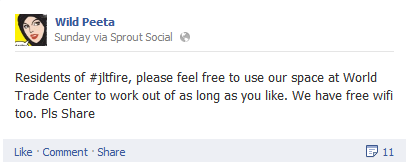
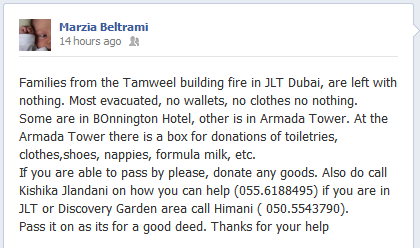
Many people posted details of people to get in touch with for donating items to those left homeless

These community charity efforts are ongoing, as is the support given by Tamweel, and will be some consolation for residents who have lost all of their belongings in the fire.

The speed with which social media has allowed people to express their support and rally others in the community to help the victims of the Tamweel Fire has been remarkable. How long would businesses or government bodies take to do the same? What is interesting to note is that Dubai Police also use Twitter to put out news alerts.

For me, what’s also been striking is that the owner of the building Tamweel doesn’t have a social media presence. I’m sure, after what has happened, that will change in a very short space of time.

Where’s the corporate response to #Sandy?

The response to tropical storm/hurricane Sandy online has been remarkable. There’s little anyone else is talking about, and even as far off as the Middle East people are sending their wishes to those caught in the storm’s path. To give you an idea about how Sandy has been trending on social media, have a look at the analytics graph from Hashtag.org for #sandy.

The graph, from hashtags.org, is from a one percent sample of Twitter traffic over the past 24 hours.

Everyone has been pitching in to provide help, support and comfort to those affected. According to thenextweb, Twitter has supported relief efforts by promoting the following twitter accounts @RedCross, @FEMA,@NYCMayorsOffice, and @MDMEMA. “Twitter is also listing government accounts and resources on its blog and giving #Sandy a custom page,” according to the piece by Harrison Weber on TNW.

Even celebrities have been taking to the social media space to talk about Sandy.

https://twitter.com/ABFalecbaldwin/status/263245395025600512

Aside from the danger to life posed by Sandy, the main talking points have been flooding and power outages. As a big fan of the likes of ABB (my former company) and GE, I was hoping that they and others would be talking about the disaster and lending a hand to get everything back on track. Estimations are that eight million people are without power right now in the Eastern seaboard of the US, and that utility company staffers are traveling from as far as California and Texas to help out in New York.

And what is on GE’s Facebook page?

This was GE’s latest post to their Facebook page, which is liked by over 900,000 people. There’s no mention of Sandy.

And ABB?

ABB’s latest Facebook post which was put up in the afternoon of October 30. Again, no mention of Sandy.

This isn’t exactly an empirical study, but it worries me that two of the world’s most respected electrical engineering companies are not lending their support or even making their support known by social media. While I understand that many corporates don’t want to be seen to be taking advantage of the situation, surely there’s a time and place for them to offer their support and advice publicly.

Not talking about what is affecting millions of people seems so out of place, especially when on social media and when the companies mentioned provide solutions that power our utilities.

After all, aren’t we supposed to be talking with each other via Facebook and Twitter. Or do we go on, ignoring global events? Hardly being socially responsibly on social media, is it?

Don’t be evil – Google, freedom of speech, corporate responsibility and that video

I’m a huge fan of Google. The company has defined the internet era. Google is the world’s most popular search engine. Youtube is more popular than television in many parts of the world. Google Maps has redefined how we get from A to B. I could go on and on, but you get the point. Google has even entered the common language as the term people use when they refer to searching on the internet: “Go Google it…”

Google has done all of this and more while living by its ‘don’t be evil’ corporate motto. While Google has been criticized before for bending and breaking this mantra (most notably with its operations in China), the last couple of weeks have been remarkable. There’s probably few of you out there who have not heard about the film, named ‘the Innocence of Muslims’. The film, which has caused a global uproar, was uploaded to Youtube at the start of July.

Since then, there have been riots and demonstrations worldwide. Dozens have been killed and injured. And yet, Google has refused to pull it off Youtube. According to an AP story from two weeks back:

“Google is refusing a White House request to take down an anti-Muslim clip on YouTube, but is restricting access to it in certain countries.

The White House said Friday that it had asked YouTube to review whether the video violated its terms of use. Google owns YouTube, the online video sharing site.

YouTube said in a statement Friday that the video is widely available on the Web and is “clearly within our guidelines and so will stay on YouTube.” (the full piece can be viewed here)

Google argues that only materials which are in clear violation of laws or that promote hate speech will be removed from Youtube.
Google says The Innocence of Muslims does not however breach YouTube guidelines. However, Google has blocked users from seeing the video in India, Indonesia, Libya and Egypt due to local laws and “the sensitive situation”. Youtube’s full statement from Friday 14 September is below.

“We work hard to create a community everyone can enjoy and which also enables people to express different opinions. This can be a challenge because what’s OK in one country can be offensive elsewhere. This video — which is widely available on the Web — is clearly within our guidelines and so will stay on YouTube. However, we’ve restricted access to it in countries where it is illegal such as India and Indonesia as well as in Libya and Egypt, given the very sensitive situations in these two countries. This approach is entirely consistent with principles we first laid out in 2007.”

For me, the video is the clearest indication yet that Google has given up on its ‘Don’t be evil’ mantra. Google had to pull down a video from Brazil after its resident of its Brazilian operations was arrested for breaking local laws.

Google constantly argues that Youtube is a channel and that it has no say in what should be on that platform for the sake of free speech. However, how many newspapers would accept advertising from Neo-Nazi groups? How many television channels would run an advert for euthanasia? Just like these media channels, Google has a responsibility to its audience. This cannot simply be about pure profit and driving up viewer numbers. Google sells products globally, it has to be responsible globally as well.

The fact that these videos are still on Youtube shames Google. I for one hope that the company I have admired for so long finally wakes up and does the right thing on this issue and others in the future by better defining and vetting what should go up on platforms such as Youtube and reacting to communities sooner rather than not at all.

Please Google, don’t be evil…

Google, please don’t be evil. Come back from the dark side.

The dangers of speaking your mind online – lessons from the Middle East

Kuwaiti graphic designer Mohammed Sharaf @MohammadRSharaf created the following image to support Nasser Abdul during his trial for tweeting offensive material

The internet is full of misconceptions. I often feel that most people think that the world wide web is a place where they can go to say anything, both positive and (most often) negative. The past 18 months and pending legislation should make anyone and everyone think twice about the above. Cases in Saudi Arabia, Bahrain, and Kuwait have cast aside the notion that cyberspace is a domain where anything and everything goes.

A number of trials and guilty verdicts both underline the importance of tempering what people say online as well as underscore what authorities do and do not deem as illegal. The first high-profile legal proceedings took place in Kuwait when in June of last year a Kuwaiti national was charged with slandering Bahrain’s royal family and a religious group.

Despite claiming that his Twitter account was hacked Nasser Abdul was found guilty and sentenced to three months in jail which he had already served by the time his sentence was pronounced. There have been other cases in Kuwait, including the prosecution and sentencing of Mubarak Al-Bathali to six years in jail (this was commuted to six months) for Tweets attacking certain religious groups.

The most famous case of jailing for tweeting is that of Hamza Kashgari, who published three tweets about an imaginary meeting between himself and the Prophet Mohammed. His comments drew an instant reaction from Saudis online; in the hours that followed over 30,000 tweets regarding Kashgari were published online. Kashgari was accused of apostasy and fled to Malaysia. He was deported back to Saudi Arabia and jailed. Kashgari is still in detention, despite pleas by his family for his release and his apology for his actions (the basic story and roundup can be read here on Wikipedia).

Bahrain’s authorities have also taken to court individuals for publishing their thoughts in online public forums. The most famous and most recent case is that of activist Nabeel Rajab who tweeted about the Prime Minister’s visit to Muharraq in June and was accused of publicly insulting Muharraq’s residents for their support of Sheikh Khalifa bin Salman al-Khalifa. According to Bahrain’s prosecutor Rajab had claimed that Muharraq’s residents had only welcomed the Prime Minister during a visit because he had offered them subsidies.

Bahrain’s Information Affairs Authority said his acquittal on defamation charges “was due to the judge’s uncertainty regarding the evidence submitted to support the lawsuit”. Rajab, who has spent two months in jail while awaiting the outcome of this and another case, had been faced with possible charges before for his use of Twitter, in 2011, in what would have been the first such case in the Middle East.

Clearly the Arab Spring, which has led to regime change in three Middle East countries and is still being felt across the region, has sharpened the thinking of numerous governments across the region. According to media reports in June of this year, Bahrain is introducing legislation to curb misuse of social media.

I am still trying to fully understand the full implications of Bahrain’s proposed social media law, but I am assuming that this would cover and make an illegal offense the publishing of any comments online or through social media that would appear to contradict government policy or government statements. Kuwait is also leaning in this direction, as this editorial by Reuters makes clear.

What is clear is that the Middle East’s online community is becoming increasingly politicized. I’d argue that many people, frustrated with the lack of political debate in traditional media, are going online to voice their issues and concerns. The Dubai School of Government has estimated that there are 1.3 million active users on Twitter in the region.

Switching tack slightly, how will the increase in political discourse affect online communication efforts/campaigns? Will communication professionals and agencies steer completely away from anything that could be construed as political or biased to one community? And will we see more people using online aliases? While many governments would like to regulate online activity, how are they going to force users to reveal their true identities when using services that are based in Europe or the US?

Would we even see sites such as Facebook or Twitter blocked by governments in the region (this did happen in Egypt during January 2011 when the authorities tried to stop any and all access to social networking sites)? That’s the logical conclusion, but how would you do this when these sites have become part of people’s everyday lives? As always, there seem to be many more questions than answers when it comes to the Middle East. The freedom to voice one’s thoughts online are no exception.

Twitter and politics in the Middle East – Arab political figures on Twitter

Following on from a previous post on the top religious figures in Saudi Arabia using Twitter I’m profiling a couple of the most prolific political and governmental officials and rulers in the Gulf.

If you’re looking for a good resource on global political movers and shakers then check out the Twiplomacy report by global PR agency Burson-Marsteller. There’s some interesting insights here, though I hope the below snapshot will give you a little more information on the Middle East region in particular.

So here’s the top five six countdown. I could add a lot more and I hopefully will do over time.

1. Jordan’s Queen Rania Al Abdullah.
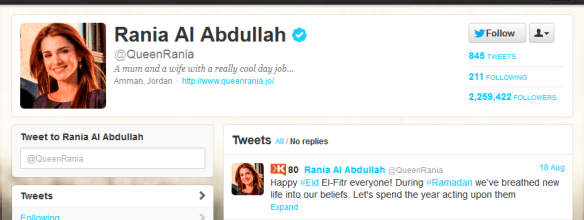
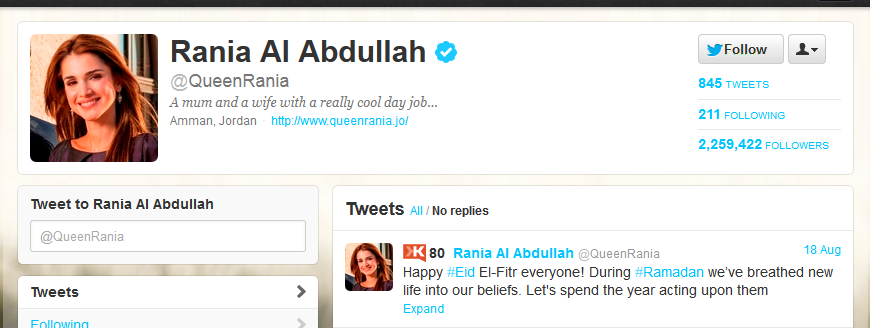
Jordan’s Queen Rania is the most popular political figure in the region with over two million followers.

The most popular political figure on Twitter is not based in the Gulf, but rather on the Arabian Peninsula’s periphery. Jordan’s Queen Rania Al Abdullah is without a doubt the most popular government-related figure in the Middle East (I saw government as her husband King Abdullah II is the head of state). To date she has amassed two and a quarter million Twitter followers. The Queen usually tweets about charitable issues which she is involved in or supports, such as education, healthcare, and youth-related schemes. Queen Rania also has a YouTube channel and Facebook site as well as her own website at http://www.queenrania.jo.

Queen Rania has used social media to engage in conversation. The best known example is a campaign launched in 2008 entitled Send me your Stereotypes. The Queen asked people to send her their questions about Islam and the Arab world. She talked about topics such as honour killings, terrorism and women in the Middle East.

Queen Rania started using Twitter in the Spring of 2009 and she has occasionally used the site to answer questions from followers. She is not a prolific user of Twitter (having sent 845 tweets her account averages less than a tweet a day), and her engagement and communications are spread across all of her social media channels. Queen Rania messages in English primarily rather than Arabic.

2. Sheikh Mohammed bin Rashid Al Maktoum

Sheikh Mohammed passed the one million mark on Twitter at the end of July 2012

The ruler of the Emirate of Dubai and the Vice President of the United Arab Emirates, Sheikh Mohammed bin Rashid Al Maktoum has a large following on Twitter through which he disseminates information on Dubai’s economic development, charitable initiatives, and (sometimes) religion.

Sheikh Mohammed often writes in Arabic to address issues which are important to UAE nationals. In addition to his twitter feed there’s a Facebook site which was set up in June 2009 and has over 600k likes and a more recent Youtube page which was set up in February of this year but which already has 580 thousand video views.

Sheikh Mohammed tweets on average less than once a day (he posts at approximately the same rate as Queen Rania and has posted to date 862 tweets) but he does retweet fairly often (once every 9.1 Tweets). An avid horse racer, the Sheikh does talk about his passion for racing as well as the environment.

3. Abdul Aziz Bin Fahd Al Saud

Abdul Aziz Bin Fahad is an avid user of Twitter and has written just under 5,500 tweets in 10 months.

The claimed twitter account of the youngest (and it’s always claimed the favourite) son of Saudi Arabia’s late King Fahd Bin Abdul Aziz Al Saud has only been active since November of last year but already has 637 thousand followers. The account, which hasn’t been verified by Twitter, is supposedly owned by Abdul Aziz Bin Fahd Al Saud (the account is his initials followed by his birth year).

While not in government, as a son of Saudi Arabia’s previous king Abdul Aziz Bin Fahd Al Saud wields considerable influence in the Kingdom both through his family as well as his various assets. He owns half of MBC, the Middle East’s largest broadcaster, as well as other investments both regionally and globally. Abdul Aziz was previously head of the Diwan of the Council of Ministers in the Saudi government.

Tweeting exclusively in Arabic Abdul Aziz Bin Fahd Al Saud talks about both the mundane (for example sending holiday greetings to followers) to voicing his support for the Saudi King (and his uncle) Abdullah. Abdul Aziz Bin Fahd Al Saud has written about controversial topics such as trying to stop the broadcasting of MBC’s latest Ramadan blockbuster Omar, which was based on the life of the Prophet’s companion Omar Bin Al-Khattab, as well as allegations of excess leveled against him by others using Twitter.

On average Abdul Aziz Bin Fahd Al Saud writes twenty tweets a day and regularly engages with followers.

4. Sheikh Abdullah ibn Zayed Al Nahayan

Abdullah ibn Zayed Al Nahayan engages more with followers on Twitter on a daily basis than any other minister in the region

The UAE’s Foreign Minister is another avid Twitterer. Despite only having joined the social media site in November 2011 Sheikh Abdullah ibn Zayed Al Nahayan has written over 7,600 tweets at a rate of 24 a day.

Writing in Arabic Sheikh Abdullah focuses on national and regional issues related to the UAE such as the Abu Mousa island dispute between the UAE and Iran as well as more general topics such as religion and culture.

Sheikh Abdullah often engages with his audience which is mainly UAE and GCC nationals and retweets every 2.5 tweets. Over half of Sheikh Abdullah’s tweets are replies to followers.

5. Doctor Walid Al-Tabtabai

Doctor Walid Al-Tabtabai is a controversial figure in Kuwaiti politics both for his views as well as his use of Twitter

One of Kuwait’s most colourful politicians, Doctor Walid Al-Tabtabai is a conservative Islamist (Salafist) member of parliament who has attracted controversy for many of his views (which he frequently expresses via his unverified Twitter account). Dr Al-Tabtabai talks most frequently about Kuwaiti and regional politics with his 227 thousand plus followers which he has built up since joining Twitter in November 2010.

Dr Al-Tabtabai was at the center of a legal case when he posted screenshots of a Kuwaiti national’s Twitter page and demanded the man be arrested for what were described as “insulting tweets of the Sunni sect and severe criticism and insults to the Saudi and Bahraini regimes for their stand against the Bahraini protests.”

The case was one of the first in the Gulf to see someone being prosecuted for airing their views on Twitter. However, as a parliamentarian Dr Al-Tabtabai enjoys immunity from public prosecution.

On average Dr Al-Tabtabai writes 7.3 tweets per day in Arabic and retweets every 2.2 Tweets.

6. Khalid ibn Ahmed Al Khalifa

Diplomat, Ambassador, Foreign Minister of Bahrain, Bon Vivant… Khalid Al khalifa is many things on Twitter

With possibly the best Twitter bio of any politician in the Middle East and over nine thousand tweets sent it’s maybe no surprise that Bahrain’s Foreign Minister has been so active on Twitter. Khalid Al Khalifa has had to contend with the diplomatic consequences of Bahrain’s security policies following a year and a half of demonstrations against the government.

The Foreign Minister is one of Bahrain’s most outspoken figures online and uses his Twitter feed to talk about government policy as well as to promote the Bahraini government’s point of view overseas as well as at home.

Khalid Al Khalifa also tweets on issues not related to Bahrain such as regional politics, and frequently talks about his travels and his meetings with other politicians. He also frequently uploads pictures to his Twitter account. The Minister retweets every 5.4 tweets and writes in both English and Arabic.
Are journalists putting too much trust in social media sources?

The internet and digital communication has had a profound effect on the media industry. Media can be distributed globally in a matter of moments, and the ease with which journalists can find sources has been greatly aided by tools such as Twitter. Need a quote? Then search a hashtag on Twitter or for a blog via Google and find a credible source.

There’s no denying that social and digital media are shaping how journalists work. Rather than quoting in the traditional sense, news articles reference tweets.

There are risks in referring to sources in this manner. Can you trust that they person is who they say they are? Do they really represent those who they claim to be talking on behalf of? Do they know the subject well enough to be viewed as a credible source?

I can imagine that the Arab Spring has been both exciting and infuriating for media. Many countries have not taken too kindly to media entering their borders and reporting on goings-on. There have been some groundbreaking stories coming out of Syria in particular, with journalists putting themselves in harms way to report on the ground.

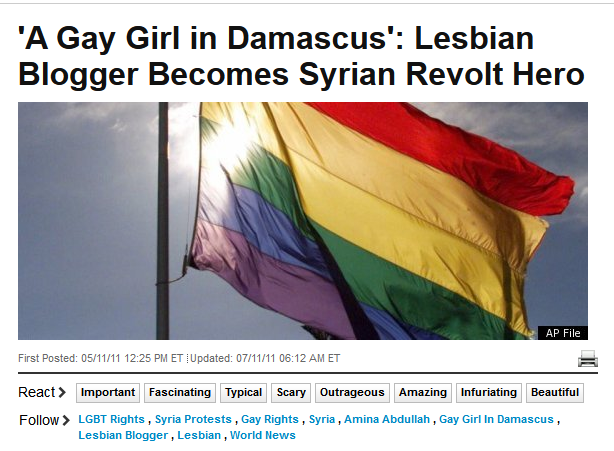
And then there has been instances of deception. The worst was the case of the Gay Girl in Damascus, who went from being a global source on what was going on in Syria through her blog to…

… an American graduate student named Tom MacMaster who was studying in Scotland.

The hoax may be the worst case example of what can go wrong when using online media for references. What concerns me more is when journalists and media outlets source speakers online. Unless they’re careful, the people who end up becoming the witnesses or the quoted experts are those with the biggest following online.

Of course, this doesn’t just happen online. I was listening to a post on the BBC World a week ago and heard a report about the first Saudi female Olympians. The person being interviewed was a female Saudi journalist residing in New York.

As I sat listening to the report, I could not help but ask myself why was the BBC interviewing a person sitting thousands of miles away from the country under focus. Would this person hold a mainstream opinion? Even some of her facts which she used to corroborate her arguments were flimsy (for example, she said there are no female gyms in Saudi Arabia, which is false).

Being a good journalist is one of the hardest jobs out there, especially in the Middle East where people can often be reticent around media and yet the editor still wants the story filed ASAP. However, I would like to ask my friends in the media to think before they quote from online, and ask themselves if they’re background checking that person, if they need to quote the same person for the Xth time, and if they should quote from online sources when alternatives are available.

Islam, Politics and Activism – the most popular Saudi-based Muslim scholars on Twitter

It can be both fascinating and bizarre to compare regions and cultures through any lens. A couple of articles on the issue of Twitter, its users and the number of their followers caught my eye this week. The first was a piece entitled Our cleric and their Lady Gaga by Saudi media analyst Yasser Al-Ghaslan (Yasser can be followed on Twitter at @alghaslan).

I’m going to start providing brief profiles of the most popular (which I’m defining here as most followed) users of Twitter in Saudi Arabia and then profile users in other countries around the Gulf.

First up, let’s profile the most popular users in Saudi. It may be no surprise that religious figures are the top Tweeters in Saudi Arabia. The below is a top five list of Saudi religious figures.

1. Dr Mohammed Al-Arefe/@MohamadAlarefe – relatively young in comparison to his peers (he was born in 1970), Dr Mohammed Al-Arefe is possibly the most followed person in the Middle East on Twitter with 2.3 million followers. Dr Al-Arefe is a insatiable user of social media (there are several channels on Youtube named after him), and he’s been a pioneer in his use of social media including working with corporate sponsors such as Du to answer questions about religion through Twitter and other digital media channels.

Dr Al-Arefe involves himself in a number of political issues; he recently organized a fundraiser for Syrian refugees and tweeted about Arab Muslims in Iran. Dr Al-Arefe is generally considered to be a mainstream Saudi religious figure in terms of his outlook and views.

With over 2.3 million followers Dr Al-Arefe is the most popular Twitter user in the Middle East

2. Dr Ayed Al Qarnee/@Dr_alqarnee – Dr Ayed Al Qarnee is a well-known Islamic scholar who is best known outside of Saudi for his publications which include Don’t Be Sad (La Tahzan) and also Do Not Despair (La Tayass) which was blacklisted after Dr Al Qarnee admitted plagiarizing another author. Dr Al Qarnee has over 1.5 million followers on Twitter, and he’s also active on Facebook and Youtube.

Dr Al Qarnee is often viewed as a progressive in terms of his comments and thoughts. He was one of the first popular scholars in Saudi to rule that Islam does not prohibit women from driving. He has worked with corporations such as telco operator Zain Saudi to promote Islam through digital channels. Unthinkable for most scholars in Saudi, Dr Al Qarnee also collaborated with popular Saudi singer Mohammed Abdu. Dr Al Qarnee also uses Twitter to promote Muslim causes worldwide. He’s been prominent of his support for the Syrian people against the Syrian government and has recently been Tweeting about oppressed Muslim communities in Burma.

Dr Al Qarnee is one of the most outspoken and popular Islamic scholars on Twitter today.

3. Dr Salman Al Auda/@salman_alodah – Dr Al Auda is possibly the best known of the five religious figures on this list due to his media work and his jailing and subsequent rehabilitation. Born in 1955 or 1956 in Buraidah, Al-Qassim, Al Auda studied under a number of prominent conservative scholars including Abd al-Aziz ibn Abd Allah ibn Baaz and Muhammad ibn al Uthaymeen. Al Auda was jailed for five years for preaching against the Saudi government. Before his imprisonment Dr Al Auda was an ultraconservative; after his release Dr Al Auda became a different person. He preaches coexistence and tolerance with other religions. Dr Al Audah is the editor of website Islam Today, he regularly appeared on TV network MBC and he uses the internet to give lectures to his followers.

Dr Al Auda has a huge following on Twitter and to date he’s the most prominent user of the service having sent over 14 thousand messages to his fans

After Dr Al Audah it’s more difficult to discern who should make up the remainder of the list. If I’ve got this wrong then please do let me know and I’ll amend.

4. Dr Tareq AlSuwaidan/@TareqAlSuwaidan – While not a Saudi (Dr AlSuwaidan is Kuwaiti by nationality), Dr AlSuwaidan is an ever-present face on both traditional and social media channels. While Dr AlSuwaidan is the least orthodox of those on this list (his PhD was in petroleum engineering rather than religious studies), he was an early adopter of television with shows across a number of networks. A self-pronounced moderate, Dr AlSuwaidan has just under 700 thousand followers on Twitter and 460 thousand likes on his Facebook page. He has applications available through Apple’s iTunes online store.

Dr AlSuwaidan is a regular user of Twitter, where he generally preaches dialogue and tolerance. Dr AlSuwaidan is less involved in politics than the other preachers on the list. However, he has taken a strong stance on Syria to support activists opposed to the regime.

Dr AlSuwaidan is the most popular Kuwaiti scholar online and on social media with just under 700,000 followers

5. Adnan Al-Arour/@AdnanAlarour – The final person on the list is Sheikh Adnan Al-Arour. Riyadh-based but originally hailing from Hama in Syria, Al-Arour is a conservative cleric who studied under a number of prominent Saudi scholars including Abd al-Aziz ibn Abd Allah ibn Baaz. Al-Arour has had a number of books published and regularly appeared on Safa TV, an Islamic satellite channel based in Egypt. Al-Arour has just under 500 thousand followers on Twitter and over a 100 thousand likes on Facebook.

What marks Al-Arour out from his peers on the list is his involvement in the conflict in Syria. Most of Al-Arour’s online dialogue revolves around events in Syria and his vocal support for the ending of the country’s present regime.

Riyadh-based Syrian religious figure Sheikh Adnan Al-Arour has just under half a million followers on Twitter. His main focus is on events in Syria

While nearly all of the messaging put out by those listed above is in Arabic, the Financial Times’ correspondent in Riyadh Abeer Allam wrote a sharp piece on the phenomenon which is well worth a read. The article can be viewed here.

As a final twist to the above Saudi-based newspaper Al Eqtisadiah wrote a piece about Saudi celebrities buying followers on Twitter. The article’s main points were reproduced here in English on Al Arabiya. Two of the five scholars listed above are mentioned in the article. If I ever have the time I may check out these allegations. If anyone else has done then please do drop me a line.

Muck Rack and monitoring media on #Twitter and Social Media cc@muckrack

Forgive the name. Muck Rack isn’t probably what you think. If you’re a comms professional and you frequently use Twitter (or other social media tools) to both monitor and reach out to journalists then this web-based application will be ideal for you.

So what does Muck Rack do? Essentially Muck Rack tracks what journalists are saying about the top news of the moment across a range of . A subscription version monitors what journalists are saying about any given topic and sends real-time press alerts to subscribers based on options such as keywords used.

Muck Rack’s set-up and operating model aims to ensure that only journalists are monitored – journalists are vetted manually before being added to Muck Rack’s monitoring lists (if I’m wrong Muck Rack then please do correct me on this one). To quote Muck Rack, “by verifying the journalists on social media who do the muckraking for major media outlets and analyzing what they say in real time, Muck Rack delivers a glimpse of tomorrow’s newspaper to you today.”

Muck Rack claims to list thousands of journalists on Twitter, Facebook, Tumblr, Quora, Google+, LinkedIn and more. Apart from Al Jazeera English most would appear to be based in the US and Europe (you can see a full listing here), and I don’t have details as to how many are in emerging markets such as the Middle East. Plus, I’m still not sure if languages other than those based on the Roman alphabet are catered to.

Muck Rack has a handy daily email service which will analyze what journalists are saying on a variety of topics which is also free to sign up for and can be accessed from here. The good news for hacks is that if you’re a journalist you can avail of the paid-for service for free. Communications and PR professionals will have to pay.

The service starts at 99 dollars a month and includes a license for one user, the ability to create three media lists and alerts, a power search function, and access to the journalist directory.

There’s probably much more I should be saying about this service, but so far it seems to be very handy for reaching out to media online. Muck Rack also writes a helpful blog which is worth a read.

For those curious people out there here’s a screen shot of how Muck Rack works when searching for trending topics. The below was analysis of messaging on the issue of Twitter suspending journalist Guy Adams for posting NBC chief’s email address.

A snapshot of reporting from Muck Rack on a trending topic taken from a WSJ blog