Understanding the Gulf’s psyche through social media (well, mainly Twitter)

What are the religious police up to now? Didn’t they learn from #Dammam-Hayaa-Closes-Dinosaur-Show? (credit: expo2020)

I’m endlessly fascinated by social media and how people interact online. For me, online interactions tend to shed light on people’s off-line personalities. In this post I hope to share my own observations about how each of the Gulf’s nationals deals and interacts online.

Let’s start with Bahrain. Bahrain possibly has the highest concentration of social media users in the Gulf. Bahrainis are very media-savvy and that shows in their effective use of social media channels. The country’s polarization following the events of February and March 2011 is evident online, with the two sides doing their utmost to ensure that their voices are heard. Bahrain has some of the most-followed Twitter users in the Gulf but they inevitably relate to the political and human rights situation on the island. There’s a lot of trolls out there as well, so be aware that if you’re going to delve into any issue relating to Bahrain you’re going to draw attention to yourself.

Emiratis are fiercely patriotic and proud of their country’s achievements over the past 41 years. Emiratis speak in unison when it comes to politics and are the most supportive nationality in terms of the country’s leadership. Unlike Saudi, Kuwait, or Bahrain you’ll find little debate on the country and its long-term direction but more insight into social issues particularly those which affect the national community. You’ll find royal family members online, members of the Federal National Council, a police chief and lots of UAE-based expats.

Kuwaitis are known for many things, including being opinionated. This is no different online. The Gulf country with the most blogs per person Kuwait is all about politics and disagreement. Kuwait’s politics is just as vibrant online as it is in the country’s parliament, and when you mix in other electrifying issues such as the Bidoon, the country’s rulers, the Arab Spring and religion you’re going to come up with an incendiary cocktail. Some of the most interesting Tweeters are Kuwaiti bloggers and parliamentarians. Just handle with care!

The Qataris are a mischievous bunch. When they’re not commenting on Qatar’s latest attempt to buy a path across the globe (what next after Marks and Spencers?) they’re making the most out of their sense of fun with raucous commentary on the latest goings on in their country. Their musings on Qtel’s attempts to rebrand itself to Ooredoo were biting, as was the boycott against the very same company for its poor customer service (is anyone in the UAE and Etisalat listening?). The Qataris are a wonderful bunch to follow. And one or two of them love their Dunkin’ Donuts coffee!

Saudis, yes you cannot avoid them online just as you cannot avoid them in the physical world. I love Saudis and I love them just as much in cyberspace. They’re open, they’re diverse and they talk about everything. Saudis are not afraid to poke fun at themselves and they’re just at home talking about social issues, politics, arrange boycotts (aka AlShaya and Al-Marai) and even debate religion. There’s some remarkable Saudis online, from preachers to royals and ministers. Saudi is one of Twitter’s fastest growing markets. And they watch more Youtube than any other country worldwide. They are officially living online. And yes, one of them owns (a bit of) Twitter.

And finally, there’s the Omanis (I’m skipping the alphabetic sequencing on this one). I’ve rarely come across Omanis on social media, possibly because I’m not close to issues that they write about or follow. Omanis are known to be kind, courteous and have a fun sense of humour. Which means I really should go and find some Omani tweeters to detox from all of the politics and debate in the rest of the region.

How much variety and discrimination is there in the Gulf?

The GCC is as diverse and complicated as any other part of the globe (credit: rasheedsworld.com)


Looking on in from the outside, most expatriates see the Arabian Peninsula as one monotonous geography. The women wear black (unless they’re Kuwaiti) and the mean wear white. The language is the same, and everyone is a Muslim. And that’s the Gulf.

Well, hardly. Each country is unique, and offers a wealth of diversity in terms of culture, history and opinions. The range of accents in Bahrain is so prominent that a local will be able to tell where a compatriot may be from how the greeting alone.

Saudi is the most diverse country in the region. Its twenty million nationals come from all four corners of the world, and don’t be surprised to meet a Saudi whose roots trace back to Indonesia, China, or Western Africa. The Kingdom’s Western Region is the richest melting pot you’ll come across, thanks to hundreds of years of pilgrimage to the two holy cities of Makkah and Madinah. Often foreigners think that Dubai or Doha are the two cities that offer the greatest contrast of cultures and groups, but they don’t come close to what Jeddah has to offer.

And Christians in Kuwait and Bahrain? And a Jewish community in Manama? Yes, they’re locals (but there’s not many of them).

And of course, with variety comes discrimination. There’s a good deal of nepotism across the Gulf mainly due to the tribal, bedouin nature. It’s not uncommon to find a certain group dominating in one company – it’s not so much where a person is from as often as what their tribal name is. Many Saudis don’t use their tribal names any more. And there’s also discrimination based on region (Jeddah versus Riyadh, Dubai versus Abu Dhabi etc), on the history behind the family name (in other words how far back can the family’s genealogy be traced), and on religion (which mathab or religious affiliation a person adheres to).

While this isn’t unique to the Gulf (tell me a place where there isn’t any discrimination) what I do find interesting is the institutionalized discrimination in certain parts of the GCC. Some states, most notably Saudi Arabia, Kuwait, Bahrain and Oman count GCC nationals as locals when it comes to hiring and nationalization quotas. The UAE and Qatar do not – when they say local they mean local. For a European the difference in policy between the two groups is hard to fathom (especially when considering the relatively small populations of both Qatar and the UAE when compared to Saudi Arabia).

So, the next time you’re sitting in the coffee ship and sipping on your coffee do remember to ask yourself where the gentleman in white is from. You may be surprised at how much you can learn about a region that is full of culture and contrast.

One story, two different takes – How Saudi Gazette is reporting and Arab News isn’t

One story has dominated Saudi media for the past week, the tragedy of 13-year-old Reham Al-Hakami who contracted HIV through a mistaken blood transfusion at a government-run hospital in the south of the country (I’ll cover this story and the outcry it has caused in a blog-post soon).

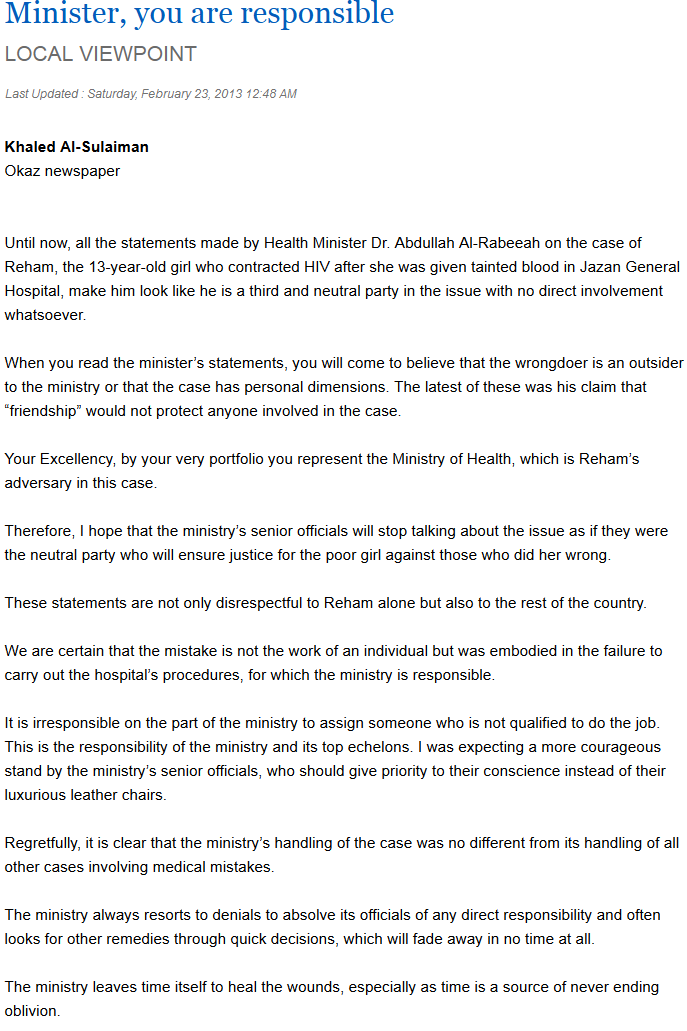
However, reading the English-language press today is a confusing affair. If you pick up Saudi Gazette, you’ll find not one piece but two on Reham. The first is a news item about another Saudi woman who has contracted AIDS. The second is a scathing opinion piece from the paper’s Arabic-language sister publication Okaz written by columnist Khaled Al-Sulaiman.

The column, which was first published in the Arabic-language daily Okaz, was rerun in Saudi Gazette

The column, which was first published in the Arabic-language daily Okaz, was rerun in Saudi Gazette

And then there’s the main piece on the Ministry of Health in Arab News, which focuses on a letter from the King thanking “the Health Minister Dr. Abdullah Al-Rabeeah and for obtaining certificates from the US-based Joint Commission International (JCI) for 15 medical facilities and accreditation from the Central Board of Accreditation for Healthcare Institutions (CBAHI) for 50 hospitals over the past 12 months.”

And here is the main piece on the Ministry of Health from Arab News. There's a second article covered, which is also not related to Reham

And here is the main piece on the Ministry of Health from Arab News. There’s a second article covered, which is also not related to Reham

I know which newspaper I’d rather be reading today. The team at Saudi Gazette and its owners should be praised for their editorial integrity and coverage of the issue.

Incidentally, Arab News is known as the Green Truth owing to the colour of its front and back pages and the quality of its copy. While the colour print hasn’t changed there’s been a noticeable shift in editorial since Khaled Al Maeena left at the end of 2011. During those two years Arab News has had two editors-in-chief (Abdulwahab Al-Faiz and now Mohammed Fahad Al-Harthi) and has lost staff to Saudi Gazette. I for one hope that Arab News receives the investment and political backing from its owner SRMG that the newspaper needs to compete editorially with Saudi Gazette.

Saudi Bubblers and women’s scuba diving in the Kingdom

Here’s something you may not know about the Kingdom – Saudi has some of the best diving spots in the world. The Hijaz coast which borders the Red Sea offers a richness of marine wildlife that is unparallelled (the islands around Farasan are replete with dolphins, turtles and sharks). Saudi can rival or even beat neighbors like Egypt when it comes to a diving experience. But, as always, the secret is in the marketing.

I had the pleasure of talking to one person who is doing his utmost to tell everyone he meets about the beauty of Saudi Arabia’s Hijaz Coast and the wonders of diving for both expats and the country’s nationals. Nawaf Al Otaibi is one of the founders of Bubblers, a Saudi-based group that aims to give as many people as possible the chance to fall in love with diving off Saudi’s coast.

“We set up Bubblers to offer people new to the sport a simply way to get certified and also give divers the chance to get back into the water once they’ve completed their certifications. We wanted to help people dive in an organized fashion, and we focus on arranging group trips that range from one to five days in length. We also offer snorkeling to people who want to dip their toes into the water but aren’t yet sure about taking up diving. Our aim is to show to as many people as possible what the Red Sea has to offer and we’ve found that eight percent of our snorkelers sign up for a full diving course as soon as they’re out of the water and back on the boat.”

Bubblers is the first Saudi-based scuba diving community that bills itself as multinational – the group has a Facebook presence and just under two hundred members to date. And Bubblers aims to please all. “We have a diverse group of divers, including Saudis. We’re finding that more and more Saudis are joining us on our trips. Over the past two months, Bubblers has arranged four trips, each with a maximum of twenty people. The ages have ranged from 11 up to 72 years. We take care of everything, from A to Z, even including flights from Riyadh, food and other transportation needs. We’re also finding that women are taking up the sport. They can dive fully hooded and covered, and we welcome then on board our trips.”

No matter how good you are, if you’re a newbie or you already have fish gills, Bubblers can take care of you through a host of diving courses and training, including the basic open water diver developed by the Professional Association of Diving Instructors, as well as the advanced open water diver, master scuba diver and dive master certification.

And on the issue of women diving in the Kingdom, you may be surprised. Scuba diving can be done in my favorite piece of clothing, the burkini, and a recent article in English-language newspaper Arab News focused on demands from Saudi women for female-only diving areas. I’ve pull a quick quote from the article, which highlights the obstacles women face when diving in the Kingdom.

An increasing number of women scuba divers want designated areas to dive in the Red Sea to avoid the obstacles they face when trying to obtain a permit for a diving trip.

Just to whet your appetite have a look at these pictures from Bubblers divers, including the talented photographer Mr. Vincent Al Hawary.

If your interest has been piqued then call Nawaf on and start planning for an unforgettable experience. His details and details for the rest of the group’s founders can be found in this handy pdf brochure made by the team at Bubblers (please do click on the link below). Of course, you won’t need me to tell you that you will need Adobe Acrobat or a pdf viewer to open.

Bubblers Profile

Fre! It’s wine, it’s in Saudi Arabia, and it’s legal (for now…)

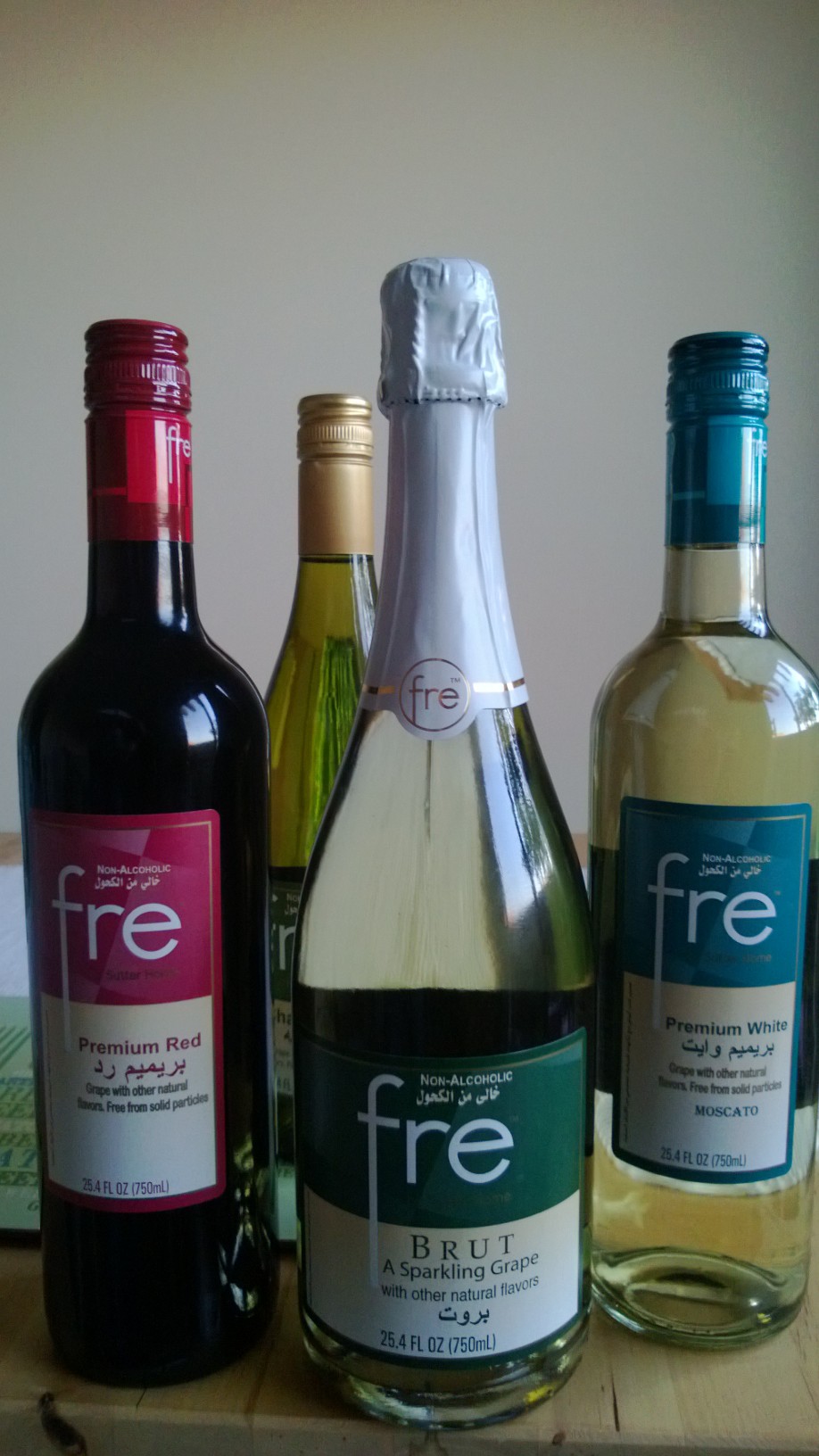
No, it’s not how you say good morning in Swedish or Norwegian (although it’s fairly close I’ve been told). Instead, Fre is a modern miracle of science. Fre is wine without the alcohol. Don’t ask me how it’s done, or if the company thought of Saudi Arabia when they conceptualized Chardonnay without the 14.5 percent on the bottle. But Fre is magical. And it is available in Saudi Arabia.

Now, I know there will be skeptics out there. You will say, it’s only apple juice with a fancy name. No, Fre is different. We’ve tried Fre on numerous foreign friends, and presumably some wine connoisseurs, who’ve come to visit us in the Magic Kingdom. Once we had a group of executives from a very well-known IT brand visit the compound and they thought we were running the biggest alcohol racket in all of Jeddah once they’d opened the cupboards. We weren’t. It was Fre.

Our savior on many an occasion we had foreign guests! And it tastes like the real thing too!

Our savior on many an occasion we had foreign guests! And it tastes like the real thing too!

We first discovered Fre in a popular Chinese restaurant in Jeddah opposite Takhasusi hospital. After that we were hooked, though my wife always swore that the stuff has alcohol in. We always used to find Fre in Jeddah, in Sawary supermarkets or sometimes Danube. There’d be the occasional shipment to Riyadh, to Tamimi Safeway, but Tamimi usually stocked the cheaper and less fancy Vinola. I once took a bottle with me from Jeddah to Riyadh on an internal flight. The x-ray machinist didn’t know what to do with me, bless him.

Fre isn’t cheap at around 50 or 60 Riyals a bottle, but there’s lots of variety (Brut, Merlot, Chardonnay, Moscato, and White Zinfandel) but it’s cheaper than the other stuff one may find in Saudi Arabia and it’s certainly more enjoyable than a stay in a prison cell. Now go and buy some! And if you don’t believe me then look at this video. I just wish I had the distribution rights for this stuff!

Are the Saudis the QR Code kings of the region?

The Magic Kingdom always seems to get a bad reputation when it comes to adoption; everyone else always seem to think that Saudi Arabia will be the last to the party. However, on my last trip to Riyadh a couple of weeks back I was pleasantly surprised to see QR codes at the airport and throughout the city.

I’m sure that even if you can’t recall what QR codes are, you will have seen them in magazines or on posters. QR codes (the QR stands for quick response) are optical machine-readable labels which resemble bar codes. QR codes have become popular in consumer advertising in the United States, Europe and Asia due to their ease of use and the ability to guide/track a consumer’s actions through the technology; smartphone users (that’s most of us nowadays) can use QR-code scanner apps to open a website which relates to the advertiser and its products. For an example of a QR code have a look below; the code is even branded.

A branded QR code from the BBC (credit: shadowdev.com)

In Riyadh’s King Khalid Airport the mobile operator Mobily is using QR codes on its advertising boards to direct traffic to product microsites. Riyadh Municipality is also using QR codes to help the public identify street names and places. Similarly, Jeddah Municipality has started rolling out a QR code tagging system for its streets. To quote from the English-language daily Arab News article.

Visitors and residents will be able to learn of a street name, location and GPS coordinates by taking a snap shot using their smart phone reader.

“The signs have already been mounted at number Jeddah’s districts,” said undersecretary for projects and urban construction at the Jeddah mayor’s office Ibrahim Kutub Khana. “This includes Basateen, Muhamadia, Naeem and Salamh. These new signs includes a property’s GPS coordinates, street name and location inside the district. To make locating and navigating in Jeddah more easier and convenient visitors and residents.”

By pointing their smart phones at the QR code tag, all the information is stored inside a database. The information can be accessed through satellite positioning systems.

Plans are also under way for installing additional new signs in more of the city’s districts.

Not only are advertisers using QR codes, but the Saudi government has managed to implement a system for two cities, each with a population of seven million people. How’s that for a regional first? Let’s hope other advertisers in the region follow the Saudi lead and start using QR codes in their advertising/content.

How to avoid the speed cameras in Saudi with Twitter

If you're looking for a way to beat the Saudi speed traps look no further than Twitter!

If you’re looking for a way to beat the Saudi speed traps look no further than Twitter!

Saudis are ingenious. And they don’t like to be told what to do. When you combine the two the results are imaginative to say the least. I’m late to the game on this one but I was intrigued when a family member showed me the latest attempt to beat Saher, the country’s traffic cameras which have been fining speeding Saudi drivers ever since they were installed back in 2010.

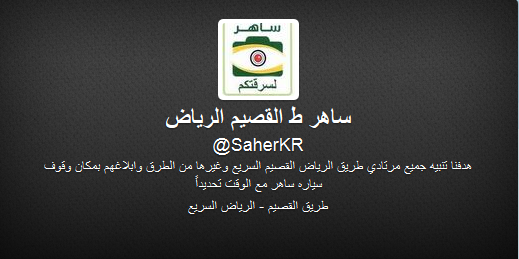
The friend opened up his phone, went to his Twitter feed and clicked through on to one Twitter account, named @SaherKR. This feed can be used by followers to alert their fellow Formula One drivers of any mobile or fixed Saher cameras, checkpoints, or any other inconveniences on the road between Riyadh and Qasim. One example is below.

https://twitter.com/SaherKR/status/297708381358137344

There’s dozens of these accounts today in Saudi. My favourite is @Saher_khj which is followed by 10,000 Twitterers and gives all the details needed to avoid speed traps including the exact area of the camera, the speed limit and the time of day the user has passed by the camera.

I am left asking myself however how these people have the time to write a 140 character message while most likely doing 150 kilometers an hour in their Toyota Camrys or Hyundai Accords. Maybe that’s why their driving is so erratic as they’re shuffling their fingers across their iPhones whilst attempting to steer the car?

This isn’t the first time that the Saudis have used technology to overcome pesky government interference. The first widely reported solution was a mobile phone application called Trapster which alerted drivers via their iPhones of speed cameras in the vicinity. The application proved so popular that mobile phone shops were charging customers over $100 dollars to install on the iPhone. The application itself was free (if you don’t believe me, it’s printed in the media so it must be true).

And the fun part of this detective work? The family member who showed me all of these Tweets works as a senior manager in the Saudi Interior Ministry and is responsible for road safety. Boys, they know who you are and where you are! Ticketing by Twitter? Sounds good to me!

My recollections of Saudi Arabia’s Prince Mugrin

Saudi Arabia’s next Second Deputy Prime Minister Prince Mugrin Bin Abdulaziz Al Saud whom we found to be a captivating individual

For all you Saudi fans and fanatics out there, the news of Prince Mugrin’s appointment as the second deputy prime minister took most by surprise. There’s a wonderful piece on Prince Mugrin and what this means to Saudi Arabia here by Michael Stephens. However, it is possible that Prince Mugrin, who is the youngest surviving son of the founder of the Kingdom, would become King.

I’m not going to go over the same ground that every Saudi watcher has covered over the past few days. What I will do is recall me and my wife’s personal memories of Mugrin from 2007. We were media partners to the first e-government conference in Saudi Arabia, e-Transactions, and had unfettered access to the event and its speakers. Prince Mugrin was, if I remember correctly, the only royal family member to both attend and speak at the event.

Prince Mugrin was on a panel which was addressing the issue of bureaucracy as it relates to online services. What struck my wife in particular was how candid the Prince was, particularly in relation to Saudi government. In effect, he said that Saudi Arabia had far too much bureaucracy and that e-government could not be in place sooner. For a prince who is first-tier (even the royal family in KSA has rankings) and who held the position of head of the Saudi Intelligence at the time Mugrin seemed acutely aware of the problems that faced society. We were impressed by his open demeanor and his directness.

A more lasting impression, and probably an indication as to why Mugrin is reportedly close to King Abdullah, was made during Mugrin’s tour of the exhibitor partners. Again, as the publisher of the media guides to the event, we had a stand in the exhibition area. A number of the team on the stand were female, and Prince Mugrin greeted them all warmly and even going so far as to shake their hands and asking them about the conference.

To this day my wife who was at the stand when Prince Mugrin visited talks fondly of the encounter. While much has been made of the succession remaining with the sons of the founder of the Kingdom rather than being passed down to the next generation of the Al Saud family, I’m optimistic that Prince Mugrin will continue to promote King Abdullah’s agenda to slowly but surely reform the Kingdom’s government and cultural practices.

Fifty Three Million and Counting – Facebook’s hold on the Middle East

Based on the latest statistics shared at the Studio Edge event Facebook is the one network to rule them all (unless you’re a keen bird watcher that is)

Facebook came to town last week, and they brought lots of numbers with them. I was lucky enough to be invited along to the first Studio Edge event in the Middle East region. And I was astounded by the numbers that the team kept on rolling out. I’ve summarized these numbers below for you.

According to Facebook’s own research there are fifty three million active Facebook users in the region who use the service at least once a month. Egypt is Facebook’s largest market, followed by Saudi Arabia and then the United Arab Emirates.

Fifty two percent of Facebooks users access the site solely through their desktops and laptops; thirty eight percent use both mobile phones and computers, and ten percent only use their mobiles updating their profile and other Facebook activities. Twenty million people in the Middle East and North Africa are using Facebook today through their smart phones.

The average age of Facebook users in the region is 27 years and 64 percent of MENA users are male. That’s in contrast to the global split of male to female users which is currently 50/50. MENA Facebookers spend approximately seven hours on Facebook a month (that’s double the global average). And fifty two percent of Facebookers in the UAE use Facebook whilst watching television.

Middle East Facebook users like 84 pages compared to the global average of 51, and they view approximately 550 pages a month. Over forty percent of their time is spent on the news feed section of Facebook.

And to top off all of that, Facebook’s user base is growing in excess of 20 percent in the region.

With all of this information above, I’m hoping that we’re going to see more businesses online using the site. But if there was ever any doubt that Facebook is a first-tier consumer communications channel then please do re-evaluate how you use the network and start using the site properly.

One other interesting observation from the Facebook event. Most of the attendees were from advertising and creative agencies. I only spotted one public relations company. And yet, Facebook is all about content. Shouldn’t the Middle East’s PR industry be getting in on the act and promoting the quality of its social media services more?