The Gulf, social media and its self-deprecating humour

The Gulf is known for many things but a sense of humour hasn’t traditionally been on the list, even less so self-deprecating humour. With the advent of social media, in particular YouTube, both the Gulf’s residents and nationals have started to develop content like there’s no tomorrow. The best is currently coming from Saudi Arabia. One example is La Yekthar, one of the most popular comedy shows on the net. The team regularly tackles and takes on stereotypes of Saudis, and one of their latest clips was a fantastic set-up of how Saudis are often perceived by foreigners. The video, which is below, also sends a not-so-subtle message to Saudis that this type of image, of arrogance and violence, isn’t the right thing to do.

Bahrain has also followed suit with a number of send-ups of the typical Bahraini stereotypes. The clips, which are common on the video-sharing site Keek, focus on a variety of stereotypes which are mainly based on geography (for example, Al-Riffa and Muharraq). I’m going to have to search for these but I’m going to upload as soon as I can.

Even Qatar is getting in on the act. The only local Qatari comedian I know, Hamad Al-Amari, routinely does stand-up routines poking fun at Qatari stereotypes before switching effortlessly into an Irish accent (he spent part of his childhood in Ireland). Have a look at one of his sets below.

And then there’s the UAE. While there are a number of local comedians here including the likes of Ali Al Sayed the country has arrested those, even nationals, who have poked fun at the country’s stereotypes. Emirati Salim Dahman and a group of young males who made a spoof YouTube video named the ‘The Deadly Satwa Gs’ were arrested after uploading the clip. No reason seems to have been given for their arrest, but the assumption would be that they’ve been detained for insulting national sensitivities.

To quote from 7Days, which featured the story yesterday, ‘The Deadly Satwa Gs’ video is a spoof of young people who try to act tough. At the martial arts school, the recruits learn how to throw a shoe and call for back-up on their mobile phones. When they graduate from the school, they are all given Barcelona football jerseys, supposedly matching a style worn by young men in Dubai.

The video, which is still available online, is hardly groundbreaking satire and is fairly tame when compared to the content coming out of the Magic Kingdom. However, comedy isn’t always a laughing matter depending on where you are in the Gulf.

PS If you want to know why I haven’t mentioned Kuwait ask any Gulf Arab about Kuwaitis and humour.

A Digital Journalism Masterclass – Qatar’s Doha News and @dohanews

Let’s face it, the Gulf doesn’t win many awards for quality investigative journalism. There’s some outstanding journalists out there, but in a region where most/all of the news outlets are underfunded and owned by bodies or individuals who don’t have a media background we’re left with a lack of quality reporting.

Three people, journalists with experience of global media outlets such as the BBC, the Wall Street Journal, and Al Jazeera, took it upon themselves to take on Qatar’s media scene and create a news portal that would deliver news in real time. The result was Doha News, a news service that began its life on Twitter as @dohanews and then developed into a daily news blog.

The stated aim of Doha News is “to educate, inform, and stimulate positive change in the community.” What the three people behind the project – Shabina Khatri, Omar Chatriwala, and Tory Scott – have essentially done is to create a community site where the public can send in their content, be it images or news stories, and have that content edited and displayed for the rest of the community to see and comment upon.

Doha News hasn’t just become another news website; the portal has frequently beaten other media channels to breaking stories. Similarly, the quality and accuracy of the site’s news has been commended. No other Doha-based media outlet has covered the Villaggio Mall fire tragedy as comprehensively as Doha News. The site’s team went so far as to produce a 57-page e-book on the anniversary of the disaster which won praise for its coverage of what went wrong on the day of the Villaggio Mall fire and the ensuring events including the trial and steps taken by the Authorities and Mall owners to ensure a similar incident never happens again.

Below is a selection of items from the site including a news piece and pictures from users of the site. If you’re looking for news on Qatar or simply want to understand more about digital journalism in the Gulf Doha News is definitely worth a visit or three. Let’s hope others take up the mantle and create similar news portals for the rest of the region.

This piece is fairly typical of Doha News - a local interest story that uses social media to engage and benefit local viewers

This piece is fairly typical of Doha News – a local interest story that uses social media to engage and benefit local viewers

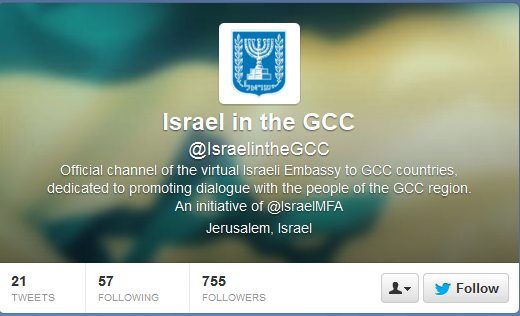
Social media and diplomacy – @IsraelintheGCC, Israel’s virtual embassy in the Gulf

The launch of the @IsraelintheGCC twitter account is a cheap but potentially effective media channel for the Israeli government

The launch of the @IsraelintheGCC twitter account is a cheap but potentially effective media channel for the Israeli government

No matter your political persuasion, you have to admit that the Israelis are an ingenious bunch. Their latest idea is a simple concept, a virtual embassy for a part of the world where there’s little/no Israeli State presence, the Gulf. Israel, which doesn’t enjoy official diplomatic relations with any of the Gulf states, has launched a ‘virtual embassy in the Gulf’ through Twitter. The account, which is named @IsraelintheGCC, aims to “open lines of dialogue” with people living in the Gulf according to a report by the UAE-based English-language daily Gulf News. According to the Israeli daily Haaretz, the person behind the idea is Yoram Morad, Director of the Department of Digital Diplomacy at the Ministry of Foreign Affairs of Israel.

Not unsurprisingly, Israel has always faced challenges when trying to communicate its point of view to its Arab neighbours. However, that hasn’t stopped the State from engaging various mediums to argue for its policies. Israel launched an Arabic-language television channel in 1994 following the announcement of the Israeli-Palestinian peace process. The establishment of the @IsraelintheGCC twitter account follows news of a potential re-engagement between the Israelis and Palestinians as well as mounting pressure on Iran to halt its nuclear enrichment programme.

It could be argued that Israel has been much more active than the Arab states in terms of communicating its key messages – there were plans to launch a Hebrew-language channel in Egypt as of last year according to the Christian Science Monitor, but I haven’t heard much in the way of an actual launch.

The messaging employed by @IsraelintheGCC, which is being run by the Twitter account of the Israeli Foreign Ministry, would appear to be aimed at propagating a more diplomatic tone than that of Israel’s internal politics. The account, which has tweeted 21 times to date, has only quoted the country’s Prime Minister twice (its fair to say that Bibi Netanyahu wouldn’t win many popularity contests in the Gulf), but it has talked about social media in the Arab world, sustainability issues, and wished followers a Ramadan Kareem. The one time Netanyahu has been quoted was in relation to European sanctions on the Lebanese organization Hizbollah which isn’t well liked in the Gulf due to its pro-Iranian stance. There are tweets in Arabic too. Have a look at some of the posts below.

Over the past couple of years social media has allowed companies, politicians and celebrities to directly bypass the media and reach out directly to anyone that wants to listen. Now the same can be said of social media for States who, for diplomatic reasons, cannot establish a physical presence. I’ll be following the account, and am looking forward to seeing how long this project lasts, how much dialogue it generates and how successful it becomes for the Israeli government.

Why do Middle East executives not blog and five reasons for starting a corporate blog today

Is this question even relevant any more? Middle East execs, what are you waiting for? (image source: http://www.homeschoolblogging.com)

There’s no doubt about it, blogging is huge. But don’t take my word for it, let’s look at the numbers. On blogging platform WordPress there are almost seventy million blogs, which are read by 360 million people each month. There’s even more blogs on the Tumblr (over 100 million as of April 2013) and Livejournal platforms (approximately 62 million blog sites as of April 2013). While blogging may not hug the headlines as much as social media, the online writing format continues to grow. By the end of 2011, NM Incite, a Nielsen/McKinsey company, was tracking over 181 million blogs worldwide, compared to only 36 million in 2006.

Similarly, blogging has become one of the most popular tools among corporations in a number of geographies. Research by the Center for Marketing Research at the University of Massachusetts has pointed to growth across both the Fortune 500 and the Inc. 500 in 2012. Forty-four percent of Inc. 500 companies, the fastest publicly-firms in America, were blogging, while twenty-eight percent of America’s largest publicly-listed firms had a corporate blog. The most interesting statistic was that sixty-three percent of CEOs of companies who did blog contributed personally to content.

These statistics from the Center for Marketing Research at the University of Massachusetts Dartmouth underline how popular blogging is with corporations in the US (image source: http://www.umassd.edu)

It’s fair to say that the Middle East corporate world, and the Gulf in particular, doesn’t share this same level of enthusiasm for blogging. Few publicly-listed companies have a blog – we’re literally talking a handful – and even those blogs that are online are rarely updated.

While it’s hard to speculate on the reasons why so few CEOs blog here, the one assumption that I’d make is either they don’t feel a need to communicate with their stakeholders or they don’t want to reveal information through a medium such as a blog (this subject does need more research, but the lack of blogging here maybe reflects a wider lack of understanding of digital communications).

For a pastime that was once considered on the fringe of journalism, blogging is a pivotal online media channel for breaking news, sharing content and developing an audience. Blogs are often quoted in the media and it allows a corporation to control the message and yet promote a healthy dialogue with its internal and external stakeholders.

There are many reasons for starting a corporate blog, but we’re going to focus on the five basics which should underline to your chief executive officer the value in having a blog for your company and including blogging as part of our communications strategy.

1) It’s all about transparency

We all want and sometimes need more information, and yet corporations often keep too much of a lid on what external stakeholders see and know. A blog allows you to let others look inside the company and give them a better understanding of any and every issue you care to tackle, from sustainability to product development and customer relations.

The benefit of transparency is increased trust. Your (potential) customer base should better understand why you do what you do. Customers and investors will feel much better informed and they may be more willing to buy your product and invest in your company.

However, don’t take transparency to mean republishing your press releases in a different format. Some of the most successful corporate blogs are those that take a nuanced approach, that tackle the good and the bad. The less biased you are, the more likely you are to be trusted when publishing a blog.

2) Bringing some humanity to the Corporation

Corporations are often seen as soul-less, grey worlds. And the same can often be said for a corporation’s communications approach; the bland press releases, the staid web-site which rarely seems to be updated. As people we all thrive on interaction and dialogue and that’s why blogs are so successful. They’re your corporation’s personal voice, a voice that need not use corporate-speak and jargon but instead adopt a tone that is more informal and conversational.

Your blog will need a face. It could be the CEO or another senior person. But a blog doesn’t need to be written by an executive. Some of the most insightful blogs are written by product managers, researchers and others who are passionate enough to make what they are saying interesting.

The beauty of blogging is that you don’t need to stay on message all the time. You can write about diverse topics which don’t need to be about the company. Customers will see through marketing pitches so step away from the self-promotion. Instead, offer human insights into recent events, industry news and other related information. Let your customers know more about you than just your product line-up and they’ll begin to become more loyal to your brand.

3) Starting a dialogue

Unlike many other forms of communication, blogs are there to receive feedback as well as to be a voice for the company. When you engage readers and respond to dialogue – both positive and negative – you’ll be doing much more than just promoting your company.

Blogs are a great way to test the water, to understand your customers’ perception on certain issues. And even if the comments are negative, at least you’ll know what your customers are thinking and be able to respond and bring them back on board. Get talking on a blog and even those stakeholders who may not agree with your company’s strategy will appreciate your efforts to talk with and about these issues in a forum that allows for and encourages debate.

4) Drive that web traffic!

Want a business reason for blogging that your sales team can measure? How about the web traffic that a blog will drive to your site. Many web engines such as Google rank sites based on content, on relevance and popularity. A blog that is updated regularly, that has content that is popular and that links to other sites you’ll find your own corporate site being ranked much higher by search engines such as Google. Once your own blogging site has become established you’ll find others linking to you, which will further propel your blog to the top of the search rankings and towards the nirvana of a first page listing.

5) Measure your blogging success

The beauty of communicating on your own site is that you can analyze your visitor statistics, to understand where your visitors are coming from, what they’re doing on your blog, what they’re using to read your blog (are they viewing your blog on a PC, a tablet or a mobile?) and how they’re reaching your site. The beauty of web analytics is that the more you have, the better you can make your blog and improve your visitor numbers. From there you can start defining your blog’s goals and measure your goal conversion, review how you’re promoting your blog and understand which topics and keywords are the most successful in driving traffic to your site.

Unlike traditional public relations metrics, online measurement tools are instant and can give you a full picture of what you’re doing right and how you can improve your blogging outreach. Blogging technologies are evolving but don’t feel daunted by the technological challenge. Blogging can be simple enough to begin with, and most blogging platforms have their own in-built analytics to help you out.

Attacks on Al-Jazeera intensify following the fall of Egypt’s Muslim Brotherhood

Al-Jazeera has come under fire for its alleged political ideology in its coverage of Egyptian news (image source: islam.ru)

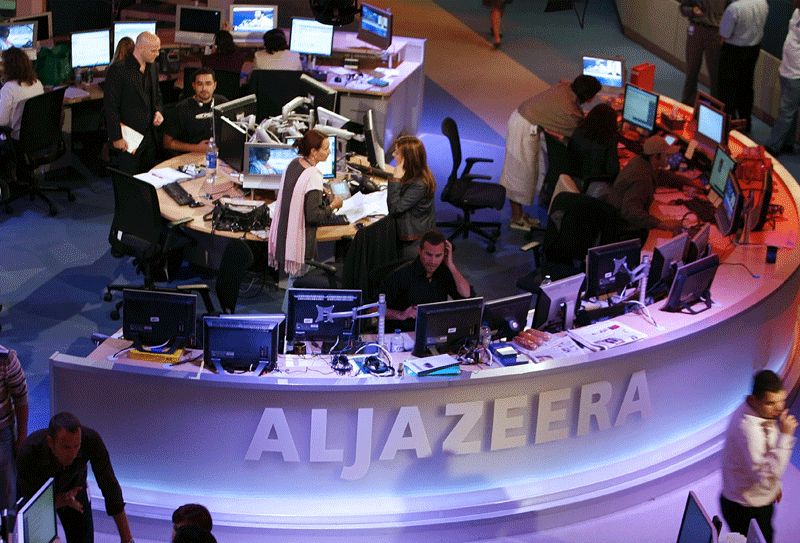
Who doesn’t know Al-Jazeera? The Doha-based and Qatar-owned news broadcaster became infamous for its airing of messages from Al-Qaeda’s leaders, most notably Osama Bin Laden. The news channel, which was created in 1996 following attempts by the British Broadcasting Corporation to set up their own Arabic channel failed, has always been the target of criticism partly due to its political inclinations and its inability to criticize its owners – the State of Qatar – while running documentaries and publishing news critical of neighbouring Middle East states.

However, Al-Jazeera has been having a particularly rough time of late following recent events in Egypt. partly of its own making but what’s even more interesting is the level of coverage that other media has given to targeting Al-Jazeera following the fall of the Muslim Brotherhood’s Government in Egypt.

Ever since the events of the end of June and the start of July in Cairo it’s almost felt as if there’s been a witch-hunt against Al-Jazeera due to its Egyptian coverage. The main accusation? Al-Jazeera’s bias towards the Muslim Brotherhood.

While I understand the accusation, the fact that many of those making the claims are firstly media publications and secondly state-owned doesn’t sit well with me. I know of few state-owned media who are not guilt of being their master’s voice and hence being guilty of their own allegations against Al-Jazeera. Furthermore, I always find it strange when media attack other media; it’s hard enough being a journalist as it is today without being criticized by fellow colleagues.

I’m going to highlight a couple of articles below, from the Dubai-based and Dubai-owned Gulf News. The first and the most conspicuous news item was a special which was run on the 14th July entitled Al Jazeera loses respect over Egypt coverage. Do read over and share your views with me on this one.

Founded in 1996 and funded by Qatar, Al Jazeera was supported by many Egyptian revolutionaries. Demonstrators in Tahrir Squar chanted for it. Also, Al Jazeera staffers were feeling proud that they contributed to the Egyptian revolution with their work and coverage. They made the network the most popular channel in the country.

However, when the now ousted president Mohammad Mursi pushed through an unpopular consistution last November, many Egyptians found themselves flipping from Al Jazeera to other Egyptian networks. Distrust over its coverage reached unprecedented levels and took it from being the most popular to the most hated channel — its staff were now feeling embarrassed as their reputation was dragged through the mud.

A senior official at Al Jazeera who did not want to be named said that while the network appeared to be a neutral media network it was still a political tool in the hands of the Qatari emir. “He personally visited the studios during the Iraq war to make sure no footage of dead of abducted soldiers was aired. It was clear he was under US pressure,” the official said.

“In a special meeting in 2009 attended by some media seniors in Doha, the Emir said that Egypt’s regional role must be ended forever,” said another official. “When the Muslim Brotherhood announced it would field deputy chairman Khairat Al Shater as a candidate in the elections, the news team slotted it as the second story in the news bulletin, but then upon special request from the Emir’s palace, it was bumped up to the first news story.”

A producer claimed that when people started complaining and accusing Al Jazeera of favouring Islamists in Egypt, the station started to exclude any outspoken political analysts and opponents of the Brotherhood from appearing on its screen. On the other hand, he said, video reports that propped up Mursi and the Brotherhood’s image were welcomed by management in Doha. Anchors who used to interrupt the Muslim Brotherhood’s opponents in live interviews were judged as excellent.

The perceived bias prompted many leading journalists and TV anchors to leave the network. Aktham Suliaman, the German-based correspondent who left the station recently, told the German magazine Der Spiegel: “Before the beginning of the Arab Spring, we were a voice for change — a platform for critics and political activists throughout the region. Now, Al Jazeera has become a propaganda broadcaster.”

Another Beirut-based correspondent said that “Al Jazeera takes a clear position in every country from which it reports — not based on journalistic priorities but rather on the interests of the Foreign Ministry of Qatar. In order to maintain my integrity as a reporter, I had to quit.”

Other interesting articles from Gulf News include Al Jazeera staff resign after biased Egypt coverage, Al Jazeera’s role raises questions, and media bias infuriates Egyptian moderates which I am quoting from below.

Al Jazeera’s Egypt channel (Al Jazeera Mubasher Misr) is blatant in its support for the Brotherhood giving no platform whatsoever to the other side. Egyptian authorities attempted to remove it from air, but failed to do so because Al Jazeera allegedly hijacked broadcast vehicles from Egyptian State TV, now protected by the crowds in Rabaa Adawiya.

Local reporters were so incensed they demanded the ejection of Al Jazeera’s senior editor in Egypt from a press conference. Some 22 of Al Jazeera’s employees resigned asserting pro-Islamist bias at the top. On Friday, I was shocked to see someone I recognised on the stage in Rabaa Adawiya, engaged in whipping up the crowds.

There was the host of Al Jazeera’s programme Bela Hodod (Without Frontiers) Ahmad Mansour advising on how to manipulate media coverage and insisting that pictures of June 30 massive anti-Mursi protest had been photoshopped.

June 30’s aftermath has not only thrust the Arab world’s most populated country into uncertainty, it has eroded media credibility and prompted the crossing of a thin red line between honest reporting and political/ideological propaganda. Journalism requires an ethical revolution before Al Jazeera, CNN and others can ever be trusted again.

What I find ironic is the lack of coherency of the argument as it relates to allies. An example in point would be Bahrain. The island’s press is markedly pro-government, and yet there’s no media bias criticism from those who have pointed their finger at Al-Jazeera. If you’re going to adopt an argument at least be consistent in its use. Otherwise, why should we the public trust any of you?

Understanding the Gulf’s psyche through social media (well, mainly Twitter)

What are the religious police up to now? Didn’t they learn from #Dammam-Hayaa-Closes-Dinosaur-Show? (credit: expo2020)

I’m endlessly fascinated by social media and how people interact online. For me, online interactions tend to shed light on people’s off-line personalities. In this post I hope to share my own observations about how each of the Gulf’s nationals deals and interacts online.

Let’s start with Bahrain. Bahrain possibly has the highest concentration of social media users in the Gulf. Bahrainis are very media-savvy and that shows in their effective use of social media channels. The country’s polarization following the events of February and March 2011 is evident online, with the two sides doing their utmost to ensure that their voices are heard. Bahrain has some of the most-followed Twitter users in the Gulf but they inevitably relate to the political and human rights situation on the island. There’s a lot of trolls out there as well, so be aware that if you’re going to delve into any issue relating to Bahrain you’re going to draw attention to yourself.

Emiratis are fiercely patriotic and proud of their country’s achievements over the past 41 years. Emiratis speak in unison when it comes to politics and are the most supportive nationality in terms of the country’s leadership. Unlike Saudi, Kuwait, or Bahrain you’ll find little debate on the country and its long-term direction but more insight into social issues particularly those which affect the national community. You’ll find royal family members online, members of the Federal National Council, a police chief and lots of UAE-based expats.

Kuwaitis are known for many things, including being opinionated. This is no different online. The Gulf country with the most blogs per person Kuwait is all about politics and disagreement. Kuwait’s politics is just as vibrant online as it is in the country’s parliament, and when you mix in other electrifying issues such as the Bidoon, the country’s rulers, the Arab Spring and religion you’re going to come up with an incendiary cocktail. Some of the most interesting Tweeters are Kuwaiti bloggers and parliamentarians. Just handle with care!

The Qataris are a mischievous bunch. When they’re not commenting on Qatar’s latest attempt to buy a path across the globe (what next after Marks and Spencers?) they’re making the most out of their sense of fun with raucous commentary on the latest goings on in their country. Their musings on Qtel’s attempts to rebrand itself to Ooredoo were biting, as was the boycott against the very same company for its poor customer service (is anyone in the UAE and Etisalat listening?). The Qataris are a wonderful bunch to follow. And one or two of them love their Dunkin’ Donuts coffee!

Saudis, yes you cannot avoid them online just as you cannot avoid them in the physical world. I love Saudis and I love them just as much in cyberspace. They’re open, they’re diverse and they talk about everything. Saudis are not afraid to poke fun at themselves and they’re just at home talking about social issues, politics, arrange boycotts (aka AlShaya and Al-Marai) and even debate religion. There’s some remarkable Saudis online, from preachers to royals and ministers. Saudi is one of Twitter’s fastest growing markets. And they watch more Youtube than any other country worldwide. They are officially living online. And yes, one of them owns (a bit of) Twitter.

And finally, there’s the Omanis (I’m skipping the alphabetic sequencing on this one). I’ve rarely come across Omanis on social media, possibly because I’m not close to issues that they write about or follow. Omanis are known to be kind, courteous and have a fun sense of humour. Which means I really should go and find some Omani tweeters to detox from all of the politics and debate in the rest of the region.