Understanding the Gulf’s psyche through social media (well, mainly Twitter)

What are the religious police up to now? Didn’t they learn from #Dammam-Hayaa-Closes-Dinosaur-Show? (credit: expo2020)

I’m endlessly fascinated by social media and how people interact online. For me, online interactions tend to shed light on people’s off-line personalities. In this post I hope to share my own observations about how each of the Gulf’s nationals deals and interacts online.

Let’s start with Bahrain. Bahrain possibly has the highest concentration of social media users in the Gulf. Bahrainis are very media-savvy and that shows in their effective use of social media channels. The country’s polarization following the events of February and March 2011 is evident online, with the two sides doing their utmost to ensure that their voices are heard. Bahrain has some of the most-followed Twitter users in the Gulf but they inevitably relate to the political and human rights situation on the island. There’s a lot of trolls out there as well, so be aware that if you’re going to delve into any issue relating to Bahrain you’re going to draw attention to yourself.

Emiratis are fiercely patriotic and proud of their country’s achievements over the past 41 years. Emiratis speak in unison when it comes to politics and are the most supportive nationality in terms of the country’s leadership. Unlike Saudi, Kuwait, or Bahrain you’ll find little debate on the country and its long-term direction but more insight into social issues particularly those which affect the national community. You’ll find royal family members online, members of the Federal National Council, a police chief and lots of UAE-based expats.

Kuwaitis are known for many things, including being opinionated. This is no different online. The Gulf country with the most blogs per person Kuwait is all about politics and disagreement. Kuwait’s politics is just as vibrant online as it is in the country’s parliament, and when you mix in other electrifying issues such as the Bidoon, the country’s rulers, the Arab Spring and religion you’re going to come up with an incendiary cocktail. Some of the most interesting Tweeters are Kuwaiti bloggers and parliamentarians. Just handle with care!

The Qataris are a mischievous bunch. When they’re not commenting on Qatar’s latest attempt to buy a path across the globe (what next after Marks and Spencers?) they’re making the most out of their sense of fun with raucous commentary on the latest goings on in their country. Their musings on Qtel’s attempts to rebrand itself to Ooredoo were biting, as was the boycott against the very same company for its poor customer service (is anyone in the UAE and Etisalat listening?). The Qataris are a wonderful bunch to follow. And one or two of them love their Dunkin’ Donuts coffee!

Saudis, yes you cannot avoid them online just as you cannot avoid them in the physical world. I love Saudis and I love them just as much in cyberspace. They’re open, they’re diverse and they talk about everything. Saudis are not afraid to poke fun at themselves and they’re just at home talking about social issues, politics, arrange boycotts (aka AlShaya and Al-Marai) and even debate religion. There’s some remarkable Saudis online, from preachers to royals and ministers. Saudi is one of Twitter’s fastest growing markets. And they watch more Youtube than any other country worldwide. They are officially living online. And yes, one of them owns (a bit of) Twitter.

And finally, there’s the Omanis (I’m skipping the alphabetic sequencing on this one). I’ve rarely come across Omanis on social media, possibly because I’m not close to issues that they write about or follow. Omanis are known to be kind, courteous and have a fun sense of humour. Which means I really should go and find some Omani tweeters to detox from all of the politics and debate in the rest of the region.

How much variety and discrimination is there in the Gulf?

The GCC is as diverse and complicated as any other part of the globe (credit: rasheedsworld.com)


Looking on in from the outside, most expatriates see the Arabian Peninsula as one monotonous geography. The women wear black (unless they’re Kuwaiti) and the mean wear white. The language is the same, and everyone is a Muslim. And that’s the Gulf.

Well, hardly. Each country is unique, and offers a wealth of diversity in terms of culture, history and opinions. The range of accents in Bahrain is so prominent that a local will be able to tell where a compatriot may be from how the greeting alone.

Saudi is the most diverse country in the region. Its twenty million nationals come from all four corners of the world, and don’t be surprised to meet a Saudi whose roots trace back to Indonesia, China, or Western Africa. The Kingdom’s Western Region is the richest melting pot you’ll come across, thanks to hundreds of years of pilgrimage to the two holy cities of Makkah and Madinah. Often foreigners think that Dubai or Doha are the two cities that offer the greatest contrast of cultures and groups, but they don’t come close to what Jeddah has to offer.

And Christians in Kuwait and Bahrain? And a Jewish community in Manama? Yes, they’re locals (but there’s not many of them).

And of course, with variety comes discrimination. There’s a good deal of nepotism across the Gulf mainly due to the tribal, bedouin nature. It’s not uncommon to find a certain group dominating in one company – it’s not so much where a person is from as often as what their tribal name is. Many Saudis don’t use their tribal names any more. And there’s also discrimination based on region (Jeddah versus Riyadh, Dubai versus Abu Dhabi etc), on the history behind the family name (in other words how far back can the family’s genealogy be traced), and on religion (which mathab or religious affiliation a person adheres to).

While this isn’t unique to the Gulf (tell me a place where there isn’t any discrimination) what I do find interesting is the institutionalized discrimination in certain parts of the GCC. Some states, most notably Saudi Arabia, Kuwait, Bahrain and Oman count GCC nationals as locals when it comes to hiring and nationalization quotas. The UAE and Qatar do not – when they say local they mean local. For a European the difference in policy between the two groups is hard to fathom (especially when considering the relatively small populations of both Qatar and the UAE when compared to Saudi Arabia).

So, the next time you’re sitting in the coffee ship and sipping on your coffee do remember to ask yourself where the gentleman in white is from. You may be surprised at how much you can learn about a region that is full of culture and contrast.

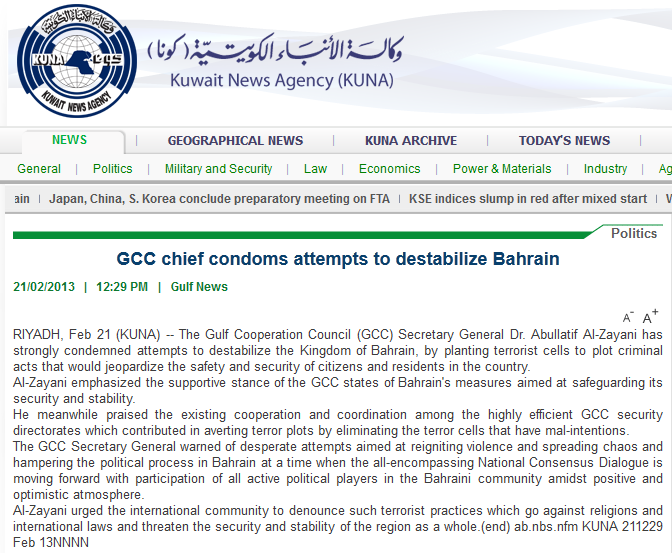
The benefits of spell-checking in the Middle East: GCC Chief condoms Bahrain

I’ve often considered being a journalist in the Middle East a curse. I’m surrounded by poorly spelled English signage, all of which I not-so-secretly want to correct. I used to find myself shaking my head from side to side as I’d count all the grammatical and spelling mistakes in certain areas of Riyadh.

While those in charge of signage may have the excuse of not being near a spell-checker when producing the prints, journalists cannot plead the same. And the below is just a shocker. I’m assuming that KUNA, Kuwait’s News Agency, has a good roster of staff to both write, edit, and proof-read. I just hope that someone amends this story and quick. But for posterity here’s a screen capture.

The headline says it all...

The headline says it all…

The pride of the Gulf: Kuwaitis and their determination to realize their civil rights

Kuwait has seen unprecedented levels of demonstrations over the past month

Kuwait isn’t a place one would naturally associate with freedom and democracy. The country and its nationals are often derided by other Gulf Arabs for a number of reasons (if you live in the Gulf you’ll understand what I’m talking about here).

When it comes to participation in government, there’s no doubt in my mind that the rest of the Gulf could learn a great deal from Kuwait. The country has always had, by GCC standards, a vibrant and active political scene. Kuwait’s Constitution guarantees democratic representation by virtue of Article 6, Part 1 which states that “the System of Government in Kuwait shall be democratic, under which sovereignty resides in the people, the source of all powers.”

When talking about civil protests in the Gulf area a common refrain has been to ask “why are there any protests at all?” The perception is that Gulf Arabs have money, and that they are looked after and provided with all that they may need by their respective governments. This may be true in some cases, but it misses the point entirely. Kuwaitis are demanding more say in their government and how the country is ruled.

The challenges in Kuwait are best summed up by Kuwaiti opposition leader Musallam Al-Barrak in his article for the Guardian newspaper. You can read the article here, but I will also quote from it below.

We are protesting against an unconstitutional change in the electoral law pushed forward by the emir. The electoral system divides Kuwait into five districts; 10 parliamentarians are elected from each district. Previously people could cast four votes per ballot, but the new law permits voters to cast only one. This change aims to quell the national assembly’s role, as it facilitates the governing authority’s control of electoral outcomes – which in turn undermines the country’s democratic legitimacy.

On a deeper level, however, the demonstrations are against individual rule, something Kuwaitis have long and actively refused. In 1962, when the current constitution – which limits the governing authority’s role – was issued, it established that the public has the right to impose its opinions on the emir through the elected national assembly – a right that the governing authority refuses to acknowledge. The current struggle is therefore a struggle for power. Is power – as stated in the constitution – for the public, or is it – contrary to the constitution – for the emir?

The majority of people also believe that the government, representing the ruling family, is not serious in its battle against corruption. In fact, people are convinced they are sponsoring it. This belief was one of the reasons behind the dissolution of the 2012 parliament and the recent changes in the electoral system, following the opposition’s exposure of evidence that state money was being transferred to private accounts in London, Geneva and New York, and of the previous government bribing parliamentarians in 2009.

I for one am proud of the Kuwaiti people for standing up for what they believe to be their rights and against the actions of Kuwait’s ruler. They’ve shown bravery, determination, and a belief in themselves despite the very real risks to themselves. Kuwait’s people, both men and women, clearly believe in themselves and their ability to take the country forward. Kuwaitis have proved that they are prepared to risk a great deal for the right to govern themselves and fight corruption.

In his article for the Guardian Al-Barrak writes that in the end the people of Kuwait will be triumphant. I would hope that any victory for democratic participation in Kuwait would be felt by others across the Gulf. Will we one day look back to Kuwait in 2012 and say this is where the Gulf’s Arab Spring began? Today Kuwait and its people should be seen as the pride of the Gulf.

While the country does seem to be going through an unprecedented crisis, I do also feel that the Emir of Kuwait should be recognized to an extent for allowing protests (or at the very least, not cracking down in the same/similar manner to his GCC neighbours). Maybe I’m wrong on this, but Kuwait would seem to be the one country in the Gulf which allows for its nationals to protest openly. While I have read about and been told of attempts to use force and arrests to dispel protestors I certainly couldn’t imagine these scenes being repeated in any other city in the Gulf as of today.

For more on what is happening in Kuwait watch the below report from Al Jazeera’s English channel which makes for fascinating viewing.