Unknown's avatar

About alexofarabia

I'm am obsessive compulsive communicator who has lived in the Gulf for almost a decade. Enjoying the challenge of working in a region where you've got to be innovative, patient and determined to make things happen. Miss being a full-time journalist! Miss family even more! Sometimes I mouth off, but more often I grit my teeth and try to encourage change through a smile (not as easy as you think). Despite now living in Dubai Bahrain is home for me.

Was Alwaleed’s decision to take on Forbes the right one?

Will Alwaleed make up with Forbes or will this fake front cover be the closest he gets to being featured positively in the magazine again? (picture credit: Forbes)

In terms of Saudi Arabia and the Middle East, they don’t come much bigger than Alwaleed Bin Talal Al Saud. The ‘Rainbow Prince’ and grandson of the founder of the state of Saudi Arabia, is one of the world’s richest men. But recently his fortunes have taken a tumble. The Prince has taken offense to Forbes magazine this year during the publication’s compiling of its annual Rich List. The publication, which is the leading authority on the world’s richest people, has been accused of libel by Alwaleed over a claim that it underestimated his fortune by $9.6bn through stock market manipulations of his publicly-listed company Kingdom Holding.

Alwaleed, who’s often named the richest businessman in the Middle East, has made his anger with Forbes well-known to the media through a decision to take Forbes to the high court in London. His legal counsel has filed a defamation claim against the Forbes publisher, Forbes editor Randall Lane and two Forbes journalists for undermining his name. The prince insists that he’s worth closer to $30 billion, which would take him from the 26th richest person on the Forbes Rich List to a ranking within the top ten.

“The basis for actively pursuing a legal action against Forbes would not be about ranking on some list or personal wealth, it is about correcting seriously defamatory comments that have been made about HRH Prince Alwaleed as an individual and Kingdom Holding Company.”

While the prince has played his hand, the question is was this the right reaction? Was bringing everything to the surface the best action Alwaleed could have taken? Forbes initially responded to Alwaleed’s anger the same way that most top-tier publications do, by rebuking his claims through a research-based argument. Below are some excerpts from the feature.

“That [Forbes] list is how he wants the world to judge his success or his stature,” says one of the prince’s former lieutenants, who, like almost all his ex-colleagues, spoke on the condition of anonymity for fear of reprisal from the Arab world’s richest man. “It’s a very big thing for him.” Various thresholds–a top 20 or top 10 position–are stated goals in the palace, these ex-employees say.

Forbes ran down a whole history of its dealings with Alwaleed in relation to the Rich List and the excerpts below don’t paint the prince in a good light (as one may expect following such a fall-out).

“That [first] outreach [to Forbes] proved to be the first in what is now a quarter-century of intermittent lobbying, cajoling and threatening when it comes to his net worth listing. Of the 1,426 billionaires on our list, not one–not even the vainglorious Donald Trump–goes to greater measure to try to affect his or her ranking.

In 2006 when FORBES estimated that the prince was actually worth $7 billion less than he said he was, he called me at home the day after the list was released, sounding nearly in tears. “What do you want?” he pleaded, offering up his private banker in Switzerland. “Tell me what you need.” Several years ago he had Kingdom Holding’s chief financial officer fly from Riyadh to New York a few weeks before the list came out to ensure that FORBES used his stated numbers. The CFO and a companion said they were not to leave the editor’s office until that commitment was secured.”

As can be expected, when you take on a global publication and accuse it of lies, that publication isn’t going to take things lightly. Forbes has run subsequent pieces on Alwaleed contradicting his uncle, the King of Saudi Arabia, in an article entitled Is Prince Alwaleed Trying To Undermine The Saudi King? The piece focused on Forbes initial allegations that the stock market was manipulated to suit the valuation of the Alwaleed-owned investment vehicle Kingdom Holding.

In my article about Prince Alwaleed that Forbes published in March, we quote a former employee of Alwaleed’s, who describes the Saudi stock market as follows: “The players are not many. They come in with big funds, and they buy from each other. There are no casinos. It’s the gambling site of the Saudis.”

As the Forbes writer Kerry Dolan notes, stock market manipulation is an issue that the King himself has taken umbrage with. As a journalist in the country, market manipulation of stocks on the Saudi Bourse Tadawal is well-known and many Saudis will openly tell you whom they suspect of manipulating pricing.

Forbes has also published a very classy picture library detailing what it describes as The Fabulous Life of Price Alwaleed Bin Talal AlSaud (It’s an interesting read, but did Forbes have to drop to tabloid level?).

More recent events have also, in my mind, put Alwaleed’s decision to take on Forbes into a different context. The prince has been involved in another civil case in a London court after himself being sued by a Jordanian businesswoman named Daad Sharab who says she was not paid a promised $10 million commission for brokering the sale of a jet owned by Alwaleed to Libya’s former leader Muammar Gaddafi. The following comments were noted during the cross-examination of Alwaleed by Reuters.

[Alwaleed] repeated time and again that the agreement all along had been that Sharab would receive an amount that would be decided “at my discretion”, and she overstepped the mark by asking for $10 million.

“She did not respect the fact that it was my discretion … Discretion means I have all the right to do whatever I want,” Alwaleed said. “When she came with 10 (million dollars) I went to zero.”

These comments prompted Sharab’s lawyer, Clive Freedman, to ask the prince whether his discretion was supposed to be exercised reasonably, or “like the discretion of an absolute ruler who follows his every whim”.

Freedman accused the prince of making up his evidence as he went along and of being a “debt-dodger” who had refused to pay Sharab for years of work on his behalf, giving no reason until forced to by litigation.

The prince said he did not lie, adding that Sharab had understood all along that she would be paid at his discretion and no one had forced her to work for him on those terms.

But Judge Peter Smith expressed surprised at the prince’s defense. “Nobody is going to do business with you if it relies on your discretion and your discretion becomes capricious,” the judge told the prince.

“Your case then is that your discretion entitles you to not pay her anything? I thought you were an honorable man and you wouldn’t take advantage of people in this way,” he said.

The judge said that it would be better for the parties to settle the case out of court, warning that one or both parties were at risk of being branded liars in his judgment. “I cannot believe that’s in the interest of either of you,” he said.

More recently, at the end of June, one of Kingdom Holding’s board members stepped down from his role for personal reasons. While Ahmed Halawani, who led private equity investments for the prince, may have felt it was time to leave Alwaleed after ten years of service, did recent pressures influence his decision?

And finally, there’s the case of another of Alwaleed’s former business partners. Pierre Daher, the CEO of Lebanese television station LBC International, has given several interviews with Dubai-based marketing publications focusing on his fall-out with Alwaleed. The story is another fascinating read, and is well worth your time.

In all of this, the focus shifts from the other party to Alwaleed. The issues of transparency and of trust keep repeating themselves. Who do we believe? Putting out a media statement is a very different thing to taking another party to court. As Alwaleed has already seen himself this summer, a London court is very different from the Middle East.

Alwaleed has excellent media relations in the Middle East, where he’s seldom questioned (Alwaleed owns a minority stake in several media outlets globally and locally, including in the region’s largest publisher Saudi Research and Publishing Group). But was it wise to openly question and then take to court a global title such as Forbes? We will soon see how this plays out, but I for one am looking forward to what should be an explosive trial between Forbes and Alwaleed.

Will there be more Farsi-language newspapers? On its 35th birthday Al-Sharq Al-Awsat goes Iranian

Al-Sharq Al-Awsat in Farsi? It’s going to happen, and most likely soon.


There’s few pan-Arab newspapers of note. Al-Sharq Al-Awsat, or AAA as I and others so lazily call it, is one of those papers that is everywhere and which demands respect. The green-tinted paper, which only this week celebrated its 35th anniversary and which was one of the first to be printed offshore in London, is a must-read for anyone looking to understand politics in the Gulf and between the Gulf states and the rest of the Middle East.

Owned by the Saudi Research and Marketing Group, the paper is set to again make history by being the first tier-one newspaper in the region to publish in Farsi. While I don’t have the full details on when or how (I’m assuming that the focus will be more on online rather than an actual print version simply to reach as many Farsi speakers inside and outside Iran), the move may mark the beginning of an effort by Saudi Arabia – the Saudi Research and Marketing Group is run and majority owned by the Saudi Royal family – to proactively communicate with Iran’s people directly in their own language.

The timing is also fascinating, coming as it does after the conclusion of Iran’s former President Ahmadinejad’s time in office and the election of the new President-elect Hassan Rouhani. Rouhani has been described as a moderate and one of his many tasks may include reducing the amount of censorship imposed on Iranians living in their own country; Iran has one of the most sophisticated web filter systems active globally today allowing the Government to block any external site at will.

Al-Sharq Al-Awsat’s Farsi move may be long overdue. There’s been concerted efforts by the Iranian Government for some time to speak directly to an Arab audience, most noticeably through its television station Press TV. Will other Gulf governments follow Al-Sharq Al-Awsat’s lead and print their own Farsi language paper or launch more Farsi-language websites?

Lessons in cultural misunderstandings from the Gulf

Are we more a melting pot or a basket-case of cultural groups? (picture source: http://kidspartyheaven.wordpress.com)


The Arabian Gulf is often called a melting pot of cultures, where diverse groups and nationalities meet, work and live together and understand one another. Every now and then, there are moments when a different reality comes to light, when it’s blindingly obvious that we still have a long way to go.

I had the pleasure of having two of those ‘cultural moments’ last Wednesday. The first was with Emirates, the national airline of Dubai. Emirates is an interesting organization, in that it’s one of the most profitable airlines in the world, is owned by the Government of Dubai, and yet most of its senior management is not from the Gulf region.

I enjoy flying Emirates, and I often receive a great service from the airline. I had to rebook both my and my wife’s ticket and pay for the difference over the phone. All went smoothly, until it came to the issue of payment. You see, the habit in the most of the Arab world, and particularly in the Gulf, is for the wife not to take her husband’s name for religious reasons. And yet, I couldn’t pay for her ticket over the phone because my surname obviously is different. The lady on the other end of the phone wasn’t an Arab, but she wasn’t the person who drew up the rules at an airline owned by an Arab government.

Cultural misunderstanding one was resolved not through explaining why my and my wife’s names were different – I did try my best – but for other reasons (I’m a Skywards airline rewards member, which solves everything over the phone). The second cultural crossed-wires was much more fun and less painful but just as much an eye-opener.

I received a message from a friend asking for information about a company I know. Here I was naively thinking he was looking for a job. Instead, he’d been asked by a parent to check up on a person at the company whom a family member had received a proposal of marriage from.

While I’m never averse to providing a job reference or to help someone in their search for the right role, I explained that I may have to draw the line on background checking someone I didn’t know to help facilitate (or not) a marriage request.

We often talk about melting pots, about coming together and living alongside others in harmony et cetera. But how much do we really know about the other? And how often does our lack of cultural awareness catch us out? With Ramadan only a few days away maybe it’s time we did more to understand each other and our diverse backgrounds?

A taste of Bahrain – Emmawash Restaurant

Bahrain has another local destination to head to if you’re looking for traditional fare. Check out this video by online channel MyBahrainME and I dare you not to lick your lips in anticipation!

GEMS foot-in-mouth syndrome and the curious case of the disappearing comments

Please don’t put your foot in your mouth. If you have to say something do mutter the words when the room is empty, or when you’re in the middle of the ocean. And it’s also advisable to stay away from media (image credit: http://www.ronedmondson.com)

There’s a condition that I like to name foot-in-mouth syndrome. Basically, foot-in-mouth happens when an executive talks to a journalist and doesn’t think before they speak. This results in classic ‘how did they say that’ quotes which often whip up a storm of protests from all and sundry.

This week we had one of the best foot-in-mouth moments I’ve read for some time. The chairman of GEMS Education, the UAE’s largest provider of primary and secondary education, gave an interview to Gulf Business. The story was rapidly picked up by Arabian Business and has provoked hundreds of comments from some very angry parents. The quotes which did the (most) damage were below.

Parents have no right to complain about fees if they choose a high school they cannot afford, GEMS Education chairman said of “grumbling” parents in an interview with Gulf Business.

“If you put your children in a school that you can’t afford then you can’t grumble,” Sunny Varkey said.
“You understand what I’m saying? You must choose a school that you can afford.

“It’s normal human behaviour [for parents] to defend fees. But parents can very well see which are the schools that are good, outstanding, fair, or not good. And, accordingly, they can choose a school.”

I love media sites on the internet, partly because of the ability to leave comments and the inevitable pearls of wisdom that readers leave. Varkey’s foot-in-mouth (and if you can’t see why this is a disaster of an interview for Varkey, you’re beyond the pale) was attacked from all sides by parents. Comments included such wonders as ‘It’s no wonder GEMS and HSBC (?) are the two most hated firms in the UAE’, and ‘If graduates from your schools are as arrogant as you are then your schools are definitely not worth the tuition. I would highly recommend getting media training before giving out interviews.’

I wish I could show you more comments; the last time I saw the piece with the comments section still live there were 98 printed which must be a record for the site. However, Arabian Business’ publisher ITP has taken off comments for this piece, either due to the severity of the comments or, more likely, someone possibly threatening legal action.

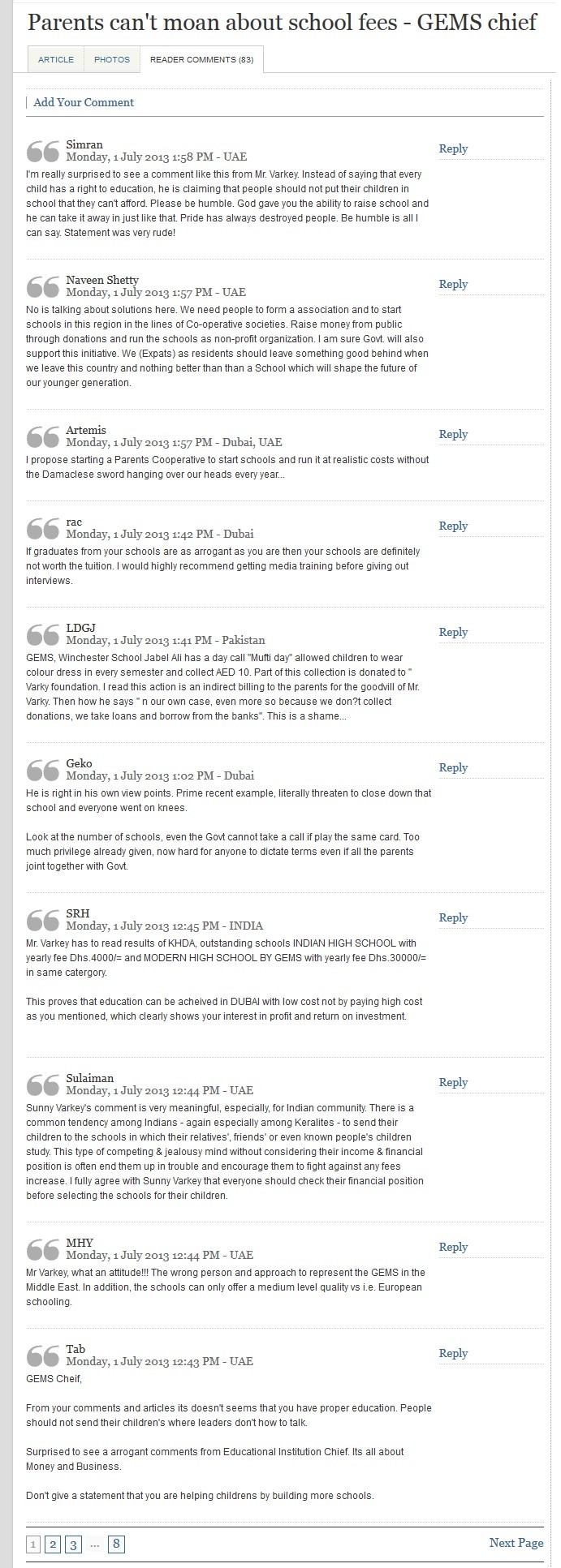
What happened to the comments on Sunny Varkey’s case of foot-in-mouth? I don’t know. But I can at least leave you this cached screen shot to show you that what goes on the internet can always be found!

Where did the comments go? Only ITP and GEMS will know!

Where did the comments go? Only ITP and GEMS will know!

Is Dubai ready for what comes after the Expo 2020 win?

Is Dubai ready for the scrutiny that will follow the Expo 2020 win? Has the country learned any lessons from Qatar’s FIFA World Cup experiences? (image credit: http://www.expo2020dubai.ae)

The stage is all set, the bids are in. If I were a betting man I’d probably place my house on Dubai winning the Expo 2020, the World Fair that is set to be held in 2020 and which is expected to attract millions of visitors over a six month period. Of the other four national/city bidders Thailand has pulled out of the process and of the other three (Brazil, Turkey and Russia), two have been experiencing mass protests of late relating to governance issues (that’s a very PC way of saying riots, teargas and and general chaos as played out on television).

The bidding for the Expo 2020 is winding up this summer with a vote and decision expected by November. But if/when Dubai does win, what next? Ok, we have the plans to build a World Fair that is expected to bring in over 30 million people but as Qatar now understands the big events also bring major scrutiny.

Let me explain further; Qatar’s winning of the 2022 FIFA World Cup was exceptional and unexpected by most. Almost immediately after Qatar won the bid the questions came flying in. How does Qatar treat its ‘enslaved’ foreign workers? Will the beer flow for the fans? And, the most bizarre one I’m sure for the Qataris, will homosexuals be allowed to go to Qatar without facing the risk of being arrested? As they’ve found out, the bigger the event the greater the level of questioning on issues, many of which may not be directly related to the event.

I wonder how much Dubai is ready for this level of scrutiny? The Emirate suffered during the global economic crisis, and it could be argued that Dubai’s cause wasn’t helped by its lack of transparency on financial issues. How will Dubai cope with the level and intensity of questioning that will come win the Expo 2020 win? While I don’t see the Expo as being as high profile an event as the FIFA 2022 World Cup, Dubai and the UAE aren’t so dissimilar to Qatar in terms of issues such as labour rights, security issues and freedom of expression.

Is Dubai ready for the questions that will come after, Inshallah, the Emirate wins the Expo 2020 win? What do you think?

Balancing the information load – Saudi’s Ministry of Health and the Coronavirus

Do images such as this reassure or panic the public? (picture credit: Arab News)

When it comes to many issues, be it driving or otherwise, religion, and long beards, the Kingdom has always made the headlines. However, Saudi Arabia has been in the news recently for what could be an emerging health pandemic. The disease, named the Coronavirus, was first discovered and identified in the summer of 2012. Since then at least 30 people have died in Saudi Arabia from the Coronavirus according to the World Health Organization as reported by Reuters on the 31 May.

The country’s Ministry of Healthy has been criticized over a number of issues related to the Coronavirus. First up was the issue of firing the doctor who discovered the first case in the Kingdom and reported the virus (for the full story click on the link here for the piece on the UK’s The Guardian.

However, recent criticism has focused on a lack of transparency when releasing information about the Coronavirus. An article yesterday published in the English-daily Arab News was particularly scathing (by Saudi standards). I’m linking the article here and will quote in full below.

A specialist in infectious diseases said that withholding information by the Ministry of Health about the spread of the coronavirus following the deaths of the infected patients is significantly damaging and provides no benefit.

The specialist spoke on the condition of anonymity. He said citizens and residents in Saudi Arabia have the right to accessible information about the disease.

“I do not know why the Ministry of Health discreetly hid the information of the first case of Coronavirus in Saudi Arabia, and the infection got to Al-Ahsa region where the disease has appeared and is starting to spread. They bear the responsibility for this,” he said.

The specialist suggested that the reality seems to be withheld from the domestic public opinion, and the public does not know if the ministry has detailed information about the spread of the virus and refuses to disclose it, or whether they have not reached any conclusion. He said the Ministry of Health looks at research centers in Saudi universities as competitors when the relationship with research centers at universities should be a complementary relationship, not competitive.

He added that MoH indeed prefers to discover the scientific research on diseases via universities abroad rather than Saudi universities, although there are a number of Saudi universities that enjoy a huge potential and have reference laboratories recognized by the World Health Organization (WHO).

However, the Ministry of Health refuses to cooperate with them because they perceive them as competitors in spite of their supportive work with the MoH, he said.

He said preventive measures taken by the Ministry of Health lacks transparency, with no announcement about where the spread of infection started and whether it originated in Al-Ahsa or came from abroad. He also noted that ministry did not give any scientific information or details about the reasons for the spread of the virus.

“Unfortunately there are no details and nothing was published except the number of cases and deaths. This is not enough. It does not allow us to investigate the causes of the disease.”

Today, he said, there are more than 30 cases, but there is no clear information about the source of the disease and we do not know the results of the investigations.

What’s prominent here is that the article is a translation of a piece from Al-Eqtisadiah newspaper. Both papers are owned by the Saudi Royal family and the fact that these opinions are now running in the local press doesn’t bode well for the Ministry of Health. There’s no name associated with the ‘specialist’ and no invitation to respond by the Ministry.

There’s a significant lack of information about the Coronavirus, and when there’s a lack of awareness about a public issue such as a suspected epidemic people will seek information from other sources, most especially social media. However, if a public body reveals too much information they will be open to criticism that they are creating an unnecessary panic. There’s an interesting take on this issue by one public health blog, the Avian Flu Diary, that I’m going to quote below (do read the article in full if you have time).

We may simply be seeing a public relations backfire created as a direct, and 100% foreseeable, consequence of an overly secretive Saudi risk communications policy.

If there’s one thing you can count on in a crisis, it’s that rumors and speculation will rush in to fill any information void.

The other possibility is that this outbreak is somehow substantially worse than we are being told. But if that’s true, it seems unlikely that they could keep it hidden for very long.

Which puts us in a watchful waiting mode, looking for any indication – one way or the other – of how this outbreak is playing out.

It’s hard to see how this case has brought to light any positives for any of the parties involved. However, if there’s anything to be learned my hope is that the Ministry hires a public affairs agency that is specialized in such crisis communications, as this issue has the capacity to become much bigger and at a pace that few communications people would be able to handle. Remember SARS anyone?

Block and Bridge the SABIC way – an example from the World Economic Forum

Al-Mady is a media veteran and knows how to handle journalists through the use of techniques such as block and bridge (picture source: Arabianoilandgas.com)

There’s few companies which have a better reputation in the Middle East than SABIC. Founded almost forty years ago, Saudi Basic Industries Corporation has grown to become one of the world’s largest chemicals businesses and one of the top 100 corporations worldwide. SABIC is the largest public company as listed on Saudi Arabia’s stock exchange.

But no matter how well you try, there’s always some things that you can do better. SABIC’s CEO Mohammed Al Mady was at the World Economic Forum last week which was held in Jordan. Al Mady was speaking on a panel discussion alongside Saudi Arabia’s Princess Ameerah al-Taweel, the wife of Al Waleed Bin Talal and one of Saudi Arabia’s most outspoken women when it comes to female rights and the issue of change in the Kingdom.

Unsurprisingly, the issue of women’s employment in the Kingdom came up. This topic has been a major issue of debate over the past couple of years as the Kingdom has pondered how best to get women into work without upsetting cultural sensitivities.

The below quotes are from an article on Arabian Business which are a discussion between Princess Ameerah al-Taweel and SABIC CEO Mohammed Al Mady. It makes for an interesting if embarrassing read.

While a member of the audience during a separate WEF session on the Arab employment crisis, Princess Ameerah challenged Saudi Basic Industries Corporation (SABIC) CEO Mohammed Al Mady to explain why his company had not “opened the door” to Saudi women.

Al Mady defended the company by saying it had employed 50 women, but the audience laughed when it was revealed SABIC had 20,000 employees.

“We have been slow for sure,” Al Mady conceded.

“That was not really by design that we want to be against women or anything, but we want to get the best practice done in Saudi Arabia because there are many mistakes that have happened and it really gives bad names for the employees and the employers.

“Now we’re in a position to get the best practices and do it in our company and you will see a big change.”

Well, yes, it’s not the best publicity for SABIC especially when one considers that most of SABIC’s plants are in the Eastern Region where women have been employed in mechanical roles by Saudi Aramco. However, what Al Mady did was a classic public relations tactic; he blocked and bridged. The technique is well-known and allows the interviewee to switch attention back to a key message or talking point. And Al-Mady spoke about a perennial favourite, military conscription. Below are quotes from both Arabian Business and Al-Arabiya.net.

“The countries have to work very hard in how to change the perception of their youth so that they can accept the existing jobs.

“How do we change them? Governments have to probably draft them into the military for six months before they go into the job market … [to] give them resilience, [teach] them how to be modest, how to work, how to take the ladder step by step until they reach what they want.”

“It gives them resilience… they have to take the ladder step-by-step before they get what they want. The countries have to work very hard and have to change the perception of their youth so that they can accept the existing jobs… The people themselves need to change.”

While I’m not completely sold on the concept of military service (it hasn’t done many favours to Egyptians, Syrians or Lebanese) Al-Mady’s block and bridge captured more headlines than the female employment gaffe and it says a great deal about Al-Mady’s media skills. If only more CEOs had his media abilities (maybe that’s a subject for another, future post).

Is the media a government tool or an independent voice – thoughts from Abu Dhabi

Freedom of expression or expression of national institutions? We’re still very much in the latter camp in the Middle East (image credit: http://www.menassat.com)

There was a fairly low key but important discussion this week in the UAE’s Federal National Council. The body, the closest thing that the UAE has to a parliament, welcomed Shaikh Abdullah Bin Zayed Al Nahyan, the country’s Foreign Minister, to discuss the issues of the media and the work of the National Media Council, the UAE’s regulatory body for the sector.

The below excerpts are from an article in Gulf News which ran this week. Have a read through the quotes:

The National Media Council came under fire from the House for its “weak role in [the] Emiratisation of the media, dominance of foreign media content and lack of plans to promote the [UAE’s] cultural identity.”

The NMC was also criticised for the lack of coordination between the media outlets and universities, lack of training programmes for journalists and broadcasters, and a failure by media outlets to address concerns of citizens.

The FNC also voiced concern over the UAE’s low ranking in the press freedom index. Ali Jasem, a member from Umm Al Quwain, said the UAE ranked 158th on the Press Freedom Index last year.

Shaikh Abdullah said he expected that the ranking will improve once the new media law is issued with an article that bans jailing journalists for exercising their duties.

Shaikh Abdullah said discussions in the FNC lacked a uniform stand on the issue of freedom of expression.
“Some members demand a higher ceiling of freedom and less control, while others call for censorship, which is confusing,” Shaikh Abdullah said.

Shaikh Abdullah reiterated that the NMC respected the editorial policies of all media outlets operating in the country and that it never intervened in their work or nature of their content.

“The country’s policy is to leave the executive work to the media outlets, whether owned by the local governments or the private sector, so that there will be no contradiction between [the NMC’s] work and theirs,” he added.

Shaikh Abdullah said media outlets are “our partners and they are wholeheartedly contributing to the UAE’s media strategies.

It’s fairly common in the Middle East for the media to be seen as a tool of government policy. The media reiterates the government line and rarely engages in debate. This viewpoint hasn’t changed much despite attempts by global media outlets, newswires such as Reuters and Bloomberg, to write uncensored about a range of social, political and cultural issues.

What’s noticable from the above is that even in a country which is fairly media-friendly by the standards of the Middle East there’s still a view that the media needs to be an instrument of policy which ‘promotes cultural and national identity.’ I’ve been incredibly fortunate to have been raised in a part of the world where a strong, independent media fosters debate, promotes transparency and holds others to account. How far are we from this state of affairs in the Middle East? Your guess is as good as mine. However, in the meantime I’ll keep flying the flag for a media sector that has the teeth to do its job and act as an independent voice for discussion, debate and originality.

How to pull off a public relations fake coup – the handsome Emirati who didn’t get kicked out of Saudi

Saudi Arabia often has the ability to surprise, delight and amaze in equal measures. But every now and then, it’s not the Magic Kingdom that surprises as much as the lack of knowledge and ignorance shown by the outside world. One story broke in April that didn’t fail to grab headlines the world over.

Allegedly three Emirati men were kicked out of Saudi Arabia’s largest cultural festival by the religious authorities for “being too handsome”. The three men were asked to leave Janadriyah and then deported from Saudi to protect the virtues of the Saudi women present. The story was broken in America by Jezebel and the piece makes for a very entertaining read.

There’s been literally thousands of pieces now written on this and the ensuing ‘outing’ of one of the men, an aspiring actor whose name is Omar Borkan Al Gala.

Unfortunately ladies, which Omar obviously exists the story is a hoax. LiveLeak website was one of the first to break the news of the hoax and this is how whoever was behind the public relations coup did it.

Let’s start firstly with the facts. We have three Emirati men who were kicked out of Janadriyah. Firstly, this is feasible. Riyadh is a conservative place and the religious authorities are present at Janadriyah to monitor all the naughtiness that goes on. However, having been to the Festival a number of times these three would have had to have whipped off their kandouras/thobs to get kicked out such is the amount of inappropriate behaviour that can occur at Janadriyah.

There was an incident at the UAE pavilion when one of the religious authorities objected to Emirati singer Aryam’s presence at the event. He himself tried to force her removal but was instead arrested by the National Guard. The incident was captured on Youtube and is below.

The other apparent truth is that one of the three Emiratis who was outed was present at Janadriyah. However, he had gone into the family section where single male bachelors are not allowed and started dancing. His dancing apparently wasn’t to the taste of everyone present and he was asked to leave the area according to LiveLeak which quotes from a news piece which now seems to have disappeared.

And that seems to be the basis for what then happened.

Someone with an active imagination, a good deal of time and a great deal of media talent spotted an opportunity to seed a story with Elaph.com, an online website that focuses on news in Saudi Arabia. The original story, which has disappeared into the caches of the internet, wrote that three Emiratis had been deported from the Janadriyah Festival and Saudi Arabia for being too handsome. There was a quote to this effect from an ‘unnamed’ Saudi official.

The story quickly snowballed after getting picked up by the English press in the Kingdom, and one of the three men, Omar Borkan Al Gala, apparently outed himself on his Facebook page. The man became a celebrity overnight. He’s been interviewed worldwide and he’s already picked up acting work.

The story surrounding Borkan Al Gala, which loosely translates to Volcano of Love, contains numerous inaccuracies. The first is deportation from Saudi Arabia. As an Emirati and a GCC National he cannot be deported from Saudi Arabia under these circumstances. I’ve never even heard of a GCC National being deported from one country to another. Strike one…

Secondly, the other two Emiratis have never been outed. You’d think that they’d be in on the act as well and keen to grab their fifteen minutes of fame. But unfortunately, the ladies will have to wait for their pictures to be plastered over the web. Strike two…

And finally, the story broke via a news website from an ‘unnamed Saudi official’. Saudi officials rarely speak out of turn, especially on such a topic. It took over a week for Al Gala’s name to be ‘leaked’. In this day and age of instant social media updates, I’d have assumed that this story and the identity of the three Emirati men would have been the news item on both Saudi and Emirati Arabic-language Twitter networks. But no, that wasn’t the case. Strike three…

I’ve got to give it to Al Gala. He’s made the most of the opportunity, of the ignorance about Saudi Arabia, and of the lack of fact-checking on this one. It’s a fun story and one which doesn’t do any harm. But seriously, being too handsome for Saudi? Have the Emiratis met any Saudi boys lately? In the words of my partner, “Saudi men are much more attractive…”

He got kicked out of Saudi and I didn’t? But I’m impossibly handsome (source: http://www.hippobrigade.com)