Have the Gulf’s Media had enough of Facebook & Google? Or are they too late?

journalism-john-oliver-man-repeller-feature

Can print survive in an era of digital dominance? And is the Gulf’s print media ready to adapt to stay afloat? (image source: http://www.manrepeller.com)

If you thought being a publisher was tough in the US or Europe, then try life in the Gulf. Over the past couple of weeks the Editor-in-Chief of the largest English newspaper in the Gulf, the Gulf News, has written two op-eds lambasting the likes of Facebook and Google for essentially taking advertising revenues away from the local papers whilst offering little news in return. Entitled “Stop the local media from bleeding”, Abdul Hamid Ahmad’s first piece spoke of the need to help newspapers from going under due to a decline in ad revenues. In his own words:

In these tough times and the rough waters that all media are treading through — be it the print, online, television and radio — something has to be done to save and secure the future of these media houses.

Here I mean the local media — the one that have grown with the country for the past four decades and established publication houses. They are a part of the UAE’s legacy; they are a part of the fabric of society.

Here in the UAE, we have several titles in Arabic and English – some are owned by the government and others by the private sector.

Most of these are newspapers that have online editions – the online editions being extensions of the print publications.

But looking at them over the past three years makes me feel very sorry and sad.

I am talking about the fact that they are being dried up financially and forced to near closure.

I have been in the business of journalism for more than 35 years now. I have grown from a reporter to copy editor to section head, managing editor to Editor-in-Chief and Publishing Director. I have never seen our media in such a miserable situation as today.

Gulf News’ Abdul Hamid followed up this piece with a second a week later, calling for a levy on online ad platforms which could be used to support local media.

I wonder how much Google, Facebook, Amazon and other global titans pay for licence fees in the UAE?

I assume they pay a similar amount like other companies despite the revenue they make from the market…

Amazon pays a similar amount to the grocery next door. And Facebook pays a similar amount to a barber shop in Satwa…

First, we must implement some of the steps that countries such as France have taken — reduce taxes on local media outlets and raise fees payable by these giants that is equal to their stature.

Their giant status and businesses must attract taxes that are commensurate with their size and volume of trade.

Second, governments can step in and support national media in difficult times such as now and help them survive.

This can be done either through direct financing by the government or by instructing big local companies — governmental or semi-governmental — to advertise in local media, instead of changing their structure of payments and giving these giants big money and leaving only a few pennies for local media.

Priority on ad spending should be on the national media and not on international media.

Other steps could also include exempting local media from some taxes.

In fact, in doing this, it will not just benefit newspapers and news organisations, but it will be in favour of national interest and sovereignty.

Because if we do not have our own media, we will not have our own voice when we need it. National media is needed as a matter of national security.

It preserves our identity and social and cultural values — hallmarks of a vibrant society.

Others have joined in, calling for more support for local publishers (have a read of this piece by Aby Sam Thomas, Editor-In-Chief at Entrepreneur Middle East, as well as this piece in the Saudi-based English-language daily Arab News).

On a recent trip to Saudi, the pressures on the local print media were openly talked about. Some journalists spoke of fewer print staff, others that the government would have to step in and subsidize the newspaper industry.

Supporting Local Media

The Gulf’s media isn’t unique in this challenge. Newspapers have been going out of print for years, particularly in places such as the United States; almost 500 newspapers were shut down in the US between 1970 and 2016. Advertising, the main source of revenue, is drying up, and newspaper circulations are dropping. Digital news sites aren’t making up for the shortfall in revenues either.

So, what’s the answer? More and more publications are charging their readers for accessing content. This is a brave decision, especially in a time when the media has become commoditized and services such as Google News offer up the same story.

Charging for content requires publishers to invest in their media staff and produce unique journalism that readers are interested in. This is another challenge that the Gulf’s newspapers will need to face up to. Most of the newspapers are government owned, and they cascade news down from officials to the public. Newspaper management across the Gulf are going to have to start producing content that readers are interested in, as it’s going to be the readers who will pay for that content.

Then, there’s the question of advertisers. Advertisers have shifted online for logical reasons. Online gives them reach at rates that make sense. Online advertising is real-time, the return-on-investment can be more easily measured, and it allows for a simpler path to purchase.

Newspapers such as the Guardian have been quick to adapt themselves to the needs of advertisers, blending trust in their reporting with the requirements of advertisers, to come up with new mediums such as native advertising. If newspapers are to win back advertisers, they’ve got to look to new advertising solutions that readers will also be interested in (if anyone wants ideas, they could have a look at what the New York Times is up to).

An Online Ad Tax?

I doubt that the governments in the region are going to step up and start levying fees on the likes of Facebook and Google, especially when they’re lobbying for these firms to invest more locally to help develop the local tech sector (the operations of these firms are primarily sales).

To date, the only major publication to close down in the UAE was 7Days, which was a privately-owned paper that pushed the boundaries of reporting on more than one occasion. Other privately-held news formats have also struggled, with the owners of the Doha News having to sell their site due to reporting restrictions.

What I have no doubt of is that there’s nowhere near enough investment in journalism, particularly reporting that readers want to see. Consolidation in the industry is inevitable, and it’ll only happen sooner if the media industry isn’t willing to adapt and change. And that will be a loss for us all, particularly for those working in public relations and communications. For me and for anyone who understands communications, print media still matters.

Zain Ramadan’s ad, the MBC ban and how politics & business mix in the Middle East

This week Zain put out its Ramadan ad. The Kuwait-based telecommunications company has a reputation for mixing politics into its messaging during the holiest month of the year for Muslims. The company’s advertisement last year, which took on the issue of extremism through a portrayal of suicide bombings and terrorist attacks, became a viral hit in the Arab World.

This year, Zain’s timing is impeccable. The topic of the video is Jerusalem. You can watch the video below (it’s subtitled and includes a couple of nifty cameos by global leaders such as Angela Merkel as well as Donald Trump). There’s also a good description of the video and its context provided by The National’s Naser Al Wasmi. Already there’s been two million views of the video in less than two days.

Zain’s stance on political advertising is unusual. While there’s been a movement in the West for companies to take a stand on political issues that were once deemed to be off-limits (for example, immigration in America), companies in the Middle East rarely speak about wider societal issues.

While Zain’s latest Ramadan video may prove popular with many (Zain has operations in eight countries in the region, including Jordan, Iraq and Lebanon), there’s been reports in the Kuwaiti press that the MBC Group, the largest satellite television station, has banned the airing of the ad on their stations during Ramadan. MBC, which is Saudi-owned, banned the airing of Turkish soap operas in March of this year, a decision which surprised many given the popularity of Turkish dramas across the Middle East but which must be viewed in light of recent Saudi-Turkish relations.

Zain’s Ramadan ad is a rare example of a Middle East business taking the brave decision to use its media voice to take a stance on a political issue. But as has been shown by MBC and other voices online, it’s neither easy nor simple to take on a political issue in a region which is already politically divided across multiple fault lines.

A how-to on the UAE’s “Social Influencer” Licensing & three outstanding questions

It’s almost Ramadan, the time of year when we post and pray. This year’s Ramadan may be a little different, possibly more stressful for some. Under regulations introduced in March by the UAE’s National Media Council (NMC), those making money to promote brands will need to be signed up with an e-media license by June or else face fines and other sanctions.

In the rest of this post, I’ll share the definition of what is an influencer as per the NMC, the process to get certification, as well as three questions I have on issues which maybe aren’t addressed or which have not been talked about. Thank you to Lexis Nexis and Fiona Robertson at AlTamimi for the below.

Who is an “influencer”?

The legislation is straightforward as to who is covered. To quote from the National Media Council:

“Any person who practices the above-mentioned media activities on Social Media, on a commercial basis, shall obtain a prior license from the Council, provided that:
1. It shall have an account on the generally recognized Social Media;
2. Ads that are presented on Social Media shall be subject to the advertising standards that are applicable at the Council;
3. Social Media accounts’ owners who offer paid advertising services shall obtain a license from the National Media Council in accordance with the applicable regulations in this regard and hereunder.
4. The account owner is responsible for the content of the account.”


The resolution covers all electronic media across the country. And the NMC defines electronic advertising as “any paid or unpaid form of presentation or promotion of ideas, goods or services by electronic means or network applications”.
For a person to get an e-media license, they’ll also need a trade license. The cost of both will be a minimum 30,000 Dirhams depending on where you buy your trade license (the e-media license is 15,000AED).

How do you get a License?

Below are the requirements and the process to follow to apply for an e-media license:

e-media license

The three questions

I’m sure there’s lots of questions from people who work in the marketing and communications industry on this new legislation. My three are:

  1. How does this cover children? There are some child stars in the US who have made millions from social media. Think of “Toys Review for kids by a kid!, for example (the six year-old child and his family have made in excess of 10 million dollars). Does the legislation cover this? There are young social media players here such as Rashed Belhasa who I assume are putting out paid content.
  2. What happens to those pushing out content on behalf of employers? The definition of electronic advertising is wide enough to ask me this question. Many employees share content from their employers. I’m assuming this won’t come under the purview of the NMC, but it’d be good for them to explicitly say so.
  3. Is this a blow to the concept of micro-influencers? The idea of people with smaller followings online, say 20,000 on Twitter and Instagram, working with brands has become popular over the past year. Often these people don’t take much money in return for sharing any content or working with a brand. Would they be able to afford the licensing? In addition, would an influencer agency want to take them on board, and bevvy up the cash with the prospect of getting a lower return than working with someone more established, with stronger brand appeal and a greater number of followers?

I guess we’ll find out how this all plays out soon. In the meantime, Ramadan Kareem!

Dubai’s new volunteering law – the basics and what it means for you

Volunteering in the UAE has become more common, but it’s not clear what impact the law will have on volunteer numbers (image: Time Out Abu Dhabi)

Last month Dubai introduced for the first time legislation covering volunteering in the Emirate. The new law, which was passed a week ago, will impact both the public and organizations who want to donate their time and skills for free to local charities.

I’ll share information on the new law below from Gulf News, as well as analysis on the law at the bottom. As the law is now in effect, if you want the most up to date advice you will need to reach out to Dubai’s Community Development Authority (CDA) which is charged with its implementation.

Competencies 

The law grants the CDA a number of specialisations and jurisdictions regarding voluntary work, which include drawing up plans and public policies for voluntary work in Dubai and supervising their implementation, as well as encouraging public and private bodies and enterprises to launch voluntary work initiatives in Dubai.

The authority will also be responsible for approving the template for voluntary work agreements in coordination with bodies accepting volunteers, in addition to setting up a database to register volunteers in the emirate. (my emphasis here)

Analysis – All volunteering must be part of a wider agreement, and all volunteers must be logged into a database by the CDA.

Specialised volunteer work 

The law specifies that certain qualifications, expertise and conditions are required when it comes to specialised volunteer work, and specialised volunteers will need to have a license and the necessary permits from relevant bodies.

The CDA will issue licenses for specialised volunteer work when it ascertains that all conditions listed in this law have been met.

Analysis: If you’re a specialist (say a lawyer, or an accountant) then you’ll need to get permissions from the CDA (and other bodies) before volunteering. It’s not clear what other bodies the law is referring to here.

Volunteering teams 

Volunteers can set up teams, according to the law, on the condition that the team is registered in the official CDA database, and the nature of these teams, as well as terms and conditions that they should meet, will be set through a resolution issued by CDA’s Director-General.

Volunteers or volunteer teams are not allowed to collect donations or announce that donation will be collected until they have notified the CDA and have received the approval of concerned bodies.

As per the law, specific hours can be allocated during the official working hours of public and private employees in Dubai to participate in various volunteering activities, as long as it does not infringe on their vocational rights. The employers of the volunteering employees will have to coordinate with the bodies who are accepting the voluntary work prior to nominating any of its employees for carrying out institutional voluntary work. The public and private bodies will bear the responsibility for any consequences resulting from the voluntary work of the volunteers.

Analysis: If you’re a corporate or public sector body and you have a team donating their time, the full details will need to be logged by the CDA. No donation-collecting will be allowed (that’s already in practice at the moment). Plus, it looks as if the CDA is requesting corporates for employee volunteering to only happen during office hours. Any work done will be the responsibility of the organization which the volunteer employees work for.

Obligations of bodies accepting volunteers 

The law obliges government and private entities, including civil establishments licensed to work in Dubai, to set their voluntary standards and regulations and provide the Community Development Authority with these standards and controls, as well as to identify categories of volunteers and the nature of the work that each category can perform provided that the volunteer work shall be compatible with the volunteer’s qualifications and intellectual and physical abilities. 

The entities shall be obliged with training volunteers to carry out the tasks entrusted to them and helping them to highlight and foster their talents and ensure that their abilities are used properly.

The entities obligations include recording the volunteers’ data, the nature of voluntary work entrusted to them and the number of hours they volunteered in the database approved by the Community Development Authority, providing volunteers with necessary equipment, tools and information, and with insurance against injuries, infections and civil liability for harming others. 

Entities accepting volunteers shall be thereby responsible for all voluntary work expenses, including that of for the treatment of volunteers of any damage sustained while performing volunteer work, provided that such damage is caused due to the fault of the bodies in which they are volunteering with.

The entities obligations also include ensuring the safety of volunteers and beneficiaries of voluntary work against any damage that they may suffer from in the course of doing voluntary work, developing a preventive and safety system in coordination with the competent authorities, not to assign volunteer with more than (420) voluntary hours within one year, overseeing volunteers to verify that they are doing voluntary work as required, awarding the volunteers appreciation certificates once they complete the voluntary work perfectly.

Analysis: This seems to set out the need for all those entities involved in volunteering to have minimum written standards on the type of volunteering they’re offering/engaged in, who volunteers and whether the two are suited to each other. All volunteering needs to be logged and that information provided to the CDA. Charities will be liable for ensuring that volunteers are treated well (would this require insurance, I wonder?).

Voluntary work agreement

According to the law, the bodies accepting volunteers may seek help from volunteers as per the voluntary work agreement prepared by the CDA. The agreement shall contain all details regulating the relationship between the volunteer and the body they are volunteering in.

The law stipulates that the volunteers must not be less than 18 years old, otherwise, they need to get the approval of their guardians. Volunteers must be of good conduct and physically capable of undertaking voluntary work.

Analysis: The CDA will begin issuing voluntary work agreements to codify and professionalize volunteering. Volunteers will need to have clean records in order to be able to volunteer.

Rights and duties of volunteers 

The law stipulates that volunteers must abide by the voluntary work agreement and complete the voluntary work perfectly within the pre-determined time. Volunteers must respect the principles, goals and regulations of voluntary work set by bodies accepting volunteers. They also must respect the confidential information that they come across while carrying out voluntary work.

Volunteers must commit to the limits of the voluntary work, its goal and not to delve into the affairs of the bodies they are volunteering in. They must maintain the equipment and devices that they are given for voluntary work and to give it back to the bodies once the voluntary work is done.

Analysis: I’m not sure if any is needed here!

In conclusion, the law seeks to codify, measure and professionalize volunteering. However, there’s lots of questions still to be asked. How complex will volunteering become, and what other legislation or activities will the Government of Dubai undertake to promote volunteering. As the law has now been published, it’s already in effect. Charities, individuals and organizations involved in volunteering will have six months to ensure their full compliance.

You can download the full law here (in Arabic) – Dubai volunteering law

The Global Capability Framework and how it will raise awareness of our roles as communicators among our HR colleagues

The World Public Relations Forum took place last month in Oslo. The event, probably the world’s biggest gathering of international PR professionals, included an announcement by the University of Huddersfield and the Global Alliance on the launch of the Global Capability Framework (GCF).

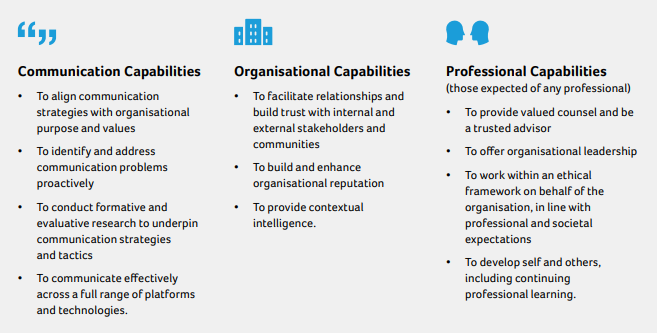
I’m more than just excited about the GCF. This project, which took two years to complete, defines the capabilities of PR professionals globally (there are country frameworks too for Argentina, Australia, Canada, Singapore, South Africa, Spain, Sweden, United Kingdom and United States). It’s a design that we can all use to better career plan, manage our teams and their development, recruit for the right skills and develop curricula that will help those practicing PR.

The 11 key capabilities identified by the GCF are of universal value to everyone in the profession (image source: Huddersfield Business School)

What’s more exciting is how the team behind the GCF are bringing this framework to life. They’re working with a team of software engineers to create a tool that’ll enable us to assess both individual and collective capabilities and set developmental goals. A sample visual is below.

I’ll admit that a shot of how the tool works doesn’t do it justice. I’ve seen the tool in action, and the possibilities it provides in terms of not only mapping skills and future development, but also transforming development goals into a training plan are inspiring.

What the Global Capability Framework and the tool also provide is an ability to engage with and educate our friends in HR what communications is. To paraphrase Dr Anne Gregory, Professor of Corporate Communication at the University of Huddersfield and director of the project, we have a capability framework that can be applied globally; reflects cultural and regional variations in public relations as a profession; and is forward looking in its approach which can be used by both global academic and practitioner communities.

What this means is that for the first time, our colleagues in HR have a resource that maps out everything they need to hire communicators, to train communicators, and to develop them over the long term. They also have a tool which will measure progress.

Why does this matter? I’ve often found that the functions we work with, such as Human Resources, don’t know what we do well enough. And yet they’re defining our function for us, they’re writing our job descriptions, they’re involved in hiring, and they’re measuring our success. We’re now talking their language, with a framework which has been developed both both academics and practitioners. The GCF will also help to standardize teaching for future generations of PR professionals.

It’s always been a tragic irony that the world’s community of communicators have struggled to explain exactly what they do and how they do it to their colleagues, particularly in HR and also in management. We now have the means to educate the people we work alongside in Human Resources. Our next challenge is how to educate those above us on our contributions to the organizations we work for.

Thank you to Professor Anne Gregory, Dr Johanna Fawkes, Dr Elizabeth Montoya-Martinez and Dr Royce Turner at the University of Huddersfield in the UK, to Argentina’s Professor Gabriel Sadi, Australia’s Dr Marianne Sison and Dr Katharina Wolf, Canada’s Dr Amy Thurlow and Dr Alex Sevigny, Singapore’s Professor Gregor Half, Spain’s Professor Elena Gutierrez-Garcia, South Africa’s Professor Ronel Rensburg, Sweden’s Professor Jesper Falkheimer and America’s Professor Katerina Tsetsura for all the work and time you’ve put into this. I believe the impact that this work will have on the industry is immense. I’m looking forward to using the GCF tool and helping others better understand what we do.

For more information on the GCF, you can download the complete capability framework and individual frameworks from the University of Huddersfield here.

Creatives, PR and Media – Where are the Gulf’s Faces to Watch?

There’s many young faces to watch in the Gulf’s creative, public relations and media industries, but if you’re looking for Gulf nationals on the agency side you’ll be sorely disappointed. The industry must find ways to solve this issue of diversity and inclusion.

I’ve enjoyed reading about the future of the region’s marcomms sector over the past couple of weeks in Campaign Middle East. The publication has listed the ‘ones to watch’ in the creative, public relations and media sectors. The people featured are an impressive bunch, and just reading about their abilities, potential and experiences at such a young age (they’re all 30 or under) is inspiring.

I was struck, however, by one detail. I didn’t see anyone I recognized as a Gulf national. There was so much talent from countries such as Egypt and Lebanon, but no one from Saudi or the UAE.

For anyone based over here, it’s probably not a surprise that there’s not enough diversity and inclusion in the marcomms industry/function, especially on the Agency side (this listing was Agency-focused). While there are Gulf nationals working agency-side, especially in Bahrain and Saudi, there’s certainly not enough.

How Can We Attract More Nationals?

The marcomms industry isn’t alone in struggling to attract enough young national talent – only one percent of the Emirati labor force is employed in the private sector, compared to 60 percent in government. But the landscape across the Gulf has shifted in a number of countries. Governments in Bahrain, Oman and Saudi Arabia are heavily promoting the idea of nationals applying to the private sector. More nationals are also eager to try new fields, particularly in the creative space. Here’s my suggestions on what each party must do to change perceptions and encourage diversity and inclusion.

The Industry and National Misconceptions

Let’s begin with the agencies and private sector firms who hire (the client side). We’ve got to break down the misconceptions and stereotypes around nationals, focusing on two key points. First, there’s the issue of work ethic; for far too long, there’s been a view that Gulf nationals don’t want to and won’t work the longer hours that the private sector asks of them (governments traditionally worked from 7 or 8am to early afternoon). Second, there’s compensation; Gulf nationals have often earned more working for the public sector.

I’m not going to be naive and pretend that these issues don’t exist. In Kuwait, Qatar and the UAE there’s a high differential between private and public sector pay for nationals, as well as additional benefits such as longer vacations.

However, we’ve already seen a shift in Bahrain, Oman and Saudi, where it’s common to find a national working in marketing or comms on the client side. To their credit, some agencies such as Gulf Hill and Knowlton have always looked to hire local in these markets (they had a large roster of Saudis some years back, and they’ve also hired a number of Bahrainis). In these markets governments are both telling their nationals to look towards the private sector and reducing the compensation differential.

For many in the private sector, they’ve not even put in the effort to test if the old stereotypes are true. There’s nowhere near enough engagement with universities across the region, not enough internships for nationals, and little in the way of mentoring. These are low-cost activities, which both agencies and clients should be undertaking. At the very least, they need to look for local talent, so they can benefit from insights that only nationals can bring to the table.

Governments and Talent Development

The private sector is only one half of the challenge. The other is governments.  Understandably, the region has long sought to develop its own talent. The number of nationals working in the marcomms function has risen rapidly, at least on the government side. It’s understandable that many nationals, particularly in Qatar and the UAE, would want to work in the public sector – pay in these two countries is, generally speaking, much higher. Plus, there’s a preference for locals, meaning there’s less competition for positions.This has become a double-edged sword. There’s more marketing and communications jobs in government, pay is better, and there’s less competition for these roles. What this has led to is young nationals being advanced into senior roles, often when they’re not yet ready or experienced enough.

If governments are serious about developing local talent, they’ve got to change this approach to public sector hiring and instead focus on long-term development, in partnership with private sector firms. This could include funded internships, either at home or abroad, as well as engagement with industry associations such as the IABC to promote certifications and long-term career mapping (I’ll share more about this soon). What’s clear is that national communicators who have worked only in one sector are missing out on all the potential learnings and development the other can offer, including the ability to work with and learn from other nationalities and culture (diversity and inclusion is also an issue on the government side).

Advice for Young Gulf Nationals

My advice for any young Gulf national is simple. Go and explore the private sector, understand the training and development it can offer you, and ensure you’ve tried every single option before you go into the public sector. If you’re after a challenge and you’re passionate about what you do, the money and position will follow. But if you want to be the very best you can be, and learn from a wider group of people from around the world, then moving into the private sector will be the best thing that you can do.

Likewise, we need you. We need the industry to be more diverse and inclusive (this equally applies to the public sector, where there aren’t enough expats working today), we need your insights and knowledge, and we need your understanding of the local culture, behavioral psychology, and awareness of how the Gulf’s local communities are changing. Today, we don’t have enough of this on the agency or client side. And it’s our loss. This scenario needs to change.

If you want to talk more, message me. I’m always giving my time to universities, to talk about the profession and help you understand your options. I’m happy to answer any question you may have, and point you in the right direction.