Youtube has changed how we view and understand video on the internet. But despite the site’s importance (Youtube streams four billion videos a day), many agencies or corporate firms don’t use Youtube or monitor its content.
If you’re looking for an easier way of measuring trends such as top rated, most favourited, most shared and trending videos then check out http://yt-feeds.appspot.com/. This site, which allows you to access Youtube’s API feeds, will tell you what you need to know about 18 different categories of videos from 34 different countries or regions (the Middle East region includes details for Saudi Arabia, Egypt and the United Arab Emirates).
Youtube’s API feeds site is incredibly easy to use and will help you better understand which videos are proving popular online
And as an extra treat, check out this video from the team behind Youtube’s most popular Saudi comedy channel/program, La Yekthar. This is a short clip for the comedy team, and while the dialogue is in Arabic I’m sure you’ll understand the underlying comedy.
If you’re interested in knowing about La Yekthar then have a read of this profile of one of the comedians behind the show. The shows that the La Yekthar team post onto Youtube are usually viewed a million times plus. I hope you enjoy the clip below.
Every once in a while, you come across a story that is heartbreaking. What happened to Natalie Creane is tragic. Four years ago Natalie and her new fiance celebrated their engagement by staying at the Emirates Palace Hotel in Abu Dhabi. After arriving she opened the wardrobe door and bent to put her shoes in the wardrobe. She looked up as a wooden panel fell from the front of the AV unit and hit her on the head, right on the temporal lobe.
According to a number of sites set up on her behalf Natalie was diagnosed with intractable refractory epilepsy and brain trauma. Since then she has been in four comas, she suffers from seizures which cause her to collapse suddenly and she has frequently sustained serious injuries during these seizures, including broken bones. Natalie has been on ventilators, had blood clots in her lung and leg, extreme blood toxicity, paralysis, temporary loss of sight, massive hair loss, severe debilitating headaches, temporary loss of speech, confusion, permanent memory loss, insomnia, constant infections due to suppressed immunity and has been admitted over 20 times to intensive care. Natalie suffers from Post Traumatic Intractable Refractory Epilepsy and Traumatic Brain Injury.
Despite all that has happened to her Natalie’s case with the Emirates Palace Hotel is still outstanding. The Emirates Palace Hotel initially referred the family to its insurance company. After talks with the company broke down, the family was faced with the hotel’s lawyers. Forced to take their case to court, a full two years after the accident, the family is still fighting for justice now – four years on from Natalie’s accident.
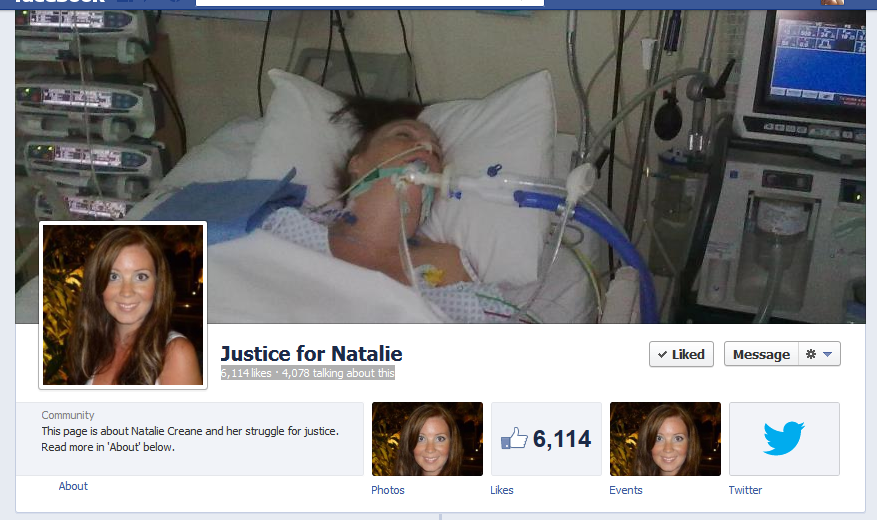
After four years of what I can imagine to be a living nightmare, including two years of litigation, Natalie’s family have finally gone public. They set up a Facebook page on the 9th of July which you can see here, and the family also set up two twitter handles, @JusticeForNatal and @JusticeForNat.
As of today, the Facebook page has 6,114 likes. Even more importantly when it comes to measuring influence and importance on Facebook 4,078 users are currently talking about Natalie. Here’s a screenshot of her page below.
The Justice for Natalie Facebook Page has only been live a few weeks but has already gone viral in the UAE and beyond
Her family have made use of Twitter to get her story noticed by media through retweets and mentions, posting pictures both via Twitter and Pinterest, and using the hashtag #justicefornatalie (there was some initial confusion online around the 20th when the Twitter handle switched from @justicefornatal to @justicefornat).
Ten days after setting up the social media channels Natalie’s story broke in mainstream media with a news piece in the UAE’s largest English circulation newspaper Gulf News followed by news pieces online at Albawaba and in print with another English-language UAE newspaper, 7Days. Natalie’s story has since been covered by global news outlets such as the BBC and the Huffington Post.
(Natalie’s story was first covered here last year by the National, but owing to the UAE’s defamation and libel laws newspapers use initials rather than full names when covering an active case).
Natalie’s family have also set up an online petition via Care2 where they’re aiming to gather 2,000 signatures (the petition is here and they’ve set up Team Natalie Marathon in Abu Dhabi for November (you can sign up here).
There’s even videos on Youtube, including the below which was put together by a supporter of the campaign.
Natalie’s family have stressed that the campaign has one aim, namely to raise her case’s profile and find some settlement so that Natalie can receive the support that she so desperately needs.
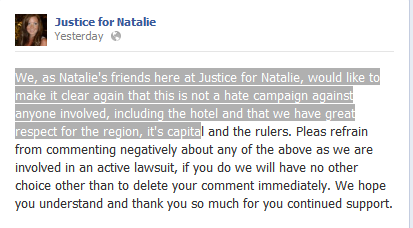
Rather than being a negative, hate campaign against the hotel the family are using human interest messages and regular updates on Natalie’s condition to attract attention and build a community online. In the space of two and a half weeks Natalie’s case has gotten more attention than it has done over four years. Understandably, the family have tried to get this issue resolved in a way that will not prejudice a court settlement, but with Natalie’s condition not improving it’s understandable that they feel the best way to ensure that their daughter has the care she needs is now through public relations.
Natalie is currently in a public hospital in Dubai, Rashid Hospital, where she is receiving palliative care. As her family write on Natalie’s Facebook page, “she urgently needs to receive specialist neurological help but the family has spent all they have over the past four years as they fought to get the hotel to step up and admit its liability for an incident which has resulted in such appalling consequences for Natalie.”
I for one hope that the Emirates Palace Hotel and the Kempinski Hotels group which manages the property settle this as soon as possible. They’re harming their own reputation. And, most importantly, they are denying their own responsibility to provide care for an incident which could be said to be a result of their own negligence.
How online communities have rallied round Natalie’s family is remarkable. And it goes to show how effective social media today can be in highlighting a worthy cause. Let’s all hope that Natalie finally gets justice and receives the support she needs to recover from all that has happened to her.
I love to post random videos. And this is a beauty. In Saudi seeing a camel by the side of the road isn’t unusual. The drive from Dubai to Al Ain used to be infamous for car-camel crashes (due to a camel’s body weight, height in relation to a car bonnet and its spindly legs, if you hit one it’d fall through the windscreen and seriously injure or kill the driver and front seat passenger). However, having a camel running up a bypass off Dubai’s main highway is unheard of (at least over the past couple of years).
So next time you drive, never mind those inane motorists, the plodding trucks and speeding taxis. It’s the camel that you have to take care to avoid. Especially while filming a clip for Youtube.
Youtube has been one of the key tools of activists across the globe, and particularly in the Middle East. In response to requests from NGOs and activists on the ground who are naturally concerned about their safety when uploading videos to the site Youtube has today launched face blurring. This tool allows video uploaders and editors to obscure faces within videos with the click of a button.
“Whether you want to share sensitive protest footage without exposing the faces of the activists involved, or share the winning point in your 8-year-old’s basketball game without broadcasting the children’s faces to the world, our face blurring technology is a first step towards providing visual anonymity for video on YouTube.”
The screenshot below, which is taken from Youtube’s blog page and post on this new service, is an example of how the technology will work in practice. It’ll be interesting to see how often this is used by activists, and how authorities will respond. Kudos however to Youtube and Google for listening and providing a solution that should, I hope, save people from torture, intimidation, or worse.
The picture above shows clearly how simple it will be from now on to blur people’s faces on Youtube.
PS this is going to give marketers out there a fun new way to roll out teaser campaigns! I can’t wait to see who gets creative with this for their brands.
I’ve got to admit. There’s no other mainstream show quite like it. For those of you who haven’t experienced Al Jazeera’s the Stream, what are you waiting for?
In brief, Al Jazeera describes the Stream as a web community and daily television show powered by social media and citizen journalism. What this means in practice is that viewers take part in the show in real time, through tweeting with the hashtag #AJStream or talking with the @AJStream twitter profile. Viewers can also record their thoughts, which are often broadcast live on the show or are promoted via the Stream’s website or on its Facebook and Youtube pages. The program doesn’t stop after thirty minutes; the Stream continues broadcasting via the web for viewers to follow the topics under discussion.
Have a look for yourself at one of the Stream’s most powerful programs, on Bahrain’s social media confrontations. And ask yourself, why aren’t more broadcasters engaging their viewers this way? For me, this is the future of media. That’s why I love the Stream.
“May you live in interesting times”. That ancient Chinese proverb is a favourite, and never has it rung truer than today for anyone who lives in the Middle East.
The past 18 months has completely changed our region. Few have been immune to the changes that have swept the Middle East, including Saudi Arabia. During this time so many taboos have been broken. As a media junkie and former journalist what has been most striking is how people are now controlling the message themselves through the use of the internet.
For decades governments in the region controlled the news agenda. Saudi Arabia’s news channels, both television and newspapers, are all state-controlled. The use of satellite dishes was illegal (I can’t ever remember reading any official announcements legalizing satellite dishes in the country) and all foreign publications imported into the country were censored with a black pen. Anything that was critical was either black penned, ripped out of the magazine or newspaper, or, in the worst case, the publication would be banned.
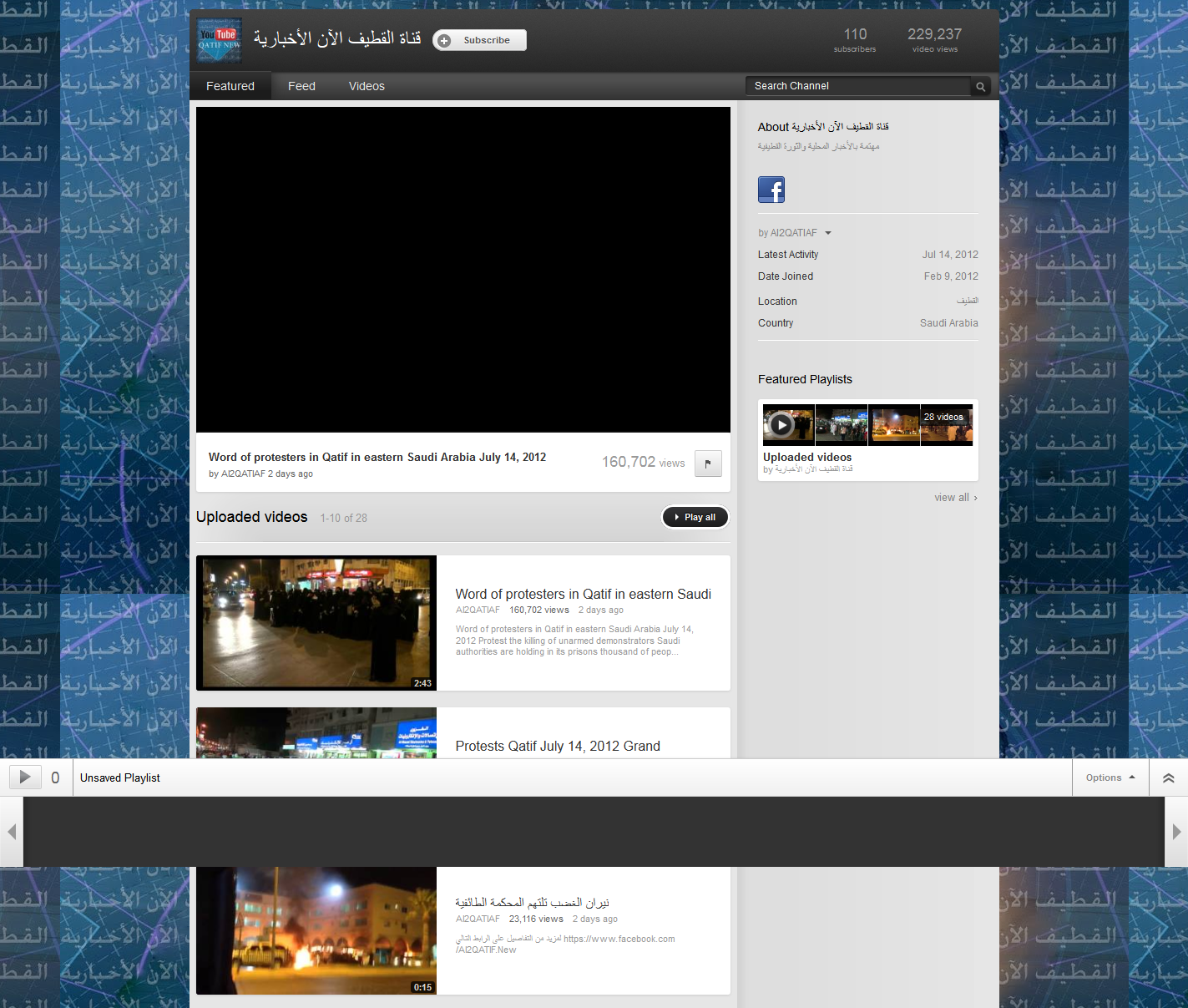
What has happened over the past 18 months has changed this perception. For reasons that I’m not going to go into on this blog post – I’m only focusing on the communications aspect rather than the politics – various events have taken place in Qatif, in Saudi Arabia’s Eastern Region. There have been several incidents of late in Qatif. What is remarkable is how those who are protesting in Qatif are using Youtube to spread their message. Previously, they never had any means to tell their story. To see how that has now changed, look at the below.
The above video has been viewed 160 thousand times in the space of two days. What is just as remarkable is the channel where this is hosted on Youtube. The channel’s name is Qatif News Channel, and videos are uploaded daily.
The Qatif News channel is hosted on Youtube and has been viewed over 200,000 times since it was set up on February 9th 2012.
This media is being used to tell a story that is feeding global media, such as this report by Al Jazeera.
Confronted with today’s ability to collect content, upload it to the internet and distribute that media, there’s little that official media or policy can do apart from run editorials condemning such actions. The below is from the English-language Saudi Gazette and sums up media reactions in the Saudi press.
Maintain public peace, Al-Qatif sheikhs tell youth was the standard line in many Saudi media publications.
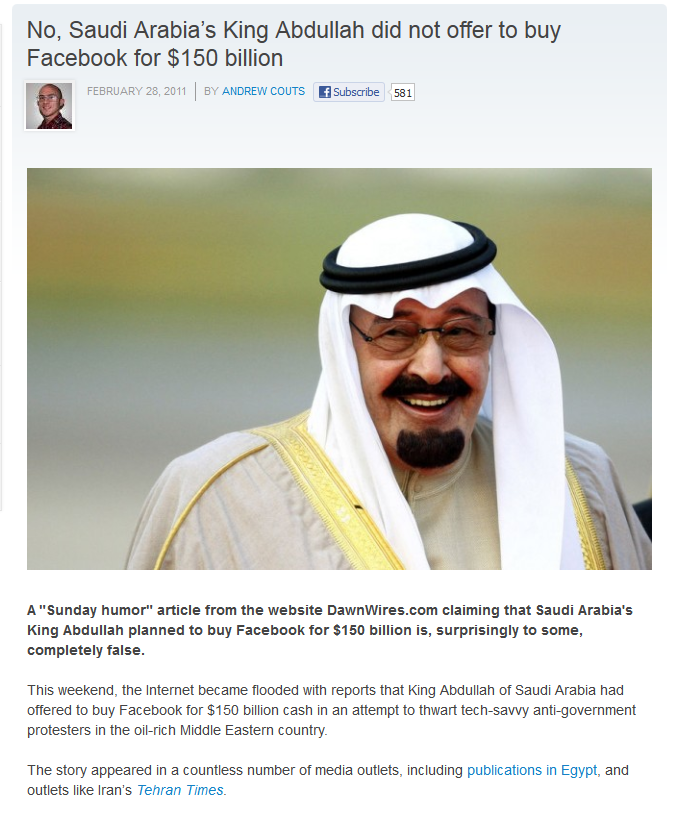
The question faced by governments is how do they regain control of media channels and ensure that their message is heard loud and clear? There’s no going back, there’s no closing down the internet (Egypt’s Mubarak tried and failed). Some governments have become media-savvy and are now creating their own content for distribution online. A rumour circulated last year that Saudi’s King Abdullah had bough Facebook to stop the Arab Spring. Maybe someone wasn’t joking when they suggested buying Facebook?
No, Saudi Arabia’s King Abdullah did not offer to buy Facebook for $150 billion.
We’re coming round once again to Ramadan, and I wanted to take the chance to write about one case study from last year’s holy month which underlines how much the media landscape is changing.
AlSayegh Media is a UAE-based agency headed by Abdullatif Al Sayegh, the former CEO of Dubai Media Incorporated. While AlSayegh Media is only a couple of years old some of its campaigns have, for me, been groundbreaking in terms of their use of content and social media to reach out to diverse audiences and build communities.
One of the hardest demographics out there to crack for any company in the Middle East is traditional/conservative/religious individuals. Firstly, because there’s a possibility that they may be more sensitive to marketing due to their beliefs. Secondly, there are relatively few religious media channels through which to communicate effectively and which may be receptive to conveying a message on behalf of a company when compared to more mainstream media. Even if a company has a message that they’d like to promote and which would appeal to this target audience, how do they reach this demographic?
The UAE telecoms operator Du decided to be different last year. The telco turned to AlSayegh Media to come up with a unique and original campaign for Ramadan that would by association promote Du and its services.
Rather than me saying how they did it, I’ll let AlSayegh Media’s own write up speak for itself.
15,000+ unique Facebook fans in just 4 weeks for a Ramadan campaign with Sheikh Dr Mohammed al Oraifi and Du. Now that is impressive.
As if that wasn’t enough here’s some more stats for you. Over 500 participants took part in the accompanying Khatim Al Qur’an competition. Over 9,600 calls were made to Sheikh Dr Mohammed al Oraifi. And there was an increase of 300% plus in fan engagement on Du’s Facebook page.
AlSayegh Media developed a series of Tabs for Du’s Facebook site which facilitated interaction with the intended demographic (these tabs aren’t live at the moment, but I’m assuming they’ll come back online next week for the start of Ramadan). However, here’s a clip of how the tabs looked last year below.
What to me is more impressive than anything else is the success that AlSayegh Media achieved for Du despite all of the noise during Ramadan. The Holy Month is a communications nightmare due to all of the religious programming that is aired over the four weeks. That AlSayegh Media was able to cut through the chatter and connect with such a hard-to-reach audience (this campaign was only UAE-focused, and aimed at Arabic and English speaking Muslims) speaks volumes about the agency’s strategy, Du’s activation marketing, and the impact of social media.
And the best thing? It was achieved at a fraction of what the same concept would have cost if televised. I’ve been told that even Du didn’t expect the volume of callers that the campaign attracted. Low cost, high return on investment, and community engagement? What’s better than that?
Let’s hope that AlSayegh Media’s Du Ramadan campaign this year will outdo 2011. According to the firm’s CEO Sheikh Dr Mohammed al Oraifi has agreed to the concept once again, and that they’re looking to expand the scope by which Muslims can reach out to the Sheikh. I’d love to see his question and answer sessions being streamed live and then posted onto Youtube, as well as a live Twitter Q&A session which would also help generate discussion between Du and the Muslim community in the UAE.
If you’re curious about Sheikh Dr Mohammed al Oraifi you can follow him on Twitter at @MohamadAlarefe or here for Facebook. The good Sheikh has almost three million followers on Twitter and 13,578 likes on Facebook and is one example of how Islamic scholars are taking to social media to communicate with their followers (I’ll blog more about this soon as well as the amount of fake accounts set up in his name).
And in case you’re curious to hear more about the founder of the company Abdullatif Al Sayegh here’s a clip of him talking at Tedx Ajman last year.
If you’re really not enjoying that flight, if the in-flight service isn’t what you hoped for, or if your in-seat screen is not responding, just remember that you’re not flying on Middle East Airlines.
One traveler took on Middle East Airlines via social media. You can read about Hussein Dajani’s story here.
Or just watch the video, which is much more fun.
The one thing I will never understand is that while no one I know enjoys traveling on MEA, try and get a Lebanese national to fly anything else (if you’re flying from Saudi the choice is understandable). If you’re that unhappy, then show your displeasure by not using the airline.
Kudos to Hussein Dajani for taking on the airline and proving that consumers can make a difference through social media.
Social media is the latest and greatest thing at the moment in the world of marketing and communications but how do we in an emerging market make the most out of what we’d call influencers, people on the web who are followed and listened to by others. The challenge that we face in a market is the Middle East is a lack of the mainstream online influencers, bloggers. Compared to Europe and the US, there are fewer bloggers in the Middle East, especially in countries such as Saudi Arabia. For those interested in pioneer bloggers, have a look at this list compiled by commentator Sultan Al-Qassemi or the Arab Media and Society’s portal on blogs.
Despite the challenges social media is an incredibly powerful way of reaching out to an audience, partly due to directness as well as its credibility. But how do you find the right influencers to reach out to? There’s a couple of very simple ways to do this and tools to use. Klout is probably the best known site for analyzing social media influence across a variety of sites such as Twitter, Facebook, Google+, LinkedIn, FourSquare, Youtube, Instagram, and WordPress.
Klout trawls social media network data and creates profiles on individuals and assigns them a “Klout score.” The higher the Klout score the more influence a person has online. Klout claims to have built more than 100 million profiles from crawling social media sites. While the site is far from perfect, it’s probably the most widely used tool to rate someone’s social media influence. You can search on Klout’s website either by topic or by the influencer’s name. Klout will give you three lists – one for top influencers, one for top +k recipients (basically people who have been rated highly by other Klout users rather than Klout’s own ratings system), and one for best content. Try a search on Dubai using Klout and see whom the website recommends.
The Klout profile for Mashable journalist Brian Hernandez
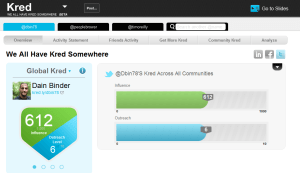
There are a number of other social ranking sites. The one which is gaining the most interest is kred.ly. At the moment Kred.ly is limited to analyzing people’s Twitter feeds only. However, Kred.ly may become very useful as it’s linked into a website called peoplebrowsr. Peoplebrowsr aims to give marketers and communicators access to influencers. The idea goes that you’d be able to identify people who are specialized in a certain topic and then pay them to promote your company or service. I’d love to hear from anyone who has used kred.ly and peoplebrowsr, especially in the Middle East.
Screenshot from social media analytics site kred.ly for blogger Dain Binder
So let’s give an example of what I’d be looking to do if I was working in tech. First thing would be to identify people with a big enough audience and enough credibility to influence others. One such user may be a prolific twitter user and the founder of saudimac.com Khaled Abdulrahman. Tweeting with the handle @khaled Khaled has over 13,000 followers and regularly updates his web site.
Khaled is a great example of an influence as he uses multiple sites to engage with an audience.
The challenge I have now is how to work with or influence Khaled. Traditional marketing would have meant paying the influencer. This is common for celebrity social media endorsements. However, this doesn’t always have to be the case with bloggers and topic specialists. Many may be willing to support you if they believe in the cause that you are promoting or if the content you give them is relevant or interesting.
The beauty of Klout, kred.ly and other tools is that they’re either free or fairly cheap to use. So when you’re next looking for people to help you communicate to an intended audience you’ve got no excuse for not finding the right influencers on the world wide web.
While I’d love to have a peak at the number of unique users on the site, social media activity in the Kingdom surged during the two days. Writing with the hashtag #womanforum Saudi and Arab nationals shared and commented on the views presented by the speakers (as this is Riyadh/Saudi women speakers did not share the same hall as the men and so were not visible in the video if you were wondering why there seemed to be no women at a women’s conference).
Most of the tweets and updates were in Arabic, but others did post in English.
While the media did pick up on important aspects of the event, the pieces were published several days after and lacked both the immediacy of the social media feeds as well as the cut and thrust of the debates online. With Saudi women and their rights being such an important topic in the Kingdom today, you’d have to ask if one article in a newspaper could do justice to the entire event.
As an addition to the above much of the argument for Saudi women working has been waged online. This is one video that was circulated this week using the womanforum hashtag. The video was uploaded in March but was circulated again this time round due to the renewed focus on women’s rights and work in Saudi. There’s nothing like a viral conversation, even in the magic kingdom.






 Alex of Arabia's Blog