Do you want to know more about social media in the Middle East? Download the TNS ArabSMIS report here

Do you not know where to start when it comes to social media and the Middle East? This report may be your answer (image source: http://blue16media.com)

Do you not know where to start when it comes to social media and the Middle East? This report may be your answer (image source: http://blue16media.com)

We have our fair share of big events in Dubai and this week was no exception. The past two days has seen the Emirate become the place to be for social media influencers. Whilst we found ourselves invaded by all types of beautiful people (and others) waving their selfie sticks and pouting for the camera, there were some handy takeaways for an audience looking to learn more about how to use social media to build brands for themselves, their companies or their countries. Oh, and Twitter has finally decided to open an office in the MENA region, obviously in Dubai.

The most impressive part of the Arab Social Media Influencers Summit was the report. Coming in at a whopping sixty seven pages, the report by research house TNS covers a whole host of areas of social media interest across the MENA region. The study combines both qualitative research with a quantitative survey of more than 7200 users of social media spread evenly
across 18 Arab countries.

If you’re looking to know which channels are used across MENA, then look no further. The report includes stats on LinkedIn, Facebook, Twitter, Instagram, Whatsapp, Google+, and YouTube. It also includes social media usage habits, including time of use, duration of use and devices used. Most importantly, the report looks into attitudes about social media across the region and what people are doing online.

If you’re doing anything online in the MENA region, download this report and start dissecting. You can thank me later, on social media.

The ASMIS Social Media MENA Report

When it comes to social media, advertising and the Middle East, why don’t we have any ethics?

The region loves social media, but its influencers and advertisers are less keen to say when a post is paid for (image source: www.business2community.com)

The region loves social media, but its influencers and advertisers are less keen to say when a post is paid for (image source: http://www.business2community.com)

Who needs ethics right? Ethics are boring, they’re dry, and they mean we have to use disclaimers. Ethics really aren’t fun. But you know what, without them we’d be in a fair amount of trouble. With the Arab Social Media Influencers Summit happening this week in Dubai, and a fair few social media influencers being in town (including quite a few from Kuwait who don’t make it clear that they accept money for posting on their social media channels), I want to reprint this post which I shared with the Media Network Middle East last month. I’d love to hear your views on ethics, or the lack thereof, when it comes to social media and advertising in our region.

While European and American consumers are benefiting from crystal clear regulations on sponsored social media content, there’s little to no clarity here on the same.

We’re awash with social media in our region. Everywhere you go, you’ll see people sliding their fingers left and right, pushing up and pulling down on their smartphone screens. We’re all at it, checking our Instagram accounts, refreshing our Twitter feeds, and posting Facebook updates.

Today we have social media celebrities, people who have become famous through their online activities. There are Instagrammers in Kuwait with over a million followers, Facebookers in the UAE with hundreds of thousands of likes, and Saudi Tweeters with followings equal to the population of Bahrain.

Alongside these social media celebrities we have witnessed the rise of paid posts. Those of you with a keen eye will have noticed how many celebrities online have become more commercial, and have begun to share updates, images and videos promoting brands.

There’s nothing wrong with promotional advertising. Using paid influencer marketing is a common tactic to spread awareness, promote a brand, and to engage social media users across the globe. Online advertising can be more cost effective in terms of measurement and reach.

However, there’s no distinction between an advert and paid-for content. Both involve a payment of some kind by a company for a promotion of its brand or services. Regulators across Europe and the United States have essentially ruled that if money is changing hands, obvious disclosure must occur in-ad. Their reasoning is simple; consumers have a right to know what is an advert and what is not an advert.

While European and American consumers are benefiting from crystal clear regulations on sponsored social media content, there’s little to no clarity here on the same. Consumers here have no authority to turn to or no regulations to guide them on what is and what isn’t sponsored.

There seems to be little eagerness for brands or social media celebrities to advertise what is paid-for content either. This is understandable, as their followers may be less inclined to engage with a post if they know it is sponsored, or even follow a person who they know accepts money for posts.

While this lack of disclosure may appeal in the short term and help to maximise revenues (paid-for posts in Kuwait can fetch up to three thousand dollars per posting), it does nothing to building goodwill and trust with consumers across the region. A lack of honesty and transparency on what social media celebrities are paid to post will negatively affect trust in both the sponsoring brand as well as the celebrity who is accepting the payment in return for sharing the content.

In the US the burden is on brands to ensure that their endorsers, such as bloggers and online influencers) are in compliance in terms of disclosure. Paid-for posts have to include language such as #Ad, Ad: or Sponsored. Even brand posts and shares by a company’s employees have to be clearly labeled to account for the bias.

Either brands can take action and begin to self-regulate, or they can wait for regulators to finally step in and possibly take a harder-line approach to sponsored influencer endorsements. Is risking a reputation and trust, built up over years of marketing, worth risking over a lack of disclosure? I hope the answer is no.

The Gulf’s new social media hybrids and the success of @maxofarabia

Living in a region which is known for diversity but which is still pervaded by barriers between all the cultures you’ll find in the Gulf, I’m fascinated by individuals who bring differing peoples together. One such person is Max, who goes by his online moniker maxofarabia. A British-American by background, Max has not only lived in the Gulf but he’s also taken the region to heart. Unlike many expats, Max has picked up Arabic and is fluent in the language (he has a strong Emirati accent).

By creating content in both English and Arabic about issues that are relevant to nationals, Max is opening up a new world for both expats as well as those outside of the region. Max prefers Instagram, but you can also find him on Twitter and Facebook (he’s also on Snapchat, but I’m way too old for that platform). His popularity among Emiratis is evident, and he regularly uploads videos about the UAE and its people to his Instagram account, where he is followed and watched by almost 190 thousand people. Max has become a social media ambassador for a number of projects in and around Dubai.

If you’re an expat and you’d like to know more about the Emirates in particular, then Max of Arabia is one to watch. Have a look at some of his posts below (apologies but Instagram’s embedding function is taking a day off today).

A good morning from Max's trip into the desert on the trails in the UAE

A good morning from Max’s trip into the desert on the trails in the UAE

Huge thanks to @hooralq for the invitation to @sharjahart - a great evening spent in one of my favorite cities, surrounded by creativity, with some of my favorite people - #Sharjah #SharjahArt

Huge thanks to @hooralq for the invitation to @sharjahart – a great evening spent in one of my favorite cities, surrounded by creativity, with some of my favorite people – #Sharjah #SharjahArt

Max even looks good in a thob - here at a wedding in Riyadh

Max even looks good in a thob – here at a wedding in Riyadh

Lost in the fog – is Etihad’s social media crisis down to an operational failure?

For some passengers, the experience of the fog and resultant delays weren’t helped by Etihad’s social media support despite the best efforts of the social media team (image source: http://www.todayszaman.com)

I love challenges. I’m an even bigger fan of crises. They seem to bring out the best in us, pushing us to our limits and testing our abilities. While I admit to enjoying being put through the ringers, I do feel for Etihad’s social media team during a bout of fog at the beginning of January. On the first Saturday of the year, during a peak time of year for travel, think fog descended on the UAE’s capital and closed Abu Dhabi International Airport for just over an hour. The airport’ closure affected Etihad’s scheduling for several days.

Before I go further, let me brief you on the airline’s communications outreach. Etihad has a sophisticated social media set-up, including a dedicated Twitter account for Etihad’s customer service, at @EtihadHelp, as well as customer support on Facebook. Etihad’s response time is usually less than 20 minutes, and each and every customer correspondence from the team is signed off by the team member’s initials.

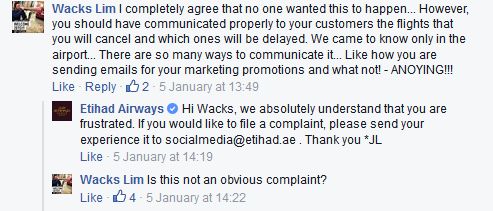
The fog literally consumed the social media team however. As people, the one instance that we can all agree on is that we hate anything going wrong when we travel, including travel delays and lost luggage. Stories of delays, including passengers stranded on the tarmac for half a day, without food or information, made headlines globally. Etihad’s social media channels were replete with angry passengers looking for a solution to their problems. Have a look at some of the exchanges below as well as media coverage.

This is one example of many of the discussions that took place on Facebook between Etihad and its customers following the fog

This is one example of many of the discussions that took place on Facebook between Etihad and its customers following the fog

https://twitter.com/ravaliareddy/status/551286654938251264

A number of thoughts come to mind. While Etihad has a stellar social media operation, how much leverage does the social media have over operations. Or to put it slightly differently, what accountability is there between operations and the social media team. Does the organizational structure, either formal or informal, help or hinder the social media team’s operations on behalf of customers? Etihad is a large organization of just under 15,000 employees; what can the social media team do on the customer’s behalf?

I’ll admit, these are special circumstances. Thousands of passengers were either stranded or had their luggage misplaced. However, we now live in a connected world where consumers’ expectations are amplified. While social media can speed up communications with consumers, is social media being set up to fail if operations cannot keep up? What are your thoughts?

Beware of the booze! The UK Embassy in Qatar’s @ukinqatar Twitter feeds spreads its Christmas message

Christmas is a merry time of year, and, if you are following the UK Embassy in Qatar on Twitter, then you’d be forgiven that all of us Brits are enjoying ourselves much more than is safe during December.

In the run up to Christmas on the 24th/25th of December, the UK Embassy began tweeting its annual countdown using the lyrics of the traditional song ‘the 12 Days of Christmas’. The Embassy has decided to remind British nationals in Qatar of their behaviours, with a specific focus on alcohol and its side effects.

While there’s not been a backlash as much as bemusement around the campaign (see below for reactions), the reasons for this messaging seems to be the need to stress good behaviour among British nationals in Qatar and the wider Gulf. A British Embassy spokesman told the Doha News that debate around its campaign was welcome.

“We are glad our 12 days of Christmas tweets have sparked a debate amongst Doha’s Twitter community. Whether you love them or hate them, we hope that they make people stop and think about the best way to enjoy a safe and happy festive season.

Christmas is a special time for many of us in Doha but it can be a time when people become carried away with the festivities and forget that the culture and laws in Qatar are different to that of the UK.”

https://twitter.com/vanish_forever/status/540455820803063809

https://twitter.com/escapetoqatar/status/540464143023624192

https://twitter.com/bradycreel/status/541535613745627136

The following Tweets from the Embassy have focused less specifically on alcohol, and whilst some of the responses to the account, which is followed by over 9,000, have been positive and thankful for the reminders, others have been less than impressed. Let’s hope the embassy focuses on positive messaging next year.

#ChallengeBahrain, an island in gridlock and a social media backlash

If you were planning to enjoy a quiet weekend in Bahrain this weekend, you’ll have been disappointed. Most likely, you’ll have also spent your Saturday stuck in traffic. The island kingdom was host to Challenge Bahrain, a professional triathlon with a $500,000 prize purse. Most importantly, for the smallest country in the Gulf (which measures a whopping 765.3 km²), the Challenge Bahrain triathlon covered a total of 113 kilometers.

The size of the triathlon meant that many of the roads around Bahrain were closed for most of Saturday, including the island’s key highways such as King Faisal Highway, and Sheikh Isa Bin Salman Causeway. Unfortunately, most of Bahrain’s residents seemed to be unaware that there was 1) a race, and 2) that the race would mean traffic chaos during the weekend.

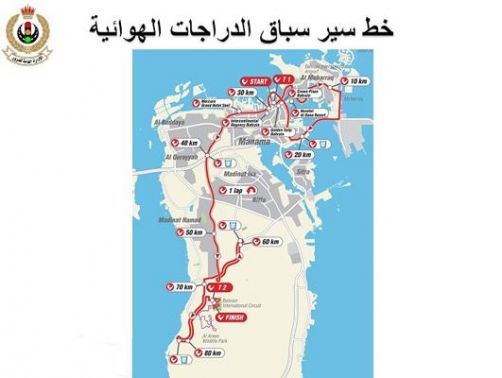
To give you an idea of how much the race affected the island, this is a map of the race's path across Bahrain

To give you an idea of how much the race affected the island, this is a map of the race’s path across Bahrain

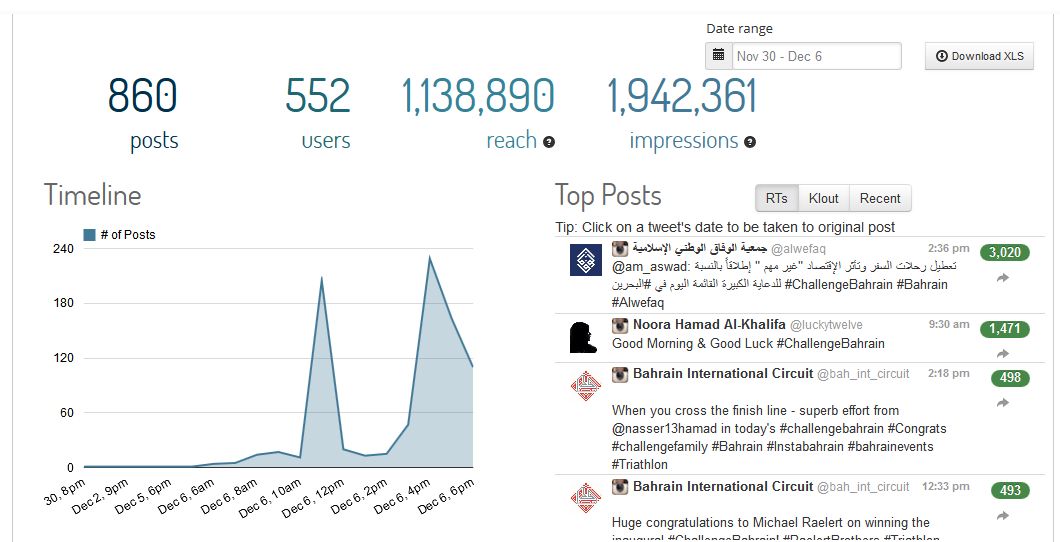
The ensuing disruption to traffic meant that most people decided to stay at home. Instead, they vented their annoyance online, on social media. To give you an idea of how popular the topic became, have a look at the below analysis from Keyhole, and remember that the total population of Bahrain is just over 1.3 million people.

An analysis of the #ChallengeBahrain hashtag by Keyhole

An analysis of the #ChallengeBahrain hashtag by Keyhole

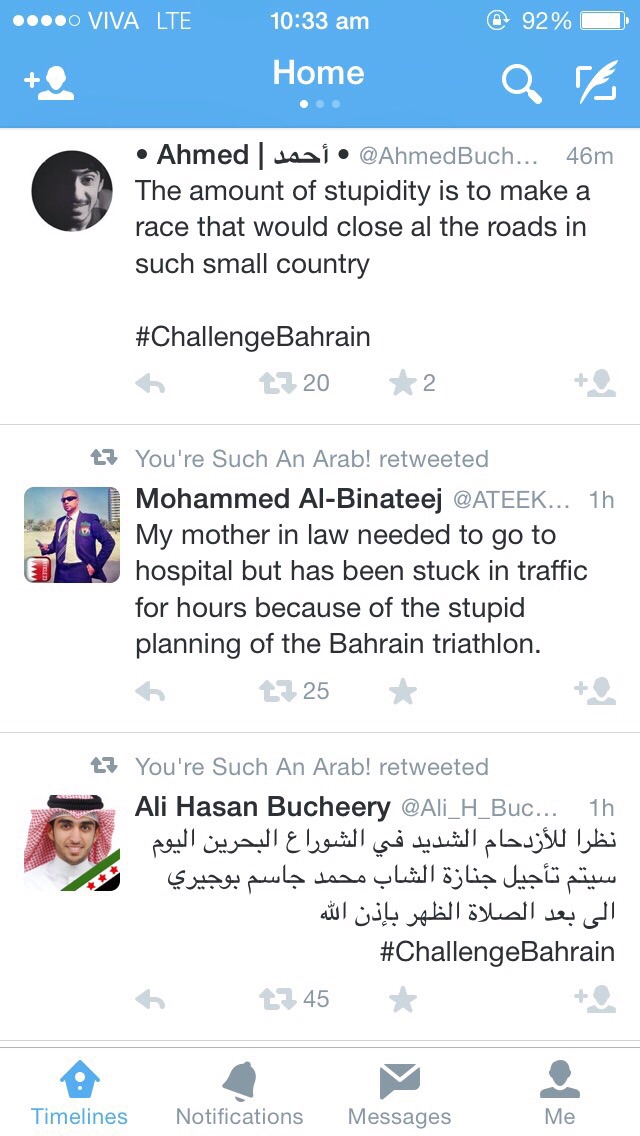
Tweeting and messaging with the hashtags #ChallengeBahrain and #ترايثلون_البحرين Bahrainis showed their feelings about the race and its planning. They let the race organizers know of their displeasure.

A small selection of the Twitter posts using the hashtag #ChallengeBahrain

A small selection of the Twitter posts using the hashtag #ChallengeBahrain

More tweets from yesterday's #ChallengeBahrain

More tweets from yesterday’s #ChallengeBahrain

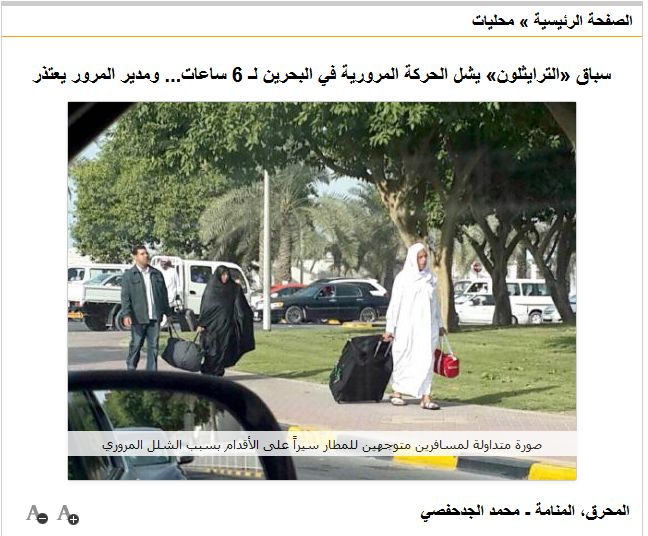
For those heading to the airport it was even worse. As many of the roads to Bahrain International Airport were closed people had to walk for kilometers just to make it to the terminal.

Images of the traffic from Al-Deir and Samaheej near to the Bahrain International Airport. People had to walk for miles to reach the terminal building.

Images of the traffic from Al-Deir and Samaheej near to the Bahrain International Airport. People had to walk for miles to reach the terminal building.

Unfortunately, Bahrain’s Gulf Air was one of the sponsors. Forty two flights were delayed due to transportation in and around the Airport; hardly the type of brand association any airline would need.

The traffic was so bad that even Bahrain’s chief traffic cop had to apologize publicly for the mess.

Bahrain's top traffic cop apologizes for the gridlock during #ChallengeBahrain

Bahrain’s top traffic cop apologizes for the gridlock during #ChallengeBahrain

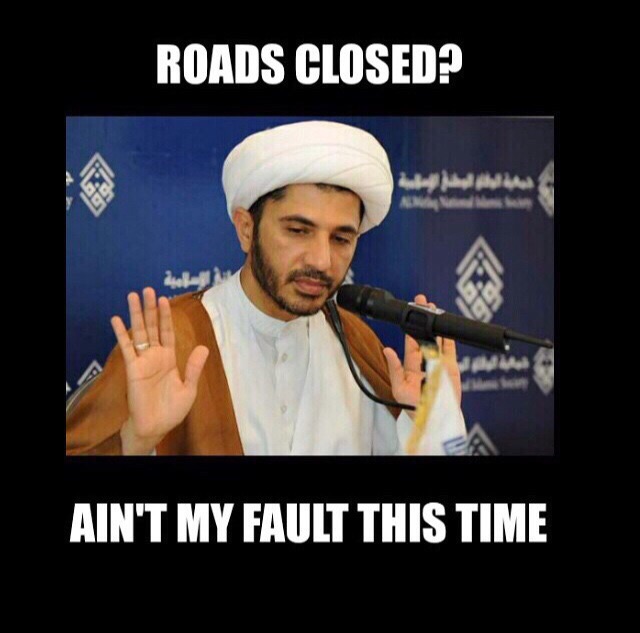
Some Bahrainis did see the funny side. Many created and shared memes, particularly on dark social sites such as Whatsapp, hinting at how successful the event had been in shutting down Bahrain, a feat which even Bahrain’s main political opposition couldn’t achieve.

A meme of AlWefaq's leader and #ChallengeBahrain

A meme of AlWefaq’s leader and #ChallengeBahrain

While the event came to a close on the same day, many of the organizers are looking ahead to 2015 and the second edition of Challenge Bahrain. For most Bahrainis, their hope is that someone will be listening to their social media and that whatever happens next year will not impact the island on the scale as they saw yesterday. If it takes several months to get in shape for a triathlon, I can’t wait to see what the island’s residents have in store for next year’s gridlock as they prepare over the next 12 months for Challenge Bahrain 2015.

First there was #MyDubai, and now we have #InAbuDhabi – Promoting a city on social media

Will #InAbuDhabi do for the capital what #MyDubai has done for Dubai’s social media presence?

There’s a saying that imitation is the sincerest form of flattery. If that’s the case, then #MyDubai, the social media campaign which was launched to give the city’s residents a way to tell their own story, now has another honor to its name in addition to the one million Instagram uploads.

Abu Dhabi has followed in the footsteps of #MyDubai and launched its own hashtag to share experiences. To quote from the Khaleej Times:

Residents and visitors to the Capital have a new platform to share their experiences and events: #inAbuDhabi.

Announced on Sunday by the Abu Dhabi Tourism and Culture Authority (TCA), the new online service is meant to promote the emirate’s culture, entertainment, heritage and hospitality both at home and abroad.

“The #inAbuDhabi campaign will be wide-reaching and rolled out across all communication channels of our visitabudhabi online resource. It will be used across social media for maximum reach and impact and will be a tool to tell the destination story locally, regionally and internationally,” said Mouza Al Shamsi, acting executive director of Marketing and Communications at TCA.

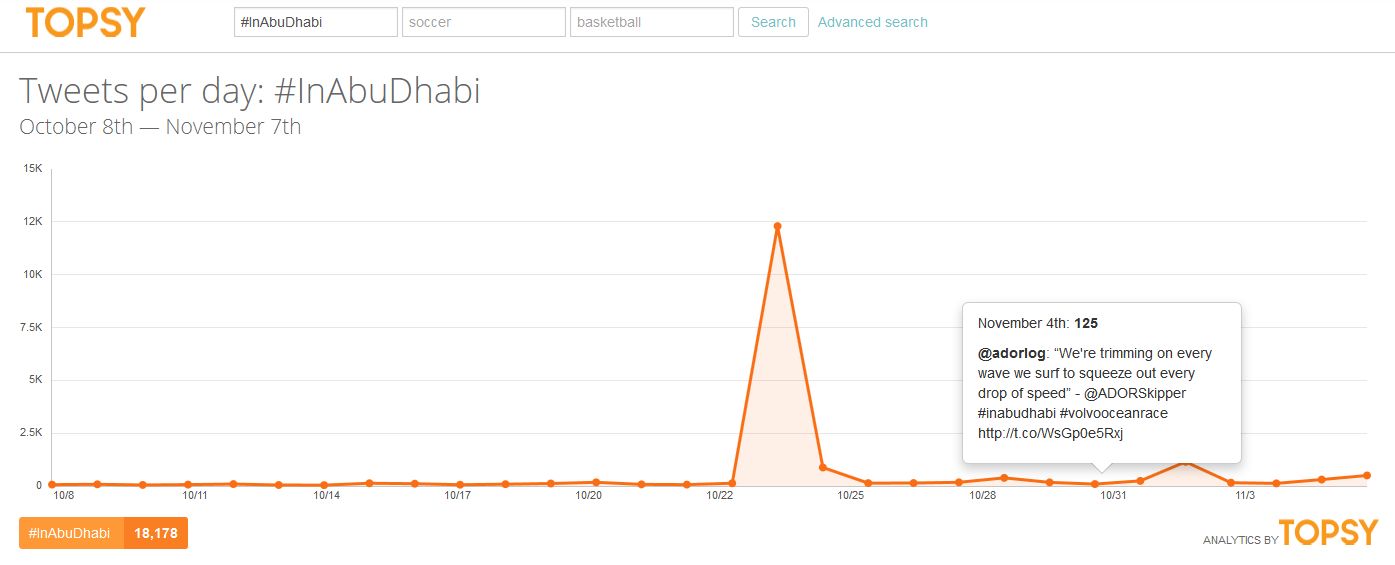
So far, so good. However, despite launching the campaign on October 20th it’s probably fair to say that the #inAbuDhabi hashtag is yet to trend among social media users. Most of the usage has been by corporate accounts related to tourism such as @VisitAbuDhabi, @AbuDhabiEvents and @EtihadAirways.

The hashtag #InAbuDhabi had a strong start but has tailed off rapidly since its launch

The hashtag #InAbuDhabi had a strong start but has tailed off rapidly since its launch

Will #InAbuDhabi become another #MyDubai? Does it have the emotional resonance with residents of the capital? Or should Abu Dhabi’s Tourism and Culture Authority not imitated Dubai and done something completely different? What do you think?

#Hajjselfie, Whatsapp and smartphones – how is technology changing Islam and Muslims?

We’re a funny bunch in how we can change so quickly and then justify how we’ve changed 180 degrees. I remember how up until ten years back, camera phones were banned in Saudi Arabia. And today, the hot topics are #Hajjselfie and how modern technology is making its mark on Saudi society.

The beginning of October was the timing for the annual Hajj pilgrimage, a mandatory religious duty for Muslims. During Hajj Muslims are to abstain from all temptations which may lead to sin; in essence, the pilgrimage is a time for renewal for the two million plus Muslims who take the rite of passage annually.

This year, one of the major stories which broke at Hajj was the #hajjselfie. You’ll probably know of the selfie, a self-portrait photograph, typically taken with a hand-held digital camera or camera phone and then shared online via social networking services. This year, the selfie was introduced en-mass to Hajj. To quote from Saudi Gazette and AFP.

Raising his arm, Yousef Ali hugs his elderly father near the Grand Mosque in Makkah as they grin for a selfie — a craze that has hit this year’s Haj. But not everyone is happy about young pilgrims from around the world constantly snapping “selfie”, photographs taken of one’s self, as they carry out Haj rights.

From Tawaf — circumambulating the Holy Kaaba — to prayers atop Mount Mercy in Arafat, and stoning of the “devil” in Mina, the key stages of Haj have all been recorded on cameras and smartphones for posterity, and for instant sharing through social media.

“As this is my first pilgrimage, it is important for me to document all the events taking place around me,” Ali, 24, told AFP, snapping a picture of himself with a green sign reading “Big Jamarah”, which refers to a wall where pilgrims ritually stone the Satan.

“Wherever I go, I take pictures, especially since nowadays we have these little cameras… that offer a full view of the area,” the bearded Kuwaiti said with a smile.

The increasingly popular phenomenon has sparked controversy among conservatives, however, with some taking to Twitter to criticize pilgrims who take selfies.

“When we went for Umrah in the mid-90s, Dad nearly had his camera confiscated to shouts of ‘haram!’ Now, #HajjSelfie is A Thing. What a world,” wrote one Tweeter.

Another user named Kahwaaa wrote: “It’s a time to connect to Allah and purify my soul. #hajjselfies selfies shouldn’t be taken.”

But others said the issue was being blown out of proportion.

“People creating a huge issue about #hajjselfies. If photos are allowed during Haj then what is wrong with selfies?,” asked Abdul Mufeez Shaheed.

Nothing at all, says Ali’s father Mohammed Ali, 65.

“A person taking such pictures is documenting a rare event”, a once-in-a-lifetime experience for many Muslims, he said, wearing a traditional white robe.

“This is a symbolic place representing history,” Mohammed Ali added, pointing to the three sites which pilgrims began stoning on Saturday at the start of the Eid Al-Adha feast of sacrifice, which is celebrated by Muslims worldwide.

Two women covered in traditional black abayas and veils hurried toward the Big Jamarah wall, but not without stopping for a quick self-portrait along the way.

“My daughter and I are taking selfies to show our Haj pictures to our family in Paris. It’s also a nice memento,” said one of the women, a Saudi pilgrim from Jeddah who gave her name only as Umm Abdallah, 44.

Her daughter Wafaa Ahmed, 19, said: “I love taking many selfies wherever I go to keep them for myself, as well as to show them to my friends and brothers.”

Speaking to AFP by telephone, a professor of Islamic Shariah law Riyadh said that “if photographs are only for personal memory and not for disseminating, then no problem.

“But if they were for the purpose of showing off, then they are prohibited, such as the photography that takes place at the (Haj) rites.”

The scholar requested anonymity.

“It is better for Muslims to avoid them,” he said of selfies.

For the teenage pilgrim Wafaa Ahmed, “this is not a convincing view” because taking selfies “has nothing to do with religion”.

The elderly pilgrim Mohammed Ali also discounts the scholar’s opinion.

He says the camera “is a tool such as mobiles, used even by religious scholars who have not prohibited them, so why prohibit another tool of the modern era?”

As he speaks, a group of young Saudi men gather for a group selfie in front of a Jamarah wall before they stone the “devil”.

Analytics of #Hajjselfie by Topsy. The trend peaked on October the 4th.

Analytics of #Hajjselfie by Topsy. The trend peaked on October the 4th.

The #hajjselfie wasn’t the only social media story coming out of Saudi Arabia this month. A recent piece in Saudi Gazette bemoaned the erosion of traditions surrounding the vacation among Saudi nationals.

“Take for instance the recent Haj holidays where it was common practice to visit relatives but several people did not do so,” said Omar Yousif Tobbal, a senior projects manager in a government firm.

He said that these occasions allow families to spend time together but people are increasingly resorting to calling or texting their relatives to extend their greetings instead of actually visiting them.

“If it hadn’t been for modern technology, families would meet, dress up and generally enjoy themselves,” he said, adding that before the advent of technology, Saudis had more time for each other and talked for hours on common themes of interest. However, there are some who still observe the occasion in accordance with tradition, he noted.

It’s not all for the worse however. One positive which came out of the combination of social media and Hajj this year was the appreciation show to the security teams who were working to ensure the safety of the two million pilgrims through the use of the hashtag #thanks_security_men. This time from Arab News.

Photos and videos of security officers from various military sectors assisting and providing services to pilgrims during the Haj season have been trending across social networking sites, such as Twitter. A number of religious leaders and media personnel have devoted their pages to discussing the positive role of security authorities in Saudi Arabia in the success of this year’s Haj season.

Active users on social networking sites produced various hashtags, notably #thanks_security_men, to express their gratitude and appreciation for their humanitarian efforts and positive representation of Saudi Arabia.

What are your thoughts on the above? Do you think #Hajjselfie is halal or haraam? Let me know your thoughts, especially if you were on Hajj. And have a look over the #hajjselfie images below from BuzzFeed, from what is one of the most amazing spectacles on earth.

https://instagram.com/p/tiNN9gykKn

https://instagram.com/p/tTIH6ZEPEs

https://instagram.com/p/thiGdlANFk
Thinking of drinking and driving? @TimHortonsGCC criticized by Dubai Police for social media blunder

There’s a fine line between engaging and offending online. The popular Canadian coffee shop chain Tim Hortons got into trouble this week with a post which went on on its @TimHortonsGCC Twitter account and its Facebook page.

The post below went online on the 14th of this month. Almost immediately after posting, the picture was attacked by the brand’s followers as being inappropriate and encouraging dangerous driving.

Do you drink and drive? The image from Tim Hortons GCC was criticized both by fans and by the Dubai Police (image source: http://www.7daysindubai.com_

Even worse for the brand, drinking and eating whilst driving is deemed as an offense by Dubai Police. The social media team’s image was in contravention of the Emirate’s laws. You pretty much know you’ve boo-booed when the police tell you off.

Speaking to local English-language newspaper 7Days, Dubai Police’s Colonel Saif Muhair Al Mazroui explained following such advice could risk lives on the roads.

He said: “Any motorist who doesn’t pay attention to the road is endangering the lives of others. Eating or drinking inside the car while driving is prohibited as it might cause accidents when the motorist gets busy and doesn’t focus on the road.”

Tim Hortons GCC did pull down the advert after it was posted and the CEO issued an apology shortly afterwards. Santhosh Unni explained that the image “was meant to reflect a common consumer behaviour pattern. We do not promote reckless driving and request our customers to always be careful on the road.”

However, brands need to think twice particularly when the issue of safety is involved. The Tim Hortons GCC Twitter feed and Facebook pages haven’t been active since the posting, which may suggest the brand is having a second look at how it manages its social media. The next time you think of drinking and driving, remember Tim Hortons GCC.