If you don’t like it, then leave! Hey @Dutweets and how not to deal with customers online

One week, two social media blunders in the United Arab Emirates. First we had Subaru Emirates and now we have Du, the UAE’s second largest telecommunications company, getting everyone into a tizzy.

The background to the story, which has been covered by the UAE-based magazine Computer News Middle East, is an increase in charges for the company’s home user pricing plans. The price increases, which have risen by up to 37 percent, seem to have been posted on the company’s website rather than having being formally announced by the company.

Unsurprisingly, consumers haven’t taken to Du’s price increases (note – for data services the UAE operates a monopolistic system whereby you have to purchase from the sole telco who is licensed to operate in your area, which is either Du or Etisalat). Du’s twitter account, @Dutweets, has been inundated with tweets from aggrieved consumers who understandably don’t want to pay more for their existing service and don’t want Du’s offer of additional phone minutes in compensation for the higher prices. Have a look below:

Unfortunately, for the people in the company running the Du account (Du handles social media internally I believe) things have gone from bad to worse. One reply has gone viral and is receiving a swathe of negative feedback on Du and its social media efforts.

I do feel for @Dutweets as they’re having to face the fallout from a pricing decision which has been poorly executed and hasn’t been communicated in the right manner – from a customer perspective there’s no justification for a price rise for the same service, especially when Du’s customers have no other provider and when their existing contracts should be honored for the contracts’ duration. However, if a company isn’t willing to resolve issues through social media then what’s the point of entering into a dialogue with the community? And no matter the frustration levels you can’t respond to customers in a manner that seems unsympathetic. So please, no more Hey! messages @dutweets. Understand the concerns, pass on the message to the executives and wait for a positive message from upstairs. Don’t do a Subaru, because you’re only going to make things much, much worse for yourselves.

https://twitter.com/WildeTrude/status/364691859576061954

https://twitter.com/alextohme/status/364719579089485826

Subaru Emirates, Facebook, sexism, racism, and loss of life = a social media disaster

I’m a hardened comms person/journalist. I’ve seen a lot of materials which offends and much of that material doesn’t surprise me. However, this morning I was wincing at a post on Facebook, on the UAE page of the automotive brand Subaru. The post, which relates to a recent accident which claimed the lives of four people, offends both women and a specific nationality. While this isn’t enough, not a single positive piece of advice is given to drivers to help avoid such a tragedy in the future. The post is screen-captured below. And to ensure maximum shock value what would you title such a piece? ‘Women drivers at it again’.

For me, pretty much everything that could have been done wrong was done wrong with this post. Frankly, it's disgusting.

For me, pretty much everything that could have been done wrong was done wrong with this post. Frankly, it’s disgusting.

To fan the flames of outrage further, the admin person does not apologize but rather seeks to defend the comments against the criticism (sixty comments and counting and 58 shares within 21 hours). This has gone out to 15,000 accounts who have liked the page and has been distributed to hundreds more through the shares. Depending on Subaru Emirates’ advertising policy in the UAE this could have reached hundreds of thousands more. Stepping aside from the grotesqueness of the post, it’s a remarkable thought that the company could have alienated over half of its potential buyer base. As an aside, I doubt that the page has asked permission from the newspaper Emirates 24/7 to use this image in a commercial setting.

I’m not going to delve deeper into this as there’s little positive about this episode apart from to learn what not to do when promoting a brand through Facebook. Subaru, please do the right thing and apologize for the post and ensure that the admin person learns the error of their ways.

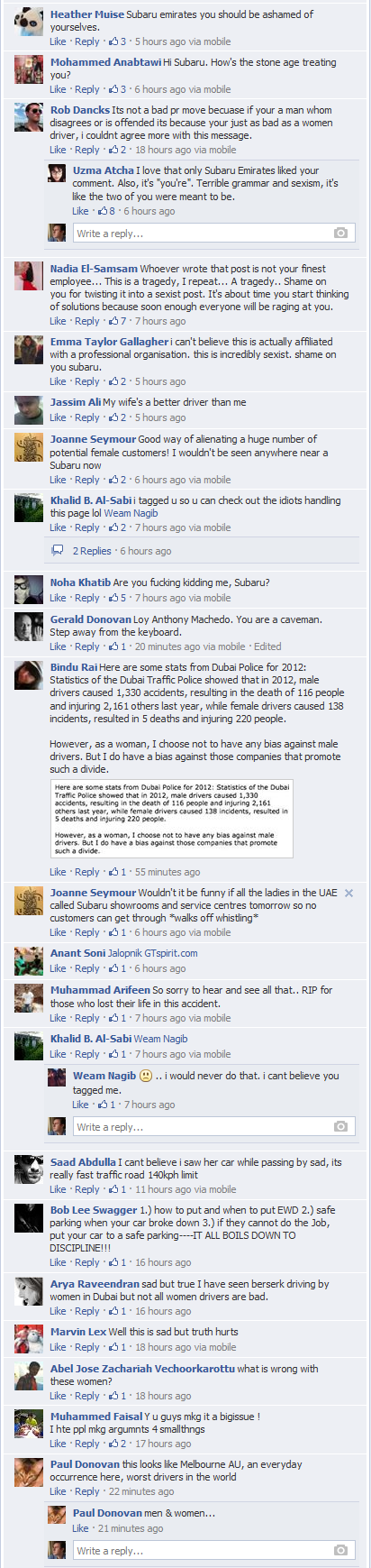
Comments are below for the post (apologies for the size but it’s easy to zoom in and view/read).

This is the first comments screen shot. Note the defensive post by Subaru Emirates and the anger of the responses.

This is the first comments screen shot. Note the defensive post by Subaru Emirates and the anger of the responses.

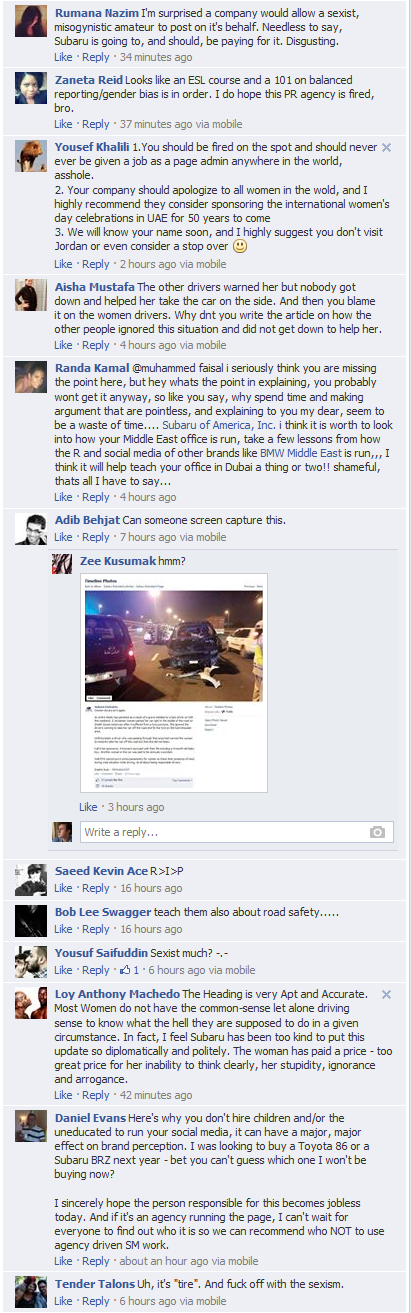
And it goes on...

And it goes on…

And on and on...

And on and on…

I’m sure that Subaru has guidelines for appropriate social media usage for its internal staff and agencies. They need to ensure that these guidelines are understood by all and that they are followed by their social media admin persons. I’ll be writing a how-to blog for how to use Facebook properly soon. As a responsible individual, we all need to understand the other. That’s even more true when you’re running someone else’s brand on their behalf.

Social media and diplomacy – @IsraelintheGCC, Israel’s virtual embassy in the Gulf

The launch of the @IsraelintheGCC twitter account is a cheap but potentially effective media channel for the Israeli government

The launch of the @IsraelintheGCC twitter account is a cheap but potentially effective media channel for the Israeli government

No matter your political persuasion, you have to admit that the Israelis are an ingenious bunch. Their latest idea is a simple concept, a virtual embassy for a part of the world where there’s little/no Israeli State presence, the Gulf. Israel, which doesn’t enjoy official diplomatic relations with any of the Gulf states, has launched a ‘virtual embassy in the Gulf’ through Twitter. The account, which is named @IsraelintheGCC, aims to “open lines of dialogue” with people living in the Gulf according to a report by the UAE-based English-language daily Gulf News. According to the Israeli daily Haaretz, the person behind the idea is Yoram Morad, Director of the Department of Digital Diplomacy at the Ministry of Foreign Affairs of Israel.

Not unsurprisingly, Israel has always faced challenges when trying to communicate its point of view to its Arab neighbours. However, that hasn’t stopped the State from engaging various mediums to argue for its policies. Israel launched an Arabic-language television channel in 1994 following the announcement of the Israeli-Palestinian peace process. The establishment of the @IsraelintheGCC twitter account follows news of a potential re-engagement between the Israelis and Palestinians as well as mounting pressure on Iran to halt its nuclear enrichment programme.

It could be argued that Israel has been much more active than the Arab states in terms of communicating its key messages – there were plans to launch a Hebrew-language channel in Egypt as of last year according to the Christian Science Monitor, but I haven’t heard much in the way of an actual launch.

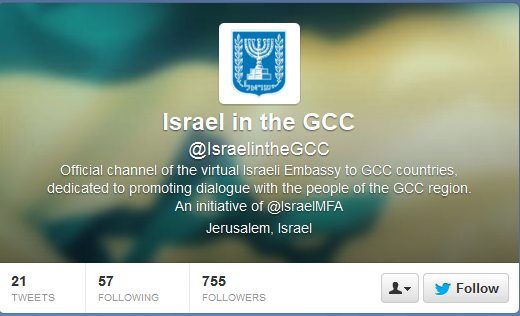
The messaging employed by @IsraelintheGCC, which is being run by the Twitter account of the Israeli Foreign Ministry, would appear to be aimed at propagating a more diplomatic tone than that of Israel’s internal politics. The account, which has tweeted 21 times to date, has only quoted the country’s Prime Minister twice (its fair to say that Bibi Netanyahu wouldn’t win many popularity contests in the Gulf), but it has talked about social media in the Arab world, sustainability issues, and wished followers a Ramadan Kareem. The one time Netanyahu has been quoted was in relation to European sanctions on the Lebanese organization Hizbollah which isn’t well liked in the Gulf due to its pro-Iranian stance. There are tweets in Arabic too. Have a look at some of the posts below.

Over the past couple of years social media has allowed companies, politicians and celebrities to directly bypass the media and reach out directly to anyone that wants to listen. Now the same can be said of social media for States who, for diplomatic reasons, cannot establish a physical presence. I’ll be following the account, and am looking forward to seeing how long this project lasts, how much dialogue it generates and how successful it becomes for the Israeli government.

Why do Middle East executives not blog and five reasons for starting a corporate blog today

Is this question even relevant any more? Middle East execs, what are you waiting for? (image source: http://www.homeschoolblogging.com)

There’s no doubt about it, blogging is huge. But don’t take my word for it, let’s look at the numbers. On blogging platform WordPress there are almost seventy million blogs, which are read by 360 million people each month. There’s even more blogs on the Tumblr (over 100 million as of April 2013) and Livejournal platforms (approximately 62 million blog sites as of April 2013). While blogging may not hug the headlines as much as social media, the online writing format continues to grow. By the end of 2011, NM Incite, a Nielsen/McKinsey company, was tracking over 181 million blogs worldwide, compared to only 36 million in 2006.

Similarly, blogging has become one of the most popular tools among corporations in a number of geographies. Research by the Center for Marketing Research at the University of Massachusetts has pointed to growth across both the Fortune 500 and the Inc. 500 in 2012. Forty-four percent of Inc. 500 companies, the fastest publicly-firms in America, were blogging, while twenty-eight percent of America’s largest publicly-listed firms had a corporate blog. The most interesting statistic was that sixty-three percent of CEOs of companies who did blog contributed personally to content.

These statistics from the Center for Marketing Research at the University of Massachusetts Dartmouth underline how popular blogging is with corporations in the US (image source: http://www.umassd.edu)

It’s fair to say that the Middle East corporate world, and the Gulf in particular, doesn’t share this same level of enthusiasm for blogging. Few publicly-listed companies have a blog – we’re literally talking a handful – and even those blogs that are online are rarely updated.

While it’s hard to speculate on the reasons why so few CEOs blog here, the one assumption that I’d make is either they don’t feel a need to communicate with their stakeholders or they don’t want to reveal information through a medium such as a blog (this subject does need more research, but the lack of blogging here maybe reflects a wider lack of understanding of digital communications).

For a pastime that was once considered on the fringe of journalism, blogging is a pivotal online media channel for breaking news, sharing content and developing an audience. Blogs are often quoted in the media and it allows a corporation to control the message and yet promote a healthy dialogue with its internal and external stakeholders.

There are many reasons for starting a corporate blog, but we’re going to focus on the five basics which should underline to your chief executive officer the value in having a blog for your company and including blogging as part of our communications strategy.

1) It’s all about transparency

We all want and sometimes need more information, and yet corporations often keep too much of a lid on what external stakeholders see and know. A blog allows you to let others look inside the company and give them a better understanding of any and every issue you care to tackle, from sustainability to product development and customer relations.

The benefit of transparency is increased trust. Your (potential) customer base should better understand why you do what you do. Customers and investors will feel much better informed and they may be more willing to buy your product and invest in your company.

However, don’t take transparency to mean republishing your press releases in a different format. Some of the most successful corporate blogs are those that take a nuanced approach, that tackle the good and the bad. The less biased you are, the more likely you are to be trusted when publishing a blog.

2) Bringing some humanity to the Corporation

Corporations are often seen as soul-less, grey worlds. And the same can often be said for a corporation’s communications approach; the bland press releases, the staid web-site which rarely seems to be updated. As people we all thrive on interaction and dialogue and that’s why blogs are so successful. They’re your corporation’s personal voice, a voice that need not use corporate-speak and jargon but instead adopt a tone that is more informal and conversational.

Your blog will need a face. It could be the CEO or another senior person. But a blog doesn’t need to be written by an executive. Some of the most insightful blogs are written by product managers, researchers and others who are passionate enough to make what they are saying interesting.

The beauty of blogging is that you don’t need to stay on message all the time. You can write about diverse topics which don’t need to be about the company. Customers will see through marketing pitches so step away from the self-promotion. Instead, offer human insights into recent events, industry news and other related information. Let your customers know more about you than just your product line-up and they’ll begin to become more loyal to your brand.

3) Starting a dialogue

Unlike many other forms of communication, blogs are there to receive feedback as well as to be a voice for the company. When you engage readers and respond to dialogue – both positive and negative – you’ll be doing much more than just promoting your company.

Blogs are a great way to test the water, to understand your customers’ perception on certain issues. And even if the comments are negative, at least you’ll know what your customers are thinking and be able to respond and bring them back on board. Get talking on a blog and even those stakeholders who may not agree with your company’s strategy will appreciate your efforts to talk with and about these issues in a forum that allows for and encourages debate.

4) Drive that web traffic!

Want a business reason for blogging that your sales team can measure? How about the web traffic that a blog will drive to your site. Many web engines such as Google rank sites based on content, on relevance and popularity. A blog that is updated regularly, that has content that is popular and that links to other sites you’ll find your own corporate site being ranked much higher by search engines such as Google. Once your own blogging site has become established you’ll find others linking to you, which will further propel your blog to the top of the search rankings and towards the nirvana of a first page listing.

5) Measure your blogging success

The beauty of communicating on your own site is that you can analyze your visitor statistics, to understand where your visitors are coming from, what they’re doing on your blog, what they’re using to read your blog (are they viewing your blog on a PC, a tablet or a mobile?) and how they’re reaching your site. The beauty of web analytics is that the more you have, the better you can make your blog and improve your visitor numbers. From there you can start defining your blog’s goals and measure your goal conversion, review how you’re promoting your blog and understand which topics and keywords are the most successful in driving traffic to your site.

Unlike traditional public relations metrics, online measurement tools are instant and can give you a full picture of what you’re doing right and how you can improve your blogging outreach. Blogging technologies are evolving but don’t feel daunted by the technological challenge. Blogging can be simple enough to begin with, and most blogging platforms have their own in-built analytics to help you out.

What are the dos and dont’s regarding defamation in the UAE

Defamation in the UAE is a criminal rather than a civil matter and the burden of proof is on the defendant. So be aware of the risks when you post online (image source: http://www.turbosquid.com).

After the outcry surrounding the arrest of the videographer who filmed an alleged assault in the street this week I thought it best to recap what defamation in the UAE covers and how to ensure that you don’t get into issues when creating and uploading content to the web.

Defamation in the UAE is different to most European jurisdictions in that defamation is a criminal rather than a civil matter. Raising a defamation case in the UAE is easy to do (actually, it’s much easier to do here than in other Gulf states including Saudi Arabia) and there’s no distinction between public forums and being online. The basics, as noted by Adil Khan in a post for sovedo.com, are below.

  • It is publicly forbidden to take a picture of another person without their permission.
  • Verbal abuses or gestures (even without the presence of a witness) can also lead to a fine and/or sentence.
  • Defamation via libel (written) or slander (spoken) is dealt by a criminal court as opposed to a civil court, where punishments would only include a monetary fine.

The burden of proof is on the defendant to show that the allegations are false. Similarly, truth isn’t an absolute defense if the comment or content has proved to be damaging to the reputation of the person or organization who/which claims to have been defamed.

The issue of defamation gets even more complicated when it comes to social media. Blogger extraordinaire Alexander McNabb covered a case back of May of a University Lecturer who’d been charged of defamation for writing a blog about his experience with a previous employer. All social media channels are considered to be public forums, regardless of where those forums are hosted. Social media channels are considered to be prominent public forums and even those people posting anonymously can be prosecuted.

Two legal counsels from law firm Clyde and Co., Rebecca Kelly and Sharon Procter, have published one piece on AMEinfo that is worth a read both for individuals and their employers when it comes to social media and defamation in the UAE.

Probably, the best piece of advice is play it safe if you’re not sure whether your comments could be construed as defamation or not. And if you’re still unsure, remember the penalty for being convicted of defamation can be up to two years in prison and a fine of as much as Dh20,000 (US$5,444). So post in haste, repent at leisure.

Citizen journalist beware – the perils of shooting video in Dubai

Dubai’s social media was buzzing yesterday with chatter about a video uploaded to Youtube of a local apparently beating a van driver. The video, which was initially taken off Youtube and which can be viewed above, shows the national using his agal to hit the Indian driver who’d apparently clipped his four-wheel drive and who hadn’t stopped during the initial collision. Part of the incident, including the national’s car license plate were captured in the video, which was reposted several times on Youtube. According to media reports including one piece from the daily Gulf News, the issue became a police matter not due to the alleged assault itself but rather due to the video going viral and the attention that it attracted.

A video of a government official beating a van driver was posted on YouTube has generated a public outcry and urged police to take legal action, said a legal expert.
“Initially it was an ordinary assault case, yet as soon as it was posted on YouTube, it went viral on social media channels. Since then, the case became of public concern and incited public opinion — that was when Dubai Police intervened. They took the required legal action against the involved persons,” advocate Mohammad Abdullah Al Redha told Gulf News.

Sources from Dubai Public Prosecution confirmed to Gulf News that investigations started in the afternoon as soon as they received the case.

Al Redha said: “It became a case of disdain and disparagement and particularly that it’s Ramadan, the month of mercy and forgiveness. When such incidents develop into a matter of public opinion and concern, police have the right to refer the case to prosecutors. According to the Criminal Procedures Law’s article 10, the Public Prosecution [in its capacity as the legal representative of the public right] can order the police to open an official complaint against the government official even if the van driver doesn’t do so.”

The case took an interesting turn today with the news that the person who took the video, a fellow driver, was arrested. According to Gulf News, the alleged defendant’s son lodged the case citing defamation of his father and family.

Major General Al Mazeina, acting chief of Dubai Police, said the Asian man who posted the clip was arrested after the Emirati official’s son lodged a defamation complaint at Al Ghusais Police Station.

“We only arrested the man who took the video because of a complaint lodged by the family of the Emirati official,” said Major General Al Mazeina.

He said that no one had the right to take pictures or film anyone without permission and acknowledgment from the person who is pictured.

“The man who took the video was supposed to take the video to the police or to the concerned authority to report the incident and then the police for sure would take action but instead of that the man posted the video on YouTube,” said Major General Al Mazeina.

The son told police that the video had been seen by hundred of thousands of people worldwide, which had damaged the reputation of his father and the whole family.

Major General Al Mazeina said the Asian man admitted to police that he took the video and posted it on YouTube and that he also sent it to some of his friends. He said the Asian man happened to be passing by at the time the incident took place.

Under the UAE’s cybercrime laws, recording videos in public without the permission of those being filmed is illegal and constitutes defamation. Despite the uproar over the issue, it seems that the authorities may not be willing to drop the case against the person who took the video despite calls on social media to reward his decision to film and post the event online. The message is simple – don’t film anything that could be construed as negative and share it online. Or else you could be facing public charges.

Understanding the Gulf’s psyche through social media (well, mainly Twitter)

What are the religious police up to now? Didn’t they learn from #Dammam-Hayaa-Closes-Dinosaur-Show? (credit: expo2020)

I’m endlessly fascinated by social media and how people interact online. For me, online interactions tend to shed light on people’s off-line personalities. In this post I hope to share my own observations about how each of the Gulf’s nationals deals and interacts online.

Let’s start with Bahrain. Bahrain possibly has the highest concentration of social media users in the Gulf. Bahrainis are very media-savvy and that shows in their effective use of social media channels. The country’s polarization following the events of February and March 2011 is evident online, with the two sides doing their utmost to ensure that their voices are heard. Bahrain has some of the most-followed Twitter users in the Gulf but they inevitably relate to the political and human rights situation on the island. There’s a lot of trolls out there as well, so be aware that if you’re going to delve into any issue relating to Bahrain you’re going to draw attention to yourself.

Emiratis are fiercely patriotic and proud of their country’s achievements over the past 41 years. Emiratis speak in unison when it comes to politics and are the most supportive nationality in terms of the country’s leadership. Unlike Saudi, Kuwait, or Bahrain you’ll find little debate on the country and its long-term direction but more insight into social issues particularly those which affect the national community. You’ll find royal family members online, members of the Federal National Council, a police chief and lots of UAE-based expats.

Kuwaitis are known for many things, including being opinionated. This is no different online. The Gulf country with the most blogs per person Kuwait is all about politics and disagreement. Kuwait’s politics is just as vibrant online as it is in the country’s parliament, and when you mix in other electrifying issues such as the Bidoon, the country’s rulers, the Arab Spring and religion you’re going to come up with an incendiary cocktail. Some of the most interesting Tweeters are Kuwaiti bloggers and parliamentarians. Just handle with care!

The Qataris are a mischievous bunch. When they’re not commenting on Qatar’s latest attempt to buy a path across the globe (what next after Marks and Spencers?) they’re making the most out of their sense of fun with raucous commentary on the latest goings on in their country. Their musings on Qtel’s attempts to rebrand itself to Ooredoo were biting, as was the boycott against the very same company for its poor customer service (is anyone in the UAE and Etisalat listening?). The Qataris are a wonderful bunch to follow. And one or two of them love their Dunkin’ Donuts coffee!

Saudis, yes you cannot avoid them online just as you cannot avoid them in the physical world. I love Saudis and I love them just as much in cyberspace. They’re open, they’re diverse and they talk about everything. Saudis are not afraid to poke fun at themselves and they’re just at home talking about social issues, politics, arrange boycotts (aka AlShaya and Al-Marai) and even debate religion. There’s some remarkable Saudis online, from preachers to royals and ministers. Saudi is one of Twitter’s fastest growing markets. And they watch more Youtube than any other country worldwide. They are officially living online. And yes, one of them owns (a bit of) Twitter.

And finally, there’s the Omanis (I’m skipping the alphabetic sequencing on this one). I’ve rarely come across Omanis on social media, possibly because I’m not close to issues that they write about or follow. Omanis are known to be kind, courteous and have a fun sense of humour. Which means I really should go and find some Omani tweeters to detox from all of the politics and debate in the rest of the region.

Social media brand hijacking – Emirates and Etihad fakes and lessons for a corporate online presence

A story broke at the beginning of the month about a couple of campaigns out there in the social media universe. Both piggybacked on two of the UAE’s most established brands. Essentially, the two campaigns offered those who followed the chance to win free flights with Emirates Airline and Etihad Airways.

According to the UAE’s English-language newspaper The National which broke the story here in the UAE, the promotion launched on the picture-sharing site Instagram and stated that the first 20,000 people who would follow each account and would share the respective campaigns with a specific hashtag would receive free tickets for themselves plus one to Dubai or Abu Dhabi. The Emirates Instagram account was named EMIRATESPROMOTION while the Etihad campaign ran under the hashtag #EtihadPromotion.

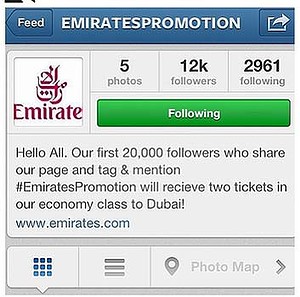
The branding is there, the name may be dodgy, but there's no official Emirates account. So why not believe it?

The branding is there, the name may be dodgy, but there’s no official Emirates account. So why not believe it?

Too good to be true you may think, and the campaigns were fake. That didn’t stop 10,000 people following the fake Emirates account which featured the company’s logo and photos skinned from the company’s website. I don’t know how long the fake competitions were up and running for, but both Emirates and Etihad put out statements warning people not to fall for the fake campaigns. The Emirates statement is below.

To all our fans, Emirates has three official social media channels which are:

http://www.facebook.com/emirates
http://www.google.com/+Emirates
http://www.youtube.com/Emirates

When we launch competitions or new social media channels, you will be the first to know via our Facebook, G+ or YouTube channels and on emirates.com.

Thank you for your continued support
Emirates”

Emirates also sent a statement to the Australian website The Vine stating that “Emirates Airline does not have an official Instagram account. Any Emirates-related accounts or promotions on Instagram do not belong to us.”

Similarly, Etihad wrote on its Twitter account that “Etihad Airways has no association with any accounts or promotions (such as #EtihadPromotion) competition currently running on Instagram as we don’t have an official Instagram account yet. Thanks for checking.”

How does this concept sound to you? There’s lots of random people out there on social media, and scams and the internet aren’t mutually exclusive. So why do brands focus on some social media channels and not others? For example, both Emirates and Etihad don’t have Instagram accounts. Emirates doesn’t even have a Twitter account. Wouldn’t it be best for a brand simply to park their presence on the major social media channels (no one can do everything on social media, there’s simply too many channels and sites out there).

And this point may be even more relevant albeit off on a tangent for Emirates, which spends several hundred million dollars on sports marketing (the most recent announcement being the tie-up with Formula One). Isn’t the airline missing out through not focusing on social media? Imagine how much Emirates could achieve in brand positioning and amplifying that sports marketing spend by promoting itself through social media. As I’ve said before, technology is a wonderful leveler. It’d seem a waste not to wring every single penny in return on investment from those mega-bucks sports sponsorships.

So next time you see a promotion which is too good to be true just send a Facebook message to the airlines and ask them if they’ve gotten round in Instagram (or Twitter in Emirates’ case). And, as they say in France bon chance!

This gentleman clearly feels Emirates would benefit from more social media presence. Do you?

This gentleman clearly feels Emirates would benefit from more social media presence. Do you?

Fifty Three Million and Counting – Facebook’s hold on the Middle East

Based on the latest statistics shared at the Studio Edge event Facebook is the one network to rule them all (unless you’re a keen bird watcher that is)

Facebook came to town last week, and they brought lots of numbers with them. I was lucky enough to be invited along to the first Studio Edge event in the Middle East region. And I was astounded by the numbers that the team kept on rolling out. I’ve summarized these numbers below for you.

According to Facebook’s own research there are fifty three million active Facebook users in the region who use the service at least once a month. Egypt is Facebook’s largest market, followed by Saudi Arabia and then the United Arab Emirates.

Fifty two percent of Facebooks users access the site solely through their desktops and laptops; thirty eight percent use both mobile phones and computers, and ten percent only use their mobiles updating their profile and other Facebook activities. Twenty million people in the Middle East and North Africa are using Facebook today through their smart phones.

The average age of Facebook users in the region is 27 years and 64 percent of MENA users are male. That’s in contrast to the global split of male to female users which is currently 50/50. MENA Facebookers spend approximately seven hours on Facebook a month (that’s double the global average). And fifty two percent of Facebookers in the UAE use Facebook whilst watching television.

Middle East Facebook users like 84 pages compared to the global average of 51, and they view approximately 550 pages a month. Over forty percent of their time is spent on the news feed section of Facebook.

And to top off all of that, Facebook’s user base is growing in excess of 20 percent in the region.

With all of this information above, I’m hoping that we’re going to see more businesses online using the site. But if there was ever any doubt that Facebook is a first-tier consumer communications channel then please do re-evaluate how you use the network and start using the site properly.

One other interesting observation from the Facebook event. Most of the attendees were from advertising and creative agencies. I only spotted one public relations company. And yet, Facebook is all about content. Shouldn’t the Middle East’s PR industry be getting in on the act and promoting the quality of its social media services more?

Are Saudis the most open nation in the Gulf?

Saudi Arabia’s society is changing at a much faster rate than many of its neighbours

Hands up all those people who’ve heard of or been to the cosmopolitan Dubai. I’m sure that you’ll know about Qatar, the country that has made a name for itself by investing all over Europe and for winning the 2022 World Cup. And there’s Kuwait, probably best known for its role in the first and second Gulf wars. One of the most beautiful countries I’ve ever visited, one could say that Oman unfortunately isn’t as well known abroad as it should be.

And then there’s Saudi Arabia, a mysterious land which up until recently was spoken of in Chinese whispers. The Magic Kingdom was a country that was known for oil, religious and cultural conservatism. Despite the spread of the internet and the ensuing countless videos and other types of multimedia information hosted online Saudi Arabia is still an unknown to most people.

The country’s reputation, image and visa regime doesn’t help to educate foreigners, but I’ve been struck recently on a number of occasions how open today’s Saudis are. This is especially true of the younger generation. Many of the Saudis I know who are under the age of 40 will talk about anything and everything, especially in a closed environment. They’re knowledgeable, they’ll know much more about the workings of the country and national government than is written about or published in the news. And they’re not afraid to be blunt about what is right and what is wrong when it comes to public policy.

Having lived in Saudi for a fair few years I’ve always been fascinated by how Saudis are becoming ever more open to sharing their views with people they know and trust, especially in the setting of the Majlis where the men traditionally gather in the evening to discuss both personal and business issues.

The difference in openness between Saudis and other GCC nationals is becoming ever more noticeable. While traditionally the most open society in the Gulf, Bahrain has been transformed due to the events of the past two years. Both Qataris and Emiratis are very welcoming, but they’re less inclined than Saudis to talk at length with foreigners on the issues that are shaping their respective countries.

And then there’s the Kuwaitis, who are probably definitely the most outspoken people in the Gulf. But for me, today’s Saudis are more open because many will acknowledge both the positives and negatives of their country.

I’m not suggesting that the country is a bastion of diverse views which are aired in public by all and sundry. There are still many subjects that are taboo, but many barriers have been broken over the past two years partly thanks to the widespread adoption of social media by many young Saudis. Just think of any controversial topic in the Gulf, and you’re going to find it being discussed in Saudi by bloggers, on Twitter and Facebook.

Looking forward, I can only hope that this openness will be a blessing to the Kingdom as it looks to tackle issues such as unemployment, the changing role of women in the society, graft and governance. These subjects will be better dealt with if there’s an open dialogue between the country’s nationals. As always, I’m optimistic about where Saudi Arabia is headed and would like to hear if you agree with me or not about my thoughts.