Reputational Issues and the Pressure from Outside to Change – Will the Gulf’s Firms Be Forced to Adopt More Worker-Friendly Policies

Smile for the media! Will Gulf-based airlines be forced to change their employment practices or will they risk possible reputational damage in the face of criticism from the foreign press? (image source: http://www.nycaviation.com)

First there was Qatar and now the UAE. I’m not talking GDPs, economic growth or any other metric that a government may promote in the public spotlight. Rather, I’m talking about media criticism, notably international media criticism of worker rights.

Over the past couple of weeks a series of articles have been written, mainly by the European media, critiquing the lack of rights for employees of Qatar Airways and Emirates. The pieces, in particular a lengthy series of allegations in Swedish newspaper Expressen, have shone a light on employment practices, many of which appear distasteful to those not used to working or living in the Gulf.

The article in Expressen entitled the Truth About the Luxury of Qatar Airways details the conditions under which Qatar Airways employees have to live. The report, which can be read here, tells of strict curfew times for air hostesses and pilots, constant surveillance, and instant terminations.

Others have run similar allegations. Even locally, we’re beginning to see these articles appear in the press; Arabian Business recently ran two pieces on the HR practices of both Qatar Airways and Emirates.

With a global presence comes greater media scrutiny. Similarly, global events on your doorstep can attract negative headlines (look no further than Brazil in the run up to this year’s World Cup or even Qatar, the 2022 World Cup andthe country’s labor camps).

In a sense, I’m surprised that this hasn’t happened sooner. The region’s three big airlines are global players who aim to capture transit traffic which they shuttle through their hubs in the Gulf. Similarly, the region’s sovereign wealth funds have been snapping up brands globally for some time now, but especially in Europe where trophy assets have become a staple for SWFs in Doha and Abu Dhabi.

So, how do the airlines react? Never one to be outdone for a quote, Qatar Airways’ CEO has furiously denied all of the allegations and has instead railed at the newspapers printing the articles and called them, in effect, racist. To quote from Arabian Business:

“Like any other organisation, we terminate nonperforming employees and these are allegations made by ex-QA staff.”

“This is not against Qatar Airways but against my home country. They are throwing stones at my country for no reason at all.”

Emirates has been more low-key in their response on the claim that they mistreat female employees by firing female cabin crew who become pregnant during the first three years of their employment.

In the long-term how should the airlines respond? If they continue to deny or ignore the allegations, will they face a backlash from consumers concerned about the airlines’ reputation? What’s certain is that the headlines are not going to go away; to the contrary, the deeper you dig, the more bodies you will find. It’s going to be fascinating to see if the negative media coverage from outside the region eventually forces a change in worker policies.

This is one theme I’m going to be following with increasing interest.

Bahrain, Saudi and the UAE use Facebook to Announce Ambassador Pullout

It’s pretty remarkable – I’m not just referring to the withdrawal of the Bahraini, Emirati and Saudi ambassadors from Doha but also the way the news was announced. I, like many others, saw the news first not on traditional news channels but via Twitter. And where was the original announcement? On the Facebook page of the Saudi Ministry of Foreign Affairs. It’s pretty remarkable to see social media being used to release such information, especially considering the medium is designed with dialogue in mind. If you read Arabic have a look at the comments on the Ministry’s page.

The original announcement, which was later carried in the region’s papers, is below.

The Saudi Ministry of Foreign Affairs announced the pullout of the three ambassadors via its Facebook page before the story broke in the traditional media

The Saudi Ministry of Foreign Affairs announced the pullout of the three ambassadors via its Facebook page before the story broke in the traditional media

A Digital Journalism Masterclass – Qatar’s Doha News and @dohanews

Let’s face it, the Gulf doesn’t win many awards for quality investigative journalism. There’s some outstanding journalists out there, but in a region where most/all of the news outlets are underfunded and owned by bodies or individuals who don’t have a media background we’re left with a lack of quality reporting.

Three people, journalists with experience of global media outlets such as the BBC, the Wall Street Journal, and Al Jazeera, took it upon themselves to take on Qatar’s media scene and create a news portal that would deliver news in real time. The result was Doha News, a news service that began its life on Twitter as @dohanews and then developed into a daily news blog.

The stated aim of Doha News is “to educate, inform, and stimulate positive change in the community.” What the three people behind the project – Shabina Khatri, Omar Chatriwala, and Tory Scott – have essentially done is to create a community site where the public can send in their content, be it images or news stories, and have that content edited and displayed for the rest of the community to see and comment upon.

Doha News hasn’t just become another news website; the portal has frequently beaten other media channels to breaking stories. Similarly, the quality and accuracy of the site’s news has been commended. No other Doha-based media outlet has covered the Villaggio Mall fire tragedy as comprehensively as Doha News. The site’s team went so far as to produce a 57-page e-book on the anniversary of the disaster which won praise for its coverage of what went wrong on the day of the Villaggio Mall fire and the ensuring events including the trial and steps taken by the Authorities and Mall owners to ensure a similar incident never happens again.

Below is a selection of items from the site including a news piece and pictures from users of the site. If you’re looking for news on Qatar or simply want to understand more about digital journalism in the Gulf Doha News is definitely worth a visit or three. Let’s hope others take up the mantle and create similar news portals for the rest of the region.

This piece is fairly typical of Doha News - a local interest story that uses social media to engage and benefit local viewers

This piece is fairly typical of Doha News – a local interest story that uses social media to engage and benefit local viewers

Social media and diplomacy – @IsraelintheGCC, Israel’s virtual embassy in the Gulf

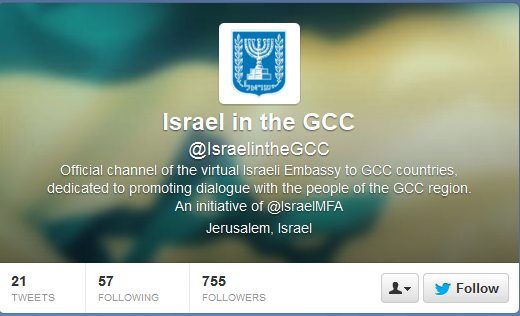
The launch of the @IsraelintheGCC twitter account is a cheap but potentially effective media channel for the Israeli government

The launch of the @IsraelintheGCC twitter account is a cheap but potentially effective media channel for the Israeli government

No matter your political persuasion, you have to admit that the Israelis are an ingenious bunch. Their latest idea is a simple concept, a virtual embassy for a part of the world where there’s little/no Israeli State presence, the Gulf. Israel, which doesn’t enjoy official diplomatic relations with any of the Gulf states, has launched a ‘virtual embassy in the Gulf’ through Twitter. The account, which is named @IsraelintheGCC, aims to “open lines of dialogue” with people living in the Gulf according to a report by the UAE-based English-language daily Gulf News. According to the Israeli daily Haaretz, the person behind the idea is Yoram Morad, Director of the Department of Digital Diplomacy at the Ministry of Foreign Affairs of Israel.

Not unsurprisingly, Israel has always faced challenges when trying to communicate its point of view to its Arab neighbours. However, that hasn’t stopped the State from engaging various mediums to argue for its policies. Israel launched an Arabic-language television channel in 1994 following the announcement of the Israeli-Palestinian peace process. The establishment of the @IsraelintheGCC twitter account follows news of a potential re-engagement between the Israelis and Palestinians as well as mounting pressure on Iran to halt its nuclear enrichment programme.

It could be argued that Israel has been much more active than the Arab states in terms of communicating its key messages – there were plans to launch a Hebrew-language channel in Egypt as of last year according to the Christian Science Monitor, but I haven’t heard much in the way of an actual launch.

The messaging employed by @IsraelintheGCC, which is being run by the Twitter account of the Israeli Foreign Ministry, would appear to be aimed at propagating a more diplomatic tone than that of Israel’s internal politics. The account, which has tweeted 21 times to date, has only quoted the country’s Prime Minister twice (its fair to say that Bibi Netanyahu wouldn’t win many popularity contests in the Gulf), but it has talked about social media in the Arab world, sustainability issues, and wished followers a Ramadan Kareem. The one time Netanyahu has been quoted was in relation to European sanctions on the Lebanese organization Hizbollah which isn’t well liked in the Gulf due to its pro-Iranian stance. There are tweets in Arabic too. Have a look at some of the posts below.

Over the past couple of years social media has allowed companies, politicians and celebrities to directly bypass the media and reach out directly to anyone that wants to listen. Now the same can be said of social media for States who, for diplomatic reasons, cannot establish a physical presence. I’ll be following the account, and am looking forward to seeing how long this project lasts, how much dialogue it generates and how successful it becomes for the Israeli government.

Is Dubai ready for what comes after the Expo 2020 win?

Is Dubai ready for the scrutiny that will follow the Expo 2020 win? Has the country learned any lessons from Qatar’s FIFA World Cup experiences? (image credit: http://www.expo2020dubai.ae)

The stage is all set, the bids are in. If I were a betting man I’d probably place my house on Dubai winning the Expo 2020, the World Fair that is set to be held in 2020 and which is expected to attract millions of visitors over a six month period. Of the other four national/city bidders Thailand has pulled out of the process and of the other three (Brazil, Turkey and Russia), two have been experiencing mass protests of late relating to governance issues (that’s a very PC way of saying riots, teargas and and general chaos as played out on television).

The bidding for the Expo 2020 is winding up this summer with a vote and decision expected by November. But if/when Dubai does win, what next? Ok, we have the plans to build a World Fair that is expected to bring in over 30 million people but as Qatar now understands the big events also bring major scrutiny.

Let me explain further; Qatar’s winning of the 2022 FIFA World Cup was exceptional and unexpected by most. Almost immediately after Qatar won the bid the questions came flying in. How does Qatar treat its ‘enslaved’ foreign workers? Will the beer flow for the fans? And, the most bizarre one I’m sure for the Qataris, will homosexuals be allowed to go to Qatar without facing the risk of being arrested? As they’ve found out, the bigger the event the greater the level of questioning on issues, many of which may not be directly related to the event.

I wonder how much Dubai is ready for this level of scrutiny? The Emirate suffered during the global economic crisis, and it could be argued that Dubai’s cause wasn’t helped by its lack of transparency on financial issues. How will Dubai cope with the level and intensity of questioning that will come win the Expo 2020 win? While I don’t see the Expo as being as high profile an event as the FIFA 2022 World Cup, Dubai and the UAE aren’t so dissimilar to Qatar in terms of issues such as labour rights, security issues and freedom of expression.

Is Dubai ready for the questions that will come after, Inshallah, the Emirate wins the Expo 2020 win? What do you think?

How much variety and discrimination is there in the Gulf?

The GCC is as diverse and complicated as any other part of the globe (credit: rasheedsworld.com)


Looking on in from the outside, most expatriates see the Arabian Peninsula as one monotonous geography. The women wear black (unless they’re Kuwaiti) and the mean wear white. The language is the same, and everyone is a Muslim. And that’s the Gulf.

Well, hardly. Each country is unique, and offers a wealth of diversity in terms of culture, history and opinions. The range of accents in Bahrain is so prominent that a local will be able to tell where a compatriot may be from how the greeting alone.

Saudi is the most diverse country in the region. Its twenty million nationals come from all four corners of the world, and don’t be surprised to meet a Saudi whose roots trace back to Indonesia, China, or Western Africa. The Kingdom’s Western Region is the richest melting pot you’ll come across, thanks to hundreds of years of pilgrimage to the two holy cities of Makkah and Madinah. Often foreigners think that Dubai or Doha are the two cities that offer the greatest contrast of cultures and groups, but they don’t come close to what Jeddah has to offer.

And Christians in Kuwait and Bahrain? And a Jewish community in Manama? Yes, they’re locals (but there’s not many of them).

And of course, with variety comes discrimination. There’s a good deal of nepotism across the Gulf mainly due to the tribal, bedouin nature. It’s not uncommon to find a certain group dominating in one company – it’s not so much where a person is from as often as what their tribal name is. Many Saudis don’t use their tribal names any more. And there’s also discrimination based on region (Jeddah versus Riyadh, Dubai versus Abu Dhabi etc), on the history behind the family name (in other words how far back can the family’s genealogy be traced), and on religion (which mathab or religious affiliation a person adheres to).

While this isn’t unique to the Gulf (tell me a place where there isn’t any discrimination) what I do find interesting is the institutionalized discrimination in certain parts of the GCC. Some states, most notably Saudi Arabia, Kuwait, Bahrain and Oman count GCC nationals as locals when it comes to hiring and nationalization quotas. The UAE and Qatar do not – when they say local they mean local. For a European the difference in policy between the two groups is hard to fathom (especially when considering the relatively small populations of both Qatar and the UAE when compared to Saudi Arabia).

So, the next time you’re sitting in the coffee ship and sipping on your coffee do remember to ask yourself where the gentleman in white is from. You may be surprised at how much you can learn about a region that is full of culture and contrast.

Are Saudis the most open nation in the Gulf?

Saudi Arabia’s society is changing at a much faster rate than many of its neighbours

Hands up all those people who’ve heard of or been to the cosmopolitan Dubai. I’m sure that you’ll know about Qatar, the country that has made a name for itself by investing all over Europe and for winning the 2022 World Cup. And there’s Kuwait, probably best known for its role in the first and second Gulf wars. One of the most beautiful countries I’ve ever visited, one could say that Oman unfortunately isn’t as well known abroad as it should be.

And then there’s Saudi Arabia, a mysterious land which up until recently was spoken of in Chinese whispers. The Magic Kingdom was a country that was known for oil, religious and cultural conservatism. Despite the spread of the internet and the ensuing countless videos and other types of multimedia information hosted online Saudi Arabia is still an unknown to most people.

The country’s reputation, image and visa regime doesn’t help to educate foreigners, but I’ve been struck recently on a number of occasions how open today’s Saudis are. This is especially true of the younger generation. Many of the Saudis I know who are under the age of 40 will talk about anything and everything, especially in a closed environment. They’re knowledgeable, they’ll know much more about the workings of the country and national government than is written about or published in the news. And they’re not afraid to be blunt about what is right and what is wrong when it comes to public policy.

Having lived in Saudi for a fair few years I’ve always been fascinated by how Saudis are becoming ever more open to sharing their views with people they know and trust, especially in the setting of the Majlis where the men traditionally gather in the evening to discuss both personal and business issues.

The difference in openness between Saudis and other GCC nationals is becoming ever more noticeable. While traditionally the most open society in the Gulf, Bahrain has been transformed due to the events of the past two years. Both Qataris and Emiratis are very welcoming, but they’re less inclined than Saudis to talk at length with foreigners on the issues that are shaping their respective countries.

And then there’s the Kuwaitis, who are probably definitely the most outspoken people in the Gulf. But for me, today’s Saudis are more open because many will acknowledge both the positives and negatives of their country.

I’m not suggesting that the country is a bastion of diverse views which are aired in public by all and sundry. There are still many subjects that are taboo, but many barriers have been broken over the past two years partly thanks to the widespread adoption of social media by many young Saudis. Just think of any controversial topic in the Gulf, and you’re going to find it being discussed in Saudi by bloggers, on Twitter and Facebook.

Looking forward, I can only hope that this openness will be a blessing to the Kingdom as it looks to tackle issues such as unemployment, the changing role of women in the society, graft and governance. These subjects will be better dealt with if there’s an open dialogue between the country’s nationals. As always, I’m optimistic about where Saudi Arabia is headed and would like to hear if you agree with me or not about my thoughts.

Supporting Saudi’s first female athletes. #London2012 #Olympics

Last night was a magical occasion. From James Bond to the Queen jumping out of a helicopter (admittedly, a double) and Mr Bean’s cameo with the London philharmonic orchestra. My own personal highlight was worth the wait. As the teams made their way into the arena three teams sent for the first time sent female athletes. The first was Brunei. Some time after Qatar’s first female athletes made their way into the arena. Finally, the wait was over. Saudi’s first female athletes appeared. Wodjan Shahrkhani and Sarah Attar walked with their heads held high and waved to the crowd. They were joined by Arwa Mutabagani, the female team manager, former professional show-jumper and mother of Saudi Arabian rider and Olympic hopeful Dalma Rushdi Malhas.

From left to right: Attar, Shahrkhani, and Mutabagani represent Saudi Arabia during the opening ceremony for London 2012

For anyone who has been following this little slice of history in the making, there’s been controversy and debate both inside Saudi Arabia and abroad about Saudi women taking part. I referred to this in a previous post. There’s still uncertainty as to whether Shahrkhani, who is supposed to be competing in judo, will be able to take part and still wear the hijab, the piece of clothing that covers her hair.

Sarah Attar will be the first Saudi woman to run in the Olympics when she competes in the 800 meters

The debate online outside Saudi Arabia has focused on women’s right and how the Kingdom is still not doing enough when it comes to promoting and protecting their equality. A good post that sums up the contrasting arguments found in yesterday’s and today’s media has been written by Huffington Post producer Ahmed Shihab-Eldin and can be accessed here.

Having lived in both Jeddah and Riyadh for years I’m proud to be able to call many Saudis, both male and female, good friends. There’s no simple answers in a country that could be said to be more diverse and varied than any other in the Middle East region.

I am however, even prouder of Attar and Shahrkhani. Whether or not people think that their participation is a symbolic gesture, they are there in London as athletes and they have set a first for their country and Saudi women. History has been made and Saudi Arabia no longer stands alone as the one country that didn’t send women to the Olympic games. The support for the ladies online and on social media forums has been overwhelming. There has been criticism as well, as this post by Amira Al Hussaini on the online portal Global Voices points out, but I would like to think that these people are a small, vocal minority (this is a great update story to the original Global Voices post by Bikaya Masr).

Their participation at London 2012 shows that change is possible – one could say it is inevitable – and that others will benefit from what Attar and Shahrkhani are doing at the London 2012 Olympics. I’ll be cheering them on during the games and I’m sure that millions of others will be behind them for all that they have and are achieving.

If anyone knows of a Twitter hashtag for supporting the ladies do let me know in the comments section.

The ladies will be flying the flag for their country during London 2012

PS you can support Sarah via her Facebook page here. I haven’t seen one for Wojdan yet, but if there is a site I’ll add it here.