Where does self-censorship begin in the Gulf?

Has much changed in the Gulf? Looking back over the last 12 months, the headlines have rightly been dominated by news of events in Egypt and Syria. On the sidelines, Iran, Israel and Palestine have filled the column inches. In comparison, the Gulf seems to have changed little.

Most of us know to think before we speak. We understand that certain issues may be difficult to discuss during certain occasions. And then there’s self-censorship, the concept of altering the spoken and written word, picture, or other published material out of concern about the consequences.

Having talked to people I admire from the art world, publishing and the online communities there is a concern and fear that the boundaries of expression are shifting. The region’s powers that be are not just watching and listening, but they are also taking action. The number of persons questioned and detained for stating their views or thoughts publicly seems to have increased, and the media coverage surrounding these events has certainly gone up several notches.

So where does that leave those writers, publishers, artists and the like who live in the Gulf? We’ve always had soft censorship in the region’s media, the concept of avoiding sensitive topics to not upset advertisers, the authorities/media owners.

However, today’s conservative wave (it may be even called a tsunami if the levels of monitoring and action pick up pace) following the Arab Spring has come up against an awakening of expression brought about by social media tools. Who will win out?

The question in my mind today is where are the red lines? What should be spoken about and when should one stay silent? And can one censor the web today without unplugging oneself from the internet?

Has there been an increase in self-censorship across the Gulf?

What is the future of the internet in the Middle East?

The past week has thrown out a couple of fun and serious stories and news reports about the internet in the Middle East. The first was Iran reportedly deciding to create its own version of YouTube in order to filter out what it deems to be inappropriate content posted on the world’s largest video-sharing network. There’s a screenshot from the Mehr site, which loads remarkably slowly for a site which hosts videos for viewing and sharing, below.

Will Iran's version of Youtube be as big a hit as the original?

Will Iran’s version of Youtube be as big a hit as the original?

The second story wasn’t as funny. The International Telecommunications Union had gathered its member states in Dubai to discuss a number of issues at the World Conference on International Telecommunications. The one which hit the headlines was internet regulation. In short, a number of countries from the Middle East and other emerging regions submitted proposals that would have allowed member countries to monitor and control data flowing through their respective parts of the internet.

While this is already happening in many parts of the world, the proposed resolution would have basically made it legal and proper for all 190 or so of the ITU’s “member states” to have the power to regulate the Internet to promote security, fight spam, et cetera.

A number of opinions and views can be found online on the issue, including interesting posts by technology historian Peter Salus entitled The UN and your Business: Why ITU Dubai Loss is your Gain and Why the ITU is the wrong place to set Internet standards by Tech writer Timothy B. Lee.

I for one am concerned about the future of the internet and online access. While internet filtering and domain blocking isn’t new to the Middle East (the Gulf’s telecommunications bodies block material that they deems offensive including religious or pornographic material) it’s clear that the past two years have opened a Pandora’s box when it comes to control of the internet. Governments in Egypt and Tunisia tried to close off access to the internet to stop revolution. That didn’t work. Gulf countries have legislated against online threats. As I’ve pointed out above Iran is building its own country-wide internet whilst blocking access to foreign-hosted sites that pose a threat to the Islamic Republic.

So where are we headed to next? How far will governments in the Middle East go in order to secure their own national communications networks? And is there anybody or anyone out there who will bring some common sense to the issue of web regulation in the Middle East?

While I don’t expect multinationals like Google and Yahoo (or even Facebook) to step up to the plate and say to Arab governments we will not regulate the web for you (after all, Yahoo and Google didn’t say no to China), I am hopeful that the region’s populations will become more vocal about their online rights. Egyptians and Tunisians have proved that they will demand and protect their new-found rights. Let’s hope others, especially in the Gulf, will begin to seriously think about what their governments are doing online and asking:

  • Who is watching me online?
  • What online data do they want and why?
  • Can I be jailed for my online activities? Do I have to self-censor my thoughts and activities?

What is the future of the internet in the Middle East? Are we headed towards a patchwork of national or regional wide webs aka Iran? Or will sense prevail? Goodness knows we need commerce and entrepreneurship to flourish in this region to generate more jobs and an open internet is essential to both. Answers on an email, an online comment, or (if your connection is monitored) a postcard please!

Are you up for some (more) government censorship and online monitoring?

The pride of the Gulf: Kuwaitis and their determination to realize their civil rights

Kuwait has seen unprecedented levels of demonstrations over the past month

Kuwait isn’t a place one would naturally associate with freedom and democracy. The country and its nationals are often derided by other Gulf Arabs for a number of reasons (if you live in the Gulf you’ll understand what I’m talking about here).

When it comes to participation in government, there’s no doubt in my mind that the rest of the Gulf could learn a great deal from Kuwait. The country has always had, by GCC standards, a vibrant and active political scene. Kuwait’s Constitution guarantees democratic representation by virtue of Article 6, Part 1 which states that “the System of Government in Kuwait shall be democratic, under which sovereignty resides in the people, the source of all powers.”

When talking about civil protests in the Gulf area a common refrain has been to ask “why are there any protests at all?” The perception is that Gulf Arabs have money, and that they are looked after and provided with all that they may need by their respective governments. This may be true in some cases, but it misses the point entirely. Kuwaitis are demanding more say in their government and how the country is ruled.

The challenges in Kuwait are best summed up by Kuwaiti opposition leader Musallam Al-Barrak in his article for the Guardian newspaper. You can read the article here, but I will also quote from it below.

We are protesting against an unconstitutional change in the electoral law pushed forward by the emir. The electoral system divides Kuwait into five districts; 10 parliamentarians are elected from each district. Previously people could cast four votes per ballot, but the new law permits voters to cast only one. This change aims to quell the national assembly’s role, as it facilitates the governing authority’s control of electoral outcomes – which in turn undermines the country’s democratic legitimacy.

On a deeper level, however, the demonstrations are against individual rule, something Kuwaitis have long and actively refused. In 1962, when the current constitution – which limits the governing authority’s role – was issued, it established that the public has the right to impose its opinions on the emir through the elected national assembly – a right that the governing authority refuses to acknowledge. The current struggle is therefore a struggle for power. Is power – as stated in the constitution – for the public, or is it – contrary to the constitution – for the emir?

The majority of people also believe that the government, representing the ruling family, is not serious in its battle against corruption. In fact, people are convinced they are sponsoring it. This belief was one of the reasons behind the dissolution of the 2012 parliament and the recent changes in the electoral system, following the opposition’s exposure of evidence that state money was being transferred to private accounts in London, Geneva and New York, and of the previous government bribing parliamentarians in 2009.

I for one am proud of the Kuwaiti people for standing up for what they believe to be their rights and against the actions of Kuwait’s ruler. They’ve shown bravery, determination, and a belief in themselves despite the very real risks to themselves. Kuwait’s people, both men and women, clearly believe in themselves and their ability to take the country forward. Kuwaitis have proved that they are prepared to risk a great deal for the right to govern themselves and fight corruption.

In his article for the Guardian Al-Barrak writes that in the end the people of Kuwait will be triumphant. I would hope that any victory for democratic participation in Kuwait would be felt by others across the Gulf. Will we one day look back to Kuwait in 2012 and say this is where the Gulf’s Arab Spring began? Today Kuwait and its people should be seen as the pride of the Gulf.

While the country does seem to be going through an unprecedented crisis, I do also feel that the Emir of Kuwait should be recognized to an extent for allowing protests (or at the very least, not cracking down in the same/similar manner to his GCC neighbours). Maybe I’m wrong on this, but Kuwait would seem to be the one country in the Gulf which allows for its nationals to protest openly. While I have read about and been told of attempts to use force and arrests to dispel protestors I certainly couldn’t imagine these scenes being repeated in any other city in the Gulf as of today.

For more on what is happening in Kuwait watch the below report from Al Jazeera’s English channel which makes for fascinating viewing.

Saudi-based journalists to follow – Reem Shamseddine

Following on from a recent post about one of my favourite journalists who covers issues related to the Kingdom, here’s a second piece for those interested in the media world of Saudi Arabia.

There are few newswires in the Kingdom (the most prominent are Bloomberg, Dow Jones, and Reuters) and the best established is Reuters. The venerable London-based news agency was the first to set up shop in Riyadh and has since expanded its bureaus to Jeddah and Al-Khobar.

Reuters has some stellar reporters working in and covering Saudi Arabia. For me, their star is the person who has been serving Reuters the longest in Saudi Arabia. Reem Shamseddine is Reuter’s main correspondent for Saudi Arabia’s energy sector and it’s a position that she has held for almost four years. During that time she’s broken every major energy story in Saudi Arabia, and in the process covering giants such as Aramco, SABIC, Dow Chemicals, Maaden etc…

Despite the size of the oil and gas industry and affiliated sectors in Saudi Arabia (the Kingdom is one of the largest oil exporters worldwide), there’s no more challenging assignment than trying to break through the myriad number of embedded public relations professionals to actually get to and report the actual story. Reem has consistently shown an ability to develop contacts and to understand the issues that are central to Saudi Arabia’s energy industry.

Reem is the type of journalist who will be thoroughly prepared for an interview and will question the interviewee on every subject. She’ll quite literally leave no stone unturned in her search for a story or piece of information.

If you’re eager to read more about Reem’s work, have a look at these articles online including interviews with the Deputy Minister for Electricity and Water and the Chairman of Saudi Electricity Company Dr Saleh Al-Awaji, an overview of Saudi Arabia’s mining sector, and of course numerous pieces with Aramco including this one on its production plans.

If you’re working in the energy or industrial sector there are a handful of journalists that you must know and deal with. Reem Shamseddine should be at the top of that list. Reem can be reached by email at Reem.Shamseddine(at)thomsonreuters.com and at Twitter on the handle @shamseddine_r

Reem Shamseddine has met with and interviewed the good and the great of Saudi Arabia’s oil and gas industry and energy sector such as the Minister for Oil Ali Al-Naimi

Middle East journalists you must follow – Caryle Murphy @CaryleM

I’ve long thought about and planned to write on journalists who have been based in Saudi Arabia and the wider Gulf and who write about the realities of life in the Arabian Peninsula.

A journalist both by profession and by passion, Caryle Murphy

The first person I’m writing about is a woman I have admired for years and whose reporting is still a lesson to all of us in the media industry on both how to write both objectively and arouse the reader’s interest. Caryle Murphy is a multiple award-winning journalist, author and scholar. She’s devoted herself to her profession and her recognitions, including a Pulitzer, hardly do her talents and impact on the profession justice.

Before I start here’s a brief biography on Caryle from the Washington-based Woodrow Wilson International Center for Scholars where she was a Middle East Program Public Policy Scholar up until July of this year.

An independent, freelance journalist, Caryle Murphy was a long-time reporter for the Washington Post, covering both domestic and international affairs for the paper. She also is the author of Passion for Islam (Scribner 2002), which explains Islam’s contemporary revival and the roots of religious extremism in the Middle East.

From 2008-2011 she worked in Riyadh, Saudi Arabia, where she reported for GlobalPost, the Christian Science Monitor, and the National in Abu Dhabi. Murphy has been appointed a public policy scholar at the Woodrow Wilson International Center for Scholars in Washington for the last quarter of 2011.

She was awarded the Pulitzer Prize for International Reporting (1991) and the George Polk Award for Foreign Reporting for her coverage of Iraqi-occupied Kuwait from inside the emirate. She was also a recipient of the Courage in Journalism Award from the International Women’s Media Foundation and the 1991 Edward Weintal Diplomatic Reporting prize. In 1994-1995, she was the Edward R. Murrow Fellow at the Council on Foreign Relations in New York.

I had the privilege of meeting Caryle for the first time when she moved over to Riyadh in 2008. I’d been at the launch event for the English-language The National newspaper in Abu Dhabi and had been watching a video made by all of their foreign correspondents. The person who stuck out the most was this American blonde lady who had the Faisaliah Tower behind her and confidently proclaimed that she was The National’s Saudi correspondent based in Riyadh.

Intrigued by the thought of an American female reporting from the heart of the Kingdom, I fired off an email to Caryle asking to meet with her. What you’ll first notice about Caryle is how sharp she is as an interviewer. She’ll have done meticulous reading on a subject and she’ll get to the crux of the matter in no time.

Having seen her do numerous interviews I know that Caryle isn’t afraid to ask about any subject, no matter its sensitivity. However, she’ll always be aware of cultural taboos and will frame questions in such a way that her interviewees would not feel offended, insulted, or unable to answer.

During her time in Saudi Caryle has written on women’s rights, the issues surrounding 9/11, religion and state, and the role that tradition plays in this deeply conservative country. For me, what has stood her apart has been the way in which she has crafted her writing, and how she asks questions of her readers. Caryle humanizes a story in a way few others are capable of.

The sad news is that Caryle is no longer based in the Middle East. She’s still writing on the region from the US however. You can follow her on Twitter at @CaryleM and also read her archive of work for The National here. Carlye also has her own website which is http://www.carylemurphy.com but this is undergoing a sprucing up at the moment and so may not be viewable.

However, do check out the below video from the beginning of 2012. Caryle is talking at USC Annenberg School of Journalism about Islam and Saudi Arabia. And if you’re reading this Caryle, I can’t wait to read your next piece of work on the Kingdom and the Middle East!

Don’t be evil – Google, freedom of speech, corporate responsibility and that video

I’m a huge fan of Google. The company has defined the internet era. Google is the world’s most popular search engine. Youtube is more popular than television in many parts of the world. Google Maps has redefined how we get from A to B. I could go on and on, but you get the point. Google has even entered the common language as the term people use when they refer to searching on the internet: “Go Google it…”

Google has done all of this and more while living by its ‘don’t be evil’ corporate motto. While Google has been criticized before for bending and breaking this mantra (most notably with its operations in China), the last couple of weeks have been remarkable. There’s probably few of you out there who have not heard about the film, named ‘the Innocence of Muslims’. The film, which has caused a global uproar, was uploaded to Youtube at the start of July.

Since then, there have been riots and demonstrations worldwide. Dozens have been killed and injured. And yet, Google has refused to pull it off Youtube. According to an AP story from two weeks back:

“Google is refusing a White House request to take down an anti-Muslim clip on YouTube, but is restricting access to it in certain countries.

The White House said Friday that it had asked YouTube to review whether the video violated its terms of use. Google owns YouTube, the online video sharing site.

YouTube said in a statement Friday that the video is widely available on the Web and is “clearly within our guidelines and so will stay on YouTube.” (the full piece can be viewed here)

Google argues that only materials which are in clear violation of laws or that promote hate speech will be removed from Youtube.
Google says The Innocence of Muslims does not however breach YouTube guidelines. However, Google has blocked users from seeing the video in India, Indonesia, Libya and Egypt due to local laws and “the sensitive situation”. Youtube’s full statement from Friday 14 September is below.

“We work hard to create a community everyone can enjoy and which also enables people to express different opinions. This can be a challenge because what’s OK in one country can be offensive elsewhere. This video — which is widely available on the Web — is clearly within our guidelines and so will stay on YouTube. However, we’ve restricted access to it in countries where it is illegal such as India and Indonesia as well as in Libya and Egypt, given the very sensitive situations in these two countries. This approach is entirely consistent with principles we first laid out in 2007.”

For me, the video is the clearest indication yet that Google has given up on its ‘Don’t be evil’ mantra. Google had to pull down a video from Brazil after its resident of its Brazilian operations was arrested for breaking local laws.

Google constantly argues that Youtube is a channel and that it has no say in what should be on that platform for the sake of free speech. However, how many newspapers would accept advertising from Neo-Nazi groups? How many television channels would run an advert for euthanasia? Just like these media channels, Google has a responsibility to its audience. This cannot simply be about pure profit and driving up viewer numbers. Google sells products globally, it has to be responsible globally as well.

The fact that these videos are still on Youtube shames Google. I for one hope that the company I have admired for so long finally wakes up and does the right thing on this issue and others in the future by better defining and vetting what should go up on platforms such as Youtube and reacting to communities sooner rather than not at all.

Please Google, don’t be evil…

Google, please don’t be evil. Come back from the dark side.
The dangers of speaking your mind online – lessons from the Middle East

Kuwaiti graphic designer Mohammed Sharaf @MohammadRSharaf created the following image to support Nasser Abdul during his trial for tweeting offensive material

The internet is full of misconceptions. I often feel that most people think that the world wide web is a place where they can go to say anything, both positive and (most often) negative. The past 18 months and pending legislation should make anyone and everyone think twice about the above. Cases in Saudi Arabia, Bahrain, and Kuwait have cast aside the notion that cyberspace is a domain where anything and everything goes.

A number of trials and guilty verdicts both underline the importance of tempering what people say online as well as underscore what authorities do and do not deem as illegal. The first high-profile legal proceedings took place in Kuwait when in June of last year a Kuwaiti national was charged with slandering Bahrain’s royal family and a religious group.

Despite claiming that his Twitter account was hacked Nasser Abdul was found guilty and sentenced to three months in jail which he had already served by the time his sentence was pronounced. There have been other cases in Kuwait, including the prosecution and sentencing of Mubarak Al-Bathali to six years in jail (this was commuted to six months) for Tweets attacking certain religious groups.

The most famous case of jailing for tweeting is that of Hamza Kashgari, who published three tweets about an imaginary meeting between himself and the Prophet Mohammed. His comments drew an instant reaction from Saudis online; in the hours that followed over 30,000 tweets regarding Kashgari were published online. Kashgari was accused of apostasy and fled to Malaysia. He was deported back to Saudi Arabia and jailed. Kashgari is still in detention, despite pleas by his family for his release and his apology for his actions (the basic story and roundup can be read here on Wikipedia).

Bahrain’s authorities have also taken to court individuals for publishing their thoughts in online public forums. The most famous and most recent case is that of activist Nabeel Rajab who tweeted about the Prime Minister’s visit to Muharraq in June and was accused of publicly insulting Muharraq’s residents for their support of Sheikh Khalifa bin Salman al-Khalifa. According to Bahrain’s prosecutor Rajab had claimed that Muharraq’s residents had only welcomed the Prime Minister during a visit because he had offered them subsidies.

Bahrain’s Information Affairs Authority said his acquittal on defamation charges “was due to the judge’s uncertainty regarding the evidence submitted to support the lawsuit”. Rajab, who has spent two months in jail while awaiting the outcome of this and another case, had been faced with possible charges before for his use of Twitter, in 2011, in what would have been the first such case in the Middle East.

Clearly the Arab Spring, which has led to regime change in three Middle East countries and is still being felt across the region, has sharpened the thinking of numerous governments across the region. According to media reports in June of this year, Bahrain is introducing legislation to curb misuse of social media.

I am still trying to fully understand the full implications of Bahrain’s proposed social media law, but I am assuming that this would cover and make an illegal offense the publishing of any comments online or through social media that would appear to contradict government policy or government statements. Kuwait is also leaning in this direction, as this editorial by Reuters makes clear.

What is clear is that the Middle East’s online community is becoming increasingly politicized. I’d argue that many people, frustrated with the lack of political debate in traditional media, are going online to voice their issues and concerns. The Dubai School of Government has estimated that there are 1.3 million active users on Twitter in the region.

Switching tack slightly, how will the increase in political discourse affect online communication efforts/campaigns? Will communication professionals and agencies steer completely away from anything that could be construed as political or biased to one community? And will we see more people using online aliases? While many governments would like to regulate online activity, how are they going to force users to reveal their true identities when using services that are based in Europe or the US?

Would we even see sites such as Facebook or Twitter blocked by governments in the region (this did happen in Egypt during January 2011 when the authorities tried to stop any and all access to social networking sites)? That’s the logical conclusion, but how would you do this when these sites have become part of people’s everyday lives? As always, there seem to be many more questions than answers when it comes to the Middle East. The freedom to voice one’s thoughts online are no exception.

Are journalists putting too much trust in social media sources?

The internet and digital communication has had a profound effect on the media industry. Media can be distributed globally in a matter of moments, and the ease with which journalists can find sources has been greatly aided by tools such as Twitter. Need a quote? Then search a hashtag on Twitter or for a blog via Google and find a credible source.

There’s no denying that social and digital media are shaping how journalists work. Rather than quoting in the traditional sense, news articles reference tweets.

There are risks in referring to sources in this manner. Can you trust that they person is who they say they are? Do they really represent those who they claim to be talking on behalf of? Do they know the subject well enough to be viewed as a credible source?

I can imagine that the Arab Spring has been both exciting and infuriating for media. Many countries have not taken too kindly to media entering their borders and reporting on goings-on. There have been some groundbreaking stories coming out of Syria in particular, with journalists putting themselves in harms way to report on the ground.

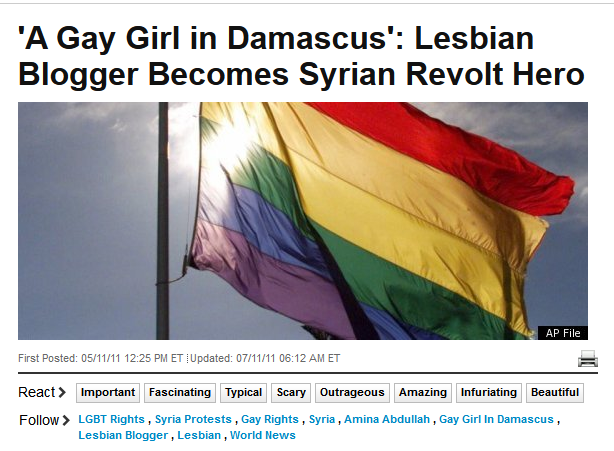
And then there has been instances of deception. The worst was the case of the Gay Girl in Damascus, who went from being a global source on what was going on in Syria through her blog to…

… an American graduate student named Tom MacMaster who was studying in Scotland.

The hoax may be the worst case example of what can go wrong when using online media for references. What concerns me more is when journalists and media outlets source speakers online. Unless they’re careful, the people who end up becoming the witnesses or the quoted experts are those with the biggest following online.

Of course, this doesn’t just happen online. I was listening to a post on the BBC World a week ago and heard a report about the first Saudi female Olympians. The person being interviewed was a female Saudi journalist residing in New York.

As I sat listening to the report, I could not help but ask myself why was the BBC interviewing a person sitting thousands of miles away from the country under focus. Would this person hold a mainstream opinion? Even some of her facts which she used to corroborate her arguments were flimsy (for example, she said there are no female gyms in Saudi Arabia, which is false).

Being a good journalist is one of the hardest jobs out there, especially in the Middle East where people can often be reticent around media and yet the editor still wants the story filed ASAP. However, I would like to ask my friends in the media to think before they quote from online, and ask themselves if they’re background checking that person, if they need to quote the same person for the Xth time, and if they should quote from online sources when alternatives are available.