Unknown's avatar

About alexofarabia

I'm am obsessive compulsive communicator who has lived in the Gulf for almost a decade. Enjoying the challenge of working in a region where you've got to be innovative, patient and determined to make things happen. Miss being a full-time journalist! Miss family even more! Sometimes I mouth off, but more often I grit my teeth and try to encourage change through a smile (not as easy as you think). Despite now living in Dubai Bahrain is home for me.

Dubai Customer Service 101 – Respond to the Complaint with a Job Offer

While the Middle East and particularly Dubai is blessed with many things, good customer service isn’t our forte. A friend went shopping for a camera at one of the local malls and had a fun experience. Have a read through his email to the company and their wonderful response. It really did crack me up when I saw it, and I’m sure that if you’ve been here and had to deal with customer service you’ll empathize!

This is the complaint letter sent to Canon. Customer service anyone?

This is the complaint letter sent to Canon. Customer service anyone?

And then the response from the company. I’ve seen some wonderful responses in my time but this is a first.

This is just hilarious! I can only hope this is an auto-reply.

This is just hilarious! I can only hope this is an auto-reply.

The UAE, Egypt and the dangers of an open bias among media

How can a journalist consider him or herself a professional after openly declaring a media bias? (image source: http://www.thepoliticalcarnival.net)

There’s few proverbs which would sum up today’s Middle East more than “may you live in interesting times”. Unfortunately as we are discovering over and over again, that Chinese proverb is not a blessing but rather a curse. When I look at Egypt over the past couple of weeks I would have thought I was watching a Ramadan-season tragi-comedy rather than real life events. The situation is desperate; the sense of hurt and anger is palpable on all sides of what is now a conflict between two opposing forces.

Generally speaking, the media in Egypt is also becoming more polarized. Most media outlets in the region are owned either directly or indirectly by the government or by groups and individuals with a specific agenda. Even those media who don’t have a particular bias still have to self-censor for fear of crossing a red line. However, it’s rare for a (supposed) journalist or media group to come out and openly show a bias.

Two incidents made the headlines this week in the UAE. The first, and the most brazen, was an announcement of a one million Egyptian pound (US$143,000) bounty for information leading to the capture of three Muslim Brotherhood leaders in Egypt. The pledge was made by an Emirati columnist named Hamad Al Mazroui through Twitter (Hamad has been called a journalist but he write columns rather than factual reporting).

This bizarre event was followed by a statement published by the UAE Writers Association in which it stated that “it is against the attempts of the Brotherhood to manipulate the tolerant image of Egypt and moderation.” The statement, which was first published on the country’s national newswire, reiterated the UAE Writers Association’s support for the Egyptian Writers Union, which has listed the Brotherhood in the terrorism list. The Association also commended the UAE’s unwavering support to Egypt.

I have few illusions about national media being influenced by their respective governments’ policies. However, the aim of journalists should be to report the facts and then provide analysis. Research by Gallup has shown that public trust in the media is highest when the media shows no bias; the opposite is true when there is an open bias.

Do such actions help to resolve the situation in another country? Do they help us to understand what is happening on the ground? And do they promote a sense of trust in media outlets here when reporting or commenting on the situation in Egypt? Journalism comes with responsibilities to report and analyse in a manner that is balanced and removed from prejudice. Let’s have more of this please, and less of an no open bias.

Is social media making the situation in Egypt better or worse?

Should we still be saying thank you to Facebook and other social media sites today? (image credit: http://www.straighterline.com)

We’ve all seen the horrid news coming out of Egypt over the past couple of days and weeks. The events have been broadcast worldwide. Thanks to social media, they’ve also featured prominently on Facebook, Twitter, YouTube and other channels. There’s been a noticeable trend; the content being shared online is becoming more radical and biased as things have gotten worse in Egypt.

There was a fascinating study by MIT, NYU and the Hebrew University of Jerusalem which suggested specific positive or negative influences create asymmetric herding effects – in plain English that means people are increasingly likely to follow the crowd online and agree with others when there’s a groundswell of opinion, especially when they share similar opinions or views.

There’s a famous English saying which seems apt for social media today, “birds of a feather flock together.” What we’re seeing on social media today is groups of individuals who share the same opinions coming together as groups. There’s less debate online of differing views and more support for and promotion of each others views.

The question is, how is this helping calm the situation on the ground? Are people thinking clearly when they post, share or comment? While Facebook was praised for its role in the 2011 revolution, my own views are that social media is now a key channel for fanning the flames of sectarian division in the country.

I’d hope people think more before they use social media to openly share their feelings on such emotional issues. It’s gotten to a point now where my timelines are split between the various groups who are constantly posting materials which reflect their own opinions. In contrast there’s little effort by either side to reach out to others. The social media world is just as polarized as opinions on the ground (maybe even more so). I’m hiding videos and pictures because I don’t want to see such open hatred on my timelines.

I sympathize with people’s views and I understand the passion on both sides. Hundreds have died and the country is in a state of emergency. On both sides, Egypt’s citizens want what they think is best for their country. But, for the sake of events on the ground, let’s pause before emotions kick in. We need more calm heads rather than hot heads, especially online and on social media.

How is the Middle East’s marketing industry dealing with the digital question?

Are marketing executives in the Middle East ready and willing for the digital era? (image source: http://www.219group.com)

One of my favourite reads on marketing in the Middle East is a monthly publication called Gulf Marketing Review. This month’s edition included the title’s inaugural value exchange survey for the region. The survey, which is conducted by da Vinci Marketing, reached out to marketing executives across the region to better understand what is happening on a brand management level.

The report, which was included face-to-face interviews with a host of marketing executives from leading brands, outlines a number of trends across the marketing strata in the region:

1) All digital – there’s more marketing focus online but marketing executives are demanding more information to better understand the benefits of digital solutions/technologies.

2) Increased specialization – clients are increasingly moving towards ‘niche’ agencies who have specific skills sets.

3) Social, mobile and content – questions remain about who manages social media (i.e. is social media handled in-house on the client side or by the client’s agency), and the importance of search and mobile to marketing teams across the region.

You can download the da Vinci’s inaugural Value Exchange Study in GMR through this link. And if you’re based in the Middle East it’s well worth buying a hard copy of this issue’s magazine. The insights are fascinating.

One place you don’t want to be for Eid – Stuck at Riyadh Airport with @BritishAirways

Video

Where do you want to be on your first day of Eid/vacation? It’s not the most pleasant experience being stuck at any airport in the world, but this story does break my heart. The above video was posted today after what appears to be a nightmare experience. The below text is from one of the passengers on BA262 which was supposed to leave on the 7th of August from Riyadh to London Heathrow but arrived three flights and a day later than scheduled. And while safety is of paramount importance and these things do happen I have to ask, why didn’t BA do better in terms of its customer service?

On checking into the airport the flight BA262 on 7th Aug 2013 from Riyadh to London was delayed by 20 minutes. This was extended to nearly 4 hours with statements every hour. The air conditioning within the airport was not working and the status updates very vague and not helpful. No refreshments were made available and the passengers left to fend for themselves. Finally we did board the aircraft and took off from Riyadh, however approx 30 minutes into the flight we started circling Riyadh and did not go anywhere. We were then told that there was an issue with the main wing flaps jamming and had to eject 20 tonnes of fuel and return to Riyadh.

The emergency landing was fast and hard but fortunately the pilot was good and we made a safe landing.

Passengers disembarked and went through a living nightmare from start to finish and ended up leaving the airport with no support from BA what so ever!!!!

The aircraft, we were told was fixed and we were to return the next day to take off at 0700hrs. We ended up taking off close to 0900hrs 8 Aug, again we climbed and again the same issue occurred about 30 minutes into the flight. The main wing flaps jammed again. we then went through the same scenario of dumping the fuel and then another emergency landing back at Riyadh airport. This time there was screaming and crying within the aircraft and again blue lights chasing us up the runway. On coming to a stand still there was a person who was took ill and passed out and the para medics were dispatched to attend the aircraft to treat the person.

BA you have en-dangered peoples lives, you have not been there when needed, you are a disgrace!!!!

Eid Mubarak to you all! عيدكم مبارك

Image

Eid Mubarak to you all! عيدكم مبارك

This Eid let’s all pray and wish for peace, especially in the Middle East region. I wish you a blessed Eid Mubarak.

عيد مبارك على لجميع وانت بالف خير

The wonderful image has been developed by Jehan Abdulkarim, Thank you Jehan!

If you don’t like it, then leave! Hey @Dutweets and how not to deal with customers online

One week, two social media blunders in the United Arab Emirates. First we had Subaru Emirates and now we have Du, the UAE’s second largest telecommunications company, getting everyone into a tizzy.

The background to the story, which has been covered by the UAE-based magazine Computer News Middle East, is an increase in charges for the company’s home user pricing plans. The price increases, which have risen by up to 37 percent, seem to have been posted on the company’s website rather than having being formally announced by the company.

Unsurprisingly, consumers haven’t taken to Du’s price increases (note – for data services the UAE operates a monopolistic system whereby you have to purchase from the sole telco who is licensed to operate in your area, which is either Du or Etisalat). Du’s twitter account, @Dutweets, has been inundated with tweets from aggrieved consumers who understandably don’t want to pay more for their existing service and don’t want Du’s offer of additional phone minutes in compensation for the higher prices. Have a look below:

Unfortunately, for the people in the company running the Du account (Du handles social media internally I believe) things have gone from bad to worse. One reply has gone viral and is receiving a swathe of negative feedback on Du and its social media efforts.

I do feel for @Dutweets as they’re having to face the fallout from a pricing decision which has been poorly executed and hasn’t been communicated in the right manner – from a customer perspective there’s no justification for a price rise for the same service, especially when Du’s customers have no other provider and when their existing contracts should be honored for the contracts’ duration. However, if a company isn’t willing to resolve issues through social media then what’s the point of entering into a dialogue with the community? And no matter the frustration levels you can’t respond to customers in a manner that seems unsympathetic. So please, no more Hey! messages @dutweets. Understand the concerns, pass on the message to the executives and wait for a positive message from upstairs. Don’t do a Subaru, because you’re only going to make things much, much worse for yourselves.

https://twitter.com/WildeTrude/status/364691859576061954

https://twitter.com/alextohme/status/364719579089485826

Subaru Emirates, Facebook, sexism, racism, and loss of life = a social media disaster

I’m a hardened comms person/journalist. I’ve seen a lot of materials which offends and much of that material doesn’t surprise me. However, this morning I was wincing at a post on Facebook, on the UAE page of the automotive brand Subaru. The post, which relates to a recent accident which claimed the lives of four people, offends both women and a specific nationality. While this isn’t enough, not a single positive piece of advice is given to drivers to help avoid such a tragedy in the future. The post is screen-captured below. And to ensure maximum shock value what would you title such a piece? ‘Women drivers at it again’.

For me, pretty much everything that could have been done wrong was done wrong with this post. Frankly, it's disgusting.

For me, pretty much everything that could have been done wrong was done wrong with this post. Frankly, it’s disgusting.

To fan the flames of outrage further, the admin person does not apologize but rather seeks to defend the comments against the criticism (sixty comments and counting and 58 shares within 21 hours). This has gone out to 15,000 accounts who have liked the page and has been distributed to hundreds more through the shares. Depending on Subaru Emirates’ advertising policy in the UAE this could have reached hundreds of thousands more. Stepping aside from the grotesqueness of the post, it’s a remarkable thought that the company could have alienated over half of its potential buyer base. As an aside, I doubt that the page has asked permission from the newspaper Emirates 24/7 to use this image in a commercial setting.

I’m not going to delve deeper into this as there’s little positive about this episode apart from to learn what not to do when promoting a brand through Facebook. Subaru, please do the right thing and apologize for the post and ensure that the admin person learns the error of their ways.

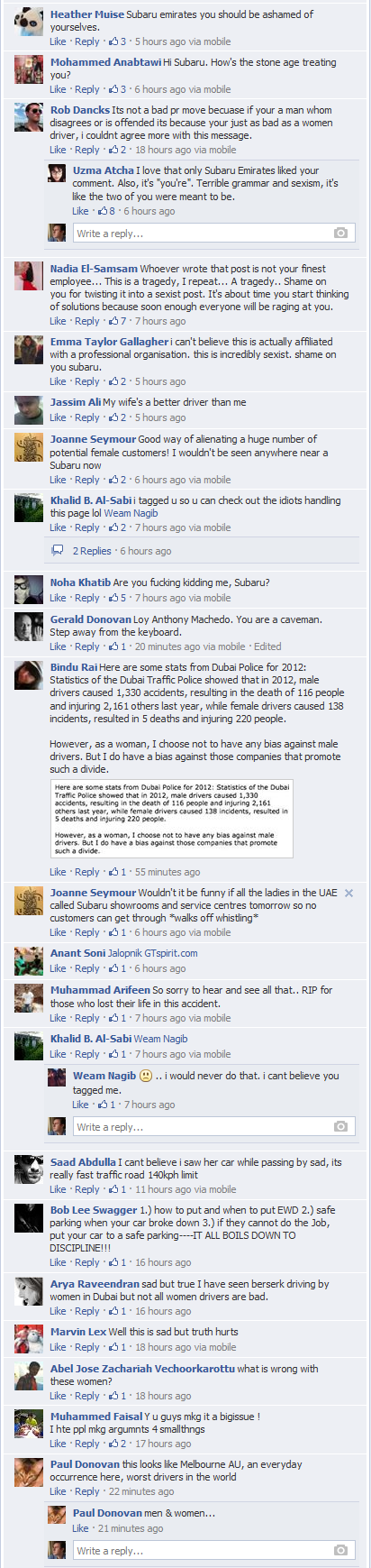
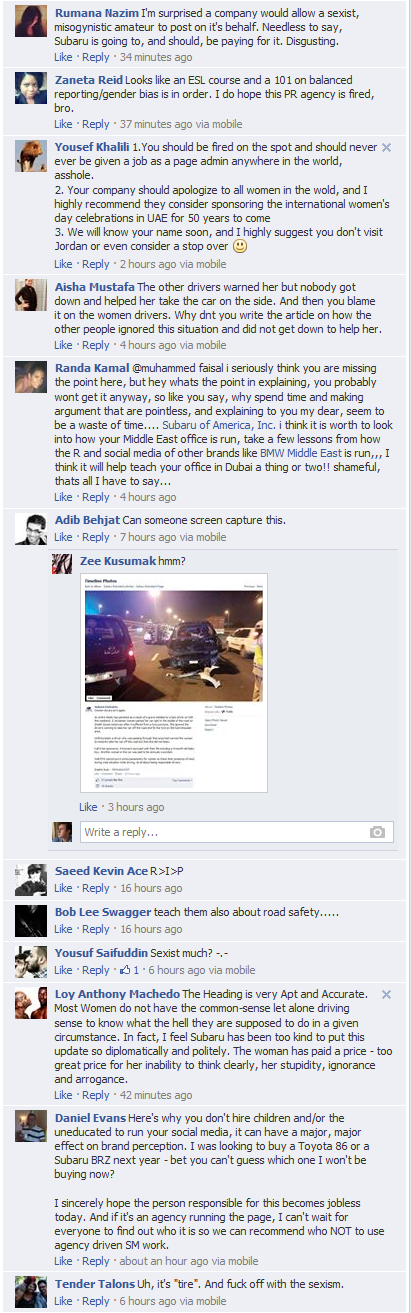
Comments are below for the post (apologies for the size but it’s easy to zoom in and view/read).

This is the first comments screen shot. Note the defensive post by Subaru Emirates and the anger of the responses.

This is the first comments screen shot. Note the defensive post by Subaru Emirates and the anger of the responses.

And it goes on...

And it goes on…

And on and on...

And on and on…

I’m sure that Subaru has guidelines for appropriate social media usage for its internal staff and agencies. They need to ensure that these guidelines are understood by all and that they are followed by their social media admin persons. I’ll be writing a how-to blog for how to use Facebook properly soon. As a responsible individual, we all need to understand the other. That’s even more true when you’re running someone else’s brand on their behalf.

A Digital Journalism Masterclass – Qatar’s Doha News and @dohanews

Let’s face it, the Gulf doesn’t win many awards for quality investigative journalism. There’s some outstanding journalists out there, but in a region where most/all of the news outlets are underfunded and owned by bodies or individuals who don’t have a media background we’re left with a lack of quality reporting.

Three people, journalists with experience of global media outlets such as the BBC, the Wall Street Journal, and Al Jazeera, took it upon themselves to take on Qatar’s media scene and create a news portal that would deliver news in real time. The result was Doha News, a news service that began its life on Twitter as @dohanews and then developed into a daily news blog.

The stated aim of Doha News is “to educate, inform, and stimulate positive change in the community.” What the three people behind the project – Shabina Khatri, Omar Chatriwala, and Tory Scott – have essentially done is to create a community site where the public can send in their content, be it images or news stories, and have that content edited and displayed for the rest of the community to see and comment upon.

Doha News hasn’t just become another news website; the portal has frequently beaten other media channels to breaking stories. Similarly, the quality and accuracy of the site’s news has been commended. No other Doha-based media outlet has covered the Villaggio Mall fire tragedy as comprehensively as Doha News. The site’s team went so far as to produce a 57-page e-book on the anniversary of the disaster which won praise for its coverage of what went wrong on the day of the Villaggio Mall fire and the ensuring events including the trial and steps taken by the Authorities and Mall owners to ensure a similar incident never happens again.

Below is a selection of items from the site including a news piece and pictures from users of the site. If you’re looking for news on Qatar or simply want to understand more about digital journalism in the Gulf Doha News is definitely worth a visit or three. Let’s hope others take up the mantle and create similar news portals for the rest of the region.

This piece is fairly typical of Doha News - a local interest story that uses social media to engage and benefit local viewers

This piece is fairly typical of Doha News – a local interest story that uses social media to engage and benefit local viewers

PR Buzzwords that we (often) could do without – Innovation and Social Responsibility

The concept of communicating through the written word is a remarkable thing – we have the ability to educate, engage and persuade through a well-written, thoroughly thought-out piece of work. And then, there’s the other end of the spectrum, when buzzwords and phrases are used without reason and with little understanding of their meaning in the context in which they’re used.

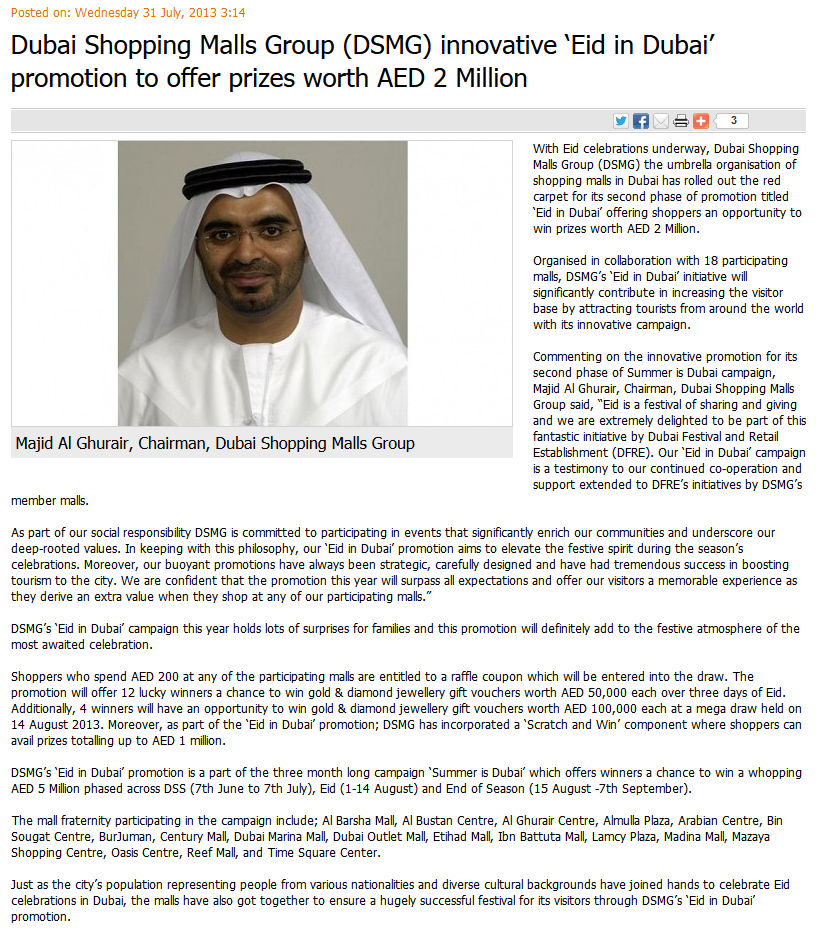
I came across one such example this week. A press release was sent out for a shopping promotion in Dubai. I’m going to post a screenshot below but you can also see the original article here.

How do the concepts of innovation and social responsibility work for a cash-based shopping promotion?

How do the concepts of innovation and social responsibility work for a cash-based shopping promotion?

I’m going to let you draw your own conclusions but let’s call a spade a spade and realize the power of words when properly used, in a setting that underlines their real meaning. Innovation is such a powerful term, as is social responsibility. But where’s the connection with this activity?

Anyone who works in public relations and communications will have been guilty of throwing in the odd ‘leading’, ‘global’ or award-winning every now and then. I’ve done it. However, is this habit becoming more commonplace within the Middle East’s communications sector.? When I have time, I’m going to do a keyword search to identify the worst offenders, the most overused phrases and buzzwords in regional press releases.

For the meantime, I’d like to ask you this. Which words are most overused and which turn your toes and make you cringe when you read them?