
Why Acknowledging Other’s Views Makes for Powerful Engagement

More leaders need to listen to and understand the views of others before speaking

I’ve been reading a fair amount of media of late. In one interview, the executive spoke about how she’d simply walked into an organisation’s reception and asked for a job. In another, the author spoke about how her country is leading the way in gender equality. And in the third piece, an opinion editorial, the author spoke about how much more hope there is now than twelve months back.

All of these views reflect their authors’ experiences and beliefs. What struck me as a reader was how their perspectives were different from my own. For example, I’d never be in a position to walk into any office and say I want to work here, at least not in the region I’m in (it very much felt like a statement made from a perspective of privilege). And for billions of people living in countries which have yet to receive any vaccines, the future is far from hopeful.

The point I’m very much trying to make here is that we all see and understand communications from our own experiences and beliefs. And executives who want to make a specific point need to think about what they’re trying to say through the lens of others.

By acknowledging differences in your argument and talking points, you strengthen your ability to persuade and convince others. Empathy is a powerful means to build partnerships and advocates, and the best way to do this is to listen to and understand what others are saying, especially those who are different than you (that’s why diversity and inclusion are fundamental to effective communications, and why all communication teams should be diverse).

Dr Kevin Ruck, Howard Krais and Mike Pounsford have done extensive research into listening and communications. Have a listen yourself into what they’re saying here. And let’s do more to acknowledge the other(s) in proper dialogues.
Goodbye Clubhouse!

Clubhouse was fun for us in the UAE, at least for a couple of weeks

The buzz came and went faster than you can say ‘two-shot vaccination’. Clubhouse has been the invite-only app that everyone has been talking about, at least iPhone users (the application isn’t available on Android phones, yet). The app, which is audio-based and is designed around the idea of creating rooms where people can listen in to speakers in a talk-radio format (think a live stream but with no video), has proved to be wildly popular in the Gulf.

Some users have likened Clubhouse to the early days of social media, where people were open and discussed anything and everything. Eman Hussein wrote a very good piece on how Clubhouse is giving a voice for people to discuss a myriad of socio-political issues in a way that hasn’t been possible for years. Others have speculated that the app would soon be banned or be eroded by fake accounts and trolling.

I’ve loved the application, and the ability to listen in and engage in talks and debates, both scheduled and on the fly. You can find rooms by interest, follow friends and colleagues, and be as involved or as uninvolved as you want. There are talks about current affairs, social issues, and even silence (which is very handy if you’re living in Cairo). And there were also a myriad of PR possibilities for the platform, which made it so exciting.

Sadly for me and all my friends in the UAE, you won’t be able to use Clubhouse. The service has been throttled to the point that the audio is, frankly, inaudible. Have a listen to the below (and Omar is on a 5G connection, which is going to be faster than my wifi).

I don’t know the reasons why this is happening. I assume it’s due to the UAE’s VoIP laws, which requires any application that uses voice over the internet to be regulated (in theory, you can call another individual via Clubhouse, but that’s not really the purpose of the application). Have the country’s networks deemed that Clubhouse is an application whose performance should be reduced to the point that it’s unusable? The only way that the application can be used is via a VPN, which is also not ideal.

It’s a shame that this is happening; Clubhouse looked to be such a fun place to hear others and hold group chats. And it doesn’t help the region in its goal to become a technology leader. But anyone who has lived here for a while knows how these things are (we can’t use Facebook messenger calling, for example). Ah well, anyone up for another WhatsApp group chat?

#MeToo and the Middle East’s media sector – what changed?

We’re a couple of days out from International Women’s Day, the time of year when we all look to gender equality. But I want to get the conversation started now, and on a different issue. A couple of events have gotten me thinking about the issue how women are treated in the media and marketing sectors in our region.

The first was a very brave article by former journalist Reem Abdellatif. Reem is no longer based in the Gulf (and I’ll get to why this is important in a minute) and she penned an op-ed on sexual harassment and assault for Israel’s Haaretz newspaper (if you’re not subscribed to Haaretz, you should be – often the reporting on the Gulf is better than what you’ll see from newspapers in the Gulf).

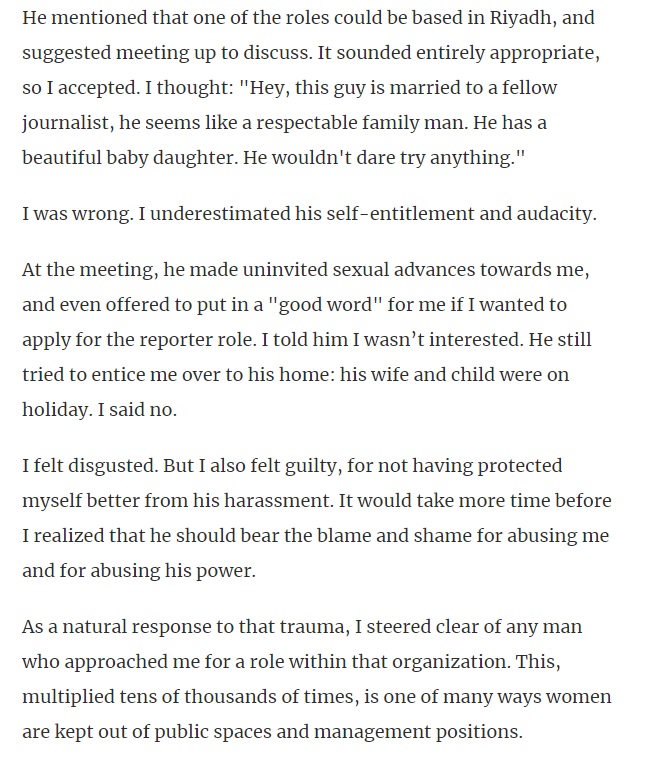
Reem’s piece is both general and personal, and Reem details her own stories of abuse. Chillingly, she describes one experience of an uninvited sexual proposition by a journalist in Dubai. It’s a story I feel many women here will be able to relate to. I’m sharing a specific piece from that story below.

Some of you may have noticed that I referred to Reem as having been based in the Gulf. She wouldn’t have been able to publish this account if she were still based here. And no media outlet would carry it, even if she weren’t based here. This is due to the region’s defamation laws, which are criminal offenses. And that brings me to my second reminder. Which I can’t even talk about, despite the seriousness of the sexual harassment allegations being made and the fact that everyone would know the organization.

And that for me is the core of the issue. In the Gulf, we can’t talk about sexual harassment, except in broad brushstrokes which have less meaning. The perpetrators get off, scot free, with little impact on their careers or their reputations. While the victims have to live with the abuse for the remainder of their lives.

If the media and marketing industry is serious about tackling gender equality, they’ve got to start with this. And that doesn’t mean making a statement about the issue of gender equality in the company, talking about the need for purpose in communications or bringing in a female head for a couple of years. Rather, it means rooting out the issue of abuse and harassment. What we have to do must include:

  • Trainings on sexual harassment and gender bias at the workplace, for all staff (most especially management);
  • Proper investigations into sexual harassment allegations, including with the authorities – these are criminal offenses, and should be treated as such, and
  • Anyone found guilty of sexual harassment should be blacklisted from agency groups, and future employers should specifically ask about this question when asking for references.

These are the basic steps the industry must take to address the issue. For all the talk about equality and opportunity, if women don’t feel safe in our industry then we’re not going to make any progress on these other issues. Who’s with me?