
What do #brands do with #franchises when consumers get #socialmedia angry?

A couple of recent events, both personal as well as public, have highlighted the challenges facing brands when it comes to franchises and customer service. Social media has given consumers the ability to interact directly with brands in ways which were never before possible. Today’s consumers expect a response from brands’ social media feeds, be it on Twitter or Facebook.

So what do brands do when they’re not in full control? How do brand communication teams deal with a consumer who is angry at a franchise? It’s an interesting question, especially for us consumers and comms professionals here in the Middle East.

A number of high profile examples have brought to light the limited scope for communications between consumers here in the Middle East and brands from locations outside of this region. The best case study would be the #noshaya Twitter-led campaign against the Kuwaiti-based retailer M.H. AlShaya. The call to boycott the company’s stores back in December was a response to AlShaya’s decision to stop providing cash refunds to customers throughout its stores.

AlShaya owns tens of franchises across the Gulf, including Top Shop, BHS, and H&M. It’s by far the largest retailer in the Middle East and thousands of Saudi consumers took to social media to vent their anger at AlShaya’s decision (for the full reasons behind the boycott please see this previous blog post).

After only a couple of hours of the campaign going live online activists started messaging the retail brands directly.

https://twitter.com/#!/hindkz/status/143315760419323904

https://twitter.com/#!/Maialshareef/status/143021336778903553

Activists sent hundreds of messages to the official Twitter accounts of retailers who had franchise agreements with M.H.AlShaya. While I may be wrong (and I hope I am) I didn’t see a single response from these retailers. These retailers weren’t helped by promoting their own refund policies on their websites, most of which were much more generous that AlShaya and included cash refunds on returned products – the activists’ key demand.

Another consumer-led campaign which hit the headlines this week relates to a nightmare incident in Saudi involving a Toyota Landcruiser which was stuck in cruise control at a speed of 210 kilometers per hour. For those Arabic readers out there check out this harrowing news piece from Al-Hayat newspaper. #ToyotaCruiseFailSa has been a top trending hashtag in Saudi for the past two days.

Out of all the car brands in Saudi Toyota probably has the best reputation for reliability and customer care. Does Toyota rely on its distributor Abdul Lateef Jameel to step in a repair the public relations damage done (so far, there’s been little word from the distributor) or do they step in themselves to reassure Saudi drivers? The response of one Toyota Landcruiser owner is typical of those trending the topic on Twitter.

https://twitter.com/#!/m_alshwaier/statuses/155276831241666560

The Arabic translates as, “I haven’t used the cruise control since buying the car because of this story.”

To ask again, when do brands step in to protect their brand value? How or what do they agree with their franchise and distributor partners as to who is responsible for what? Social media has changed the communications sector in ways that few could have envisaged. One short but interesting article online has found that consumers who contact the brand via social media are much more likely to expect a response to their queries. Check out The State of Social Marketing 2011 – 2012 by Brian Solis

I wonder how many of us in communications are taking note of what is happening around us before the same thing happens to the brands that we are entrusted with?

How to reach an audience through #SocialMedia and #influencers

Social media is the latest and greatest thing at the moment in the world of marketing and communications but how do we in an emerging market make the most out of what we’d call influencers, people on the web who are followed and listened to by others. The challenge that we face in a market is the Middle East is a lack of the mainstream online influencers, bloggers. Compared to Europe and the US, there are fewer bloggers in the Middle East, especially in countries such as Saudi Arabia. For those interested in pioneer bloggers, have a look at this list compiled by commentator Sultan Al-Qassemi or the Arab Media and Society’s portal on blogs.

Despite the challenges social media is an incredibly powerful way of reaching out to an audience, partly due to directness as well as its credibility. But how do you find the right influencers to reach out to? There’s a couple of very simple ways to do this and tools to use. Klout is probably the best known site for analyzing social media influence across a variety of sites such as Twitter, Facebook, Google+, LinkedIn, FourSquare, Youtube, Instagram, and WordPress.

Klout trawls social media network data and creates profiles on individuals and assigns them a “Klout score.” The higher the Klout score the more influence a person has online. Klout claims to have built more than 100 million profiles from crawling social media sites. While the site is far from perfect, it’s probably the most widely used tool to rate someone’s social media influence. You can search on Klout’s website either by topic or by the influencer’s name. Klout will give you three lists – one for top influencers, one for top +k recipients (basically people who have been rated highly by other Klout users rather than Klout’s own ratings system), and one for best content. Try a search on Dubai using Klout and see whom the website recommends.

The Klout profile for Mashable journalist Brian Hernandez

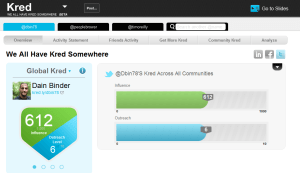
There are a number of other social ranking sites. The one which is gaining the most interest is kred.ly. At the moment Kred.ly is limited to analyzing people’s Twitter feeds only. However, Kred.ly may become very useful as it’s linked into a website called peoplebrowsr. Peoplebrowsr aims to give marketers and communicators access to influencers. The idea goes that you’d be able to identify people who are specialized in a certain topic and then pay them to promote your company or service. I’d love to hear from anyone who has used kred.ly and peoplebrowsr, especially in the Middle East.

Screenshot from social media analytics site kred.ly for blogger Dain Binder

So let’s give an example of what I’d be looking to do if I was working in tech. First thing would be to identify people with a big enough audience and enough credibility to influence others. One such user may be a prolific twitter user and the founder of saudimac.com Khaled Abdulrahman. Tweeting with the handle @khaled Khaled has over 13,000 followers and regularly updates his web site.

http://twitter.com/#!/khaled/status/153421180550922241

Khaled is a great example of an influence as he uses multiple sites to engage with an audience.

The challenge I have now is how to work with or influence Khaled. Traditional marketing would have meant paying the influencer. This is common for celebrity social media endorsements. However, this doesn’t always have to be the case with bloggers and topic specialists. Many may be willing to support you if they believe in the cause that you are promoting or if the content you give them is relevant or interesting.

The beauty of Klout, kred.ly and other tools is that they’re either free or fairly cheap to use. So when you’re next looking for people to help you communicate to an intended audience you’ve got no excuse for not finding the right influencers on the world wide web.

To #socialmedia or not to social media – #Gulf newspapers say yes, Gulf governments say no

The last twelve months have been a defining year for social media across the Middle East. Citizen journalism has flourished. Most of the mainstream media publications have also adopted or begun to adopt social media as another channel to reach the general public.

The first adopters were media outlets in the UAE, particularly those who were already well established digital media. You have the likes of arabianbusiness.com who tweet at @ArabianBusiness – the site has over 27,000 tweets and 13,000 followers on Twitter and almost 3,500 likes on Facebook. Dubai’s largest English-language newspaper Gulf News which tweets at @gulf_news, has over 21,000 followers on Twitter. Abu Dhabi’s The National has a number of prolific social media users on its writing staff, including @ben_flanagan…

http://twitter.com/#!/ben_flanagan/statuses/151940336132964352

…and @amna_alhaddad

http://twitter.com/#!/amna_alhaddad/statuses/151968268817661952

Interesting for those based outside of the UAE is how media re now turning to Twitter and Facebook. Saudi’s largest English-language publication, the Arab News, has long had a Facebook site. Arab News has more likes than Arabian Business. Rival publication Saudi Gazette has a Twitter feed on its site, and recently launched its Twitter handle, @TheSaudiGazette, last month.

http://twitter.com/#!/TheSaudiGazette/status/140188317839917056

Similarly in Bahrain, its largest English-language newspaper the Gulf Daily News now has Twitter and Facebook aggregator tools on every newspage. We’ll doubtless see more media using social networks to reach a wider audience.

While the Gulf’s media is moving ahead with social media, the region’s governments are clamping down on what could be termed anonymous social media users probably due to the role that social media has played in the Arab Spring.

Bahrain was the first to propose legislation. The country’s parliament discussed new punishments for cybercrime that include 10-year prison sentences and fines of up to 300,000 Bahraini Dinars. Kuwait and UAE are following suit. Both countries have questioned and/or detained bloggers of late for varying reasons. One article this week in Kuwait’s media suggested that the country could ban anonymous social media activity.

http://twitter.com/#!/Shusmo/statuses/151729250351845376

UAE officials have suggested that anyone caught using social media ‘irresponsibly’ will be punished.

http://twitter.com/#!/KABRASS101/status/151644446029647872

Will the drive to regulate social media in the Gulf work? Can’t wait to find out!

Viral conversations – Saudi Women’s Forum streamed live with #womanforum hashtag

I often get asked about Saudi Arabia, about its people, customs and culture. But every so often you can get a glimpse into this magic kingdom and enjoy a peak at the real Saudi. Last week, on the 10th and 11th of December, the Saudi Center for Women’s Studies held a conference on women’s rights and responsibilities. For the first time I can remember for such an event, it was streamed live on the internet, including with commentary in English.

While I’d love to have a peak at the number of unique users on the site, social media activity in the Kingdom surged during the two days. Writing with the hashtag #womanforum Saudi and Arab nationals shared and commented on the views presented by the speakers (as this is Riyadh/Saudi women speakers did not share the same hall as the men and so were not visible in the video if you were wondering why there seemed to be no women at a women’s conference).

Most of the tweets and updates were in Arabic, but others did post in English.

http://twitter.com/#!/commitmentphobi/status/147175873446019073

The organizers of the event even used Facebook to upload pictures of the event and the speakers involved. If I can dig out the link I’ll add here.

Several days later in both English and Arabic media articles were published on the event. Here’s the link to the Arab News story, and the other for the Saudi Gazette piece.

While the media did pick up on important aspects of the event, the pieces were published several days after and lacked both the immediacy of the social media feeds as well as the cut and thrust of the debates online. With Saudi women and their rights being such an important topic in the Kingdom today, you’d have to ask if one article in a newspaper could do justice to the entire event.

As an addition to the above much of the argument for Saudi women working has been waged online. This is one video that was circulated this week using the womanforum hashtag. The video was uploaded in March but was circulated again this time round due to the renewed focus on women’s rights and work in Saudi. There’s nothing like a viral conversation, even in the magic kingdom.

Bahrain’s order to reinstate unemployed employees, students and #BHSacked

The recent events in Bahrain have been covered from a to z locally, regionally and globally. Much of the conflict between the government, its supporters and opponents has gone online. Bahrain has seen a surge in the use of social media this year both pro-government and pro-protestors.

As the conflict in Bahrain has ebbed and flowed much of the debate has gone online. One group of Bahrainis who have been particularly vocal have been those who lost their jobs and university places due to their actions and views which they expressed publicly.

This group, led in part by the medics sacked from Salmaniya Hospital and other medical institutions, have been pushing for their reinstatement. The campaign, much of which has been directed online via Twitter and Facebook, has been given added impetus by the findings of the Bahrain Independent Commission of Inquiry report which investigated human rights abuses committed following the events of 2011 in Bahrain.

In its report, on pages 406 and 407, the Bahrain Independent Commission of Inquiry called for the reinstating of those who were fired from their posts. To quote verbatim from point 1664.

More generally, the report confirmed that, following on from HM King Hamad’s Eid speech, it was decided that there would be no further dismissals when the remaining 1,423 cases were reviewed. The maximum penalty upon review would be a 10-day suspension from work and salary. In other words, 1,423 dismissals by the public bodies have been overturned by the CSB and these people have already gone back to work on normal pay.

Despite the official statements there still seem to be many on the island who have not returned to work. Protests have been ongoing before the release of the BICI report at the end of November. Activities by those demanding their reinstatement has been stepped up over the past week. These protests have been extensively covered online via social media. Using the hashtag #BHSacked protesters have extensively uploaded pictures and videos of their protests.

One of the sacked doctors today protesting outside Bahrain's Ministry of Labor

They’ve also sent their messages to prominent journalists on twitter such as @nickkristof. Check out the link for a video shot from an iPhone today at the protests outside Bahrain’s Ministry of Labor.

What’s most interesting from a corporate communications point of view is how many of those who support this group have set up their own twitter accounts in the name of companies who have laid people off, including Alba and Gulf Air. Here’s a link to one tweet from a profile called antiBatelco (I’d love to embed but Twitter still hasn’t rolled out the option yet). They’ve used company logos for their account profile pictures. None of the companies affected seems to have taken to social media to defend their actions.

So what does the government of Bahrain do? What can it do? Not much legally, seeing as the human rights commission appointed by the King himself has stated that those who were fired be reinstated to their jobs. There’s little hope that people will fade away after a period of time either. As those protesting are both unemployed and educated there’s little hope that they’ll either stop protesting or taking their cause online.

The difference today is how social media and the use of images and video can keep a campaign running and running. Both sides in Bahrain have been quick to take up the use of online tools to argue their cases. However, digital media changed who now has the most share-of-voice and influence. Social media has exacerbated that shift. A group of motivated and IT-savvy activists with a couple of iPhones and Blackberries with internet connections can now challenge their governments. Where do we go from here? For those protesting back in Bahrain, it’s to get back to work.

Choosing your words carefully – Dr Kamal Subhi, coffee shops and ‘no more virgins’

SNL mocking Saudi study about women drivers (with Arabic subtitles) There’s always more than one way to say anything. This isn’t communications advice, but rather common sense pure and simple. There was nothing unusual in terms of the gist of a report on the effects of Saudi women driving which was handed to the Kingdom’s Shoura legislative Council. The document, written by Saudi academic Dr Kamal Subhi, basically said that women shouldn’t be allowed to drive (a basic document of what purports to be the report can be found here).

What unfortunately made headlines was the reasoning for Dr Subhi’s conclusions. Rather than rolling out the traditional lines of culture, of traffic congestion, or of legislative and practical difficulties, Dr Subhi was much more imaginative in his language.

To quote from the Associated Press:

The report by Kamal Subhi claims that allowing women to drive will threaten the country’s traditions of virgin brides, he said. The suggestion is that driving will allow greater mixing of genders and could promote sex.

Continuing the story, the UK’s Telegraph newspaper reported:

[The report] warned that allowing women to drive would “provoke a surge in prostitution, pornography, homosexuality and divorce”.

Within 10 years of the ban being lifted, it claimed, there would be “no more virgins” in the Islamic kingdom.

It pointed out that “moral decline” could already be seen in those other Muslim countries in which women are allowed to drive.

In the report Prof Subhi described sitting in a coffee shop in an unnamed Arab state where “all the women were looking at me”.

“One made a gesture that made it clear that she was available,” he said. “This is what happens when women are allowed to drive.”

The news report spread across the internet. Comments poured in online and through social media. Twitter users posted their own views using the hashtag #drkamalstudy. The news story even made its way onto US television, with Saturday Night Live including it in their material (watch the video below).

There’s no doubt that there are many in Saudi who are against women driving. However, today’s local news goes global in an instant. It goes without saying to me that the comments attributed to the report and to Dr Subhi do not do any good to the image of the Kingdom or its women.

The same point could have been made, but with language that was banal, boring, and staid. Unless you really believe that women driving will mean more divorces, extra-marital sex, and looser morals. With more and more attention being paid globally to local media, thanks to digital and social tools, there’s no such thing as a local story that will stay local. It’s often the case that people would double-speak, ie say one thing to one audience and pass off another message to a different audience (Yasir Arafat was known for his double speak in Arabic and English). You cannot do this today. Someone will always relay your message, translate it and then distribute to and through their own networks.

Prominent Saudi blogger Eman Al Nafjan wrote a piece on this issue for the English newspaper The Guardian.Saturday Night Live mocking Saudi study about women drivers (with Arabic subtitles) As envisioned, Dr Subhi blamed the Western media for twisting his message. To quote Eman:

“In this statement he writes that he knows the west, and his study follows international scientific standards no one can refute. He claims that he is so greatly respected by his western counterparts that they offered him citizenship. The problem with the international press report, he says, is that it was commissioned by a Saudi hater who used a miserable reporter to write a piece that unfairly summed up his 16-page paper into half a page.”

I’m a huge fan of the Kingdom, its people and cultures following the years I and my family lived there. While I may not agree with everything that the country’s government does I still have to respect the laws of the land. However, no one can defend the indefensible. And the reasoning and language used in this report just makes me cringe. It’s not what Saudi Arabia should be making the headlines for.

The customer is always right – AlShaya and a social media backlash

My favorite retail marketing phrase is the customer is always right. While this may be the case in Europe and America where the phrase was coined, here in the Gulf retailers can and often do put in place policies that would not seem to be consumer-friendly.

One of the largest retailers in the Gulf is Kuwait-based M.H. AlShaya. According to media reports AlShaya manages over 55 brands across the Middle East and operates 2,000 outlets in 15 countries. AlShaya is a monster retailer, and its brands including Debenhams, H&M, The Body Shop, Starbucks, Boots and Mothercare.

At the end of September Alshaya announced a new policy whereby it was scrapping its previous returns policy. No longer would shoppers at AlShaya stores be able to return faulty and unwanted goods for a cash or credit card refund. Instead, they would be given store credit.

To put it mildly this policy hasn’t gone down well online. Today twitterers used the hashtag #noshaya to blast the retailer for its returns policy. Prominent Saudi twitter activist @maialshareef and Dhahran-based @hindkz came up with the hashtag to vent their frustration at the change in policy returns. Those in the GCC in particular have been criticizing the policy, especially in Saudi Arabia where most retail shops do not have changing rooms. If the clothes you purchase do not fit when you try them on at home, you will not get a cash or credit card refund.

Twitterers have called for boycotts of M.H. AlShaya’s stores until the policy is changed. Some have also been contacting M.H. AlShaya’s retail partners such as H&M asking for them to force a change on M.H. AlShaya. One twitterer with the handle of @b_e_s_t wrote to @HM

Could you please review H&M store policy in Saudi Arabia. Your agent in the region refuse to pay refunds even with the receipt #noshaya

Some people online have defended M.H. AlShaya. One with the username neenoism noted that people should be angry at the Saudi authorities for refusing to install changing rooms.

Ill be buyin smthin from some ALSHAYA store eventually. Put the money on the damn card. Boycott Saudi for banning changing rooms. #noshaya

While it’s been a few months since the initial announcement re the returns policy, the only assumption for the timing of the backlash is that M.H. AlShaya has only implemented the policy recently. One of the region’s most prolific bloggers @khaled has summed up why people are upset. When compared to the brands they represent (most of whom seem to give consumers a refund even if the product or purchase is not faulty) M.H. AlShaya’s returns policy is anything but consumer friendly.

Recent social media campaigns against the likes of Qtel and AlMarai have resulted in major concessions either being promised to or made for the public’s benefit. This seems to be the start of what either may be a very short but focused campaign against M.H. AlShaya’s consumer policies or a long-term hashtag which sums up the dissatisfaction of its customers.

If you understand social media then put your hand in the air

The past year has shaken so many pre-conceived notions about the region, not least how people communicate with each other. Only a couple of days ago research from Paris-based Semiocast showed that Arabic has become the fastest growing language on Twitter. Equally Facebook has become one of the most frequented sites in the Middle East and its usage grew by upwards of sixty percent over the last year in. If anyone has any specific figures on Facebook growth and subscriber numbers for the Middle East then please do pass along.

This is fantastic if you’re a marketeer. You have endless social communities you can directly reach out to, for your brand or your products. Unlike most conventional media in this region which aren’t audited for circulation numbers, marketeers can track their spending via social media through a host of tools. With the cost of social media comparatively low compared to traditional advertising and the increasing numbers of people online and using sites such as Twitter and Facebook, you’d think marketeers would be jumping out of their seats and kissing their monitors.

My question is do companies understand social media? I’ve had several recent eye-popping examples of how firms don’t seem to understand what social media is for. There’s the case of dairy giant Almarai which failed to push through pricing increases due to a lack of direct online communication with its consumers.

But even those firms who are using social media don’t seem to understand the directness and spontaneity of digital dialogue. One exec from a digital marketing firm told me of how he’d have to have five signatures from his client before posting anything on their Facebook site. A personal experience with Dubai-based bank Standard Chartered on their Twitter feed and Facebook sites also summed up for me at least the frustrations of how social media is being used here. Rather than answer a question and have the authority to help out, the same old ‘these are the rules, we can’t do anything’ line was rolled out. If you can’t do anything, then why are you interacting with me? To increase my frustration with your brand and service?

I recently looked over a social media plan from a European-based agency, and while all the reporting structures are there to say who is being targeted and why, I still feel that the point is being missed. Social media is about a dialogue, it’s about engaging with the public in real time by people who know your company and who are able to solve an issue. It’s content and authority rolled into one. If you can get that right, then you empower your customers who in turn will listen to what you have to say. If you get social media wrong, you only end up compounding a customer’s disappointment and frustration with your poor service or product.

Social media. Is there anything more revolutionary for the marketing industry today? Let’s hope that companies in the region cotton on before a consumer Arab Spring shakes up the business community.

Empowering women in Saudi through Glowork

Despite the size of the Kingdom and the importance of the country both in terms of its GDP and population, it’s not often that I get excited about anything online over here in Saudi. Recently, one initiative which I’ve been fully behind has proved that there are people out there who understand the power of the internet and who are determined to harness it for the good of progress in Saudi Arabia.

I was introduced to the team behind Glowork before its official launch. Put as simply as possible, Glowork is the first employment website dedicated to women looking for work in Saudi Arabia. Remarkably, there’s never been any similar initiative that I’ve been aware of in the country despite the millions of women over here both in employment and wanting to work. This is even more surprising considering that the majority of Saudi university graduates are females. There’s a wealth of talent out there that few companies have tapped into.

The team at Glowork have worked flat out to build awareness about the site among all the women out there online in Saudi as well as with employers. They’ve identified a niche and they are matching women with companies who they may not otherwise have been able to connect with. The likes of Panda, Microsoft and KPMG are today using Glowork to advertise positions for women in Saudi Arabia.

What is also striking is that Glowork’s marketing people are not using conventional advertising to promote themselves. Instead, they’ve gone online and are busy posting updates on Facebook and tweeting about new positions. This approach has allowed the site to build up a loyal following among thousands of women in the Kingdom as well as enable these women to interact with those behind the site and learn about the recruitment process.

We’re still a long way off having women being an integral part of the workforce in Saudi Arabia. However, sites such as Glowork will make a huge difference to all those women looking to start their careers in Jeddah, Riyadh and Al-Khobar. When you think that there’s over ten million women here, that’s a huge market to tap into.

Kudos to Glowork’s founders for being both the first into this space and for how they’re looking to reach out to women through social media. I hope others learn from your efforts. And if you haven’t checked out the Glowork site then go there, now!