
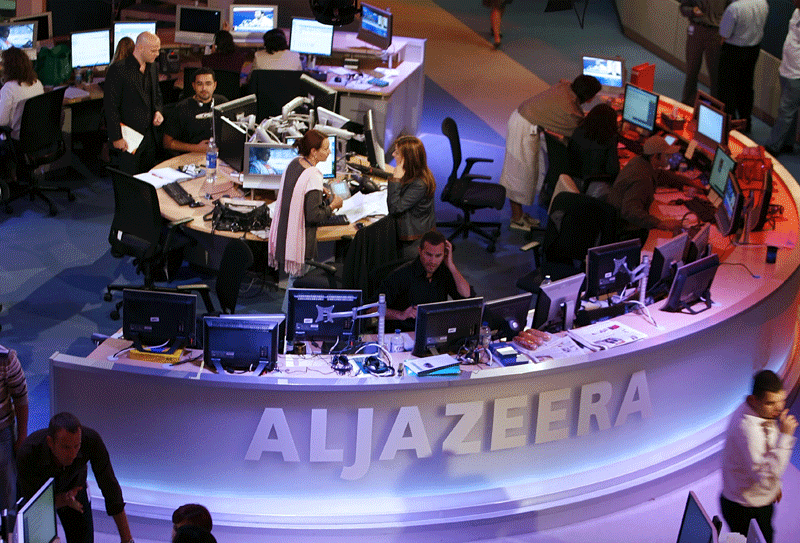
Al-Jazeera has come under fire for its alleged political ideology in its coverage of Egyptian news (image source: islam.ru)
Who doesn’t know Al-Jazeera? The Doha-based and Qatar-owned news broadcaster became infamous for its airing of messages from Al-Qaeda’s leaders, most notably Osama Bin Laden. The news channel, which was created in 1996 following attempts by the British Broadcasting Corporation to set up their own Arabic channel failed, has always been the target of criticism partly due to its political inclinations and its inability to criticize its owners – the State of Qatar – while running documentaries and publishing news critical of neighbouring Middle East states.
However, Al-Jazeera has been having a particularly rough time of late following recent events in Egypt. partly of its own making but what’s even more interesting is the level of coverage that other media has given to targeting Al-Jazeera following the fall of the Muslim Brotherhood’s Government in Egypt.
Ever since the events of the end of June and the start of July in Cairo it’s almost felt as if there’s been a witch-hunt against Al-Jazeera due to its Egyptian coverage. The main accusation? Al-Jazeera’s bias towards the Muslim Brotherhood.
While I understand the accusation, the fact that many of those making the claims are firstly media publications and secondly state-owned doesn’t sit well with me. I know of few state-owned media who are not guilt of being their master’s voice and hence being guilty of their own allegations against Al-Jazeera. Furthermore, I always find it strange when media attack other media; it’s hard enough being a journalist as it is today without being criticized by fellow colleagues.
I’m going to highlight a couple of articles below, from the Dubai-based and Dubai-owned Gulf News. The first and the most conspicuous news item was a special which was run on the 14th July entitled Al Jazeera loses respect over Egypt coverage. Do read over and share your views with me on this one.
Founded in 1996 and funded by Qatar, Al Jazeera was supported by many Egyptian revolutionaries. Demonstrators in Tahrir Squar chanted for it. Also, Al Jazeera staffers were feeling proud that they contributed to the Egyptian revolution with their work and coverage. They made the network the most popular channel in the country.
However, when the now ousted president Mohammad Mursi pushed through an unpopular consistution last November, many Egyptians found themselves flipping from Al Jazeera to other Egyptian networks. Distrust over its coverage reached unprecedented levels and took it from being the most popular to the most hated channel — its staff were now feeling embarrassed as their reputation was dragged through the mud.
A senior official at Al Jazeera who did not want to be named said that while the network appeared to be a neutral media network it was still a political tool in the hands of the Qatari emir. “He personally visited the studios during the Iraq war to make sure no footage of dead of abducted soldiers was aired. It was clear he was under US pressure,” the official said.
“In a special meeting in 2009 attended by some media seniors in Doha, the Emir said that Egypt’s regional role must be ended forever,” said another official. “When the Muslim Brotherhood announced it would field deputy chairman Khairat Al Shater as a candidate in the elections, the news team slotted it as the second story in the news bulletin, but then upon special request from the Emir’s palace, it was bumped up to the first news story.”
A producer claimed that when people started complaining and accusing Al Jazeera of favouring Islamists in Egypt, the station started to exclude any outspoken political analysts and opponents of the Brotherhood from appearing on its screen. On the other hand, he said, video reports that propped up Mursi and the Brotherhood’s image were welcomed by management in Doha. Anchors who used to interrupt the Muslim Brotherhood’s opponents in live interviews were judged as excellent.
The perceived bias prompted many leading journalists and TV anchors to leave the network. Aktham Suliaman, the German-based correspondent who left the station recently, told the German magazine Der Spiegel: “Before the beginning of the Arab Spring, we were a voice for change — a platform for critics and political activists throughout the region. Now, Al Jazeera has become a propaganda broadcaster.”
Another Beirut-based correspondent said that “Al Jazeera takes a clear position in every country from which it reports — not based on journalistic priorities but rather on the interests of the Foreign Ministry of Qatar. In order to maintain my integrity as a reporter, I had to quit.”
Other interesting articles from Gulf News include Al Jazeera staff resign after biased Egypt coverage, Al Jazeera’s role raises questions, and media bias infuriates Egyptian moderates which I am quoting from below.
Al Jazeera’s Egypt channel (Al Jazeera Mubasher Misr) is blatant in its support for the Brotherhood giving no platform whatsoever to the other side. Egyptian authorities attempted to remove it from air, but failed to do so because Al Jazeera allegedly hijacked broadcast vehicles from Egyptian State TV, now protected by the crowds in Rabaa Adawiya.
Local reporters were so incensed they demanded the ejection of Al Jazeera’s senior editor in Egypt from a press conference. Some 22 of Al Jazeera’s employees resigned asserting pro-Islamist bias at the top. On Friday, I was shocked to see someone I recognised on the stage in Rabaa Adawiya, engaged in whipping up the crowds.
There was the host of Al Jazeera’s programme Bela Hodod (Without Frontiers) Ahmad Mansour advising on how to manipulate media coverage and insisting that pictures of June 30 massive anti-Mursi protest had been photoshopped.
June 30’s aftermath has not only thrust the Arab world’s most populated country into uncertainty, it has eroded media credibility and prompted the crossing of a thin red line between honest reporting and political/ideological propaganda. Journalism requires an ethical revolution before Al Jazeera, CNN and others can ever be trusted again.
What I find ironic is the lack of coherency of the argument as it relates to allies. An example in point would be Bahrain. The island’s press is markedly pro-government, and yet there’s no media bias criticism from those who have pointed their finger at Al-Jazeera. If you’re going to adopt an argument at least be consistent in its use. Otherwise, why should we the public trust any of you?

 Alex of Arabia's Blog