Has Nokia refound its mojo? And is Microsoft responsible?

Years ago, there was only one, the phone to rule all phones. No body ever asked for a phone. They asked for a Nokia. Saudi Arabia was the land of Nokia. And the rest of the Gulf wasn’t far behind. One tale I was told about the Finnish phone behemoth was that Saudi was the largest market worldwide for Nokia’s Communicator series of phones.

Saudi ten years back. Yes, Saudis loved their Nokia Communicators (this isn’t a Communicator but they’re about the same size).

And the came Apple, followed by Samsung, HTC, Blackberry and other mobile devices of all shapes and form. And Nokia was no longer the same company that it was before.

But then, there was a change. Nokia came together with Microsoft. And something new was born.

The Lumia 920 in all its glory. Yellow is optional.

The portents didn’t speak well for the partnership between the two companies. I remember owning a Windows-based SPV phone about ten years ago. While the phone did last, it wasn’t the easiest device to use. Microsoft hasn’t had a good track record when it comes to mobile operating systems. And Nokia’s Symbian has died a death. How would the two companies compete with Apple’s iOS software and Google’s Android platform?

As a reformed optimist and a gadget monster I took the plunge and ordered a new Nokia Lumia 920 on its release last month. I liked the look of the hardware – the Lumia has a 768 by 1280 pixel screen which is slightly larger than the iPhone 4, a 1.5GHz dual-core Qualcomm processor, 32Gb of storage, an eight megapixel Carl Zeiss lens camera, NFC, Bluetooth, HSDPA and HSUPA connectivity and all the Wi-Fi that you’d need. The phone is chunkier than most, weighing in at 185 grams and with a dimension of 130.3 by 70.8 and 10.7mm, but I like my phones chunky and plumpy.

Going beyond the hardware, what I liked most about the new Nokia Windows-based lineup was the software. The operating system is simple to use with tiles on the front page to heavily-used applications and functions. The front screen can be easily customized to meet the needs of the user, it’s intuitive and copying files to and from the phone is so simple (though Microsoft still needs to work on the Windows Phone app which tends to crash when copying music). I can also sync files to my desktop and laptop using Microsoft’s Skydrive. All in all, the phone’s operating system is a joy to use and Microsoft is heading in the right direction when it comes to usability (though I’d love to see more shortcut buttons or tiles.

But there’s more good stuff to come. Nokia has long been a leader in the maps space following its acquisition of Navteq in 2008. The maps on the Lumia 920 are rich with detail including 3D rendering, they’re simple to use and most importantly they’re full of detail. With Nokia Drive you can do away with any other GPS software and hardware you may use for driving. Again, the system is easy to use, the voice directions are clear and I haven’t found any glaring mistakes in terms of geography and topography.

The most fun thing about my Nokia 920 experience so far is the Nokia City Lens, which is the smartest use of augmented reality so far. Basically, the City Lens allows you to look at the screen and view what locations of interest are nearby (be they restaurants, hotel, museums, shops, or even famous sights). Once you click on a point of interest you’ll be able to view pictures, read reviews and be guided there by Nokia Maps. Much of the content on Nokia City Lens is consumer-generated, which is going to make the application even more interesting as time goes by. As my brief explanation hasn’t the app any justice have a look at the embedded video.

I have tried the camera and true to form Nokia’s cameras as wonderfully clear. There’s much more I need to play around with on the camera settings, but I leave the photography to my talented wife.

And the downside? The applications, or lack of, currently available for the phone. There’s no Instagram as of yet and no native Twitter application, Whatsapp is still unstable, and compared to the iPhone and Android-based phones Microsoft needs to do more to convince developers to create apps for Windows 8 Mobile.

Having tested the phone both at home and abroad I know that Nokia is onto a winner. The Windows 8 environment will grow and develop with time and Nokia has bet its future on the operating system (it’s only crashed twice, which is remarkable for a Microsoft device). I’d love to see Microsoft publicize the operating system more (they’ve been surprisingly quiet in talking about Windows 8 Mobile despite it being crucial to their vision of a connected PC-phone-tablet ecosystem).

The question is now, will Nokia pick itself up again in the Gulf? While Blackberry is dying a death globally, the Canadian manufacturer is still doing remarkably well in the Gulf due in part to its Blackberry Messenger Service. Apple retains bragging rights to the best smartphone around, despite (in my view) doing remarkably little with the device since the launch of the 3GS. And then there’s Google. Can anyone stop the search giant with its Android operating system?

I’m certainly hoping that Nokia comes back strong. The product is one to shout about. Will its marketing be strong and bold enough to cut through the disappointment and ambivalence that many people feel about Nokia today in the Gulf to rediscover the love affair that they once had with the Finnish giant? Toivotaan niin Nokia! Game on Apple!

Don’t be evil – Google, freedom of speech, corporate responsibility and that video

I’m a huge fan of Google. The company has defined the internet era. Google is the world’s most popular search engine. Youtube is more popular than television in many parts of the world. Google Maps has redefined how we get from A to B. I could go on and on, but you get the point. Google has even entered the common language as the term people use when they refer to searching on the internet: “Go Google it…”

Google has done all of this and more while living by its ‘don’t be evil’ corporate motto. While Google has been criticized before for bending and breaking this mantra (most notably with its operations in China), the last couple of weeks have been remarkable. There’s probably few of you out there who have not heard about the film, named ‘the Innocence of Muslims’. The film, which has caused a global uproar, was uploaded to Youtube at the start of July.

Since then, there have been riots and demonstrations worldwide. Dozens have been killed and injured. And yet, Google has refused to pull it off Youtube. According to an AP story from two weeks back:

“Google is refusing a White House request to take down an anti-Muslim clip on YouTube, but is restricting access to it in certain countries.

The White House said Friday that it had asked YouTube to review whether the video violated its terms of use. Google owns YouTube, the online video sharing site.

YouTube said in a statement Friday that the video is widely available on the Web and is “clearly within our guidelines and so will stay on YouTube.” (the full piece can be viewed here)

Google argues that only materials which are in clear violation of laws or that promote hate speech will be removed from Youtube.
Google says The Innocence of Muslims does not however breach YouTube guidelines. However, Google has blocked users from seeing the video in India, Indonesia, Libya and Egypt due to local laws and “the sensitive situation”. Youtube’s full statement from Friday 14 September is below.

“We work hard to create a community everyone can enjoy and which also enables people to express different opinions. This can be a challenge because what’s OK in one country can be offensive elsewhere. This video — which is widely available on the Web — is clearly within our guidelines and so will stay on YouTube. However, we’ve restricted access to it in countries where it is illegal such as India and Indonesia as well as in Libya and Egypt, given the very sensitive situations in these two countries. This approach is entirely consistent with principles we first laid out in 2007.”

For me, the video is the clearest indication yet that Google has given up on its ‘Don’t be evil’ mantra. Google had to pull down a video from Brazil after its resident of its Brazilian operations was arrested for breaking local laws.

Google constantly argues that Youtube is a channel and that it has no say in what should be on that platform for the sake of free speech. However, how many newspapers would accept advertising from Neo-Nazi groups? How many television channels would run an advert for euthanasia? Just like these media channels, Google has a responsibility to its audience. This cannot simply be about pure profit and driving up viewer numbers. Google sells products globally, it has to be responsible globally as well.

The fact that these videos are still on Youtube shames Google. I for one hope that the company I have admired for so long finally wakes up and does the right thing on this issue and others in the future by better defining and vetting what should go up on platforms such as Youtube and reacting to communities sooner rather than not at all.

Please Google, don’t be evil…

Google, please don’t be evil. Come back from the dark side.

Youtube to enable blurring of faces on videos from today

Youtube has been one of the key tools of activists across the globe, and particularly in the Middle East. In response to requests from NGOs and activists on the ground who are naturally concerned about their safety when uploading videos to the site Youtube has today launched face blurring. This tool allows video uploaders and editors to obscure faces within videos with the click of a button.

To quote from the blog which can be read here:

“Whether you want to share sensitive protest footage without exposing the faces of the activists involved, or share the winning point in your 8-year-old’s basketball game without broadcasting the children’s faces to the world, our face blurring technology is a first step towards providing visual anonymity for video on YouTube.”

The screenshot below, which is taken from Youtube’s blog page and post on this new service, is an example of how the technology will work in practice. It’ll be interesting to see how often this is used by activists, and how authorities will respond. Kudos however to Youtube and Google for listening and providing a solution that should, I hope, save people from torture, intimidation, or worse.

The picture above shows clearly how simple it will be from now on to blur people’s faces on Youtube.

PS this is going to give marketers out there a fun new way to roll out teaser campaigns! I can’t wait to see who gets creative with this for their brands.

Don’t name yourself after a model. #SAGIA and its #SEO image antics

Before I write anything else thank you @Khaled and @TurkiSaudi for showing me this.

SAGIA or the Saudi Arabian General Investment Authority is tasked with bringing in foreign direct investment to Saudi Arabia. Obviously the organization has to have a pretty solid online presence. It’s previous governor Amr Dabbagh was known for his media outreach.

But my oh my, someone needs to work on their search engine optimization. Check out SAGIA on Google images. As @turkiSaudi says, that’s what happens when you name your organization after a model (Sagia Castaneda that is). @Khaled, I think you’re onto something when you say that she should be a spokeswoman.

https://twitter.com/#!/khaled/status/162105471296208897

How to reach an audience through #SocialMedia and #influencers

Social media is the latest and greatest thing at the moment in the world of marketing and communications but how do we in an emerging market make the most out of what we’d call influencers, people on the web who are followed and listened to by others. The challenge that we face in a market is the Middle East is a lack of the mainstream online influencers, bloggers. Compared to Europe and the US, there are fewer bloggers in the Middle East, especially in countries such as Saudi Arabia. For those interested in pioneer bloggers, have a look at this list compiled by commentator Sultan Al-Qassemi or the Arab Media and Society’s portal on blogs.

Despite the challenges social media is an incredibly powerful way of reaching out to an audience, partly due to directness as well as its credibility. But how do you find the right influencers to reach out to? There’s a couple of very simple ways to do this and tools to use. Klout is probably the best known site for analyzing social media influence across a variety of sites such as Twitter, Facebook, Google+, LinkedIn, FourSquare, Youtube, Instagram, and WordPress.

Klout trawls social media network data and creates profiles on individuals and assigns them a “Klout score.” The higher the Klout score the more influence a person has online. Klout claims to have built more than 100 million profiles from crawling social media sites. While the site is far from perfect, it’s probably the most widely used tool to rate someone’s social media influence. You can search on Klout’s website either by topic or by the influencer’s name. Klout will give you three lists – one for top influencers, one for top +k recipients (basically people who have been rated highly by other Klout users rather than Klout’s own ratings system), and one for best content. Try a search on Dubai using Klout and see whom the website recommends.

The Klout profile for Mashable journalist Brian Hernandez

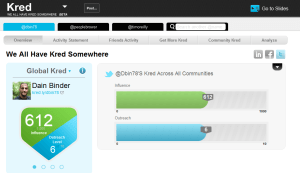
There are a number of other social ranking sites. The one which is gaining the most interest is kred.ly. At the moment Kred.ly is limited to analyzing people’s Twitter feeds only. However, Kred.ly may become very useful as it’s linked into a website called peoplebrowsr. Peoplebrowsr aims to give marketers and communicators access to influencers. The idea goes that you’d be able to identify people who are specialized in a certain topic and then pay them to promote your company or service. I’d love to hear from anyone who has used kred.ly and peoplebrowsr, especially in the Middle East.

Screenshot from social media analytics site kred.ly for blogger Dain Binder

So let’s give an example of what I’d be looking to do if I was working in tech. First thing would be to identify people with a big enough audience and enough credibility to influence others. One such user may be a prolific twitter user and the founder of saudimac.com Khaled Abdulrahman. Tweeting with the handle @khaled Khaled has over 13,000 followers and regularly updates his web site.

http://twitter.com/#!/khaled/status/153421180550922241

Khaled is a great example of an influence as he uses multiple sites to engage with an audience.

The challenge I have now is how to work with or influence Khaled. Traditional marketing would have meant paying the influencer. This is common for celebrity social media endorsements. However, this doesn’t always have to be the case with bloggers and topic specialists. Many may be willing to support you if they believe in the cause that you are promoting or if the content you give them is relevant or interesting.

The beauty of Klout, kred.ly and other tools is that they’re either free or fairly cheap to use. So when you’re next looking for people to help you communicate to an intended audience you’ve got no excuse for not finding the right influencers on the world wide web.

Google, Blackberry and Apple, where’s the Arab content?

I had the chance to sit with some very switched on and influential telecoms executives twice this week. While the first was a shin-dig for the most widely respected telecoms awards ceremony in the Middle East, CommsMEA, the other was a tea and dinner with a number of senior people from Saudi Arabia.

I love to sit down for a tea or a coffee. You hear more over a cup of warm water and a tea bag than you will ever do in an all-day meeting. The one thing that the executives were discussed was a content portal. One in particular was fed up. He told me, Blackberry and Google move too slow. All Google wants to do is sell Adwords rather than provide our country and region with a portal to sell applications.

Let me tell you a bit about apps, in case you didn’t know. Those programs that you can download to your smartphone are big business. The global leader by a mile, Apple has sold or given to iPhone owners 18 billion apps through its online store. Apple today offers over half a million apps to customers worldwide. Well, anywhere apart from the Middle East that is.

The problem for most of us consumers in this region is that we cannot pay for content online for our smartphones. Why? Because our credit and debit cards aren’t accepted by these online gateways. While consumers with a US or Europe-based credit card and address can choose from millions of songs, apps, and videos, those less fortunate souls in nearly all of the Gulf can only access free-to-download programs (the one exception is the UAE where Apple launched an online content store for local credit and debit card holders in August of this year).

What annoys telcos so much is that they’ve deployed state-of-the-art data networks based on LTE technology. In other words, they’re ready and waiting to see consumers download hundred of megabytes of data a day. Data is the next big cash cow for mobile carriers in the Middle East. So it’s annoying to see yourself all ready to go out and having no ride to get there.

But while Apple rules the roost when it comes to content, where’s Google and Blackberry? Everyone I know in this region has a Blackberry device, and yet the only application people seem to use is Blackberry Messenger or BBM for short. Similarly, Google’s Android mobile phone operating system is winning fans from across the region. So why aren’t they willing to beat Apple at its own game and roll out content stores for the region?

It’s getting to the point of desperation when operators have to develop their own online content and app store. But if that’s what it’ll take to get Google, Apple and Blackberry moving then so be it. Similarly, the more apps we shift in this region, the more content we’re actually going to get in Arabic (there’s always been a issue in the Middle East with the lack of Arabic-language applications for smartphones). The more content we have in Arabic, the more apps the operators and content owners will sell. It’s simple logic, and it’ll make lots of money. So what are you waiting for Google, Blackberry, and Apple. Where’s the Arabic content.

The only thing I’d like to know is whatever happened to Microsoft?

PS Claire good to see you at the CommsMEA event. Did you ever hire that comms director?