What a powerful picture and story. Just have a look at the below. Thanks to the boys at @wildpeeta for this.


What a powerful picture and story. Just have a look at the below. Thanks to the boys at @wildpeeta for this.
A storm was kicked up by a remarkable story about a Toyota Land Cruiser that apparently malfunctioned when on cruise control. I wrote briefly about the story a couple of weeks back, but to sum up the incident (you can find the original story here in Al Hayat newspaper in Arabic here) a Toyota Land Cruiser was stuck in cruise control at a speed of 210 kilometers per hour. The car was stopped by police who shot a number of live bullet rounds at the vehicle. Luckily no one was harmed, but the story rapidly went viral on social media and #ToyotaCruiseFailSa was a top trending hashtag in Saudi for days.
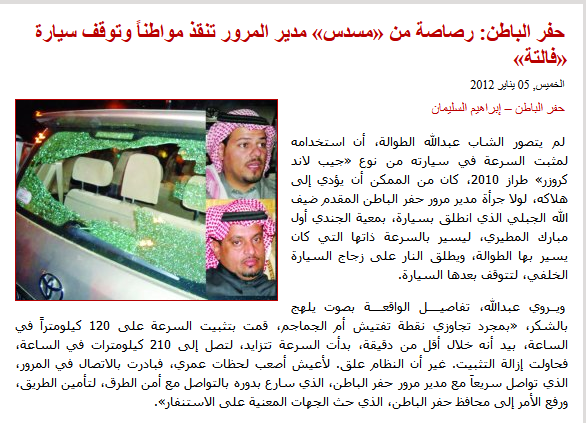
Toyota’s distributor Abdul Latif Jameel has crafted a sterling reputation as one of, if not, the best provider of automotive service in the Kingdom. Following the media reports of what happened in Hafr Al-Batin the company apparently tested the car along with several governmental bodies.
To cut the story short, Abdul Latif Jameel arranged a press conference to explain its findings and response to the incident. The seriousness of the incident and its brand implications was underlined by Abdul Latif Jameel’s decision to hold the event on a Friday, the weekend over here in the Kingdom.
After a series of tests on the car and what was Abdul Latif Jameel’s explanation? Hafar Al-Batin incident a deliberate act by car owner: Expert committee (byline from the follow day’s Arab News which can be read here).
In summary, Abdul Latif Jameel came out fighting. It claimed that:
• the cruise control system in the Toyota Land Cruiser is flawless and working in the proper manner
• not a single incident of cruise control system defects had been reported from any Toyota vehicles sold in Saudi Arabia
• the company will never allow a flaw to go unreported
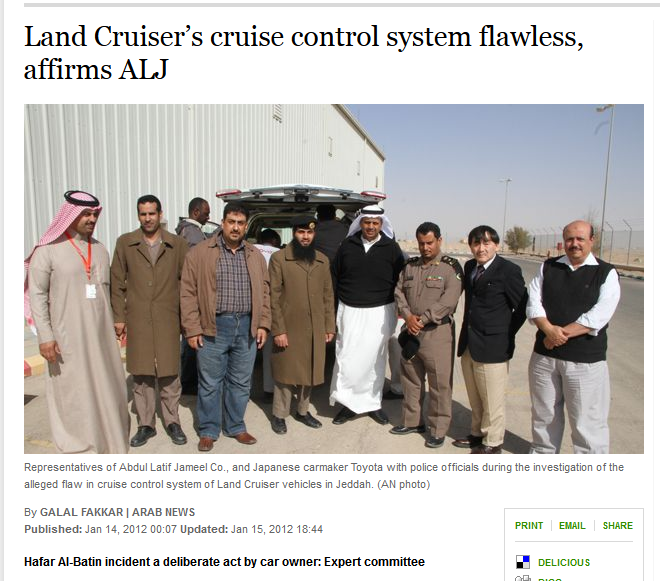
To paraphrase from the article, Abdul Latif Jameel laid the blame for the incident solely on the car’s owner.
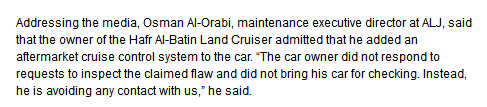
I’m not going to jump in and get into the nitty gritty of car mechanics, but would anyone be surprised if a customer didn’t respond after having a near-death experience with your product? What concerned me was that the Saudi media didn’t reach out to the car’s owner to verify what Abdul Latif Jameel’s executives had said. Instead, they reported one side and not the other.
The above is pretty much a bog standard response from firms based in Saudi, to deny there’s a problem or that if something has happened that it is their problem. Would I want to buy a product from a company that shoves the blame onto the product owner? That doesn’t apologize, even if it isn’t their fault?
I had the pleasure to meet with Colin Hensley, Former General Manager of Corporate Affairs & Planning, Toyota Motor Europe, Belgium, at the Saudi Brand and Communications Forum last year. Toyota was put through the ringers in 2010 for all of their recalls. Then the largest car manufacturer in the world, Toyota recalled over 7.5 million cars. Colin told me how Toyota had learned valuable lessons from the incidents and was now putting those lessons into practice. I would have hoped that Toyota would have shared those lessons with Abdul Latif Jameel.
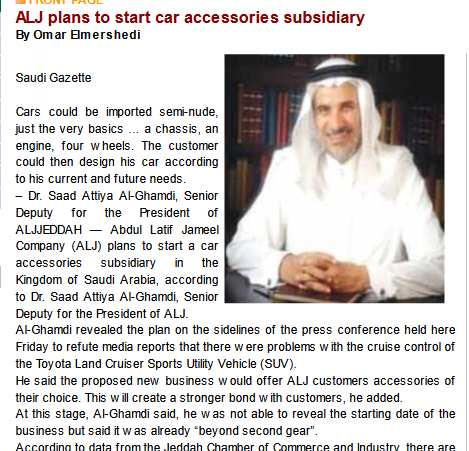
One day after the Abdul Latif Jameel press conference the distributor puts out another news story. Abdul Latif Jameel plans to start car accessories subsidiary. I’m not making this up unfortunately. Let’s hope someone sees the funny side of this, as I don’t.
Most of us act pretty sensibly all of the time. We know the limits and we tend not to cross them. An advertising creative exec should know the red lines better than anyone. Their job often involves the use of humor while at other times they will intend to shock consumers to attract their attention. Many of us will know of campaigns launched by Benetton which aim to cause offense. When such adverts are released they’re often pulled very quickly due to a wrap on the wrists both by consumers as well as national advertising watchdogs such as the Advertising Standards Authority.
I and countless others watched on over the past two weeks as one Dubai-based gym launched a series of adverts online via its Facebook site. While it was obvious that the adverts were designed to be controversial the use of an image of Auschwitz and the tagline kiss your calories goodbye was a step too far for many people.

In what seems to then have been a concerted PR campaign the Dubai-based Circuit Factory reached out to a number of media outlets in the country to apologize for the advert. The gym’s owner has explained that he didn’t see the advert, that the designer behind the advert was fired (strangely this person isn’t named and shamed), and that a donation of 3,900 Dirhams would be made to a Holocaust-related charity. The first and best article which was featured in The National can be found here.
The one point which wasn’t picked up by the journalists covering this story was the perception of the Holocaust in the Middle East. Most of those covering the Circuit Factory debacle were European writers, who in my own view have a different view to the importance of the Holocaust as opposed to most natives of the Middle East. Here the Holocaust is viewed through the prism of the Palestinian issue, and it could be argued that there is less sympathy towards the victims of the Holocaust due to the antipathy felt towards Israel by Arabs.
Whether this featured in the thinking behind the Circuit Factory’s advertising or not, the question that one has to ask is why is there no advertising watchdog in the UAE, or any other country in the region? I would have assumed that the Gulf’s various ministries of information and culture would oversee the advertising industry. But despite the obvious thought there seems to be little desire to introduce such a concept in the Gulf (there are exceptions such as Dubai’s real estate watchdog vetting foreign real estate advertising in the Emirate but these are the exception rather than the norm).
Certainly, the Holocaust advert would have been pulled in the UK by the advertising watchdog. The Circuit Factory would also have been censured and could have been fined a hefty amount. Would firms think twice about releasing shock advertising if they’d be wrapped over the wrists? I’d hope so. The initial apology was released via Twitter.
https://twitter.com/#!/CircuitFactory/status/154164519931887617
The Circult Factory has certainly benefited from the free publicity. The Auschwitz advertising coverage has gone global and the owner has admitted that the demand generated by the publicity has been remarkable.
In contrast the price paid for this coverage has been virtually nil. The donation made by the gym’s owner wouldn’t even cover an advert equivalent to the space taken by a single story published in The National. I’m being cynical here, but I very much doubt that this advert was put out without awareness of the PR buzz that would be generated. I hope I’m wrong, but having worked in comms and media for so long nothing surprises me.
For more fun images from The Circuit Factory’s owner have a look here (yes, we’re giving more free PR for the company but they’re interesting to look at to get a view of why I feel this wasn’t just a mistake). And why not throw in a second classy image while we’re at it, from the Vietnam War.

A couple of recent events, both personal as well as public, have highlighted the challenges facing brands when it comes to franchises and customer service. Social media has given consumers the ability to interact directly with brands in ways which were never before possible. Today’s consumers expect a response from brands’ social media feeds, be it on Twitter or Facebook.
So what do brands do when they’re not in full control? How do brand communication teams deal with a consumer who is angry at a franchise? It’s an interesting question, especially for us consumers and comms professionals here in the Middle East.
A number of high profile examples have brought to light the limited scope for communications between consumers here in the Middle East and brands from locations outside of this region. The best case study would be the #noshaya Twitter-led campaign against the Kuwaiti-based retailer M.H. AlShaya. The call to boycott the company’s stores back in December was a response to AlShaya’s decision to stop providing cash refunds to customers throughout its stores.
AlShaya owns tens of franchises across the Gulf, including Top Shop, BHS, and H&M. It’s by far the largest retailer in the Middle East and thousands of Saudi consumers took to social media to vent their anger at AlShaya’s decision (for the full reasons behind the boycott please see this previous blog post).
After only a couple of hours of the campaign going live online activists started messaging the retail brands directly.
https://twitter.com/#!/hindkz/status/143315760419323904
https://twitter.com/#!/Maialshareef/status/143021336778903553
Activists sent hundreds of messages to the official Twitter accounts of retailers who had franchise agreements with M.H.AlShaya. While I may be wrong (and I hope I am) I didn’t see a single response from these retailers. These retailers weren’t helped by promoting their own refund policies on their websites, most of which were much more generous that AlShaya and included cash refunds on returned products – the activists’ key demand.
Another consumer-led campaign which hit the headlines this week relates to a nightmare incident in Saudi involving a Toyota Landcruiser which was stuck in cruise control at a speed of 210 kilometers per hour. For those Arabic readers out there check out this harrowing news piece from Al-Hayat newspaper. #ToyotaCruiseFailSa has been a top trending hashtag in Saudi for the past two days.
Out of all the car brands in Saudi Toyota probably has the best reputation for reliability and customer care. Does Toyota rely on its distributor Abdul Lateef Jameel to step in a repair the public relations damage done (so far, there’s been little word from the distributor) or do they step in themselves to reassure Saudi drivers? The response of one Toyota Landcruiser owner is typical of those trending the topic on Twitter.
https://twitter.com/#!/m_alshwaier/statuses/155276831241666560
The Arabic translates as, “I haven’t used the cruise control since buying the car because of this story.”
To ask again, when do brands step in to protect their brand value? How or what do they agree with their franchise and distributor partners as to who is responsible for what? Social media has changed the communications sector in ways that few could have envisaged. One short but interesting article online has found that consumers who contact the brand via social media are much more likely to expect a response to their queries. Check out The State of Social Marketing 2011 – 2012 by Brian Solis
I wonder how many of us in communications are taking note of what is happening around us before the same thing happens to the brands that we are entrusted with?
SNL mocking Saudi study about women drivers (with Arabic subtitles) There’s always more than one way to say anything. This isn’t communications advice, but rather common sense pure and simple. There was nothing unusual in terms of the gist of a report on the effects of Saudi women driving which was handed to the Kingdom’s Shoura legislative Council. The document, written by Saudi academic Dr Kamal Subhi, basically said that women shouldn’t be allowed to drive (a basic document of what purports to be the report can be found here).
What unfortunately made headlines was the reasoning for Dr Subhi’s conclusions. Rather than rolling out the traditional lines of culture, of traffic congestion, or of legislative and practical difficulties, Dr Subhi was much more imaginative in his language.
To quote from the Associated Press:
The report by Kamal Subhi claims that allowing women to drive will threaten the country’s traditions of virgin brides, he said. The suggestion is that driving will allow greater mixing of genders and could promote sex.
Continuing the story, the UK’s Telegraph newspaper reported:
[The report] warned that allowing women to drive would “provoke a surge in prostitution, pornography, homosexuality and divorce”.
Within 10 years of the ban being lifted, it claimed, there would be “no more virgins” in the Islamic kingdom.
It pointed out that “moral decline” could already be seen in those other Muslim countries in which women are allowed to drive.
In the report Prof Subhi described sitting in a coffee shop in an unnamed Arab state where “all the women were looking at me”.
“One made a gesture that made it clear that she was available,” he said. “This is what happens when women are allowed to drive.”
The news report spread across the internet. Comments poured in online and through social media. Twitter users posted their own views using the hashtag #drkamalstudy. The news story even made its way onto US television, with Saturday Night Live including it in their material (watch the video below).
There’s no doubt that there are many in Saudi who are against women driving. However, today’s local news goes global in an instant. It goes without saying to me that the comments attributed to the report and to Dr Subhi do not do any good to the image of the Kingdom or its women.
The same point could have been made, but with language that was banal, boring, and staid. Unless you really believe that women driving will mean more divorces, extra-marital sex, and looser morals. With more and more attention being paid globally to local media, thanks to digital and social tools, there’s no such thing as a local story that will stay local. It’s often the case that people would double-speak, ie say one thing to one audience and pass off another message to a different audience (Yasir Arafat was known for his double speak in Arabic and English). You cannot do this today. Someone will always relay your message, translate it and then distribute to and through their own networks.
Prominent Saudi blogger Eman Al Nafjan wrote a piece on this issue for the English newspaper The Guardian.Saturday Night Live mocking Saudi study about women drivers (with Arabic subtitles) As envisioned, Dr Subhi blamed the Western media for twisting his message. To quote Eman:
“In this statement he writes that he knows the west, and his study follows international scientific standards no one can refute. He claims that he is so greatly respected by his western counterparts that they offered him citizenship. The problem with the international press report, he says, is that it was commissioned by a Saudi hater who used a miserable reporter to write a piece that unfairly summed up his 16-page paper into half a page.”
I’m a huge fan of the Kingdom, its people and cultures following the years I and my family lived there. While I may not agree with everything that the country’s government does I still have to respect the laws of the land. However, no one can defend the indefensible. And the reasoning and language used in this report just makes me cringe. It’s not what Saudi Arabia should be making the headlines for.
The past year has been one of transformation across the Middle East. What has happened on the ground has been mirrored online. Today fewer people out there across the Arab world would deny that the internet will make a difference.
The Arab Spring as it has been labeled by the media has affected the way that consumers interact with brands and their products/services. Arab consumers, particularly young consumers, are much more willing to voice their frustrations and concerns online. If pushed, they will also take on brands and coordinate their actions with others online in what could be dubbed concerted campaign-like actions.
We’ve seen a number of examples of consumer-led action in 2011. There’s been the widely publicized #Qtelfail campaign which highlighted how unhappy both foreigners and Qataris were with Qatar’s government-owned telecommunications firm Qtel. Then there was the #VodafoneShokran hashtag which was used by Egyptians to criticize the global telco for its decision to turn off its network during the Egyptian uprising.
Even Saudis have gotten into the habit of getting online to flex their consumer muscle. On July 3 the largest dairy producer in the Middle East Almarai raised the price of a two-liter bottle of fresh milk from seven to eight Saudi Riyals and reduced the size of its one Saudi Riyal laban from 200ml to 180ml. The company had justified the price hikes by pointing to increasing costs for raw materials, packaging and higher wages.
Saudi consumers went online to protest at the price rises. Those on Twitter used the hash tags #mara3i, #StopMara3i to voice their concerns, noting that other diary companies had not raised their prices. A Facebook page calling for a Gulf-wide boycott also attracted hundreds of followers.
Boycott-related images posted on Twitter internet included a photo of Almarai-branded laban bottles in a store overlaid with text reading “Let it rot.” Another picture, from a Saudi Twitter user, featured a bottle of Almarai laban with the caption “Go to Hell My Friend – Saudi Citizens.”
“Usually, companies raise their prices if it suffers losses,” said statement written on a Facebook page set up to boycott Almari’s products. “Well, this is absolutely not the case for Almarai, one of the biggest Saudi companies in terms of revenue. Why does it want to raise profits? Is it willing to form an economic empire at the expense of the crushed citizen?”
Egyptian newspaper Al-Ahram published a few of the thousands of comments published online. “They exploit us by increasing prices and consumer protection doesn’t turn a hair,” Abdul Aziz Al Qobeishy said on “together to face the greedy Marai.”
Another Facebook user, Yasser El-Harbi, said “Go on people and AlMarai will remain an unforgotten lesson for vendors in different sectors.”
The outburst and consumer backlash was so pronounced that the Saudi Ministry of Commerce stepped in. The Minister himself issued a decree to force Almarai to revoke the price rises which the company duly did on the 11 July.
In a written statement Almarai defended its initial decision to raise the price of its products.
“In compliance with the resolution issued by the ministry … Almarai is taking the price of its two litre fresh milk and laban pack sizes in the kingdom of Saudi Arabia to the level that prevailed with immediate effect,” the company said on its website the day after complying with the ministry’s ruling.
“However, Almarai believes that the rationale and justification for the price increase is still valid. We will continue to work with the relevant government authorities to address this issue.”
What’s so striking about the Almarai incident is that it took less than eight days of anger to surface through sites such as Facebook, Twitter and blogs or discussion boards for the Saudi authorities to take action. Almarai is listed on the Saudi stock exchange and its founders/owners include the Saudi Royal family.
It’s even more remarkable when you consider than hardly any traditional media outlets had covered the story prior to the ministry’s decision. That the ministry took notice of the thousands of Saudi consumers who had vented their anger online is an indication of how powerful social media has become.
Contrast this to the decision by Coca Cola and Pepsi to raise the price of a can from one Riyal to one and a half Riyals several years back. Despite a consumer backlash which was led by traditional media outlets such as newspapers the Ministry of Commerce did not step in to rescind the price rise.
I feel in part that social media has become a much better barometer of consumers’ feelings than traditional media in countries like Saudi Arabi. The Almarai boycott is a simple example of this.
What Almarai also proved is how bad Saudi firms are at communications and public relations. Rather than reaching out to consumers the company acted as if it was immune to criticism. The company’s CEO talked to a business news channel, MBC Al Arabiya, rather than talking to his customers. Almarai issued statements to the Saudi stock market rather than getting people online to start a discussion with disgruntled consumers. The company failed to talk with Saudis who buy its products and was duly punished for ignoring them.
Following the boycott Almarai has set up a communications department, in part to tackle reputational management issues as well as crisis communications. However, I’m not optimistic that if Almarai does try for a second time to raise prices the company will be ready to tackle the backlash. For that to happen, the management needs to understand that they have to reach out to consumers, talk with them both online and offline, and understand their concerns. I hope I am proved wrong.
For over a month now Bahrain’s national carrier Gulf Air has been running a touching, powerful marketing campaign. Named ‘Straight From The Heart’, the campaign uses both print and multimedia to feature ordinary people who use and rely on Gulf Air, not just for their flights but also for hotels, cars and insurance. Basically, Gulf Air is saying it takes care of its customers and all of their holiday/travel needs.
The campaign is featured all over the island, on billboards and in print, at Bahrain’s cinemas and online and targets as many customer segments as possible in terms of the persons portrayed in the adverts themselves. There’s the Bahraini banker in his thob and guthra, the European male executive, the young female professional, a well-known Bahraini actor and comedian and a local footballer. In the print adverts they each describe a personal experience they’ve had with Gulf Air. It’s a powerful campaign.
There’s just one problem. You could say that Bahrain has been going through a rough patch of late. Ever since February, since protests broke out, the island has gone through a political and economic crisis. Gulf Air has not been spared. To quote from an article in today’s Sunday Times, several hundred employees have been fired from the airline for a variety of reasons.
“At Gulf Air, the national carrier, 250 employees were dismissed for posting comments about the demonstrations on their Facebook accounts and other minor signs of support for the protests. Despite repeated promises that they would be reinstated, including one by King Hamad bin Isa al-Khalifa, many have still not got their jobs back.”
As a government-controlled company it appears that Gulf Air has terminated people who objected to the government clampdown on protesters during February and March. From what I’ve been told by people at Gulf Air is that all of those who were fired were Shia Muslims (the government and the Royal Family are Sunni Muslims, while most of the protesters were Shia). Some seem to have been targeted for termination simply because they were Shia, rather than because they’d voiced their concerns about the political situation and crackdown in Bahrain. In total 250 out of a total of 2,000 ground staff were laid off.
As part of the reconciliation process initiated by King Hamad bin Isa al-Khalifa, all those who were fired due to reasons related to the protests were supposed to be rehired. Rather than being reinstated, they’ve been ignored by the airline. During a speech televised live on Bahrain TV during the first night of Eid, King Hamad promised all those who had been fired that they’d be taken back. Only after this speech did Gulf Air take action. Fifty people were reinstated, on the proviso that they could be fired at a moment’s notice without legal recourse.
Instead of reappointing the people they’ve gotten rid of, Gulf Air has apparently hired replacements. According to my sources they’re mainly Indian, Sunni Muslims who are earning half of what their Bahraini predecessors took home at the end of the month. Meanwhile the sacked employees and their families are taking legal action against Gulf Air.
The point of this blog is to talk about communications, about marketing and consumers. I’m not going to talk about the politics of what happened. However, I will ask this. In Bahrain, what’s your largest customer base? They’re probably Shia and Bahraini. The population isn’t large either – there’s less than a million Bahrainis. I’m guessing most Bahraini nationals will know someone who was fired during or after the protests.
If you’re looking to build brand equity, alienating your largest customer base by firing several hundred staff isn’t a smart idea. Running a brand building campaign based on emotional values and the tagline Straight From The Heart while all this is happening isn’t what I’d deem to be appropriate either. As always, actions speak louder than words. In the case of Gulf Air, their actions are deafening enough to lose them a good deal of customers as well as money. No advertising can undo the harm done, only common sense.
 Alex of Arabia's Blog