Is Saudi in love with or scared @*#$less by Twitter?

Does this make sense? To anyone? (credit: Arab News)

Someone tell me, what is going on in the Magic Kingdom. Today we have a wonderful piece of editorial quality in Saudi Arabia’s English-language newspaper Arab News. The piece, titled Twitter may be linked to IDs, suggests that the country’s government is studying how to link Twitter accounts to identification cards, presumably to better monitor what all those naughty people are doing on the social media site. Here’s a link to the article and a quote from the piece below (as a journalist in Saudi I’ve never heard of the IT expert, but I’d probably disagree with his comments).

Twitter users beware. The Communications and Information Technology Commission (CITC) is currently studying the possibility of linking the access to microblogging site with the personal identification of social media users, according to sources.

The move is likely to create ripples in the social media circles.

A source at the CITC described the move as a natural result of the successful implementation of CITC’s decision to add a user’s identification numbers while topping up mobile phone credit.

Twitter has changed Saudi, period. And it’s not just me saying that either. There was a wonderful piece on Twitter and Saudi Arabia by CNN’s Christiane Amanpour about how the social media site has transformed how Saudis communicate.

Even the Saudi government has got in on the Twitter act. Public figures including culture and information minister Dr. Abdul Aziz Khoja, labor minister Adel Al-Faqih, and commerce minister Dr. Tawfiq Al-Rabiah all use Twitter, as do religious figures. A number of Saudi royals are also on Twitter and merrily tweeting away. And then there’s Al-Waleed. At the end of 2011 the Rainbow Prince and number XX on Forbes’ billionaire list Prince Alwaleed bin Talal announced a $300 million investment in the website. He said at the time that: “the move demonstrates our ability to identify promising investment opportunities with high potential for global impact.”

The above article follows on from a piece earlier this year in Arab News, which I’m going to quote in its entirety and which you can read yourself here.

It is very difficult to monitor Twitter, one of the most popular social networking sites in Saudi Arabia which at the moment has more than 3 million active users, according to Abdulaziz Khoja, Saudi Minister of culture and information.

“The ministry cannot monitor everything published on Twitter,” Khoja said in a statement.

He stressed the difficulty of monitoring what everybody writes, relying on the need to raise awareness among society members regarding what they write and publish on Twitter, a local paper reported.

Nonetheless Khoja declared that the ministry is following up what is happening on Twitter with a number of government agencies.
The minister highlighted the need to raise the consciousness of the active users of social networking sites and to assist the Ministry of Culture and Information in the monitoring process.

However, Khoja refused to compare the situation of social sites with online newspapers, which have been streamlined following a recent regulation.

Khoja stressed that the control on Twitter should originate from individual values and community culture. “With time, individuals will learn to express their opinions and to deal with the events in a more understanding, knowledgeable and accommodating approach,” Khoja said.

So what’s next? Monitoring what people say/think? Good people in positions of authority, Twitter is a channel and not the source. Someone tell me, what is going on. All I hear is tweet, tweet, flip, flop, flip, flop.

How communities are turning to social media when traditional media fails them: #Thx_Tom_Collins and Bahrain

Professor Tom Collins was the subject of a public campaign on the social media site Twitter. Supporters thanked him via the hashtag #Thx_Tom_Collins for his political stance and decision to resign (credit: Irish Times)

As the Middle East’s media channels have become polarized over the past 24 to 30 months, communities who find that they have little if any representation in these traditional media channels have made social media their medium of choice when spreading and disseminating their viewpoints and opinions.

A great example from Bahrain this week was a campaign organized to thank the Professor Tom Collins, the president of the Bahrain campus of the Royal College of Surgeons in Ireland (RCSI), for his decision to resign from his post after the cancellation of a major conference on medical ethics in island. The RCSI had hoped to facilitate the event at its Bahrain campus but the key organizer Médecins Sans Frontières cancelled the event shortly before it was to be held.

Professor Collins resigned after the news of the conference’s cancellation broke. He has been roundly condemned in Bahrain’s national media for his decision which he said was done “in protest over the cancellation of the two-day event which was to examine “medical ethics and dilemmas in situations of political discord or violence.” The conference’s themes were sensitive in Bahrain following widespread arrests of medics in early 2011 at the country’s main hospital and their subsequent trials, a number of which are still ongoing.

The Twitter-based campaign was launched on Thursday 28th March at 8pm Bahrain time and was organized primarily by many of the medical community in Bahrain who were arrested over the course of the two years.Their message was clear and I’ll post some of the most popular tweets below.

What I find fascinating about the above is the role of the media during a time of crisis. For me, media such as newspapers can have a viewpoint but journalists should (theoretically) report the facts. When you’re disenfranchising such a large proportion of the population what happens to that newspaper not only during a crisis but after the crisis has passed, when agreements are made and a compromise is drawn up. With traditional media suffering globally due to a loss of public trust should editors be fighting the demand to be so overtly biased? What are your thoughts?

Understanding the Gulf’s psyche through social media (well, mainly Twitter)

What are the religious police up to now? Didn’t they learn from #Dammam-Hayaa-Closes-Dinosaur-Show? (credit: expo2020)

I’m endlessly fascinated by social media and how people interact online. For me, online interactions tend to shed light on people’s off-line personalities. In this post I hope to share my own observations about how each of the Gulf’s nationals deals and interacts online.

Let’s start with Bahrain. Bahrain possibly has the highest concentration of social media users in the Gulf. Bahrainis are very media-savvy and that shows in their effective use of social media channels. The country’s polarization following the events of February and March 2011 is evident online, with the two sides doing their utmost to ensure that their voices are heard. Bahrain has some of the most-followed Twitter users in the Gulf but they inevitably relate to the political and human rights situation on the island. There’s a lot of trolls out there as well, so be aware that if you’re going to delve into any issue relating to Bahrain you’re going to draw attention to yourself.

Emiratis are fiercely patriotic and proud of their country’s achievements over the past 41 years. Emiratis speak in unison when it comes to politics and are the most supportive nationality in terms of the country’s leadership. Unlike Saudi, Kuwait, or Bahrain you’ll find little debate on the country and its long-term direction but more insight into social issues particularly those which affect the national community. You’ll find royal family members online, members of the Federal National Council, a police chief and lots of UAE-based expats.

Kuwaitis are known for many things, including being opinionated. This is no different online. The Gulf country with the most blogs per person Kuwait is all about politics and disagreement. Kuwait’s politics is just as vibrant online as it is in the country’s parliament, and when you mix in other electrifying issues such as the Bidoon, the country’s rulers, the Arab Spring and religion you’re going to come up with an incendiary cocktail. Some of the most interesting Tweeters are Kuwaiti bloggers and parliamentarians. Just handle with care!

The Qataris are a mischievous bunch. When they’re not commenting on Qatar’s latest attempt to buy a path across the globe (what next after Marks and Spencers?) they’re making the most out of their sense of fun with raucous commentary on the latest goings on in their country. Their musings on Qtel’s attempts to rebrand itself to Ooredoo were biting, as was the boycott against the very same company for its poor customer service (is anyone in the UAE and Etisalat listening?). The Qataris are a wonderful bunch to follow. And one or two of them love their Dunkin’ Donuts coffee!

Saudis, yes you cannot avoid them online just as you cannot avoid them in the physical world. I love Saudis and I love them just as much in cyberspace. They’re open, they’re diverse and they talk about everything. Saudis are not afraid to poke fun at themselves and they’re just at home talking about social issues, politics, arrange boycotts (aka AlShaya and Al-Marai) and even debate religion. There’s some remarkable Saudis online, from preachers to royals and ministers. Saudi is one of Twitter’s fastest growing markets. And they watch more Youtube than any other country worldwide. They are officially living online. And yes, one of them owns (a bit of) Twitter.

And finally, there’s the Omanis (I’m skipping the alphabetic sequencing on this one). I’ve rarely come across Omanis on social media, possibly because I’m not close to issues that they write about or follow. Omanis are known to be kind, courteous and have a fun sense of humour. Which means I really should go and find some Omani tweeters to detox from all of the politics and debate in the rest of the region.

Saudi Bubblers and women’s scuba diving in the Kingdom

Here’s something you may not know about the Kingdom – Saudi has some of the best diving spots in the world. The Hijaz coast which borders the Red Sea offers a richness of marine wildlife that is unparallelled (the islands around Farasan are replete with dolphins, turtles and sharks). Saudi can rival or even beat neighbors like Egypt when it comes to a diving experience. But, as always, the secret is in the marketing.

I had the pleasure of talking to one person who is doing his utmost to tell everyone he meets about the beauty of Saudi Arabia’s Hijaz Coast and the wonders of diving for both expats and the country’s nationals. Nawaf Al Otaibi is one of the founders of Bubblers, a Saudi-based group that aims to give as many people as possible the chance to fall in love with diving off Saudi’s coast.

“We set up Bubblers to offer people new to the sport a simply way to get certified and also give divers the chance to get back into the water once they’ve completed their certifications. We wanted to help people dive in an organized fashion, and we focus on arranging group trips that range from one to five days in length. We also offer snorkeling to people who want to dip their toes into the water but aren’t yet sure about taking up diving. Our aim is to show to as many people as possible what the Red Sea has to offer and we’ve found that eight percent of our snorkelers sign up for a full diving course as soon as they’re out of the water and back on the boat.”

Bubblers is the first Saudi-based scuba diving community that bills itself as multinational – the group has a Facebook presence and just under two hundred members to date. And Bubblers aims to please all. “We have a diverse group of divers, including Saudis. We’re finding that more and more Saudis are joining us on our trips. Over the past two months, Bubblers has arranged four trips, each with a maximum of twenty people. The ages have ranged from 11 up to 72 years. We take care of everything, from A to Z, even including flights from Riyadh, food and other transportation needs. We’re also finding that women are taking up the sport. They can dive fully hooded and covered, and we welcome then on board our trips.”

No matter how good you are, if you’re a newbie or you already have fish gills, Bubblers can take care of you through a host of diving courses and training, including the basic open water diver developed by the Professional Association of Diving Instructors, as well as the advanced open water diver, master scuba diver and dive master certification.

And on the issue of women diving in the Kingdom, you may be surprised. Scuba diving can be done in my favorite piece of clothing, the burkini, and a recent article in English-language newspaper Arab News focused on demands from Saudi women for female-only diving areas. I’ve pull a quick quote from the article, which highlights the obstacles women face when diving in the Kingdom.

An increasing number of women scuba divers want designated areas to dive in the Red Sea to avoid the obstacles they face when trying to obtain a permit for a diving trip.

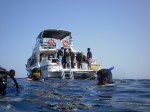
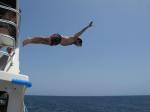
Just to whet your appetite have a look at these pictures from Bubblers divers, including the talented photographer Mr. Vincent Al Hawary.

If your interest has been piqued then call Nawaf on and start planning for an unforgettable experience. His details and details for the rest of the group’s founders can be found in this handy pdf brochure made by the team at Bubblers (please do click on the link below). Of course, you won’t need me to tell you that you will need Adobe Acrobat or a pdf viewer to open.

Bubblers Profile

Social media brand hijacking – Emirates and Etihad fakes and lessons for a corporate online presence

A story broke at the beginning of the month about a couple of campaigns out there in the social media universe. Both piggybacked on two of the UAE’s most established brands. Essentially, the two campaigns offered those who followed the chance to win free flights with Emirates Airline and Etihad Airways.

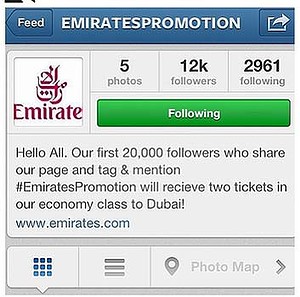
According to the UAE’s English-language newspaper The National which broke the story here in the UAE, the promotion launched on the picture-sharing site Instagram and stated that the first 20,000 people who would follow each account and would share the respective campaigns with a specific hashtag would receive free tickets for themselves plus one to Dubai or Abu Dhabi. The Emirates Instagram account was named EMIRATESPROMOTION while the Etihad campaign ran under the hashtag #EtihadPromotion.

The branding is there, the name may be dodgy, but there's no official Emirates account. So why not believe it?

The branding is there, the name may be dodgy, but there’s no official Emirates account. So why not believe it?

Too good to be true you may think, and the campaigns were fake. That didn’t stop 10,000 people following the fake Emirates account which featured the company’s logo and photos skinned from the company’s website. I don’t know how long the fake competitions were up and running for, but both Emirates and Etihad put out statements warning people not to fall for the fake campaigns. The Emirates statement is below.

To all our fans, Emirates has three official social media channels which are:

http://www.facebook.com/emirates
http://www.google.com/+Emirates
http://www.youtube.com/Emirates

When we launch competitions or new social media channels, you will be the first to know via our Facebook, G+ or YouTube channels and on emirates.com.

Thank you for your continued support
Emirates”

Emirates also sent a statement to the Australian website The Vine stating that “Emirates Airline does not have an official Instagram account. Any Emirates-related accounts or promotions on Instagram do not belong to us.”

Similarly, Etihad wrote on its Twitter account that “Etihad Airways has no association with any accounts or promotions (such as #EtihadPromotion) competition currently running on Instagram as we don’t have an official Instagram account yet. Thanks for checking.”

How does this concept sound to you? There’s lots of random people out there on social media, and scams and the internet aren’t mutually exclusive. So why do brands focus on some social media channels and not others? For example, both Emirates and Etihad don’t have Instagram accounts. Emirates doesn’t even have a Twitter account. Wouldn’t it be best for a brand simply to park their presence on the major social media channels (no one can do everything on social media, there’s simply too many channels and sites out there).

And this point may be even more relevant albeit off on a tangent for Emirates, which spends several hundred million dollars on sports marketing (the most recent announcement being the tie-up with Formula One). Isn’t the airline missing out through not focusing on social media? Imagine how much Emirates could achieve in brand positioning and amplifying that sports marketing spend by promoting itself through social media. As I’ve said before, technology is a wonderful leveler. It’d seem a waste not to wring every single penny in return on investment from those mega-bucks sports sponsorships.

So next time you see a promotion which is too good to be true just send a Facebook message to the airlines and ask them if they’ve gotten round in Instagram (or Twitter in Emirates’ case). And, as they say in France bon chance!

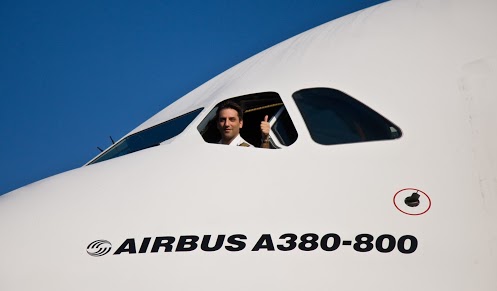
This gentleman clearly feels Emirates would benefit from more social media presence. Do you?

This gentleman clearly feels Emirates would benefit from more social media presence. Do you?

Dubizzle and shifting buying habits online for the UAE’s automotive sector

When it comes to online shopping, you should pity us poor souls in the Gulf and the wider Middle East. There’s no Amazon and no eBay. We’ve only had our own iTunes store for a couple of months (Apple officially launched its UAE iTunes store in December of 2012). When we refer to online and shopping in the Gulf, what we really mean is messaging our friends on BBM or Whatsapp while roaming the nearest/biggest mall in town.

There are some brave souls who are trying to make a difference and fight the good fight. One of my favorite sites is Dubizzle, which specializes in online classified advertising across 13 countries in the Middle East and North Africa region. Basically put, whatever you need, you’ll find it being sold on Dubizzle.

And now comes the fun part. I wouldn’t have thought that people in this region would take to the internet to buy cars, but after receiving a number of stats from Dubizzle’s very friendly marketing manager I’ve been proved completely wrong. Have a look at the below Infographic and then tell me why we don’t have more e-commerce companies operating in this region.

You think people don't buy cars online? Have a look at this, and think again.

You think people don’t buy cars online? Have a look at this, and think again.

How to avoid the speed cameras in Saudi with Twitter

If you're looking for a way to beat the Saudi speed traps look no further than Twitter!

If you’re looking for a way to beat the Saudi speed traps look no further than Twitter!

Saudis are ingenious. And they don’t like to be told what to do. When you combine the two the results are imaginative to say the least. I’m late to the game on this one but I was intrigued when a family member showed me the latest attempt to beat Saher, the country’s traffic cameras which have been fining speeding Saudi drivers ever since they were installed back in 2010.

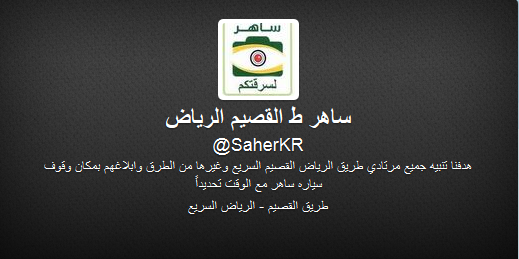
The friend opened up his phone, went to his Twitter feed and clicked through on to one Twitter account, named @SaherKR. This feed can be used by followers to alert their fellow Formula One drivers of any mobile or fixed Saher cameras, checkpoints, or any other inconveniences on the road between Riyadh and Qasim. One example is below.

https://twitter.com/SaherKR/status/297708381358137344

There’s dozens of these accounts today in Saudi. My favourite is @Saher_khj which is followed by 10,000 Twitterers and gives all the details needed to avoid speed traps including the exact area of the camera, the speed limit and the time of day the user has passed by the camera.

I am left asking myself however how these people have the time to write a 140 character message while most likely doing 150 kilometers an hour in their Toyota Camrys or Hyundai Accords. Maybe that’s why their driving is so erratic as they’re shuffling their fingers across their iPhones whilst attempting to steer the car?

This isn’t the first time that the Saudis have used technology to overcome pesky government interference. The first widely reported solution was a mobile phone application called Trapster which alerted drivers via their iPhones of speed cameras in the vicinity. The application proved so popular that mobile phone shops were charging customers over $100 dollars to install on the iPhone. The application itself was free (if you don’t believe me, it’s printed in the media so it must be true).

And the fun part of this detective work? The family member who showed me all of these Tweets works as a senior manager in the Saudi Interior Ministry and is responsible for road safety. Boys, they know who you are and where you are! Ticketing by Twitter? Sounds good to me!

Fifty Three Million and Counting – Facebook’s hold on the Middle East

Based on the latest statistics shared at the Studio Edge event Facebook is the one network to rule them all (unless you’re a keen bird watcher that is)

Facebook came to town last week, and they brought lots of numbers with them. I was lucky enough to be invited along to the first Studio Edge event in the Middle East region. And I was astounded by the numbers that the team kept on rolling out. I’ve summarized these numbers below for you.

According to Facebook’s own research there are fifty three million active Facebook users in the region who use the service at least once a month. Egypt is Facebook’s largest market, followed by Saudi Arabia and then the United Arab Emirates.

Fifty two percent of Facebooks users access the site solely through their desktops and laptops; thirty eight percent use both mobile phones and computers, and ten percent only use their mobiles updating their profile and other Facebook activities. Twenty million people in the Middle East and North Africa are using Facebook today through their smart phones.

The average age of Facebook users in the region is 27 years and 64 percent of MENA users are male. That’s in contrast to the global split of male to female users which is currently 50/50. MENA Facebookers spend approximately seven hours on Facebook a month (that’s double the global average). And fifty two percent of Facebookers in the UAE use Facebook whilst watching television.

Middle East Facebook users like 84 pages compared to the global average of 51, and they view approximately 550 pages a month. Over forty percent of their time is spent on the news feed section of Facebook.

And to top off all of that, Facebook’s user base is growing in excess of 20 percent in the region.

With all of this information above, I’m hoping that we’re going to see more businesses online using the site. But if there was ever any doubt that Facebook is a first-tier consumer communications channel then please do re-evaluate how you use the network and start using the site properly.

One other interesting observation from the Facebook event. Most of the attendees were from advertising and creative agencies. I only spotted one public relations company. And yet, Facebook is all about content. Shouldn’t the Middle East’s PR industry be getting in on the act and promoting the quality of its social media services more?

Photo a pizza while on the move? 800Pizza’s Facebook Faux-Pas

It’s probably not a good idea to ask someone to take a picture while they’re driving. Taking this a step further, it’s probably even less of a good idea to spread that message via a social media platform such as Facebook. But that’s what one pizza company in Dubai did on Monday of last week.

Someone at 800Pizza (great name by the way) thought it’d be a good idea to ask its Facebook followers to take pictures of the company’s delivery drivers whilst on the road. Needless to say, apart from being illegal and downright dangerous the concept backfired and earned the chain a telling off both from a UAE-based road safety group as well as local newspaper 7Days. The article is a great read so do check it out here.

What did it for me (and made me write this) was the comment made by the founder of the firm to the newspaper, which I will quote verbatim below.

When contacted by 7DAYS, Alessandro D’ubaldo, founder of 800 PIZZA said: “I think this has been a bit of a misunderstanding and negative reaction.” Commenting on the edited post, the restaurant owner added: “We even changed the post and someone said ‘that’s just amending the wording, why don’t you remove the whole post?’

“But I don’t understand why they’re so upset – what is all this hate about?” D’ubaldo clarified: “We didn’t mean to tell people to go around and take photos with one hand while you drive with the other hand.”

D’ubaldo also said that he didn’t think the delivery bike drivers were aware of the campaign, adding: “They don’t need to be aware, it’s OK for people to just take pictures around in a public place.”

I’m thinking of launching a campaign to ask certain people to stay off social media. And it really would be for their own good.

You may strain to read this, but anyone encouraging drivers or passengers to take pictures while driving should be prepared for an online backlash

PS thanks Mita Srinivasan for pointing this piece out to me.

Are Saudis the most open nation in the Gulf?

Saudi Arabia’s society is changing at a much faster rate than many of its neighbours

Hands up all those people who’ve heard of or been to the cosmopolitan Dubai. I’m sure that you’ll know about Qatar, the country that has made a name for itself by investing all over Europe and for winning the 2022 World Cup. And there’s Kuwait, probably best known for its role in the first and second Gulf wars. One of the most beautiful countries I’ve ever visited, one could say that Oman unfortunately isn’t as well known abroad as it should be.

And then there’s Saudi Arabia, a mysterious land which up until recently was spoken of in Chinese whispers. The Magic Kingdom was a country that was known for oil, religious and cultural conservatism. Despite the spread of the internet and the ensuing countless videos and other types of multimedia information hosted online Saudi Arabia is still an unknown to most people.

The country’s reputation, image and visa regime doesn’t help to educate foreigners, but I’ve been struck recently on a number of occasions how open today’s Saudis are. This is especially true of the younger generation. Many of the Saudis I know who are under the age of 40 will talk about anything and everything, especially in a closed environment. They’re knowledgeable, they’ll know much more about the workings of the country and national government than is written about or published in the news. And they’re not afraid to be blunt about what is right and what is wrong when it comes to public policy.

Having lived in Saudi for a fair few years I’ve always been fascinated by how Saudis are becoming ever more open to sharing their views with people they know and trust, especially in the setting of the Majlis where the men traditionally gather in the evening to discuss both personal and business issues.

The difference in openness between Saudis and other GCC nationals is becoming ever more noticeable. While traditionally the most open society in the Gulf, Bahrain has been transformed due to the events of the past two years. Both Qataris and Emiratis are very welcoming, but they’re less inclined than Saudis to talk at length with foreigners on the issues that are shaping their respective countries.

And then there’s the Kuwaitis, who are probably definitely the most outspoken people in the Gulf. But for me, today’s Saudis are more open because many will acknowledge both the positives and negatives of their country.

I’m not suggesting that the country is a bastion of diverse views which are aired in public by all and sundry. There are still many subjects that are taboo, but many barriers have been broken over the past two years partly thanks to the widespread adoption of social media by many young Saudis. Just think of any controversial topic in the Gulf, and you’re going to find it being discussed in Saudi by bloggers, on Twitter and Facebook.

Looking forward, I can only hope that this openness will be a blessing to the Kingdom as it looks to tackle issues such as unemployment, the changing role of women in the society, graft and governance. These subjects will be better dealt with if there’s an open dialogue between the country’s nationals. As always, I’m optimistic about where Saudi Arabia is headed and would like to hear if you agree with me or not about my thoughts.