The UAE, Egypt and the dangers of an open bias among media

How can a journalist consider him or herself a professional after openly declaring a media bias? (image source: http://www.thepoliticalcarnival.net)

There’s few proverbs which would sum up today’s Middle East more than “may you live in interesting times”. Unfortunately as we are discovering over and over again, that Chinese proverb is not a blessing but rather a curse. When I look at Egypt over the past couple of weeks I would have thought I was watching a Ramadan-season tragi-comedy rather than real life events. The situation is desperate; the sense of hurt and anger is palpable on all sides of what is now a conflict between two opposing forces.

Generally speaking, the media in Egypt is also becoming more polarized. Most media outlets in the region are owned either directly or indirectly by the government or by groups and individuals with a specific agenda. Even those media who don’t have a particular bias still have to self-censor for fear of crossing a red line. However, it’s rare for a (supposed) journalist or media group to come out and openly show a bias.

Two incidents made the headlines this week in the UAE. The first, and the most brazen, was an announcement of a one million Egyptian pound (US$143,000) bounty for information leading to the capture of three Muslim Brotherhood leaders in Egypt. The pledge was made by an Emirati columnist named Hamad Al Mazroui through Twitter (Hamad has been called a journalist but he write columns rather than factual reporting).

This bizarre event was followed by a statement published by the UAE Writers Association in which it stated that “it is against the attempts of the Brotherhood to manipulate the tolerant image of Egypt and moderation.” The statement, which was first published on the country’s national newswire, reiterated the UAE Writers Association’s support for the Egyptian Writers Union, which has listed the Brotherhood in the terrorism list. The Association also commended the UAE’s unwavering support to Egypt.

I have few illusions about national media being influenced by their respective governments’ policies. However, the aim of journalists should be to report the facts and then provide analysis. Research by Gallup has shown that public trust in the media is highest when the media shows no bias; the opposite is true when there is an open bias.

Do such actions help to resolve the situation in another country? Do they help us to understand what is happening on the ground? And do they promote a sense of trust in media outlets here when reporting or commenting on the situation in Egypt? Journalism comes with responsibilities to report and analyse in a manner that is balanced and removed from prejudice. Let’s have more of this please, and less of an no open bias.

How is the Middle East’s marketing industry dealing with the digital question?

Are marketing executives in the Middle East ready and willing for the digital era? (image source: http://www.219group.com)

One of my favourite reads on marketing in the Middle East is a monthly publication called Gulf Marketing Review. This month’s edition included the title’s inaugural value exchange survey for the region. The survey, which is conducted by da Vinci Marketing, reached out to marketing executives across the region to better understand what is happening on a brand management level.

The report, which was included face-to-face interviews with a host of marketing executives from leading brands, outlines a number of trends across the marketing strata in the region:

1) All digital – there’s more marketing focus online but marketing executives are demanding more information to better understand the benefits of digital solutions/technologies.

2) Increased specialization – clients are increasingly moving towards ‘niche’ agencies who have specific skills sets.

3) Social, mobile and content – questions remain about who manages social media (i.e. is social media handled in-house on the client side or by the client’s agency), and the importance of search and mobile to marketing teams across the region.

You can download the da Vinci’s inaugural Value Exchange Study in GMR through this link. And if you’re based in the Middle East it’s well worth buying a hard copy of this issue’s magazine. The insights are fascinating.

A Digital Journalism Masterclass – Qatar’s Doha News and @dohanews

Let’s face it, the Gulf doesn’t win many awards for quality investigative journalism. There’s some outstanding journalists out there, but in a region where most/all of the news outlets are underfunded and owned by bodies or individuals who don’t have a media background we’re left with a lack of quality reporting.

Three people, journalists with experience of global media outlets such as the BBC, the Wall Street Journal, and Al Jazeera, took it upon themselves to take on Qatar’s media scene and create a news portal that would deliver news in real time. The result was Doha News, a news service that began its life on Twitter as @dohanews and then developed into a daily news blog.

The stated aim of Doha News is “to educate, inform, and stimulate positive change in the community.” What the three people behind the project – Shabina Khatri, Omar Chatriwala, and Tory Scott – have essentially done is to create a community site where the public can send in their content, be it images or news stories, and have that content edited and displayed for the rest of the community to see and comment upon.

Doha News hasn’t just become another news website; the portal has frequently beaten other media channels to breaking stories. Similarly, the quality and accuracy of the site’s news has been commended. No other Doha-based media outlet has covered the Villaggio Mall fire tragedy as comprehensively as Doha News. The site’s team went so far as to produce a 57-page e-book on the anniversary of the disaster which won praise for its coverage of what went wrong on the day of the Villaggio Mall fire and the ensuring events including the trial and steps taken by the Authorities and Mall owners to ensure a similar incident never happens again.

Below is a selection of items from the site including a news piece and pictures from users of the site. If you’re looking for news on Qatar or simply want to understand more about digital journalism in the Gulf Doha News is definitely worth a visit or three. Let’s hope others take up the mantle and create similar news portals for the rest of the region.

This piece is fairly typical of Doha News - a local interest story that uses social media to engage and benefit local viewers

This piece is fairly typical of Doha News – a local interest story that uses social media to engage and benefit local viewers

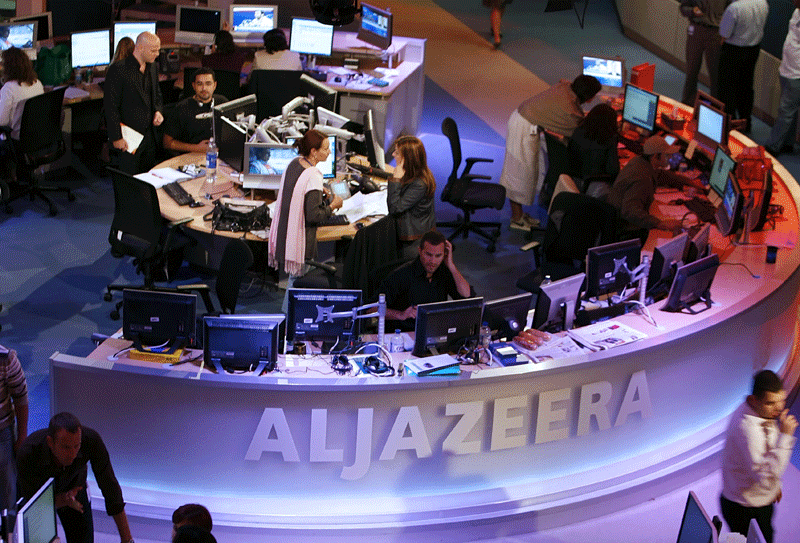
Attacks on Al-Jazeera intensify following the fall of Egypt’s Muslim Brotherhood

Al-Jazeera has come under fire for its alleged political ideology in its coverage of Egyptian news (image source: islam.ru)

Who doesn’t know Al-Jazeera? The Doha-based and Qatar-owned news broadcaster became infamous for its airing of messages from Al-Qaeda’s leaders, most notably Osama Bin Laden. The news channel, which was created in 1996 following attempts by the British Broadcasting Corporation to set up their own Arabic channel failed, has always been the target of criticism partly due to its political inclinations and its inability to criticize its owners – the State of Qatar – while running documentaries and publishing news critical of neighbouring Middle East states.

However, Al-Jazeera has been having a particularly rough time of late following recent events in Egypt. partly of its own making but what’s even more interesting is the level of coverage that other media has given to targeting Al-Jazeera following the fall of the Muslim Brotherhood’s Government in Egypt.

Ever since the events of the end of June and the start of July in Cairo it’s almost felt as if there’s been a witch-hunt against Al-Jazeera due to its Egyptian coverage. The main accusation? Al-Jazeera’s bias towards the Muslim Brotherhood.

While I understand the accusation, the fact that many of those making the claims are firstly media publications and secondly state-owned doesn’t sit well with me. I know of few state-owned media who are not guilt of being their master’s voice and hence being guilty of their own allegations against Al-Jazeera. Furthermore, I always find it strange when media attack other media; it’s hard enough being a journalist as it is today without being criticized by fellow colleagues.

I’m going to highlight a couple of articles below, from the Dubai-based and Dubai-owned Gulf News. The first and the most conspicuous news item was a special which was run on the 14th July entitled Al Jazeera loses respect over Egypt coverage. Do read over and share your views with me on this one.

Founded in 1996 and funded by Qatar, Al Jazeera was supported by many Egyptian revolutionaries. Demonstrators in Tahrir Squar chanted for it. Also, Al Jazeera staffers were feeling proud that they contributed to the Egyptian revolution with their work and coverage. They made the network the most popular channel in the country.

However, when the now ousted president Mohammad Mursi pushed through an unpopular consistution last November, many Egyptians found themselves flipping from Al Jazeera to other Egyptian networks. Distrust over its coverage reached unprecedented levels and took it from being the most popular to the most hated channel — its staff were now feeling embarrassed as their reputation was dragged through the mud.

A senior official at Al Jazeera who did not want to be named said that while the network appeared to be a neutral media network it was still a political tool in the hands of the Qatari emir. “He personally visited the studios during the Iraq war to make sure no footage of dead of abducted soldiers was aired. It was clear he was under US pressure,” the official said.

“In a special meeting in 2009 attended by some media seniors in Doha, the Emir said that Egypt’s regional role must be ended forever,” said another official. “When the Muslim Brotherhood announced it would field deputy chairman Khairat Al Shater as a candidate in the elections, the news team slotted it as the second story in the news bulletin, but then upon special request from the Emir’s palace, it was bumped up to the first news story.”

A producer claimed that when people started complaining and accusing Al Jazeera of favouring Islamists in Egypt, the station started to exclude any outspoken political analysts and opponents of the Brotherhood from appearing on its screen. On the other hand, he said, video reports that propped up Mursi and the Brotherhood’s image were welcomed by management in Doha. Anchors who used to interrupt the Muslim Brotherhood’s opponents in live interviews were judged as excellent.

The perceived bias prompted many leading journalists and TV anchors to leave the network. Aktham Suliaman, the German-based correspondent who left the station recently, told the German magazine Der Spiegel: “Before the beginning of the Arab Spring, we were a voice for change — a platform for critics and political activists throughout the region. Now, Al Jazeera has become a propaganda broadcaster.”

Another Beirut-based correspondent said that “Al Jazeera takes a clear position in every country from which it reports — not based on journalistic priorities but rather on the interests of the Foreign Ministry of Qatar. In order to maintain my integrity as a reporter, I had to quit.”

Other interesting articles from Gulf News include Al Jazeera staff resign after biased Egypt coverage, Al Jazeera’s role raises questions, and media bias infuriates Egyptian moderates which I am quoting from below.

Al Jazeera’s Egypt channel (Al Jazeera Mubasher Misr) is blatant in its support for the Brotherhood giving no platform whatsoever to the other side. Egyptian authorities attempted to remove it from air, but failed to do so because Al Jazeera allegedly hijacked broadcast vehicles from Egyptian State TV, now protected by the crowds in Rabaa Adawiya.

Local reporters were so incensed they demanded the ejection of Al Jazeera’s senior editor in Egypt from a press conference. Some 22 of Al Jazeera’s employees resigned asserting pro-Islamist bias at the top. On Friday, I was shocked to see someone I recognised on the stage in Rabaa Adawiya, engaged in whipping up the crowds.

There was the host of Al Jazeera’s programme Bela Hodod (Without Frontiers) Ahmad Mansour advising on how to manipulate media coverage and insisting that pictures of June 30 massive anti-Mursi protest had been photoshopped.

June 30’s aftermath has not only thrust the Arab world’s most populated country into uncertainty, it has eroded media credibility and prompted the crossing of a thin red line between honest reporting and political/ideological propaganda. Journalism requires an ethical revolution before Al Jazeera, CNN and others can ever be trusted again.

What I find ironic is the lack of coherency of the argument as it relates to allies. An example in point would be Bahrain. The island’s press is markedly pro-government, and yet there’s no media bias criticism from those who have pointed their finger at Al-Jazeera. If you’re going to adopt an argument at least be consistent in its use. Otherwise, why should we the public trust any of you?

Citizen journalist beware – the perils of shooting video in Dubai

Dubai’s social media was buzzing yesterday with chatter about a video uploaded to Youtube of a local apparently beating a van driver. The video, which was initially taken off Youtube and which can be viewed above, shows the national using his agal to hit the Indian driver who’d apparently clipped his four-wheel drive and who hadn’t stopped during the initial collision. Part of the incident, including the national’s car license plate were captured in the video, which was reposted several times on Youtube. According to media reports including one piece from the daily Gulf News, the issue became a police matter not due to the alleged assault itself but rather due to the video going viral and the attention that it attracted.

A video of a government official beating a van driver was posted on YouTube has generated a public outcry and urged police to take legal action, said a legal expert.
“Initially it was an ordinary assault case, yet as soon as it was posted on YouTube, it went viral on social media channels. Since then, the case became of public concern and incited public opinion — that was when Dubai Police intervened. They took the required legal action against the involved persons,” advocate Mohammad Abdullah Al Redha told Gulf News.

Sources from Dubai Public Prosecution confirmed to Gulf News that investigations started in the afternoon as soon as they received the case.

Al Redha said: “It became a case of disdain and disparagement and particularly that it’s Ramadan, the month of mercy and forgiveness. When such incidents develop into a matter of public opinion and concern, police have the right to refer the case to prosecutors. According to the Criminal Procedures Law’s article 10, the Public Prosecution [in its capacity as the legal representative of the public right] can order the police to open an official complaint against the government official even if the van driver doesn’t do so.”

The case took an interesting turn today with the news that the person who took the video, a fellow driver, was arrested. According to Gulf News, the alleged defendant’s son lodged the case citing defamation of his father and family.

Major General Al Mazeina, acting chief of Dubai Police, said the Asian man who posted the clip was arrested after the Emirati official’s son lodged a defamation complaint at Al Ghusais Police Station.

“We only arrested the man who took the video because of a complaint lodged by the family of the Emirati official,” said Major General Al Mazeina.

He said that no one had the right to take pictures or film anyone without permission and acknowledgment from the person who is pictured.

“The man who took the video was supposed to take the video to the police or to the concerned authority to report the incident and then the police for sure would take action but instead of that the man posted the video on YouTube,” said Major General Al Mazeina.

The son told police that the video had been seen by hundred of thousands of people worldwide, which had damaged the reputation of his father and the whole family.

Major General Al Mazeina said the Asian man admitted to police that he took the video and posted it on YouTube and that he also sent it to some of his friends. He said the Asian man happened to be passing by at the time the incident took place.

Under the UAE’s cybercrime laws, recording videos in public without the permission of those being filmed is illegal and constitutes defamation. Despite the uproar over the issue, it seems that the authorities may not be willing to drop the case against the person who took the video despite calls on social media to reward his decision to film and post the event online. The message is simple – don’t film anything that could be construed as negative and share it online. Or else you could be facing public charges.

The Ratner effect in Dubai: Ahmed Bin Sulayem and Jumeirah’s Lakes

He’s the boss of Jumeirah Lakes Towers but ‘he doesn’t like lakes’ (image source: arabianbusiness.com)

For those people who are old enough and who lived in the United Kingdom during the end of the Thatcher years, there’s one piece of tabloid news that always brings back memories. On 23 April 1991 the then CEO of a popular high street jewelry chain called Ratners told an audience of executives at the Institute of Directors that his products were “total crap”. Just over a year later Gerald Ratner was out of a job as consumers deserted his shops in protest at his comments.

While it’s not on the same ‘did he say that’ proportions I enjoyed reading an article last week on the UAE’s news portal Arabian Business. The publication had interviewed the executive chairman of the Dubai Multi Commodities Center Authority Ahmed Bin Sulayem. The DMCC as it’s called oversees an area of Dubai called Jumeirah Lake Towers. The lakes part of the name is fairly accurate, in that the area does have a selection of bodies of still water of considerable size.

Back to the piece by Arabian Business, and Ahmed Bin Sulayem comes out with a whopper. The executive chairman of an area named the lakes doesn’t like lakes. What’s more, he wants to do something about them (and presumably the name of the real estate).

“It’s no secret, I hate lakes. I love more efficiency. The only lake that I think will be untouchable is the one facing the Dubai Diamond Exchange [because of] the view.”

With 65,000 people living and working in almost 7,000 registered businesses and 65 completed and operational towers Jumeirah Lakes Towers is one of the largest free zones in Dubai. However Bin Sulayem goes on to say that the lakes, one of the key designs of the community, are not needed any more.

“I don’t work like that. We don’t need [the lakes], the demand is here; we don’t need to do these things to attract businesses. If I do fill in other lakes it will not be the same set-up that the park [will have]. It will be something else that gives value to the community … whatever we can add that makes more value for the community without leaving and getting into traffic. It wouldn’t be extra towers though. That’s all I can say.”

What I enjoy just as much as the story itself, what with its controversial quote which is then expanded and elucidated upon, are the comments. One particular gem is:

Bin Sulayem,

You have no concept of community or people’s rights and desires!!!

We bought lake front property not something with a cheap tacky gold souk that nobody would want. Talk to your community first and don’t just come up with comments like this on a whim!

To his credit however, Ahmed Bin Sulayem does respond to reader criticisms in the comments section. His first comment is the below:

Ahmed Bin Sulayem
Friday, 12 July 2013 5:18 PM – UAE
Roadworrier, AHMED HANIF, MOHAMED HANIF AHAMED, omar faris, nimby, Faisal, F Backer, Sheikha & Michael all of you are more than welcome to come by my office or I can visit you in JLT to see what really grieves you, the article states my opinion not what will be done. No other Lake would be touched unless the community wants a change or an addition to the JLT Community. If you don’t live in JLT I don’t follow why you would be upset about any of this especially when we are getting recommendations from the JLT community to change all the Lakes into parks which I have reservations because if the other Lakes are to be changed they should be adding more diversity & value to the JLT community.

Your constructive thoughts are very much welcomed, you can tweet on our twitter accounts @DMCCauthority & or @TheJLTCommunity as for the roads you have @RTA_Dubai

However, despite this proactive outreach by Bin Sulayem my question is why talk to the media on this specific issue. As they’re expert at, Arabian Business have published two additional pieces on the issue which are worth reading, including one where Bin Sulayem hits back at criticsm and another vowing to clean up the lakes.

Wouldn’t the communications have been handled better by releasing a resident or business survey, undertaking a town-house meeting with residents, listening to their opinions and then acting on their wishes rather than the boss saying I don’t like lakes and I want to change as implied by the article?

Isn’t it best to learn from the likes of Ratner and get the necessary media training to say what you want to say but in the right manner. But at the end of the day, shouldn’t someone be listening to the customers rather than talking to them. After all, isn’t the customer always right, even in Dubai?

Was Alwaleed’s decision to take on Forbes the right one?

Will Alwaleed make up with Forbes or will this fake front cover be the closest he gets to being featured positively in the magazine again? (picture credit: Forbes)

In terms of Saudi Arabia and the Middle East, they don’t come much bigger than Alwaleed Bin Talal Al Saud. The ‘Rainbow Prince’ and grandson of the founder of the state of Saudi Arabia, is one of the world’s richest men. But recently his fortunes have taken a tumble. The Prince has taken offense to Forbes magazine this year during the publication’s compiling of its annual Rich List. The publication, which is the leading authority on the world’s richest people, has been accused of libel by Alwaleed over a claim that it underestimated his fortune by $9.6bn through stock market manipulations of his publicly-listed company Kingdom Holding.

Alwaleed, who’s often named the richest businessman in the Middle East, has made his anger with Forbes well-known to the media through a decision to take Forbes to the high court in London. His legal counsel has filed a defamation claim against the Forbes publisher, Forbes editor Randall Lane and two Forbes journalists for undermining his name. The prince insists that he’s worth closer to $30 billion, which would take him from the 26th richest person on the Forbes Rich List to a ranking within the top ten.

“The basis for actively pursuing a legal action against Forbes would not be about ranking on some list or personal wealth, it is about correcting seriously defamatory comments that have been made about HRH Prince Alwaleed as an individual and Kingdom Holding Company.”

While the prince has played his hand, the question is was this the right reaction? Was bringing everything to the surface the best action Alwaleed could have taken? Forbes initially responded to Alwaleed’s anger the same way that most top-tier publications do, by rebuking his claims through a research-based argument. Below are some excerpts from the feature.

“That [Forbes] list is how he wants the world to judge his success or his stature,” says one of the prince’s former lieutenants, who, like almost all his ex-colleagues, spoke on the condition of anonymity for fear of reprisal from the Arab world’s richest man. “It’s a very big thing for him.” Various thresholds–a top 20 or top 10 position–are stated goals in the palace, these ex-employees say.

Forbes ran down a whole history of its dealings with Alwaleed in relation to the Rich List and the excerpts below don’t paint the prince in a good light (as one may expect following such a fall-out).

“That [first] outreach [to Forbes] proved to be the first in what is now a quarter-century of intermittent lobbying, cajoling and threatening when it comes to his net worth listing. Of the 1,426 billionaires on our list, not one–not even the vainglorious Donald Trump–goes to greater measure to try to affect his or her ranking.

In 2006 when FORBES estimated that the prince was actually worth $7 billion less than he said he was, he called me at home the day after the list was released, sounding nearly in tears. “What do you want?” he pleaded, offering up his private banker in Switzerland. “Tell me what you need.” Several years ago he had Kingdom Holding’s chief financial officer fly from Riyadh to New York a few weeks before the list came out to ensure that FORBES used his stated numbers. The CFO and a companion said they were not to leave the editor’s office until that commitment was secured.”

As can be expected, when you take on a global publication and accuse it of lies, that publication isn’t going to take things lightly. Forbes has run subsequent pieces on Alwaleed contradicting his uncle, the King of Saudi Arabia, in an article entitled Is Prince Alwaleed Trying To Undermine The Saudi King? The piece focused on Forbes initial allegations that the stock market was manipulated to suit the valuation of the Alwaleed-owned investment vehicle Kingdom Holding.

In my article about Prince Alwaleed that Forbes published in March, we quote a former employee of Alwaleed’s, who describes the Saudi stock market as follows: “The players are not many. They come in with big funds, and they buy from each other. There are no casinos. It’s the gambling site of the Saudis.”

As the Forbes writer Kerry Dolan notes, stock market manipulation is an issue that the King himself has taken umbrage with. As a journalist in the country, market manipulation of stocks on the Saudi Bourse Tadawal is well-known and many Saudis will openly tell you whom they suspect of manipulating pricing.

Forbes has also published a very classy picture library detailing what it describes as The Fabulous Life of Price Alwaleed Bin Talal AlSaud (It’s an interesting read, but did Forbes have to drop to tabloid level?).

More recent events have also, in my mind, put Alwaleed’s decision to take on Forbes into a different context. The prince has been involved in another civil case in a London court after himself being sued by a Jordanian businesswoman named Daad Sharab who says she was not paid a promised $10 million commission for brokering the sale of a jet owned by Alwaleed to Libya’s former leader Muammar Gaddafi. The following comments were noted during the cross-examination of Alwaleed by Reuters.

[Alwaleed] repeated time and again that the agreement all along had been that Sharab would receive an amount that would be decided “at my discretion”, and she overstepped the mark by asking for $10 million.

“She did not respect the fact that it was my discretion … Discretion means I have all the right to do whatever I want,” Alwaleed said. “When she came with 10 (million dollars) I went to zero.”

These comments prompted Sharab’s lawyer, Clive Freedman, to ask the prince whether his discretion was supposed to be exercised reasonably, or “like the discretion of an absolute ruler who follows his every whim”.

Freedman accused the prince of making up his evidence as he went along and of being a “debt-dodger” who had refused to pay Sharab for years of work on his behalf, giving no reason until forced to by litigation.

The prince said he did not lie, adding that Sharab had understood all along that she would be paid at his discretion and no one had forced her to work for him on those terms.

But Judge Peter Smith expressed surprised at the prince’s defense. “Nobody is going to do business with you if it relies on your discretion and your discretion becomes capricious,” the judge told the prince.

“Your case then is that your discretion entitles you to not pay her anything? I thought you were an honorable man and you wouldn’t take advantage of people in this way,” he said.

The judge said that it would be better for the parties to settle the case out of court, warning that one or both parties were at risk of being branded liars in his judgment. “I cannot believe that’s in the interest of either of you,” he said.

More recently, at the end of June, one of Kingdom Holding’s board members stepped down from his role for personal reasons. While Ahmed Halawani, who led private equity investments for the prince, may have felt it was time to leave Alwaleed after ten years of service, did recent pressures influence his decision?

And finally, there’s the case of another of Alwaleed’s former business partners. Pierre Daher, the CEO of Lebanese television station LBC International, has given several interviews with Dubai-based marketing publications focusing on his fall-out with Alwaleed. The story is another fascinating read, and is well worth your time.

In all of this, the focus shifts from the other party to Alwaleed. The issues of transparency and of trust keep repeating themselves. Who do we believe? Putting out a media statement is a very different thing to taking another party to court. As Alwaleed has already seen himself this summer, a London court is very different from the Middle East.

Alwaleed has excellent media relations in the Middle East, where he’s seldom questioned (Alwaleed owns a minority stake in several media outlets globally and locally, including in the region’s largest publisher Saudi Research and Publishing Group). But was it wise to openly question and then take to court a global title such as Forbes? We will soon see how this plays out, but I for one am looking forward to what should be an explosive trial between Forbes and Alwaleed.
Will there be more Farsi-language newspapers? On its 35th birthday Al-Sharq Al-Awsat goes Iranian

Al-Sharq Al-Awsat in Farsi? It’s going to happen, and most likely soon.


There’s few pan-Arab newspapers of note. Al-Sharq Al-Awsat, or AAA as I and others so lazily call it, is one of those papers that is everywhere and which demands respect. The green-tinted paper, which only this week celebrated its 35th anniversary and which was one of the first to be printed offshore in London, is a must-read for anyone looking to understand politics in the Gulf and between the Gulf states and the rest of the Middle East.

Owned by the Saudi Research and Marketing Group, the paper is set to again make history by being the first tier-one newspaper in the region to publish in Farsi. While I don’t have the full details on when or how (I’m assuming that the focus will be more on online rather than an actual print version simply to reach as many Farsi speakers inside and outside Iran), the move may mark the beginning of an effort by Saudi Arabia – the Saudi Research and Marketing Group is run and majority owned by the Saudi Royal family – to proactively communicate with Iran’s people directly in their own language.

The timing is also fascinating, coming as it does after the conclusion of Iran’s former President Ahmadinejad’s time in office and the election of the new President-elect Hassan Rouhani. Rouhani has been described as a moderate and one of his many tasks may include reducing the amount of censorship imposed on Iranians living in their own country; Iran has one of the most sophisticated web filter systems active globally today allowing the Government to block any external site at will.

Al-Sharq Al-Awsat’s Farsi move may be long overdue. There’s been concerted efforts by the Iranian Government for some time to speak directly to an Arab audience, most noticeably through its television station Press TV. Will other Gulf governments follow Al-Sharq Al-Awsat’s lead and print their own Farsi language paper or launch more Farsi-language websites?

GEMS foot-in-mouth syndrome and the curious case of the disappearing comments

Please don’t put your foot in your mouth. If you have to say something do mutter the words when the room is empty, or when you’re in the middle of the ocean. And it’s also advisable to stay away from media (image credit: http://www.ronedmondson.com)

There’s a condition that I like to name foot-in-mouth syndrome. Basically, foot-in-mouth happens when an executive talks to a journalist and doesn’t think before they speak. This results in classic ‘how did they say that’ quotes which often whip up a storm of protests from all and sundry.

This week we had one of the best foot-in-mouth moments I’ve read for some time. The chairman of GEMS Education, the UAE’s largest provider of primary and secondary education, gave an interview to Gulf Business. The story was rapidly picked up by Arabian Business and has provoked hundreds of comments from some very angry parents. The quotes which did the (most) damage were below.

Parents have no right to complain about fees if they choose a high school they cannot afford, GEMS Education chairman said of “grumbling” parents in an interview with Gulf Business.

“If you put your children in a school that you can’t afford then you can’t grumble,” Sunny Varkey said.
“You understand what I’m saying? You must choose a school that you can afford.

“It’s normal human behaviour [for parents] to defend fees. But parents can very well see which are the schools that are good, outstanding, fair, or not good. And, accordingly, they can choose a school.”

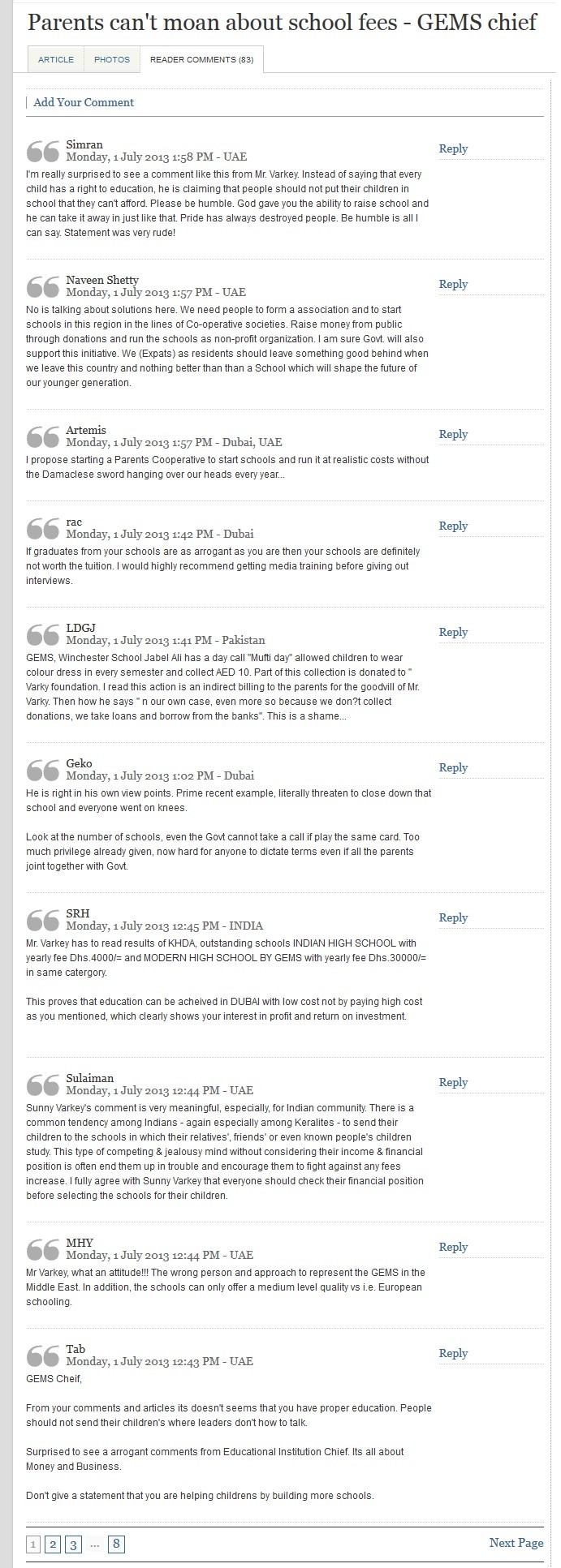
I love media sites on the internet, partly because of the ability to leave comments and the inevitable pearls of wisdom that readers leave. Varkey’s foot-in-mouth (and if you can’t see why this is a disaster of an interview for Varkey, you’re beyond the pale) was attacked from all sides by parents. Comments included such wonders as ‘It’s no wonder GEMS and HSBC (?) are the two most hated firms in the UAE’, and ‘If graduates from your schools are as arrogant as you are then your schools are definitely not worth the tuition. I would highly recommend getting media training before giving out interviews.’

I wish I could show you more comments; the last time I saw the piece with the comments section still live there were 98 printed which must be a record for the site. However, Arabian Business’ publisher ITP has taken off comments for this piece, either due to the severity of the comments or, more likely, someone possibly threatening legal action.

What happened to the comments on Sunny Varkey’s case of foot-in-mouth? I don’t know. But I can at least leave you this cached screen shot to show you that what goes on the internet can always be found!

Where did the comments go? Only ITP and GEMS will know!

Where did the comments go? Only ITP and GEMS will know!

Balancing the information load – Saudi’s Ministry of Health and the Coronavirus

Do images such as this reassure or panic the public? (picture credit: Arab News)

When it comes to many issues, be it driving or otherwise, religion, and long beards, the Kingdom has always made the headlines. However, Saudi Arabia has been in the news recently for what could be an emerging health pandemic. The disease, named the Coronavirus, was first discovered and identified in the summer of 2012. Since then at least 30 people have died in Saudi Arabia from the Coronavirus according to the World Health Organization as reported by Reuters on the 31 May.

The country’s Ministry of Healthy has been criticized over a number of issues related to the Coronavirus. First up was the issue of firing the doctor who discovered the first case in the Kingdom and reported the virus (for the full story click on the link here for the piece on the UK’s The Guardian.

However, recent criticism has focused on a lack of transparency when releasing information about the Coronavirus. An article yesterday published in the English-daily Arab News was particularly scathing (by Saudi standards). I’m linking the article here and will quote in full below.

A specialist in infectious diseases said that withholding information by the Ministry of Health about the spread of the coronavirus following the deaths of the infected patients is significantly damaging and provides no benefit.

The specialist spoke on the condition of anonymity. He said citizens and residents in Saudi Arabia have the right to accessible information about the disease.

“I do not know why the Ministry of Health discreetly hid the information of the first case of Coronavirus in Saudi Arabia, and the infection got to Al-Ahsa region where the disease has appeared and is starting to spread. They bear the responsibility for this,” he said.

The specialist suggested that the reality seems to be withheld from the domestic public opinion, and the public does not know if the ministry has detailed information about the spread of the virus and refuses to disclose it, or whether they have not reached any conclusion. He said the Ministry of Health looks at research centers in Saudi universities as competitors when the relationship with research centers at universities should be a complementary relationship, not competitive.

He added that MoH indeed prefers to discover the scientific research on diseases via universities abroad rather than Saudi universities, although there are a number of Saudi universities that enjoy a huge potential and have reference laboratories recognized by the World Health Organization (WHO).

However, the Ministry of Health refuses to cooperate with them because they perceive them as competitors in spite of their supportive work with the MoH, he said.

He said preventive measures taken by the Ministry of Health lacks transparency, with no announcement about where the spread of infection started and whether it originated in Al-Ahsa or came from abroad. He also noted that ministry did not give any scientific information or details about the reasons for the spread of the virus.

“Unfortunately there are no details and nothing was published except the number of cases and deaths. This is not enough. It does not allow us to investigate the causes of the disease.”

Today, he said, there are more than 30 cases, but there is no clear information about the source of the disease and we do not know the results of the investigations.

What’s prominent here is that the article is a translation of a piece from Al-Eqtisadiah newspaper. Both papers are owned by the Saudi Royal family and the fact that these opinions are now running in the local press doesn’t bode well for the Ministry of Health. There’s no name associated with the ‘specialist’ and no invitation to respond by the Ministry.

There’s a significant lack of information about the Coronavirus, and when there’s a lack of awareness about a public issue such as a suspected epidemic people will seek information from other sources, most especially social media. However, if a public body reveals too much information they will be open to criticism that they are creating an unnecessary panic. There’s an interesting take on this issue by one public health blog, the Avian Flu Diary, that I’m going to quote below (do read the article in full if you have time).

We may simply be seeing a public relations backfire created as a direct, and 100% foreseeable, consequence of an overly secretive Saudi risk communications policy.

If there’s one thing you can count on in a crisis, it’s that rumors and speculation will rush in to fill any information void.

The other possibility is that this outbreak is somehow substantially worse than we are being told. But if that’s true, it seems unlikely that they could keep it hidden for very long.

Which puts us in a watchful waiting mode, looking for any indication – one way or the other – of how this outbreak is playing out.

It’s hard to see how this case has brought to light any positives for any of the parties involved. However, if there’s anything to be learned my hope is that the Ministry hires a public affairs agency that is specialized in such crisis communications, as this issue has the capacity to become much bigger and at a pace that few communications people would be able to handle. Remember SARS anyone?