I'm am obsessive compulsive communicator who has lived in the Gulf for almost a decade. Enjoying the challenge of working in a region where you've got to be innovative, patient and determined to make things happen. Miss being a full-time journalist! Miss family even more!
Sometimes I mouth off, but more often I grit my teeth and try to encourage change through a smile (not as easy as you think). Despite now living in Dubai Bahrain is home for me.
This week I wrote a fun piece for the UAE-based internet news portal Kipp Report rebutting arguments put forth by the head of creative marketing and advertising agency Leo Burnett.
I’m not going to repaste the stores word for word but you can find both pieces linked here. You can find my piece, Is talent enough, via this link. The piece by Kamal Dimachkie, executive regional managing director of Leo Burnett – UAE, Kuwait and Lower Gulf, can be found here.
What I’d like is to hear from UAE and GCC nationals who are either working in this sector or who have a passion for advertising, branding and marketing. What are your thoughts on this subject? And what would you like the industry to do to encourage local talent?
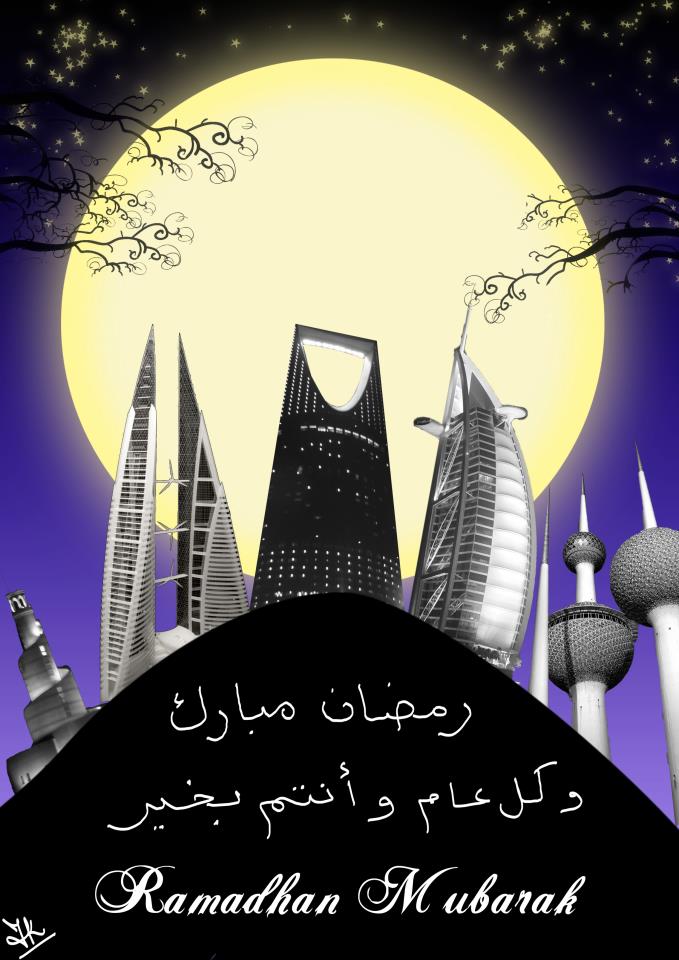
And for all of my friends, family and everybody else out there in the blogosphere I’d like to say Ramadan Kareem! We’re a day into the holy month but it’s never too late to express our blessings for this month. My wife designed the visuals below (and she’s a GCC national! Go figure…)
Youtube has been one of the key tools of activists across the globe, and particularly in the Middle East. In response to requests from NGOs and activists on the ground who are naturally concerned about their safety when uploading videos to the site Youtube has today launched face blurring. This tool allows video uploaders and editors to obscure faces within videos with the click of a button.
“Whether you want to share sensitive protest footage without exposing the faces of the activists involved, or share the winning point in your 8-year-old’s basketball game without broadcasting the children’s faces to the world, our face blurring technology is a first step towards providing visual anonymity for video on YouTube.”
The screenshot below, which is taken from Youtube’s blog page and post on this new service, is an example of how the technology will work in practice. It’ll be interesting to see how often this is used by activists, and how authorities will respond. Kudos however to Youtube and Google for listening and providing a solution that should, I hope, save people from torture, intimidation, or worse.
The picture above shows clearly how simple it will be from now on to blur people’s faces on Youtube.
PS this is going to give marketers out there a fun new way to roll out teaser campaigns! I can’t wait to see who gets creative with this for their brands.
I’ve got to admit. There’s no other mainstream show quite like it. For those of you who haven’t experienced Al Jazeera’s the Stream, what are you waiting for?
In brief, Al Jazeera describes the Stream as a web community and daily television show powered by social media and citizen journalism. What this means in practice is that viewers take part in the show in real time, through tweeting with the hashtag #AJStream or talking with the @AJStream twitter profile. Viewers can also record their thoughts, which are often broadcast live on the show or are promoted via the Stream’s website or on its Facebook and Youtube pages. The program doesn’t stop after thirty minutes; the Stream continues broadcasting via the web for viewers to follow the topics under discussion.
Have a look for yourself at one of the Stream’s most powerful programs, on Bahrain’s social media confrontations. And ask yourself, why aren’t more broadcasters engaging their viewers this way? For me, this is the future of media. That’s why I love the Stream.
“May you live in interesting times”. That ancient Chinese proverb is a favourite, and never has it rung truer than today for anyone who lives in the Middle East.
The past 18 months has completely changed our region. Few have been immune to the changes that have swept the Middle East, including Saudi Arabia. During this time so many taboos have been broken. As a media junkie and former journalist what has been most striking is how people are now controlling the message themselves through the use of the internet.
For decades governments in the region controlled the news agenda. Saudi Arabia’s news channels, both television and newspapers, are all state-controlled. The use of satellite dishes was illegal (I can’t ever remember reading any official announcements legalizing satellite dishes in the country) and all foreign publications imported into the country were censored with a black pen. Anything that was critical was either black penned, ripped out of the magazine or newspaper, or, in the worst case, the publication would be banned.
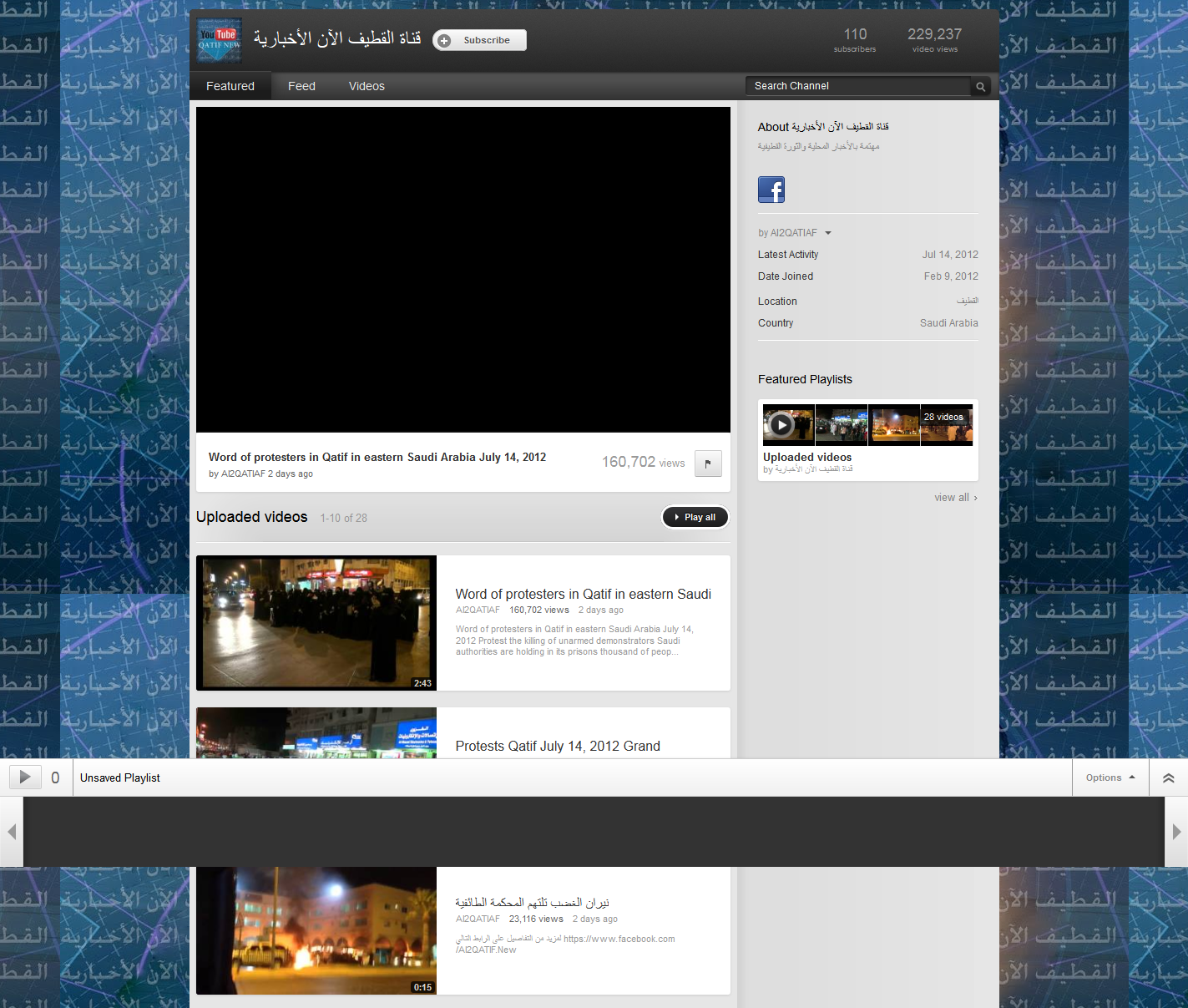
What has happened over the past 18 months has changed this perception. For reasons that I’m not going to go into on this blog post – I’m only focusing on the communications aspect rather than the politics – various events have taken place in Qatif, in Saudi Arabia’s Eastern Region. There have been several incidents of late in Qatif. What is remarkable is how those who are protesting in Qatif are using Youtube to spread their message. Previously, they never had any means to tell their story. To see how that has now changed, look at the below.
The above video has been viewed 160 thousand times in the space of two days. What is just as remarkable is the channel where this is hosted on Youtube. The channel’s name is Qatif News Channel, and videos are uploaded daily.
The Qatif News channel is hosted on Youtube and has been viewed over 200,000 times since it was set up on February 9th 2012.
This media is being used to tell a story that is feeding global media, such as this report by Al Jazeera.
Confronted with today’s ability to collect content, upload it to the internet and distribute that media, there’s little that official media or policy can do apart from run editorials condemning such actions. The below is from the English-language Saudi Gazette and sums up media reactions in the Saudi press.
Maintain public peace, Al-Qatif sheikhs tell youth was the standard line in many Saudi media publications.
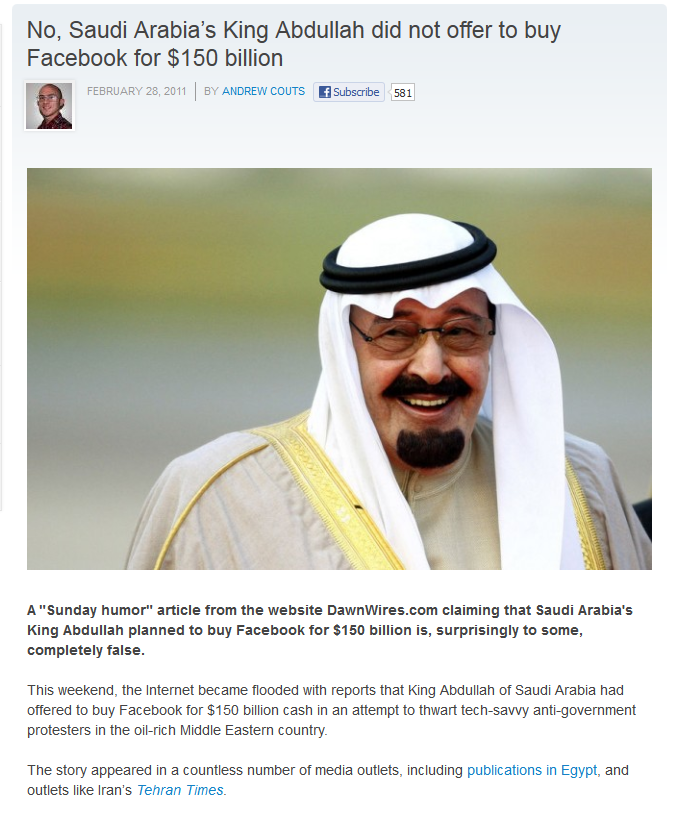
The question faced by governments is how do they regain control of media channels and ensure that their message is heard loud and clear? There’s no going back, there’s no closing down the internet (Egypt’s Mubarak tried and failed). Some governments have become media-savvy and are now creating their own content for distribution online. A rumour circulated last year that Saudi’s King Abdullah had bough Facebook to stop the Arab Spring. Maybe someone wasn’t joking when they suggested buying Facebook?
No, Saudi Arabia’s King Abdullah did not offer to buy Facebook for $150 billion.
We’re coming round once again to Ramadan, and I wanted to take the chance to write about one case study from last year’s holy month which underlines how much the media landscape is changing.
AlSayegh Media is a UAE-based agency headed by Abdullatif Al Sayegh, the former CEO of Dubai Media Incorporated. While AlSayegh Media is only a couple of years old some of its campaigns have, for me, been groundbreaking in terms of their use of content and social media to reach out to diverse audiences and build communities.
One of the hardest demographics out there to crack for any company in the Middle East is traditional/conservative/religious individuals. Firstly, because there’s a possibility that they may be more sensitive to marketing due to their beliefs. Secondly, there are relatively few religious media channels through which to communicate effectively and which may be receptive to conveying a message on behalf of a company when compared to more mainstream media. Even if a company has a message that they’d like to promote and which would appeal to this target audience, how do they reach this demographic?
The UAE telecoms operator Du decided to be different last year. The telco turned to AlSayegh Media to come up with a unique and original campaign for Ramadan that would by association promote Du and its services.
Rather than me saying how they did it, I’ll let AlSayegh Media’s own write up speak for itself.
15,000+ unique Facebook fans in just 4 weeks for a Ramadan campaign with Sheikh Dr Mohammed al Oraifi and Du. Now that is impressive.
As if that wasn’t enough here’s some more stats for you. Over 500 participants took part in the accompanying Khatim Al Qur’an competition. Over 9,600 calls were made to Sheikh Dr Mohammed al Oraifi. And there was an increase of 300% plus in fan engagement on Du’s Facebook page.
AlSayegh Media developed a series of Tabs for Du’s Facebook site which facilitated interaction with the intended demographic (these tabs aren’t live at the moment, but I’m assuming they’ll come back online next week for the start of Ramadan). However, here’s a clip of how the tabs looked last year below.
What to me is more impressive than anything else is the success that AlSayegh Media achieved for Du despite all of the noise during Ramadan. The Holy Month is a communications nightmare due to all of the religious programming that is aired over the four weeks. That AlSayegh Media was able to cut through the chatter and connect with such a hard-to-reach audience (this campaign was only UAE-focused, and aimed at Arabic and English speaking Muslims) speaks volumes about the agency’s strategy, Du’s activation marketing, and the impact of social media.
And the best thing? It was achieved at a fraction of what the same concept would have cost if televised. I’ve been told that even Du didn’t expect the volume of callers that the campaign attracted. Low cost, high return on investment, and community engagement? What’s better than that?
Let’s hope that AlSayegh Media’s Du Ramadan campaign this year will outdo 2011. According to the firm’s CEO Sheikh Dr Mohammed al Oraifi has agreed to the concept once again, and that they’re looking to expand the scope by which Muslims can reach out to the Sheikh. I’d love to see his question and answer sessions being streamed live and then posted onto Youtube, as well as a live Twitter Q&A session which would also help generate discussion between Du and the Muslim community in the UAE.
If you’re curious about Sheikh Dr Mohammed al Oraifi you can follow him on Twitter at @MohamadAlarefe or here for Facebook. The good Sheikh has almost three million followers on Twitter and 13,578 likes on Facebook and is one example of how Islamic scholars are taking to social media to communicate with their followers (I’ll blog more about this soon as well as the amount of fake accounts set up in his name).
And in case you’re curious to hear more about the founder of the company Abdullatif Al Sayegh here’s a clip of him talking at Tedx Ajman last year.
For all my friends out there who are Palestinian or who know and love the place and its people please do watch the clip below which is a promo for the show (can’t embed the video in here directly) and donate if you can via Jennifer’s page on Kickstarter which can be found here. I for one would love to see Jennifer at the Edinburgh Fringe Festival this year.
It’s always interesting to view the Gulf through the prism of global events such as the Olympics. Much has been made of the ping-pong played by Saudi Arabia’s Olympic committee with the International Olympic Committee in respects to sending Saudi females athletes to the 2012 Olympics. A good overview of the affair can be read here in a piece by the Wall Street Journal’s Ellen Knickmeyer.
The paragraph below is from Knickmeyer’s article (Knickmeyer can be followed on Twitter at @EllenKnickmeyer)
“Saudi Arabia ended its status as the last Olympic nation to refuse to send women athletes to the Olympics, agreeing just two weeks before the start of the London games to field two young female competitors, the International Olympic Committee announced.”
The Saudi female athlete saga has been making headlines globally, both in print and via broadcast outlets. Al Jazeera covered the news extensively and featured clips of one of the two Saudi ladies. Sarah Attar is a 17-year-old, California-raised and -trained track competitor who will race in the 800-meters.
Knickmeyer and others have noted that despite the gravity of the decision to finally send Saudi female athletes to the Olympics the news has not even been registered by the country’s official media outlets. “The kingdom’s state media, which recently announced the men’s teams for the games, made no public comment by Thursday evening on sending women as well.”
She was also documented at a semi final Women’s 50m freestyle race at the Hungarian National Swimming Championship 2012 a couple of months back. The video is embedded below and you can make out Faye from her swimming cap which has the Kuwaiti flag emblazoned on it.
Meet the Bahrain Olympians and spot how many are actually Bahraini
Bahraini nationals often voice concerns about the number of naturalized Bahrainis in certain segments of government (the best example would be the police force which employs few native Bahrainis). And what has been the reaction of Bahrainis to the above? One person started a hashtag called #uniteafrica while the most popular tweet was the below.
All in all, an interesting view into the culture of the Gulf through their Olympic policies. And no, I’m not even going to cover Qatar and their Brazilian/Uruguayan B football squad.
Jeddah is a remarkable place, a city of seven million souls which is the most diverse city in the Middle East bar none. There’s a phrase which is often used when talking about Jeddah, which is Jeddah ghrayr, or Jeddah is different/unique. Here’s one video which I spotted on my Tweetdeck from BBC journalist Gabriela Pomeroy (@gabrielapomeroy). The video, which has made the official selection for the Sheffield International Documentary Film Festival 2012, gives us a brief insight into one young female Saudi artist who uses graffiti to express herself in Balad, the oldest part of Jeddah.
Did you ever think you’d be watching a video about a female Saudi graffiti artist who works in broad daylight, in Saudi Arabia? As they say, Jeddah ghrayr!
If you’re really not enjoying that flight, if the in-flight service isn’t what you hoped for, or if your in-seat screen is not responding, just remember that you’re not flying on Middle East Airlines.
One traveler took on Middle East Airlines via social media. You can read about Hussein Dajani’s story here.
Or just watch the video, which is much more fun.
The one thing I will never understand is that while no one I know enjoys traveling on MEA, try and get a Lebanese national to fly anything else (if you’re flying from Saudi the choice is understandable). If you’re that unhappy, then show your displeasure by not using the airline.
Kudos to Hussein Dajani for taking on the airline and proving that consumers can make a difference through social media.
Yin and Yang, Sweet and Sour, and now MBC on social media. It seems that the Middle East’s largest free-to-air satellite station had its hands full last week. The station’s most popular talent show, Arabs Got Talent, broadcast the season finale live. The show, which has attracted millions of viewers, has trended worldwide with the hashtag #arabsgottalent over the past couple of months.
Meanwhile, another hashtag was making the rounds last week. #قناة_الفتنة translates as the channel of chaos from the Arabic to English. This less accommodating hashtag was doing the rounds in Saudi. After doing a little digging (what time will allow), it seems that the hashtag is aimed at MBC’s Ramadan schedule, and is designed to make the point that rather than portraying the spiritual side of the holiest month in the Islamic calendar MBC is more concerned with advertising revenues. Have a look at the below graphic. While you may not understand the Arabic, the picture itself speaks a thousand words (on the left is MBC, on the right is the devil).
And incidentally, who won Arabs Got Talent? A group of thirteen young men named Khawater al-Zalam who perform stunts and dance sequences with ultraviolet props and costumes set against a black background. They’re from Saudi Arabia. Check out Khawater al-Zalam’s routine during the show here.
Let’s hope that MBC’s social media team enjoy their sweet and sour as much as the rest of us.







 Alex of Arabia's Blog