How to avoid the speed cameras in Saudi with Twitter

If you're looking for a way to beat the Saudi speed traps look no further than Twitter!

If you’re looking for a way to beat the Saudi speed traps look no further than Twitter!

Saudis are ingenious. And they don’t like to be told what to do. When you combine the two the results are imaginative to say the least. I’m late to the game on this one but I was intrigued when a family member showed me the latest attempt to beat Saher, the country’s traffic cameras which have been fining speeding Saudi drivers ever since they were installed back in 2010.

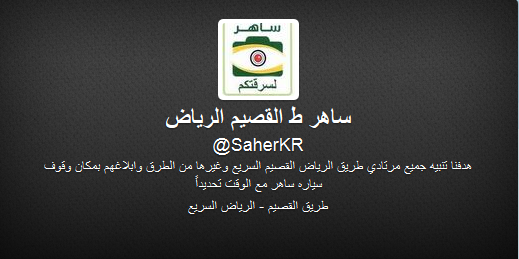
The friend opened up his phone, went to his Twitter feed and clicked through on to one Twitter account, named @SaherKR. This feed can be used by followers to alert their fellow Formula One drivers of any mobile or fixed Saher cameras, checkpoints, or any other inconveniences on the road between Riyadh and Qasim. One example is below.

https://twitter.com/SaherKR/status/297708381358137344

There’s dozens of these accounts today in Saudi. My favourite is @Saher_khj which is followed by 10,000 Twitterers and gives all the details needed to avoid speed traps including the exact area of the camera, the speed limit and the time of day the user has passed by the camera.

I am left asking myself however how these people have the time to write a 140 character message while most likely doing 150 kilometers an hour in their Toyota Camrys or Hyundai Accords. Maybe that’s why their driving is so erratic as they’re shuffling their fingers across their iPhones whilst attempting to steer the car?

This isn’t the first time that the Saudis have used technology to overcome pesky government interference. The first widely reported solution was a mobile phone application called Trapster which alerted drivers via their iPhones of speed cameras in the vicinity. The application proved so popular that mobile phone shops were charging customers over $100 dollars to install on the iPhone. The application itself was free (if you don’t believe me, it’s printed in the media so it must be true).

And the fun part of this detective work? The family member who showed me all of these Tweets works as a senior manager in the Saudi Interior Ministry and is responsible for road safety. Boys, they know who you are and where you are! Ticketing by Twitter? Sounds good to me!

My recollections of Saudi Arabia’s Prince Mugrin

Saudi Arabia’s next Second Deputy Prime Minister Prince Mugrin Bin Abdulaziz Al Saud whom we found to be a captivating individual

For all you Saudi fans and fanatics out there, the news of Prince Mugrin’s appointment as the second deputy prime minister took most by surprise. There’s a wonderful piece on Prince Mugrin and what this means to Saudi Arabia here by Michael Stephens. However, it is possible that Prince Mugrin, who is the youngest surviving son of the founder of the Kingdom, would become King.

I’m not going to go over the same ground that every Saudi watcher has covered over the past few days. What I will do is recall me and my wife’s personal memories of Mugrin from 2007. We were media partners to the first e-government conference in Saudi Arabia, e-Transactions, and had unfettered access to the event and its speakers. Prince Mugrin was, if I remember correctly, the only royal family member to both attend and speak at the event.

Prince Mugrin was on a panel which was addressing the issue of bureaucracy as it relates to online services. What struck my wife in particular was how candid the Prince was, particularly in relation to Saudi government. In effect, he said that Saudi Arabia had far too much bureaucracy and that e-government could not be in place sooner. For a prince who is first-tier (even the royal family in KSA has rankings) and who held the position of head of the Saudi Intelligence at the time Mugrin seemed acutely aware of the problems that faced society. We were impressed by his open demeanor and his directness.

A more lasting impression, and probably an indication as to why Mugrin is reportedly close to King Abdullah, was made during Mugrin’s tour of the exhibitor partners. Again, as the publisher of the media guides to the event, we had a stand in the exhibition area. A number of the team on the stand were female, and Prince Mugrin greeted them all warmly and even going so far as to shake their hands and asking them about the conference.

To this day my wife who was at the stand when Prince Mugrin visited talks fondly of the encounter. While much has been made of the succession remaining with the sons of the founder of the Kingdom rather than being passed down to the next generation of the Al Saud family, I’m optimistic that Prince Mugrin will continue to promote King Abdullah’s agenda to slowly but surely reform the Kingdom’s government and cultural practices.

Fifty Three Million and Counting – Facebook’s hold on the Middle East

Based on the latest statistics shared at the Studio Edge event Facebook is the one network to rule them all (unless you’re a keen bird watcher that is)

Facebook came to town last week, and they brought lots of numbers with them. I was lucky enough to be invited along to the first Studio Edge event in the Middle East region. And I was astounded by the numbers that the team kept on rolling out. I’ve summarized these numbers below for you.

According to Facebook’s own research there are fifty three million active Facebook users in the region who use the service at least once a month. Egypt is Facebook’s largest market, followed by Saudi Arabia and then the United Arab Emirates.

Fifty two percent of Facebooks users access the site solely through their desktops and laptops; thirty eight percent use both mobile phones and computers, and ten percent only use their mobiles updating their profile and other Facebook activities. Twenty million people in the Middle East and North Africa are using Facebook today through their smart phones.

The average age of Facebook users in the region is 27 years and 64 percent of MENA users are male. That’s in contrast to the global split of male to female users which is currently 50/50. MENA Facebookers spend approximately seven hours on Facebook a month (that’s double the global average). And fifty two percent of Facebookers in the UAE use Facebook whilst watching television.

Middle East Facebook users like 84 pages compared to the global average of 51, and they view approximately 550 pages a month. Over forty percent of their time is spent on the news feed section of Facebook.

And to top off all of that, Facebook’s user base is growing in excess of 20 percent in the region.

With all of this information above, I’m hoping that we’re going to see more businesses online using the site. But if there was ever any doubt that Facebook is a first-tier consumer communications channel then please do re-evaluate how you use the network and start using the site properly.

One other interesting observation from the Facebook event. Most of the attendees were from advertising and creative agencies. I only spotted one public relations company. And yet, Facebook is all about content. Shouldn’t the Middle East’s PR industry be getting in on the act and promoting the quality of its social media services more?

Photo a pizza while on the move? 800Pizza’s Facebook Faux-Pas

It’s probably not a good idea to ask someone to take a picture while they’re driving. Taking this a step further, it’s probably even less of a good idea to spread that message via a social media platform such as Facebook. But that’s what one pizza company in Dubai did on Monday of last week.

Someone at 800Pizza (great name by the way) thought it’d be a good idea to ask its Facebook followers to take pictures of the company’s delivery drivers whilst on the road. Needless to say, apart from being illegal and downright dangerous the concept backfired and earned the chain a telling off both from a UAE-based road safety group as well as local newspaper 7Days. The article is a great read so do check it out here.

What did it for me (and made me write this) was the comment made by the founder of the firm to the newspaper, which I will quote verbatim below.

When contacted by 7DAYS, Alessandro D’ubaldo, founder of 800 PIZZA said: “I think this has been a bit of a misunderstanding and negative reaction.” Commenting on the edited post, the restaurant owner added: “We even changed the post and someone said ‘that’s just amending the wording, why don’t you remove the whole post?’

“But I don’t understand why they’re so upset – what is all this hate about?” D’ubaldo clarified: “We didn’t mean to tell people to go around and take photos with one hand while you drive with the other hand.”

D’ubaldo also said that he didn’t think the delivery bike drivers were aware of the campaign, adding: “They don’t need to be aware, it’s OK for people to just take pictures around in a public place.”

I’m thinking of launching a campaign to ask certain people to stay off social media. And it really would be for their own good.

You may strain to read this, but anyone encouraging drivers or passengers to take pictures while driving should be prepared for an online backlash

PS thanks Mita Srinivasan for pointing this piece out to me.