
What do #brands do with #franchises when consumers get #socialmedia angry?

A couple of recent events, both personal as well as public, have highlighted the challenges facing brands when it comes to franchises and customer service. Social media has given consumers the ability to interact directly with brands in ways which were never before possible. Today’s consumers expect a response from brands’ social media feeds, be it on Twitter or Facebook.

So what do brands do when they’re not in full control? How do brand communication teams deal with a consumer who is angry at a franchise? It’s an interesting question, especially for us consumers and comms professionals here in the Middle East.

A number of high profile examples have brought to light the limited scope for communications between consumers here in the Middle East and brands from locations outside of this region. The best case study would be the #noshaya Twitter-led campaign against the Kuwaiti-based retailer M.H. AlShaya. The call to boycott the company’s stores back in December was a response to AlShaya’s decision to stop providing cash refunds to customers throughout its stores.

AlShaya owns tens of franchises across the Gulf, including Top Shop, BHS, and H&M. It’s by far the largest retailer in the Middle East and thousands of Saudi consumers took to social media to vent their anger at AlShaya’s decision (for the full reasons behind the boycott please see this previous blog post).

After only a couple of hours of the campaign going live online activists started messaging the retail brands directly.

https://twitter.com/#!/hindkz/status/143315760419323904

https://twitter.com/#!/Maialshareef/status/143021336778903553

Activists sent hundreds of messages to the official Twitter accounts of retailers who had franchise agreements with M.H.AlShaya. While I may be wrong (and I hope I am) I didn’t see a single response from these retailers. These retailers weren’t helped by promoting their own refund policies on their websites, most of which were much more generous that AlShaya and included cash refunds on returned products – the activists’ key demand.

Another consumer-led campaign which hit the headlines this week relates to a nightmare incident in Saudi involving a Toyota Landcruiser which was stuck in cruise control at a speed of 210 kilometers per hour. For those Arabic readers out there check out this harrowing news piece from Al-Hayat newspaper. #ToyotaCruiseFailSa has been a top trending hashtag in Saudi for the past two days.

Out of all the car brands in Saudi Toyota probably has the best reputation for reliability and customer care. Does Toyota rely on its distributor Abdul Lateef Jameel to step in a repair the public relations damage done (so far, there’s been little word from the distributor) or do they step in themselves to reassure Saudi drivers? The response of one Toyota Landcruiser owner is typical of those trending the topic on Twitter.

https://twitter.com/#!/m_alshwaier/statuses/155276831241666560

The Arabic translates as, “I haven’t used the cruise control since buying the car because of this story.”

To ask again, when do brands step in to protect their brand value? How or what do they agree with their franchise and distributor partners as to who is responsible for what? Social media has changed the communications sector in ways that few could have envisaged. One short but interesting article online has found that consumers who contact the brand via social media are much more likely to expect a response to their queries. Check out The State of Social Marketing 2011 – 2012 by Brian Solis

I wonder how many of us in communications are taking note of what is happening around us before the same thing happens to the brands that we are entrusted with?

How to reach an audience through #SocialMedia and #influencers

Social media is the latest and greatest thing at the moment in the world of marketing and communications but how do we in an emerging market make the most out of what we’d call influencers, people on the web who are followed and listened to by others. The challenge that we face in a market is the Middle East is a lack of the mainstream online influencers, bloggers. Compared to Europe and the US, there are fewer bloggers in the Middle East, especially in countries such as Saudi Arabia. For those interested in pioneer bloggers, have a look at this list compiled by commentator Sultan Al-Qassemi or the Arab Media and Society’s portal on blogs.

Despite the challenges social media is an incredibly powerful way of reaching out to an audience, partly due to directness as well as its credibility. But how do you find the right influencers to reach out to? There’s a couple of very simple ways to do this and tools to use. Klout is probably the best known site for analyzing social media influence across a variety of sites such as Twitter, Facebook, Google+, LinkedIn, FourSquare, Youtube, Instagram, and WordPress.

Klout trawls social media network data and creates profiles on individuals and assigns them a “Klout score.” The higher the Klout score the more influence a person has online. Klout claims to have built more than 100 million profiles from crawling social media sites. While the site is far from perfect, it’s probably the most widely used tool to rate someone’s social media influence. You can search on Klout’s website either by topic or by the influencer’s name. Klout will give you three lists – one for top influencers, one for top +k recipients (basically people who have been rated highly by other Klout users rather than Klout’s own ratings system), and one for best content. Try a search on Dubai using Klout and see whom the website recommends.

The Klout profile for Mashable journalist Brian Hernandez

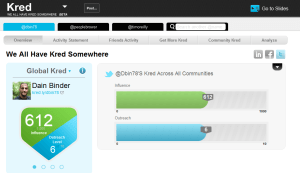
There are a number of other social ranking sites. The one which is gaining the most interest is kred.ly. At the moment Kred.ly is limited to analyzing people’s Twitter feeds only. However, Kred.ly may become very useful as it’s linked into a website called peoplebrowsr. Peoplebrowsr aims to give marketers and communicators access to influencers. The idea goes that you’d be able to identify people who are specialized in a certain topic and then pay them to promote your company or service. I’d love to hear from anyone who has used kred.ly and peoplebrowsr, especially in the Middle East.

Screenshot from social media analytics site kred.ly for blogger Dain Binder

So let’s give an example of what I’d be looking to do if I was working in tech. First thing would be to identify people with a big enough audience and enough credibility to influence others. One such user may be a prolific twitter user and the founder of saudimac.com Khaled Abdulrahman. Tweeting with the handle @khaled Khaled has over 13,000 followers and regularly updates his web site.

http://twitter.com/#!/khaled/status/153421180550922241

Khaled is a great example of an influence as he uses multiple sites to engage with an audience.

The challenge I have now is how to work with or influence Khaled. Traditional marketing would have meant paying the influencer. This is common for celebrity social media endorsements. However, this doesn’t always have to be the case with bloggers and topic specialists. Many may be willing to support you if they believe in the cause that you are promoting or if the content you give them is relevant or interesting.

The beauty of Klout, kred.ly and other tools is that they’re either free or fairly cheap to use. So when you’re next looking for people to help you communicate to an intended audience you’ve got no excuse for not finding the right influencers on the world wide web.

How to defuse a crisis at a Gulf-based telco? Tell the journalist there’s no story.

I love talking to journalists. They’re often witty, sometimes charming. One thing that journalists have an abundance of are stories and anecdotes. I’ve dealt with one Gulf-based telecommunications firm for a couple of reasons of late, and it’s a fascinating company due to internal issues and ambitions. However, this firm has faced accusations of poor customer service in its home market. Consumer anger recently came to a head with calls for a symbolic, hour-long boycott of the company’s products and services.

I’m not going to name the firm, but if you do a search on Google you won’t have to search long and hard for the story or its context.

While this in itself is an interesting development, the mark of a good communications team will be able to step in, work with journalists and bring out the positive of any negative story. This didn’t happen to one journalist colleague who inquired about the boycott. An experienced reporter on a global title, she emailed a PR executive at a public relations firm representing the telco asking about the boycott.

The response was abysmal. Rather than talking through the issue, explain the company’s attempts to improve its customer service and put right the company’s standing amongst its customers the PR executive pulled his face and told the journalist there was no story.

Telling a journalist those three words – there’s no story – is akin to holding up a red rag to a bull. Following on from this faux pas the executive then started to vent his belief (off the record) that the competition was behind the boycott.
Needless to say, despite his best efforts he failed to put over to the journalist anything remotely useful that would have conveyed how much his client were investing in time and money into their customer service.

What happened? An article in a global business title which prominently featured comments from those spearheading the boycott and a single quote from the company in question. That story was syndicated both regionally and globally. This company has operations in 17 countries and ambitions to operate telecommunications networks in many more locations.

The damage done to the firm’s reputation can’t be measured. However, there’s always time to put right what has been done. Get in touch with the journalist, show them that the company cares, that it aims to redouble its efforts. Even if the journalist doesn’t write a follow-up story you’ve left a positive impression.

To date has there been any follow-up? Unfortunately not. But then again, who needs good communications and media outreach when you’re a government-owned firm with a sizable marketing budget and only one competitor in your home market? Do you really want to have a frank and open dialogue with the media and your customers? Or are you happy with being subjected to boycott campaigns simply because you don’t want to listen and you think there’s no story? How you defuse the situation is your choice.